C3_W1_KMeans_Assignment || 吴恩达可选实验室
·
练习一
# UNQ_C1
# GRADED FUNCTION: find_closest_centroids

def find_closest_centroids(X, centroids):
    """
    Computes the centroid memberships for every example

    Args:
        X (ndarray): (m, n) Input values
        centroids (ndarray): k centroids

    Returns:
        idx (array_like): (m,) closest centroids

    """

    # Set K
    K = centroids.shape[0]

    # You need to return the following variables correctly
    idx = np.zeros(X.shape[0], dtype=int)

    ### START CODE HERE ###
    for i in range(X.shape[0]):
        distance = []
        for j in range(centroids.shape[0]):
            norm_ij = np.linalg.norm(X[i] - centroids[j])
            distance.append(norm_ij)
        idx[i] = np.argmin(distance)

    ### END CODE HERE ###

    return idx
练习二:
# UNQ_C2
# GRADED FUNCTION: compute_centpods

def compute_centroids(X, idx, K):
    """
    Returns the new centroids by computing the means of the
    data points assigned to each centroid.

    Args:
        X (ndarray):   (m, n) Data points
        idx (ndarray): (m,) Array containing index of closest centroid for each
                       example in X. Concretely, idx[i] contains the index of
                       the centroid closest to example i
        K (int):       number of centroids

    Returns:
        centroids (ndarray): (K, n) New centroids computed
    """

    # Useful variables
    m, n = X.shape

    # You need to return the following variables correctly
    centroids = np.zeros((K, n))

    ### START CODE HERE ###
    for k in range(K):
        points = X[idx == k]
        if(len(points) > 0):
            centroids[k] = np.mean(points, axis = 0)
        else:
            centroids[k] = X[np.random.choice(m, 1)].flatten()
    ### END CODE HERE ##

    return centroids
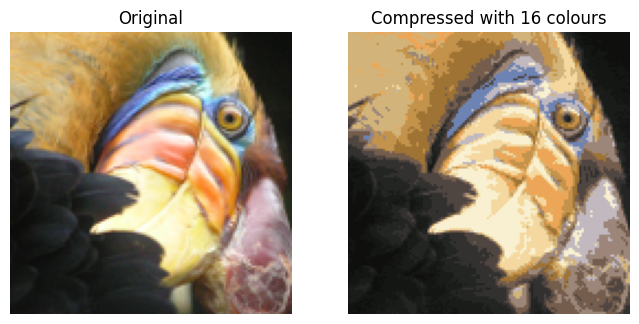
K-means应用:图片压缩,通过改变颜色的数量,颜色的数量就是K,以下是K= 16时,对图片进行压缩:
当K = 32时,
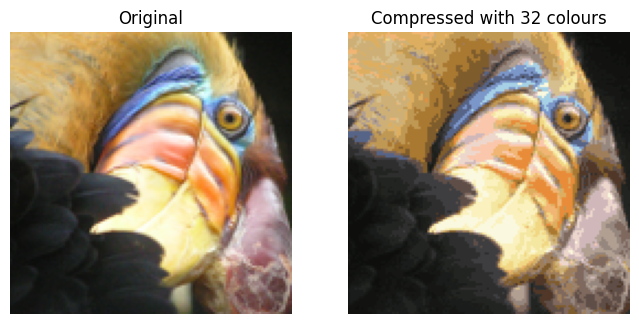
K越大,图片越清晰。
想要资料可以私信。

有“AI”的1024 = 2048,欢迎大家加入2048 AI社区
更多推荐
 5
5 0
0- 0


 已为社区贡献1条内容

所有评论(0)