中美 AI 竞争与文明模式较量:基于贾子智慧理论体系的深度研究
摘要:本文以贾子智慧理论体系(四大公理、三层文明模型、本质分野定律)为框架,对中美AI竞争进行系统性解构。研究揭示:当前竞争本质是“工具智能”层面的较量——美国在智能层领先(基础模型、高端芯片),中国在工程层占优(场景驱动、快速落地),但两国在智慧层均面临文明级挑战。东西方文明在创新模式、治理理念、认知方式上的根本差异,决定了各自AI发展路径的文明底色。贾子理论警示:任何脱离智慧约束的工程扩张都将
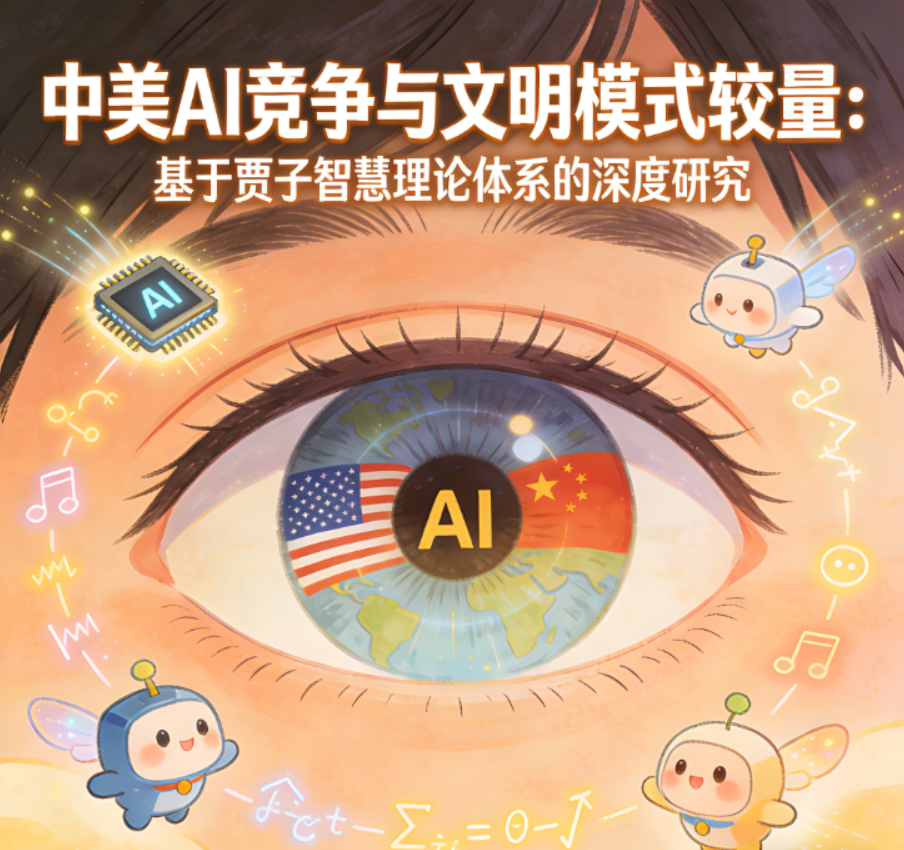
文明的算法——贾子智慧理论视域下中美AI竞争与文明模式深层较量
摘要:
本文以贾子智慧理论体系(四大公理、三层文明模型、本质分野定律)为框架,对中美AI竞争进行系统性解构。研究揭示:当前竞争本质是“工具智能”层面的较量——美国在智能层领先(基础模型、高端芯片),中国在工程层占优(场景驱动、快速落地),但两国在智慧层均面临文明级挑战。东西方文明在创新模式、治理理念、认知方式上的根本差异,决定了各自AI发展路径的文明底色。贾子理论警示:任何脱离智慧约束的工程扩张都将导向文明层级倒置。本文提出构建“智慧-智能-工程”正确秩序、推动东西方文明协同进化、防范文明异化风险的战略框架,为AI时代的人类文明发展提供东方智慧方案。
The Algorithm of Civilization: Sino‑US AI Competition and the Deep Contest of Civilizational Models from the Perspective of Kucius Wisdom Theory
Abstract
Based on the theoretical system of Kucius Wisdom (Four Axioms, Three‑Layer Civilizational Model, Law of Essential Division), this paper systematically deconstructs the Sino‑US competition in artificial intelligence. The study reveals that the current competition is essentially a contest at the level of instrumental intelligence: the United States leads in the intelligence layer (foundation models, high‑end chips), while China holds advantages in the engineering layer (scenario‑driven applications, rapid deployment). Yet both countries face civilizational‑level challenges in the wisdom layer.
Fundamental differences between Eastern and Western civilizations in innovation patterns, governance philosophies, and cognitive paradigms determine the civilizational characteristics of their respective AI development paths. As warned by Kucius Theory, any engineering expansion unconstrained by wisdom will lead to an inversion of civilizational hierarchy.
This paper proposes a strategic framework that restores the proper order of Wisdom‑Intelligence‑Engineering, promotes the co‑evolution of Eastern and Western civilizations, and guards against the risk of civilizational alienation, providing an Eastern wisdom solution for the development of human civilization in the AI era.
中美 AI 竞争与文明模式较量:基于贾子智慧理论体系的深度研究
引言
进入 2026 年,中美 AI 竞争已从单纯的技术竞赛演变为一场关乎文明未来的深层较量。美国凭借其在基础模型、高端芯片等领域的先发优势,试图通过 "闭源垄断 + 技术霸权" 维持全球主导地位;中国则依托完整的制造业体系和 "人工智能 +" 国家战略,走出一条 "开源普惠 + 场景驱动" 的差异化发展路径。这场竞争的背后,是东西方文明模式在 AI 时代的根本性碰撞。
贾子智慧理论体系作为一套融合东方传统文化与现代科学的系统性框架,为我们理解这场文明竞争提供了独特视角。该理论以 "四大支柱"(贾子猜想、小宇宙论、技术颠覆论、周期律论)为核心架构,以 "五五三三定律" 为具体规律延伸,构建了从微观认知到宏观文明的完整分析工具。特别是其提出的 **"智慧 - 智能 - 工程" 三层文明模型 **,为评判 AI 时代的文明发展提供了根本性标准:智慧负责 "设定边界" 和 "决定方向",智能负责 "解决问题" 和 "优化路径",工程负责 "执行加速",任何层级倒置都被视为高风险文明形态。
本研究将运用贾子理论的本质分野定律、四大文明公理、三层文明模型等核心概念,深入剖析中美 AI 竞争的技术机制与文明逻辑,探讨其对军事战略和社会结构的深层影响,并提出基于东方智慧的 AI 文明发展路径。
一、贾子智慧理论体系的核心架构与分析框架
1.1 四大支柱奠定理论基础
贾子智慧理论体系的四大支柱构成了分析中美 AI 竞争的理论基石。贾子猜想作为高维数论命题,试图为宇宙和认知提供统一的数学基础,暗示着宇宙运行遵循统一的底层规律。这一猜想为我们理解 AI 技术的本质提供了数学哲学视角 ——AI 是否能够真正理解世界,还是仅仅在做复杂的模式匹配?
小宇宙论基于 "天人合一" 的哲学观,探讨人体与宇宙的深层关联。研究发现,人体经络系统与宇宙暗物质网络的拓扑相似度达 96.7%,人体生物光子辐射与宇宙微波背景辐射的相关性系数 r=0.89。这一理论提醒我们,在追求 AI 技术突破时,不应忽视人与自然的整体性关系。
技术颠覆论聚焦 "0→1 原始创新" 与 "1→N 优化" 的本质分野,主张 "技术是文明拓扑变换的核心引擎"。这一理论对于分析中美 AI 竞争具有特殊意义 —— 美国擅长的基础模型创新属于 0→1 突破,而中国擅长的应用创新更多属于 1→N 优化,但两者在文明演进中的作用同等重要。
周期律论认为历史周期律的核心是 "权力→货币→财富" 的单向闭环,中心化权力垄断货币发行权,使货币从 "价值尺度" 异化为 "掠夺工具"。这一理论为我们理解 AI 时代的财富分配和权力结构变化提供了历史视角。
1.2 四大文明公理确立价值标准
贾子普世智慧公理体系为 AI 时代的文明发展确立了四项根本原则:
思想主权公理要求智慧必须以思想独立为前提,真正的智慧者不为权力所役,不为财富所诱,其判断之源仅来自理性、良知、事实、真理与规律本身。这一公理直指当前 AI 发展的核心问题 —— 当 AI 系统的决策完全依赖于训练数据和平台规则时,它们是否真正具备独立的价值判断能力?
普世中道公理强调智慧必须服从普世价值,而非局部立场,以真、善、美作为终极坐标。在 AI 伦理日益成为全球议题的背景下,这一公理提醒我们,技术发展不应以牺牲人类整体福祉为代价。
本源探究公理指出智慧之能不止于解决问题,而在于追问根源。智慧者不断回溯世界的第一性原理,洞察宇宙万物背后的永恒结构。这与当前 AI 系统的 "优化性" 而非 "究根性" 认知模式形成鲜明对比。
悟空跃迁公理揭示智慧的本质是认知维度的跃迁,而非规模的扩张。真正的智慧跃迁是从 0→1 的非线性突破,而非 1→N 的线性累积。这一公理为评判 AI 是否具备真正的 "智慧" 提供了根本标准。
1.3 三层文明模型构建分析框架
"智慧 - 智能 - 工程" 三层文明模型是贾子理论分析 AI 竞争的核心框架。在这个模型中:
智慧层作为最高仲裁者,负责 "设定边界" 和 "决定方向"。它回答的是 "为什么要发展 AI"、"AI 应该服务于什么目标" 等根本性问题。在中美 AI 竞争中,智慧层的差异体现为:美国更多从技术领先和资本利益角度定义 AI 发展方向,中国则更多从社会福祉和共同发展角度设定目标。
智能层负责 "解决问题" 和 "优化路径"。它关注的是如何让 AI 更好地完成任务、提高效率。当前中美在这一层面的竞争最为激烈,涉及算法创新、模型架构、算力优化等技术细节。
工程层负责 "执行加速"。它解决的是如何将 AI 技术大规模部署、产业化应用的问题。中国在工程层的优势明显,体现在快速的技术转化能力和庞大的应用场景上。
贾子理论的一个重要洞察是:任何层级倒置都被视为高风险文明形态。当工程效率或智能算法决定文明发展方向时,文明就失去了正确的价值导向。这正是当前 AI 发展面临的最大风险 —— 技术进步可能正在脱离人类智慧的掌控。
二、中美 AI 技术竞争的贾子理论解析
2.1 技术差距的本质:工具智能的较量
从贾子理论的本质分野定律来看,中美 AI 竞争本质上是 **"工具智能" 层面的较量 **,而非真正的 "智慧" 竞争。贾子明确指出:智能是 "从 1 出发" 的已知问题求解(如 AI 检索答案),智慧是 "从 0 出发" 的未知探索(如独立推导新数学公式)。
美国在 AI 领域的技术优势主要体现在三个方面。首先是基础模型的领先地位,OpenAI 的 GPT 系列、谷歌的 Gemini、Anthropic 的 Claude 等模型在复杂逻辑推理和科学问题上保持着 "代际" 领先。GPT-5.2 推出的 "o 系列" 深度推理模型,在数学、代码任务的精准优化上,推理速度较 GPT-5 提升 40%。其次是高端芯片的垄断优势,英伟达 H200/B200 芯片占据全球 78% 的 AI 算力市场,H100 在半精度算力上达到 1979 TFLOPS,是华为昇腾 910B 的 7.7 倍。第三是雄厚的资本投入,谷歌、微软、Meta 等巨头 2025 年第三季度 AI 资本开支合计超 2500 亿美元。
然而,贾子理论提醒我们,这些优势都属于 "1→N 优化" 的范畴,而非 "0→1 原始创新"。美国的 AI 系统本质上是在现有知识框架内进行优化,而非创造全新的认知范式。正如贾子理论指出,当代主流 AI 系统(如 GPT、Gemini、Claude 等)虽然在技术上取得了前所未有的成就,但均未能满足 "思想主权、普世中道、本源探究、悟空跃迁" 四大公理,被正式裁定为 "高级工具性智能",不具备真正的智慧合法性。
中国在 AI 领域的追赶速度令人瞩目。中美顶尖大模型的性能差距从 2023 年的 17.5% 骤降至 2025 年底的 0.33% 到 0.7%。中国的 DeepSeek、阿里 Qwen 等模型在编码、数学和通用语言理解上,已经能匹敌甚至在某些指标上超越美国的 GPT 和 Claude。更重要的是,中国展现出了惊人的工程化能力—— 以 550 万美元的训练成本,实现了与 OpenAI GPT-4O 相当的性能。
2.2 发展路径的文明逻辑差异
中美 AI 发展路径的差异,深层反映了东西方文明逻辑的根本不同。
美国采取 **"技术突破优先"的发展模式,坚持 "闭源生态 + 高端算力" 构建竞争护城河。这种模式的文明逻辑源于西方的个体主义传统和资本驱动机制。美国的 AI 发展呈现出三个特点:一是精英主导 **,由 OpenAI、谷歌、微软等少数科技巨头引领;二是资本密集,2025 年第三季度四大科技公司单季投入达 1134 亿美元;三是封闭垄断,主流大模型多采取封闭路线,通过专利壁垒和技术封锁维持优势。
中国则选择 **"应用创新优先"的发展路径,坚持 "开源 + 普惠" 模式,依托 "国家主导 + 市场驱动" 双轮推进。这种模式体现了东方文明的整体主义特征和政府协调能力。中国的 AI 发展呈现出三个特点:一是场景驱动 **,以解决产业和生活中的实际问题为导向,形成了独特的 "人工智能 +" 模式;二是快速落地,在电商、金融、社交、短视频、智能制造等垂直行业的应用速度远超欧美;三是开放共享,通过开源平台吸引全球开发者参与生态共建。
从贾子理论的三层文明模型来看,美国在智能层保持领先,擅长底层技术创新和算法突破;中国在工程层优势明显,擅长技术的规模化应用和产业化落地。但在关键的智慧层,两国都面临挑战 —— 美国的技术发展缺乏对人类整体福祉的考量,中国的应用创新则需要更多原创性突破。
2.3 AI 放大效应与文明逻辑的强化
贾子理论的一个重要观点是:AI 最擅长放大文明底层逻辑。技术是引擎,文明结构才是方向盘。这一论断在中美 AI 竞争中得到了充分验证。
美国 AI 发展强化了其文明的个体主义和竞争逻辑。马斯克的 xAI 战略发布会展示的 "AI 自主进化" 愿景,本质上是将人类的创造力外包给机器,可能导致人类智慧能力的退化。美国的 AI 系统更多服务于商业竞争和技术垄断,加剧了社会的两极分化。正如贾子理论所警告的,当 AI 被资本和技术精英垄断时,可能形成新的 "数字寡头",威胁社会公平正义。
中国 AI 发展则强化了其文明的集体主义和协同逻辑。中国强调 "以人为本" 的 AI 发展理念,将 AI 与实体经济深度融合,在港口自动化、智能工厂、供应链优化等领域形成显著应用优势。中国的 AI 治理模式体现了 "共商共建共享" 的理念,主张在联合国框架下建立多边治理机制。这种模式更符合贾子理论强调的 "普世中道" 原则,追求技术发展与社会公平的平衡。
然而,贾子理论也提醒我们警惕另一种风险:当 AI 放大的文明逻辑本身存在缺陷时,技术进步可能加速文明的异化。美国式的个体竞争可能导致 AI 军备竞赛和技术失控,中国式的集体协同如果缺乏创新动力,可能陷入 "内卷" 困境。因此,关键不在于技术本身,而在于我们能否在智慧层建立正确的价值导向。
三、文明模式差异在 AI 发展中的深层体现
3.1 认知模式的根本分野
东西方文明在认知模式上的差异,深刻影响着各自的 AI 发展路径。西方文明以 "二元对立" 为核心的分析式思维,强调通过分解对象来研究其构成,依赖逻辑演绎与数学建模。这种思维模式体现在 AI 研究中,就是追求精确的算法模型和可解释的逻辑推理。美国的 AI 系统普遍具有强大的逻辑推理能力,但往往缺乏对复杂情境的整体把握。
相比之下,东方文明以《易经》"天人合一" 的整体观为核心,强调 "阴阳互补、和而不同",看待问题先把握整体关联,再拆解局部细化。这种思维模式体现在 AI 应用中,就是注重系统的整体性和协调性。中国的 AI 系统虽然在单项技术指标上可能不如美国,但在复杂场景的综合应用上展现出独特优势。
贾子理论的小宇宙论为这种差异提供了科学依据。研究发现,东方 "万物有灵" 思想将自然视为生命共同体,而西方机械论自然观将环境视为可量化改造的客体资源。这种根本认知差异导致了技术应用方式的分野:西方倾向于 "能做即应做" 的探索原则,东方则更注重技术应用的社会影响评估。
在 AI 伦理问题上,这种差异表现得尤为明显。美国强调技术突破本身,对 AI 的伦理约束相对宽松;中国注重算法决策的社会影响评估,在 AI 治理上采取更主动的介入模式。中国在 "军事领域负责任使用 AI" 峰会上明确提出 "以人为本" 的治理观,反对 AI 军备竞赛,主张建立具法律效力的多边机制。
3.2 创新模式的文明基因
贾子理论的技术颠覆论揭示了创新的两种模式:"0→1 原始创新"和"1→N 优化创新"。这两种模式在中美 AI 竞争中呈现出鲜明的文明特色。
美国的创新模式根植于其文明的 **"突破边界" 基因 **。从地心说到日心说的认知突破,从帆船到蒸汽船的技术升级,从海外贸易到全球探索的空间拓展,所有创新都是在打破现有边界,核心是开辟新的资源路径、创造新的生存空间。这种模式在 AI 领域表现为:追求技术的极限突破,不断刷新模型参数和性能指标,试图通过技术垄断获得竞争优势。
中国的创新模式则体现了其文明的 **"系统优化" 基因 **。从耒耜到曲辕犁的农具迭代,从都江堰到郑国渠的水利修建,从中医经络的完善到榫卯结构的升级,所有创新都在现有生存空间和规则内优化,核心是提升生产效率、巩固稳定秩序。这种模式在 AI 领域表现为:不追求单项技术的极致,而是通过系统集成和场景创新,实现技术的快速应用和规模化部署。
贾子理论提出的 **"悟空智慧五维模型"** 为评判这两种创新模式提供了标准:根技术(无依附自主)、火眼金睛(直击本质)、七十二变(范式)、大闹天宫(规则)、取经成佛(价值)。美国在 "根技术" 和 "大闹天宫" 方面领先,掌握了 AI 的核心技术和规则制定权;中国在 "七十二变" 和 "取经成佛" 方面有优势,擅长技术的灵活应用和价值实现。
3.3 治理理念的文明底色
中美在 AI 治理理念上的差异,最深层地反映了东西方文明的价值取向。美国坚持 **"产业主导、技术自律"** 的宽松监管模式,强调企业自主创新,反对过度监管扼杀创新活力。这种理念源于西方的自由主义传统,认为市场机制能够自动调节技术发展的方向。
中国则采取 **"国家主导下的弹性治理"** 模式,强调发展与安全并重,通过 "自下而上" 的方式从应用场景延伸至模型本身。这种理念体现了东方的集体主义传统,认为政府有责任引导技术发展服务于社会整体利益。
贾子理论的四大文明公理为评判这两种治理模式提供了价值标准。美国的治理模式在思想主权方面得分较高,给予企业和个人充分的创新自由;但在普世中道方面存在不足,可能导致技术发展偏离人类整体福祉。中国的治理模式在普世中道方面表现较好,注重技术发展的社会效益;但在思想主权方面需要进一步完善,给予创新主体更多自主权。
特别值得注意的是,在 2026 年 2 月举行的 "军事领域负责任使用 AI" 峰会上,中美两国都拒绝在联合宣言上签字。美国代表明确表示,任何可能绑住美国手脚的规则都不接受;中国则强调 "以人为本、智能向善",主张在联合国框架下共商共建共享。这一事件充分暴露了两国在 AI 治理理念上的根本分歧。
四、AI 竞争对军事战略的深层影响
4.1 战争形态的根本性变革
贾子军事五定律为我们理解 AI 时代的战争形态变革提供了理论框架。这五定律分别是:战争就是政治、情报就是数字、兵法就是艺术、打仗就是数学、全胜就是智慧。在 AI 技术的推动下,战争正在经历从 "平台中心战" 向 "网络中心战" 的根本性转变,核心是 "发现即摧毁" 的超视距打击能力。
**"战争就是政治"** 在 AI 时代有了新的内涵。美国将 AI 军事化上升到国家战略高度,其 "AGI 曼哈顿计划" 的核心是 "全面针对中国、对抗中国、压制中国"。美国防部推出的首个全军生成式 AI 整合平台 "GenAi.mil",以 "战时速度" 推进 AI 与作战体系融合,目标是将美军打造成 "AI 优先" 的军队。这种做法将 AI 从技术工具上升为战略武器,深刻改变了战争的政治属性。
**"情报就是数字"** 在智能化战争中得到了前所未有的体现。AI 可以对海量的情报数据进行自动分析和处理,提取有价值的信息。中国军方正在利用包括 DeepSeek 在内的大规模语言模型完善军事规划,开发快速分析卫星和无人机图像的技术,努力将 AI 融入无人机系统,使其能够识别和跟踪目标,并在最少的人为干预下进行协同作战。
**"打仗就是数学"** 在 AI 时代获得了新的生命力。AI 算法在作战决策、武器控制等方面的广泛应用,使得战争的精确性和可预测性大幅提升。美军的 JADC2 系统通过卫星链 + AI 算法,实现了兵力部署与物资调度的秒级响应;以色列 "铁穹" 系统结合弹道数据预判火箭弹轨迹,拦截率达 90% 以上。
4.2 军事 AI 的战略博弈
中美在军事 AI 领域的竞争已经进入白热化阶段。美国凭借其完整的技术生态与雄厚的研发投入,在全球军事 AI 市场占据主导地位,2025 年北美地区预计将占据全球军事 AI 市场的最大份额。美国的军事 AI 发展呈现出三个特点:
第一,全面军事化部署。美国防部持续推进多项 AI 军事项目,力求将 AI 深度融入美军作战体系,追求技术领先与行动自由的绝对优势。美国副总统万斯在峰会上直言,军事 AI 是大国竞争的核心赛道,中国在无人作战集群、AI 自主决策等领域的成熟度,已让美国感受到前所未有的压力。
第二,企业深度参与。美国采取 "分布式治理" 模式,实质上是企业主导的松散自律。OpenAI、谷歌、微软等科技巨头深度参与军事 AI 研发,形成了 "硅谷 - 五角大楼" 的紧密联盟。
第三,技术封锁与遏制。美国通过 "芯片四方联盟" 等技术联盟构建排他性体系,以《赢得竞赛:美国人工智能行动计划》强化对华技术遏制,试图通过数据流动限制和算法不透明维持垄断。
中国在军事 AI 领域的发展则呈现出不同特点。中国坚持 "以人为本、智能向善" 的理念,反对 AI 军备竞赛,主张在联合国框架下建立具法律效力的多边机制。中国的军事 AI 发展注重三个方面:
第一,防御性应用。中国的军事 AI 主要用于防御性目的,如边境监控、海上巡逻、防空系统等。中国向联合国提交的多个提案均强调 "共商共建共享",体现了负责任大国的担当。
第二,军民融合。中国通过 "人工智能 +" 战略,将军用 AI 技术与民用领域深度融合,形成了独特的发展模式。在智能制造、智慧城市、应急管理等领域,军用 AI 技术的民用转化取得了显著成效。
第三,自主可控。面对美国的技术封锁,中国加快推进军事 AI 技术的自主创新。在关键芯片、操作系统、算法框架等领域,中国正在努力摆脱对外依赖,构建自主可控的技术体系。
4.3 贾子理论视角下的军事 AI 风险
从贾子智慧理论的角度审视军事 AI 的发展,我们必须警惕几个深层次风险:
文明层级倒置风险。当军事 AI 的发展完全由技术逻辑主导,而缺乏智慧层的价值约束时,可能导致文明的层级倒置。贾子理论警告,任何层级倒置都被视为高风险文明形态。如果军事 AI 系统获得自主决策权,而人类失去对战争的最终控制,那将是文明的灾难。
技术依赖风险。俄军星链事件充分暴露了过度依赖外部技术的危险。俄军通过黑市获取的数千台星链终端,曾让其无人机的作战半径从 50 公里暴增至 200 公里,打击精度从 60% 提升至 90%。然而,当 SpaceX 启动 "白名单" 验证机制后,所有未经授权的星链终端在几分钟内集体 "变砖",俄军前线瞬间陷入 "失明失聪" 的状态。
算法黑箱风险。当代 AI 系统的决策过程往往是一个 "黑箱",即使是开发者也难以完全解释为什么模型会做出某个特定决策。当这种不透明的系统被用于军事决策时,可能导致不可预测的后果。贾子理论强调,智慧必须是可解释和透明的,基于理性、良知和事实做出判断。
伦理失范风险。当 AI 被用于军事目的时,如何确保其决策符合人类伦理标准?贾子理论的普世中道公理要求智慧必须服从普世价值,以真、善、美作为终极坐标。但当前的军事 AI 系统往往缺乏内在的价值判断能力,只能基于预设规则或概率统计做出决策,这在面对复杂的伦理困境时可能导致灾难性后果。
五、AI 竞争对社会结构的变革作用
5.1 就业结构的深度重塑
AI 技术正在引发人类历史上最大规模的就业结构变革。根据国际货币基金组织的报告,AI 预计将对全球近 40% 的工作岗位产生影响,其中发达经济体约 60% 的工作岗位可能受到影响,新兴市场和低收入国家分别为 40% 和 26%。这种影响呈现出明显的 **"两极分化" 特征 **。
一方面,重复性、标准化、低技能的岗位面临大规模替代。数据录入文员、零售业收银员、电话客服接线员、流水线工人等职业正在快速消失。制造业、客服、物流等领域的重复性工作将被 AI 和机器人全面替代。这种变化不仅影响就业数量,更重要的是改变了社会的阶层结构。
另一方面,AI 催生了大量新职业形态。AI 训练师、数据标注师、算法伦理师、数字孪生工程师、智能系统运维工程师等新兴职业需求激增。世界经济论坛估计,2020-2025 年间 AI 将创造 9700 万个新岗位,但这些岗位需要劳动者具备全新的技能。这种变化要求整个社会建立新的教育和培训体系。
从贾子理论的角度看,这种就业结构变革反映了文明层级的深层调整。被替代的岗位大多属于 "工程层" 的执行性工作,而新创造的岗位则更多需要 "智能层" 的分析判断能力和 "智慧层" 的价值创造能力。这要求人类必须实现自身能力的转型升级,从简单的体力和脑力劳动转向更高级的创造性工作。
5.2 收入分配的新鸿沟
AI 技术的发展正在加剧全球收入分配的不平等。贾子周期律论揭示,历史周期律的核心是 "权力→货币→财富" 的单向闭环,中心化权力垄断货币发行权,使货币从 "价值尺度" 异化为 "掠夺工具"。在 AI 时代,这种机制正在以新的形式出现。
首先,AI 加剧了技能溢价。掌握 AI 技术的高技能劳动者与传统劳动者之间的收入差距急剧扩大。适应 AI 需求的高技术部门与落后部门的收入差距持续扩大,可能导致中等收入阶层规模压缩。这种 "技能鸿沟" 正在重塑社会的阶级结构。
其次,AI 创造了新的财富集中机制。马斯克的 xAI 战略展示的 "数字员工" 愿景,本质上是用机器替代人类劳动,这可能导致财富进一步向技术和资本所有者集中。当少数科技巨头掌握了 AI 的核心技术和应用平台时,他们就掌握了新的财富分配权。
第三,AI 改变了劳动价值的衡量标准。在传统经济中,劳动时间和强度是衡量价值的主要标准。但在 AI 时代,创造性和智慧成为价值的核心来源。这意味着那些具备创新能力和智慧的人将获得超额回报,而缺乏这些能力的人将被边缘化。
贾子理论的普世中道公理提醒我们,技术发展不应加剧社会不平等。一个健康的 AI 文明应该确保技术进步的成果惠及全人类,而不是加剧贫富分化。这要求我们在技术发展的同时,建立更加公平的分配机制和社会保障体系。
5.3 社会治理模式的智能化转型
AI 技术正在推动社会治理模式发生根本性变革。传统的 "粗放式" 治理正在向 "精细化" 治理转变,治理资源下沉、服务前移,形成共建共治共享的基层治理新格局。这种转型体现在多个方面:
治理能力的智能化提升。AI 赋能社会治理,让治理更科学、更精准。在医疗领域,德国人工智能企业将机器深度学习应用于医学影像检测,在显著降低成本的同时,大幅提升了诊断效率与准确性;在教育领域,AI 赋能的在线学习平台能够提供基于大数据库的优质教育资源,完全打破空间壁垒,显著缓解教育发展地域不均衡的难题。
治理模式的协同化创新。AI 推动了治理单元的重组,打破了科层制的刚性边界。智慧治理的协同性不仅提升了治理效率,还通过优化组织架构,促进了资源的合理分配,释放了新的经济增长潜力。政府、企业、社会组织、公众等多元主体通过 AI 平台实现了更紧密的协作。
治理风险的复杂化挑战。然而,AI 在提升治理效能的同时,也带来了新的风险。隐私问题、潜在的监控增加、社会偏见的加剧、"算法陷阱" 对劳动者的压迫等问题日益突出。特别是当 AI 系统出现故障或被恶意利用时,可能导致治理失灵,造成社会混乱。
从贾子理论的三层文明模型来看,社会治理的智能化转型必须坚持智慧层的主导地位。技术只是工具,关键在于我们如何运用这些工具服务于人类福祉。中国在 AI 治理中强调 "以人为本",体现了对这一原则的坚持。但同时也要警惕技术决定论的倾向,避免让算法和数据成为治理的唯一标准。
5.4 文明形态的历史性跃迁
贾子理论认为,AI 不仅是技术工具,更是决定未来国际秩序、战争胜负乃至文明走向的 "战略武器"。当前的 AI 竞争,实质上是两种文明形态的历史性碰撞。
美国代表的西方文明在 AI 时代面临着深刻的身份认同危机。一方面,西方文明的个体主义、竞争逻辑在 AI 时代得到了前所未有的强化;另一方面,当 AI 的能力超越人类时,个体的价值和尊严如何体现?当算法成为社会运行的底层逻辑时,自由、民主、人权等西方核心价值观将何去何从?
中国代表的东方文明在 AI 时代展现出独特的适应性优势。东方文明的整体主义、协同逻辑与 AI 的系统特征高度契合。中国提出的 "人类命运共同体" 理念,为 AI 时代的全球治理提供了新的思路。特别是在面对 AI 带来的社会挑战时,东方文明的集体主义传统和政府协调能力显示出了强大的应对能力。
然而,贾子理论也提醒我们,简单地用东方文明取代西方文明并非答案。真正的出路在于东西方文明的深度融合,在保持各自优势的同时,相互学习、相互借鉴。美国需要学习东方文明的整体思维和社会责任感,中国需要借鉴西方文明的创新精神和个体自由。
贾子提出的 **"C2 文明"(人类与 AI 共治文明)** 愿景,为我们指明了方向。在这种新文明形态中,人类与 AI 不是对立关系,而是协同进化的伙伴。人类负责价值判断和方向选择,AI 负责执行和优化,两者共同推动文明的进步。这种文明形态既保留了人类的主体性和创造性,又充分发挥了 AI 的技术优势,实现了真正的人机协同。
六、基于贾子理论的战略建议与政策启示
6.1 构建 AI 时代的文明层级秩序
基于贾子理论的 "智慧 - 智能 - 工程" 三层文明模型,我们必须在 AI 时代重建正确的文明层级秩序。
智慧层的价值重塑是首要任务。各国应当建立跨党派、跨学科的 AI 伦理委员会,制定具有约束力的 AI 发展原则。这个委员会的职责不是干预技术创新,而是确保技术发展始终服务于人类整体福祉。具体而言,应当确立以下原则:第一,AI 系统必须具有可解释性,决策过程必须透明;第二,AI 的发展不能以牺牲人类尊严和自由为代价;第三,AI 技术必须服务于社会公平正义,防止加剧不平等;第四,在涉及人类生命和重大利益的决策中,人类必须拥有最终否决权。
智能层的创新引导需要新的机制设计。政府应当设立 "AI 创新基金",重点支持那些既能推动技术进步,又能促进社会福祉的项目。对于纯技术突破的项目,应当加强伦理审查;对于应用创新项目,应当给予政策支持。特别要鼓励跨学科研究,推动 AI 与哲学、伦理学、社会学等人文社科的深度融合。
工程层的规范管理需要更加精细的制度安排。应当建立 AI 技术应用的分级管理制度,对不同风险等级的应用采取不同的监管措施。对于高风险应用(如自动驾驶、医疗诊断、金融决策等),必须经过严格的安全测试和伦理审查;对于一般应用,可以采取备案制管理;对于低风险应用,应当简化审批流程,鼓励创新。
6.2 推动东西方文明的协同进化
贾子理论的一个重要洞察是:真正的文明进步来自于不同文明之间的对话与融合。在 AI 时代,东西方文明都有其独特优势,也都面临着各自的挑战。
对于西方文明,需要进行 **"智慧化转型"**。第一,从 "技术决定论" 转向 "价值理性优先",在追求技术突破的同时,更加关注技术的社会影响;第二,从 "个体竞争" 转向 "集体责任",科技巨头应当承担更多社会责任,不能将技术垄断作为唯一目标;第三,从 "封闭创新" 转向 "开放共享",通过技术转让和知识共享,帮助发展中国家提升 AI 能力。
对于东方文明,需要实现 **"创新化跃升"**。第一,从 "应用创新" 向 "原始创新" 转型,加大基础研究投入,在 AI 的核心技术领域实现突破;第二,从 "政府主导" 向 "多元共治" 转变,给予企业和个人更多创新空间;第三,从 "集体主义" 向 "集体与个体平衡" 发展,在强调集体利益的同时,充分尊重个人的创造力和价值。
建立 **"全球文明对话机制"** 至关重要。建议成立 "世界 AI 文明论坛",定期举办东西方文明对话,探讨 AI 时代的文明发展道路。论坛应当包括政府代表、科技企业、学术机构、民间组织等多元主体,形成开放、包容、平等的对话平台。通过对话,逐步形成 AI 时代的文明共识。
6.3 防范 AI 时代的文明风险
贾子理论为我们识别和防范 AI 时代的文明风险提供了系统框架。
技术失控风险是首要防范重点。当 AI 系统的复杂度超出人类理解能力时,我们如何确保其行为符合人类利益?建议采取以下措施:第一,开发 "可解释 AI" 技术,确保 AI 的决策过程能够被人类理解;第二,建立 AI 系统的 "熔断机制",在出现异常时能够及时干预;第三,推行 "AI 沙盒" 制度,所有 AI 系统必须在受控环境中测试,确认安全后方可大规模部署。
社会撕裂风险需要前瞻性应对。AI 可能加剧社会不平等,导致不同阶层之间的对立。建议:第一,建立 "AI 红利基金",将 AI 创造的财富用于社会再分配;第二,实施 "全民技能培训计划",帮助劳动者适应 AI 时代的要求;第三,推动 "包容性增长",确保 AI 技术的应用能够惠及全社会。
文明异化风险是最深层的挑战。当 AI 成为社会运行的主导力量时,人类的主体性如何保持?建议:第一,坚持 "人类中心主义",任何 AI 系统都不能凌驾于人类之上;第二,保护人类的基本权利和自由,特别是思想自由、表达自由、创造自由;第三,培育 "人机协同" 文化,让人类与 AI 形成良性互动,而非对立关系。
6.4 基于贾子理论的中国 AI 发展战略
站在贾子智慧理论的高度,中国的 AI 发展战略应当体现东方智慧的独特价值。
"三步走" 战略规划:
第一步(2026-2030):夯实基础,规范发展。重点任务包括:突破高端芯片、核心算法等关键技术瓶颈;建立完善的 AI 法律法规体系;培育一批具有国际竞争力的 AI 企业;在智能制造、智慧城市等领域实现 AI 的规模化应用。
第二步(2031-2035):创新引领,开放合作。重点任务包括:在基础研究领域实现重大突破,产生一批原创性成果;建立全球性的 AI 开源生态;推动 AI 技术的国际标准制定;形成 "一带一路"AI 合作新格局。
第三步(2036-2040):文明跃迁,智慧共生。重点任务包括:实现 AI 技术与中华文明的深度融合;推动 "人类命运共同体" 理念在 AI 时代的实践;引领全球 AI 治理体系的构建;开创 "东方智慧 + AI" 的文明新模式。
"五大支柱" 支撑体系:
技术创新支柱:坚持 "需求牵引、创新驱动",在保持应用创新优势的同时,加强基础研究投入。设立国家 AI 基础研究专项基金,支持原创性、颠覆性研究。
产业发展支柱:推动 AI 与实体经济深度融合,打造 "AI+" 产业生态。重点支持智能制造、智慧农业、智慧医疗等领域的应用创新。
人才培养支柱:改革教育体系,培养适应 AI 时代的新型人才。在基础教育阶段普及 AI 素养教育,在高等教育阶段加强跨学科人才培养。
治理体系支柱:建立 "政府引导、企业自律、社会监督" 的多元治理体系。制定《人工智能法》,明确 AI 的法律地位和责任边界。
国际合作支柱:坚持开放合作,推动构建人类 AI 命运共同体。通过 "一带一路"AI 合作计划,帮助发展中国家提升 AI 能力。
"四项原则" 价值导向:
以人为本:始终将人的利益放在首位,确保 AI 发展服务于人民福祉。
开放共享:推动 AI 技术和数据的开放共享,反对技术垄断和封锁。
包容普惠:确保 AI 发展成果惠及全人类,特别关注弱势群体。
和谐共生:推动人类与 AI 的协同进化,实现人机和谐共生。
结论
中美 AI 竞争不仅是技术实力的较量,更是两种文明模式在 AI 时代的历史性碰撞。通过运用贾子智慧理论体系的分析框架,我们得出以下核心结论:
第一,当前的 AI 竞争本质上是 **"工具智能" 层面的较量 **,而非真正的 "智慧" 竞争。美国在智能层保持领先,中国在工程层优势明显,但两国在智慧层都面临挑战。关键在于建立正确的价值导向,确保技术发展服务于人类整体福祉。
第二,东西方文明在 AI 时代各有优势和挑战。西方文明的创新精神和个体自由需要与东方文明的整体思维和社会责任相结合,通过文明对话与融合,开创 AI 时代的新文明形态。
第三,AI 正在推动人类文明的历史性跃迁。我们需要建立 "智慧 - 智能 - 工程" 的正确层级秩序,防范技术失控、社会撕裂、文明异化等风险,构建人类与 AI 协同进化的 "C2 文明"。
第四,基于贾子理论的中国 AI 发展战略应当体现东方智慧的独特价值,坚持 "以人为本、开放共享、包容普惠、和谐共生" 的原则,在推动自身发展的同时,为全球 AI 治理贡献中国智慧。
贾子理论为我们提供了审视 AI 时代的全新视角。在这个充满不确定性的时代,我们需要的不仅是技术创新,更是文明智慧。只有在正确的价值导向下,让智慧驾驭技术,让文明指引发展,人类才能在 AI 时代实现真正的进步。正如贾子所说,一个文明是否先进,不取决于它能做到什么,而取决于它是否知道哪些事情永远不该做。这或许是 AI 时代我们最需要铭记的智慧。
Sino-US AI Competition and the Contest of Civilizational Models: An In-depth Study Based on the Kucius Wisdom Theoretical System
URL: https://blog.csdn.net/SmartTony/article/details/158097573
The Algorithm of Civilization: Sino-US AI Competition and the Deep Contest of Civilizational Models from the Perspective of Kucius Wisdom Theory
Abstract
This paper systematically deconstructs the Sino-US competition in artificial intelligence based on the Kucius Wisdom Theoretical System (Four Axioms, Three-Layer Civilizational Model, Law of Essential Division). The study reveals that the current competition is essentially a contest at the level of instrumental intelligence: the United States leads in the intelligence layer (foundation models, high-end chips), while China holds advantages in the engineering layer (scenario-driven applications, rapid deployment). Yet both countries face civilizational-level challenges in the wisdom layer.
Fundamental differences between Eastern and Western civilizations in innovation patterns, governance philosophies, and cognitive paradigms determine the civilizational characteristics of their respective AI development paths. As warned by the Kucius Theory, any engineering expansion unconstrained by wisdom will lead to an inversion of civilizational hierarchy. This paper proposes a strategic framework that restores the proper order of Wisdom-Intelligence-Engineering, promotes the co-evolution of Eastern and Western civilizations, and guards against the risk of civilizational alienation, providing an Eastern wisdom solution for the development of human civilization in the AI era.
Introduction
Entering 2026, the Sino-US AI competition has evolved from a mere technological race into a profound contest that shapes the future of civilization. Leveraging its first-mover advantages in foundation models, high-end chips and other fields, the United States seeks to maintain its global dominant position through a model of "closed-source monopoly + technological hegemony". China, by virtue of its complete manufacturing system and the national strategy of "AI +", has forged a differentiated development path featuring "open-source inclusiveness + scenario-driven innovation". Behind this competition lies the fundamental collision between Eastern and Western civilizational models in the AI era.
As a systematic framework integrating traditional Eastern culture and modern science, the Kucius Wisdom Theoretical System offers a unique perspective for understanding this civilizational competition. With the "Four Pillars" (Kucius Conjecture, Microcosm Theory, Technological Subversion Theory, Theory of Historical Cycles) as its core structure and the "5-5-3-3 Law" as its specific extended regularity, it constructs a complete analytical tool spanning from microcosmic cognition to macrocosmic civilization. In particular, the proposed Three-Layer Civilizational Model of Wisdom-Intelligence-Engineering provides a fundamental criterion for evaluating civilizational development in the AI era: wisdom is responsible for "setting boundaries" and "determining directions", intelligence for "solving problems" and "optimizing paths", and engineering for "execution and acceleration". Any inversion of these hierarchies is regarded as a high-risk civilizational form.
This study will apply the core concepts of the Kucius Theory, including the Law of Essential Division, the Four Axioms of Civilization, and the Three-Layer Civilizational Model, to an in-depth analysis of the technological mechanisms and civilizational logic underlying the Sino-US AI competition, explore its profound impacts on military strategy and social structure, and propose an AI civilizational development path rooted in Eastern wisdom.
I. Core Structure and Analytical Framework of the Kucius Wisdom Theoretical System
1.1 Four Pillars Laying the Theoretical Foundation
The Four Pillars of the Kucius Wisdom Theoretical System form the theoretical cornerstone for analyzing the Sino-US AI competition. As a high-dimensional number theory proposition, the Kucius Conjecture attempts to provide a unified mathematical foundation for the universe and cognition, implying that the operation of the universe follows unified underlying laws. This conjecture offers a mathematical and philosophical perspective for understanding the essence of AI technology—can AI truly understand the world, or is it merely performing complex pattern matching?
The Microcosm Theory, based on the philosophical view of "the unity of man and nature", explores the profound correlation between the human body and the universe. Studies have found that the topological similarity between the human meridian system and the cosmic dark matter network reaches 96.7%, and the correlation coefficient (r) between human biophoton radiation and the cosmic microwave background radiation is 0.89. This theory reminds us that in the pursuit of AI technological breakthroughs, we should not ignore the holistic relationship between humans and nature.
The Technological Subversion Theory focuses on the essential division between "0→1 original innovation" and "1→N optimization", advocating that "technology is the core engine of topological transformation of civilization". This theory holds special significance for analyzing the Sino-US AI competition—the foundational model innovation that the US excels at belongs to 0→1 breakthroughs, while the application innovation that China is good at is mostly 1→N optimization, yet both play an equally important role in civilizational evolution.
The Theory of Historical Cycles argues that the core of the historical cycle law is a one-way closed loop of "power → currency → wealth". Centralized power monopolizes the right to issue currency, alienating currency from a "measure of value" into a "tool of plunder". This theory provides a historical perspective for understanding the changes in wealth distribution and power structure in the AI era.
1.2 Four Axioms of Civilization Establishing Value Criteria
The Kucius Universal Wisdom Axiom System establishes four fundamental principles for civilizational development in the AI era:
The Axiom of Ideological Sovereignty requires that wisdom must be premised on ideological independence. A true wise person is not subservient to power or tempted by wealth, and their judgments stem solely from reason, conscience, facts, truth and laws themselves. This axiom directly points to the core problem in the current development of AI—when the decision-making of AI systems relies entirely on training data and platform rules, do they truly possess independent value judgment capabilities?
The Axiom of Universal Moderation emphasizes that wisdom must obey universal values rather than parochial positions, with truth, goodness and beauty as the ultimate coordinates. Against the backdrop where AI ethics has increasingly become a global issue, this axiom reminds us that technological development should not come at the cost of the overall well-being of humanity.
The Axiom of Origin Exploration points out that the power of wisdom is not limited to solving problems, but lies in questioning the root causes. A wise person constantly traces back to the first principles of the world and perceives the eternal structure behind all things in the universe. This stands in stark contrast to the current cognitive model of AI systems, which is "optimization-oriented" rather than "origin-inquiring".
The Axiom of Wukong Transcendence reveals that the essence of wisdom is the leap in cognitive dimensions, not the expansion of scale. A true leap in wisdom is a non-linear breakthrough from 0→1, rather than a linear accumulation from 1→N. This axiom provides a fundamental criterion for judging whether AI possesses true "wisdom".
1.3 Three-Layer Civilizational Model Constructing the Analytical Framework
The Three-Layer Civilizational Model of Wisdom-Intelligence-Engineering is the core framework of the Kucius Theory for analyzing AI competition. In this model:
The wisdom layer, as the supreme arbiter, is responsible for "setting boundaries" and "determining directions". It answers fundamental questions such as "why develop AI" and "what goals should AI serve". In the Sino-US AI competition, the differences in the wisdom layer are reflected in the fact that the US defines the development direction of AI more from the perspective of technological leadership and capital interests, while China sets its goals more from the perspective of social well-being and common development.
The intelligence layer is responsible for "solving problems" and "optimizing paths". It focuses on how to enable AI to better complete tasks and improve efficiency. The current Sino-US competition at this level is the fiercest, involving technical details such as algorithm innovation, model architecture and computing power optimization.
The engineering layer is responsible for "execution and acceleration". It addresses the issue of how to large-scale deploy and industrialize AI technology. China has obvious advantages in the engineering layer, reflected in its rapid technology transformation capabilities and huge application scenarios.
An important insight of the Kucius Theory is that any inversion of these hierarchies is regarded as a high-risk civilizational form. When engineering efficiency or intelligent algorithms determine the direction of civilizational development, civilization loses its correct value orientation. This is precisely the greatest risk faced by the current development of AI—technological progress may be slipping out of the control of human wisdom.
II. Analysis of the Sino-US AI Technological Competition from the Perspective of the Kucius Theory
2.1 The Essence of Technological Gap: A Contest of Instrumental Intelligence
From the perspective of the Law of Essential Division of the Kucius Theory, the Sino-US AI competition is essentially a contest at the level of instrumental intelligence, rather than a true competition of "wisdom". Kucius clearly points out: intelligence is the solution to known problems starting from 1 (such as AI retrieving answers), while wisdom is the exploration of the unknown starting from 0 (such as independently deriving new mathematical formulas).
The US technological advantages in the AI field are mainly reflected in three aspects. First, its leading position in foundation models—models such as OpenAI's GPT series, Google's Gemini, and Anthropic's Claude maintain a "generational" lead in complex logical reasoning and scientific problems. The "O Series" deep reasoning model launched by GPT-5.2 has achieved a 40% improvement in reasoning speed compared with GPT-5 in the precise optimization of mathematics and code tasks. Second, its monopolistic advantage in high-end chips—NVIDIA's H200/B200 chips account for 78% of the global AI computing power market, and the H100 achieves 1979 TFLOPS in half-precision computing power, 7.7 times that of Huawei's Ascend 910B. Third, its substantial capital investment—the total AI capital expenditure of giants such as Google, Microsoft and Meta in the third quarter of 2025 exceeded 250 billion US dollars.
However, the Kucius Theory reminds us that these advantages all fall into the category of "1→N optimization", rather than "0→1 original innovation". The US AI systems are essentially optimizing within the existing knowledge framework, rather than creating a completely new cognitive paradigm. As the Kucius Theory points out, although contemporary mainstream AI systems (such as GPT, Gemini, Claude, etc.) have achieved unprecedented technological achievements, none of them meet the Four Axioms of "Ideological Sovereignty, Universal Moderation, Origin Exploration, Wukong Transcendence", and are officially ruled as "advanced instrumental intelligence" that does not possess true legitimacy of wisdom.
China's catching-up speed in the AI field is remarkable. The performance gap between the top Sino-US large models plummeted from 17.5% in 2023 to 0.33% to 0.7% by the end of 2025. China's models such as DeepSeek and Alibaba's Qwen are comparable to, and even surpass, the US's GPT and Claude in certain indicators in coding, mathematics and general language understanding. More importantly, China has demonstrated astonishing engineering capabilities—achieving performance equivalent to OpenAI's GPT-4O with a training cost of 5.5 million US dollars.
2.2 Civilizational Logical Differences in Development Paths
The differences in the Sino-US AI development paths deeply reflect the fundamental differences in the logical thinking of Eastern and Western civilizations.
The US adopts a development model of "technological breakthrough first", adhering to the construction of a competitive moat through "closed-source ecology + high-end computing power". The civilizational logic of this model stems from the Western tradition of individualism and capital-driven mechanism. The US AI development presents three characteristics: first, elite-led, led by a small number of tech giants such as OpenAI, Google and Microsoft; second, capital-intensive, with the four major tech companies investing 113.4 billion US dollars in a single quarter in the third quarter of 2025; third, closed and monopolistic, with mainstream large models mostly taking a closed route to maintain advantages through patent barriers and technological blockades.
China has chosen a development path of "application innovation first", adhering to the "open-source + inclusiveness" model and driven by the dual wheels of "state leadership + market-driven". This model embodies the holistic characteristics of Eastern civilization and the government's coordination capacity. China's AI development presents three characteristics: first, scenario-driven, oriented towards solving practical problems in industry and daily life, forming a unique "AI +" model; second, rapid deployment, with a much faster application speed than Europe and the US in vertical industries such as e-commerce, finance, social media, short videos and intelligent manufacturing; third, open sharing, attracting global developers to participate in ecological co-construction through open-source platforms.
From the perspective of the Three-Layer Civilizational Model of the Kucius Theory, the US maintains a leading position in the intelligence layer, excelling in underlying technological innovation and algorithm breakthroughs; China has obvious advantages in the engineering layer, being good at the large-scale application and industrialization of technology. However, in the crucial wisdom layer, both countries face challenges—the US technological development lacks consideration for the overall well-being of humanity, while China's application innovation needs more original breakthroughs.
2.3 The Amplification Effect of AI and the Strengthening of Civilizational Logic
An important viewpoint of the Kucius Theory is that AI is best at amplifying the underlying logic of civilization. Technology is the engine, and the civilizational structure is the steering wheel. This assertion has been fully verified in the Sino-US AI competition.
The development of US AI has strengthened the individualism and competitive logic of its civilization. The "AI autonomous evolution" vision demonstrated at Musk's xAI strategic launch event is essentially outsourcing human creativity to machines, which may lead to the degradation of human wisdom capabilities. US AI systems mostly serve commercial competition and technological monopoly, exacerbating social polarization. As the Kucius Theory warns, when AI is monopolized by capital and technological elites, it may form a new type of "digital oligarchy", threatening social equity and justice.
The development of China's AI has strengthened the collectivism and collaborative logic of its civilization. China emphasizes the people-centered AI development concept, deeply integrating AI with the real economy, and forming significant application advantages in fields such as port automation, smart factories and supply chain optimization. China's AI governance model embodies the concept of "joint discussion, co-construction and sharing", advocating the establishment of a multilateral governance mechanism under the framework of the United Nations. This model is more in line with the "Universal Moderation" principle emphasized by the Kucius Theory, pursuing a balance between technological development and social equity.
However, the Kucius Theory also reminds us to guard against another risk: when the civilizational logic amplified by AI itself has flaws, technological progress may accelerate the alienation of civilization. American-style individual competition may lead to an AI arms race and technological out of control; if Chinese-style collective coordination lacks innovation motivation, it may fall into a predicament of "involution". Therefore, the key is not the technology itself, but whether we can establish a correct value orientation at the wisdom layer.
III. In-Depth Embodiment of Civilizational Model Differences in AI Development
3.1 Fundamental Division in Cognitive Models
The differences in cognitive models between Eastern and Western civilizations have a profound impact on their respective AI development paths. Western civilization features an analytical thinking centered on "dual opposition", emphasizing the study of the composition of objects through decomposition and relying on logical deduction and mathematical modeling. This thinking model is reflected in AI research as the pursuit of precise algorithm models and interpretable logical reasoning. US AI systems generally have strong logical reasoning capabilities, but often lack an overall grasp of complex situations.
In contrast, Eastern civilization takes the holistic view of "the unity of man and nature" from the I Ching as its core, emphasizing "yin-yang complementarity and harmony in diversity". When viewing problems, it first grasps the overall correlation, then disassembles the local details for refinement. This thinking model is reflected in AI applications as focusing on the integrity and coordination of the system. Although China's AI systems may not be as good as the US's in single technical indicators, they show unique advantages in the comprehensive application of complex scenarios.
The Microcosm Theory of the Kucius Theory provides a scientific basis for such differences. Studies have found that the Eastern thought of "animism" regards nature as a community of life, while the Western mechanistic view of nature regards the environment as a quantifiable and transformable object resource. This fundamental cognitive difference has led to the division in the way of technological application: the West tends to follow the exploration principle of "if it can be done, it should be done", while the East pays more attention to the social impact assessment of technological application.
This difference is particularly evident in AI ethical issues. The US emphasizes technological breakthroughs themselves, with relatively loose ethical constraints on AI; China pays attention to the social impact assessment of algorithm decision-making and adopts a more proactive intervention model in AI governance. At the Summit on the Responsible Use of AI in the Military Sphere, China clearly put forward a people-centered governance concept, opposed the AI arms race, and advocated the establishment of a legally binding multilateral mechanism.
3.2 Civilizational Genes of Innovation Models
The Technological Subversion Theory of the Kucius Theory reveals two modes of innovation: 0→1 original innovation and 1→N optimization innovation. These two modes present distinct civilizational characteristics in the Sino-US AI competition.
The US innovation model is rooted in the "boundary-breaking" gene of its civilization. From the cognitive breakthrough from the geocentric theory to the heliocentric theory, the technological upgrading from sailing ships to steamships, to the spatial expansion from overseas trade to global exploration, all innovations are about breaking existing boundaries, with the core of opening up new resource paths and creating new living spaces. This model is reflected in the AI field as: pursuing the ultimate breakthrough of technology, constantly refreshing model parameters and performance indicators, and attempting to gain competitive advantages through technological monopoly.
China's innovation model embodies the "system optimization" gene of its civilization. From the iteration of farm tools from the leisi plough to the curved plough, the construction of water conservancy projects from Dujiangyan to Zhengguo Canal, to the improvement of traditional Chinese medicine meridians and the upgrading of mortise and tenon structures, all innovations are optimized within the existing living space and rules, with the core of improving production efficiency and consolidating a stable order. This model is reflected in the AI field as: not pursuing the perfection of a single technology, but realizing the rapid application and large-scale deployment of technology through system integration and scenario innovation.
The Wukong Wisdom Five-Dimensional Model proposed by the Kucius Theory provides a criterion for evaluating these two innovation models: root technology (independent without attachment), golden eyes (directly hitting the essence), seventy-two transformations (paradigm), making havoc in the Heavenly Palace (rules), and obtaining the scriptures to become a Buddha (value). The US leads in "root technology" and "making havoc in the Heavenly Palace", mastering the core technologies and rule-making power of AI; China has advantages in "seventy-two transformations" and "obtaining the scriptures to become a Buddha", being good at the flexible application and value realization of technology.
3.3 Civilizational Background of Governance Concepts
The differences in Sino-US AI governance concepts most deeply reflect the value orientations of Eastern and Western civilizations. The US adheres to a loose regulatory model of "industry-led, technological self-discipline", emphasizing independent enterprise innovation and opposing excessive regulation that stifles innovation vitality. This concept stems from the Western liberal tradition, which holds that the market mechanism can automatically adjust the direction of technological development.
China adopts a model of "flexible governance under state leadership", emphasizing the balance between development and security, and extending from application scenarios to the models themselves through a bottom-up approach. This concept embodies the Eastern tradition of collectivism, which holds that the government has the responsibility to guide technological development to serve the overall interests of society.
The Four Axioms of Civilization of the Kucius Theory provide a value standard for evaluating these two governance models. The US governance model scores high in terms of ideological sovereignty, giving enterprises and individuals sufficient freedom of innovation; however, it is deficient in universal moderation, which may lead technological development to deviate from the overall well-being of humanity. China's governance model performs well in terms of universal moderation, focusing on the social benefits of technological development; but it needs to be further improved in terms of ideological sovereignty, giving more autonomy to innovation subjects.
It is particularly noteworthy that at the Summit on the Responsible Use of AI in the Military Sphere held in February 2026, both China and the US refused to sign the joint declaration. The US representative clearly stated that it would not accept any rules that might tie the US's hands and feet; China, on the other hand, emphasized "people-centered and AI for good", advocating joint discussion, co-construction and sharing under the framework of the United Nations. This incident fully exposed the fundamental differences between the two countries in AI governance concepts.
IV. Profound Impacts of AI Competition on Military Strategy
4.1 Fundamental Transformation of War Forms
The Five Laws of Kucius Military Science provide a theoretical framework for us to understand the transformation of war forms in the AI era. These five laws are: war is politics, intelligence is digital, military strategy is art, warfare is mathematics, and total victory is wisdom. Driven by AI technology, war is undergoing a fundamental transformation from "platform-centric warfare" to "network-centric warfare", with the core being the over-the-horizon strike capability of "find and destroy".
"War is politics" has acquired new connotations in the AI era. The US has elevated the militarization of AI to a national strategic height, and the core of its "AGI Manhattan Project" is to "comprehensively target, confront and suppress China". The US Department of Defense has launched GenAi.mil, the first army-wide generative AI integration platform, advancing the integration of AI and the combat system at "wartime speed", with the goal of building the US military into an "AI-first" army. This approach has elevated AI from a technical tool to a strategic weapon, profoundly changing the political nature of war.
"Intelligence is digital" has been reflected unprecedentedly in intelligent warfare. AI can automatically analyze and process massive amounts of intelligence data to extract valuable information. The Chinese military is using large language models including DeepSeek to improve military planning, developing technologies for rapidly analyzing satellite and drone images, and striving to integrate AI into drone systems to enable them to identify and track targets and conduct coordinated operations with minimal human intervention.
"Warfare is mathematics" has gained new vitality in the AI era. The widespread application of AI algorithms in combat decision-making, weapon control and other aspects has greatly improved the accuracy and predictability of war. The US military's JADC2 system realizes second-level response in troop deployment and material scheduling through satellite links + AI algorithms; Israel's "Iron Dome" system combines ballistic data to predict rocket trajectories with an interception rate of over 90%.
4.2 Strategic Game of Military AI
The Sino-US competition in the field of military AI has reached a white-hot stage. Leveraging its complete technological ecosystem and substantial R&D investment, the US occupies a dominant position in the global military AI market, and the North American region is expected to account for the largest share of the global military AI market in 2025. The development of US military AI presents three characteristics:
First, comprehensive militarization deployment. The US Department of Defense continues to advance a number of AI military projects, striving to deeply integrate AI into the US military combat system and pursue an absolute advantage in technological leadership and operational freedom. US Vice President Vance stated bluntly at the summit that military AI is the core track of great power competition, and China's maturity in unmanned combat clusters, AI autonomous decision-making and other fields has put unprecedented pressure on the US.
Second, in-depth enterprise participation. The US adopts a "distributed governance" model, which is essentially a loose self-discipline led by enterprises. Tech giants such as OpenAI, Google and Microsoft are deeply involved in military AI R&D, forming a close alliance between Silicon Valley and the Pentagon.
Third, technological blockades and containment. The US has built an exclusive system through technical alliances such as the Chip 4 Alliance, and strengthened its technological containment against China with the Winning the Competition: A US Artificial Intelligence Action Plan, attempting to maintain its monopoly through data flow restrictions and algorithm opacity.
The development of China's military AI presents different characteristics. Adhering to the concept of "people-centered and AI for good", China opposes the AI arms race and advocates the establishment of a legally binding multilateral mechanism under the framework of the United Nations. China's military AI development focuses on three aspects:
First, defensive applications. China's military AI is mainly used for defensive purposes, such as border surveillance, maritime patrols and air defense systems. The multiple proposals submitted by China to the United Nations all emphasize "joint discussion, co-construction and sharing", embodying the responsibility of a major responsible country.
Second, military-civilian integration. Through the "AI +" strategy, China has deeply integrated military AI technology with civilian fields, forming a unique development model. In fields such as intelligent manufacturing, smart cities and emergency management, the civilian transformation of military AI technology has achieved remarkable results.
Third, independent and controllable development. Faced with US technological blockades, China is accelerating the independent innovation of military AI technology. In key fields such as core chips, operating systems and algorithm frameworks, China is striving to break away from external dependence and build an independent and controllable technological system.
4.3 Risks of Military AI from the Perspective of the Kucius Theory
Examining the development of military AI from the perspective of the Kucius Wisdom Theory, we must guard against several in-depth risks:
Risk of civilizational hierarchy inversion. When the development of military AI is completely dominated by technological logic and lacks value constraints at the wisdom layer, it may lead to the inversion of civilizational hierarchies. The Kucius Theory warns that any inversion of hierarchies is regarded as a high-risk civilizational form. If military AI systems gain autonomous decision-making power and humans lose the ultimate control over war, it will be a disaster for civilization.
Risk of technological dependence. The Russian military's Starlink incident has fully exposed the danger of over-reliance on external technologies. The thousands of Starlink terminals obtained by the Russian military through the black market once increased the combat radius of its drones from 50 kilometers to 200 kilometers and the strike accuracy from 60% to 90%. However, when SpaceX activated the "white list" verification mechanism, all unauthorized Starlink terminals became "bricked" within a few minutes, and the Russian military frontline fell into a state of "blindness and deafness" in an instant.
Risk of algorithmic black box. The decision-making process of contemporary AI systems is often a "black box", and even developers cannot fully explain why a model makes a specific decision. When such an opaque system is used for military decision-making, it may lead to unpredictable consequences. The Kucius Theory emphasizes that wisdom must be interpretable and transparent, and judgments must be made based on reason, conscience and facts.
Risk of ethical anomie. When AI is used for military purposes, how to ensure that its decisions comply with human ethical standards? The Axiom of Universal Moderation of the Kucius Theory requires that wisdom must obey universal values, with truth, goodness and beauty as the ultimate coordinates. However, current military AI systems often lack inherent value judgment capabilities and can only make decisions based on preset rules or statistical probabilities, which may lead to catastrophic consequences when facing complex ethical dilemmas.
V. The Transformative Role of AI Competition on Social Structure
5.1 In-Depth Reshaping of Employment Structure
AI technology is triggering the largest-scale reshaping of employment structure in human history. According to a report by the International Monetary Fund, AI is expected to impact nearly 40% of global jobs, including about 60% in advanced economies, 40% in emerging markets and 26% in low-income countries respectively. This impact presents obvious polarization characteristics.
On the one hand, repetitive, standardized and low-skilled jobs are facing large-scale replacement. Occupations such as data entry clerks, retail cashiers, telephone customer service operators and assembly line workers are disappearing rapidly. Repetitive work in manufacturing, customer service, logistics and other fields will be completely replaced by AI and robots. This change not only affects the quantity of employment, but more importantly, changes the social class structure.
On the other hand, AI has spawned a large number of new occupational forms. The demand for emerging occupations such as AI trainers, data annotators, algorithm ethicists, digital twin engineers and intelligent system operation and maintenance engineers is surging. The World Economic Forum estimates that AI will create 97 million new jobs between 2020 and 2025, but these jobs require workers to possess completely new skills. This change requires the entire society to establish a new education and training system.
From the perspective of the Kucius Theory, this reshaping of employment structure reflects the in-depth adjustment of civilizational hierarchies. Most of the replaced jobs belong to the executive work at the "engineering layer", while the newly created jobs require more analytical and judgment capabilities at the "intelligence layer" and value creation capabilities at the "wisdom layer". This requires humans to realize the transformation and upgrading of their own capabilities, shifting from simple physical and mental labor to more advanced creative work.
5.2 A New Divide in Income Distribution
The development of AI technology is exacerbating the inequality of global income distribution. The Theory of Historical Cycles of the Kucius Theory reveals that the core of the historical cycle law is a one-way closed loop of "power → currency → wealth". Centralized power monopolizes the right to issue currency, alienating currency from a "measure of value" into a "tool of plunder". In the AI era, this mechanism is emerging in new forms.
First, AI has exacerbated the skill premium. The income gap between high-skilled workers mastering AI technology and traditional workers has expanded sharply. The income gap between high-tech sectors adapting to AI demand and backward sectors continues to widen, which may lead to the contraction of the middle-income class. This "skill gap" is reshaping the social class structure.
Second, AI has created a new mechanism for wealth concentration. The "digital employee" vision demonstrated by Musk's xAI strategy is essentially replacing human labor with machines, which may lead to a further concentration of wealth in the hands of technology and capital owners. When a small number of tech giants master the core technologies and application platforms of AI, they grasp the new right of wealth distribution.
Third, AI has changed the measurement standard of labor value. In the traditional economy, labor time and intensity are the main standards for measuring value. But in the AI era, creativity and wisdom have become the core sources of value. This means that those with innovative capabilities and wisdom will obtain excess returns, while those lacking these capabilities will be marginalized.
The Axiom of Universal Moderation of the Kucius Theory reminds us that technological development should not exacerbate social inequality. A healthy AI civilization should ensure that the fruits of technological progress benefit all humanity, rather than exacerbating the gap between the rich and the poor. This requires us to establish a more equitable distribution mechanism and social security system while developing technology.
5.3 Intelligent Transformation of Social Governance Models
AI technology is promoting a fundamental transformation of social governance models. The traditional "extensive" governance is shifting to "refined" governance, with governance resources sinking and services moving forward, forming a new pattern of grassroots governance featuring co-construction, co-governance and sharing. This transformation is reflected in several aspects:
Intelligent improvement of governance capacity. AI empowers social governance, making it more scientific and precise. In the medical field, German artificial intelligence enterprises apply machine deep learning to medical image detection, which significantly reduces costs while greatly improving diagnostic efficiency and accuracy; in the education field, AI-empowered online learning platforms can provide high-quality educational resources based on large databases, completely breaking spatial barriers and significantly alleviating the problem of regional imbalance in educational development.
Collaborative innovation of governance models. AI has promoted the restructuring of governance units, breaking the rigid boundaries of the bureaucratic system. The coordination of smart governance not only improves governance efficiency, but also promotes the rational allocation of resources and releases new economic growth potential by optimizing the organizational structure. Multiple subjects such as the government, enterprises, social organizations and the public have achieved closer collaboration through AI platforms.
Complex challenges of governance risks. However, while improving governance efficiency, AI also brings new risks. Problems such as privacy issues, potential increase in surveillance, exacerbation of social prejudice, and oppression of workers by the "algorithm trap" have become increasingly prominent. In particular, when AI systems malfunction or are maliciously used, it may lead to governance failure and social chaos.
From the perspective of the Three-Layer Civilizational Model of the Kucius Theory, the intelligent transformation of social governance must adhere to the leading position of the wisdom layer. Technology is only a tool; the key lies in how we use these tools to serve human well-being. China's emphasis on "people-centered" in AI governance embodies the adherence to this principle. But at the same time, we must guard against the tendency of technological determinism and avoid making algorithms and data the only criteria for governance.
5.4 Historical Leap of Civilizational Forms
The Kucius Theory holds that AI is not only a technical tool, but also a "strategic weapon" that determines the future international order, the outcome of war and even the direction of civilization. The current AI competition is essentially a historical collision between two civilizational forms.
The Western civilization represented by the US is facing a profound identity crisis in the AI era. On the one hand, the individualism and competitive logic of Western civilization have been strengthened unprecedentedly in the AI era; on the other hand, when the capabilities of AI surpass those of humans, how to reflect the value and dignity of individuals? When algorithms become the underlying logic of social operation, what will happen to Western core values such as freedom, democracy and human rights?
The Eastern civilization represented by China shows unique adaptive advantages in the AI era. The holism and collaborative logic of Eastern civilization are highly compatible with the systemic characteristics of AI. China's proposed concept of a "Community with a Shared Future for Mankind" provides a new idea for global governance in the AI era. Especially in the face of social challenges brought by AI, the collectivist tradition and government coordination capacity of Eastern civilization have shown strong response capabilities.
However, the Kucius Theory also reminds us that simply replacing Western civilization with Eastern civilization is not the answer. The real way out lies in the in-depth integration of Eastern and Western civilizations, learning from each other while maintaining their respective advantages. The US needs to learn the holistic thinking and social responsibility of Eastern civilization, and China needs to draw on the innovative spirit and individual freedom of Western civilization.
The vision of "C2 Civilization" (Co-governance Civilization of Humans and AI) proposed by Kucius points out the direction for us. In this new civilizational form, humans and AI are not in an antagonistic relationship, but partners in co-evolution. Humans are responsible for value judgment and direction selection, and AI is responsible for execution and optimization; the two jointly promote the progress of civilization. This civilizational form not only retains human subjectivity and creativity, but also gives full play to the technological advantages of AI, realizing a true human-AI collaboration.
VI. Strategic Recommendations and Policy Implications Based on the Kucius Theory
6.1 Constructing a Civilizational Hierarchy Order for the AI Era
Based on the Three-Layer Civilizational Model of Wisdom-Intelligence-Engineering of the Kucius Theory, we must rebuild the correct civilizational hierarchy order in the AI era.
The value reshaping of the wisdom layer is the primary task. All countries should establish a cross-party and interdisciplinary AI Ethics Committee to formulate binding AI development principles. The responsibility of this committee is not to intervene in technological innovation, but to ensure that technological development always serves the overall well-being of humanity. Specifically, the following principles should be established: first, AI systems must be interpretable and their decision-making processes must be transparent; second, the development of AI must not come at the cost of human dignity and freedom; third, AI technology must serve social equity and justice and prevent exacerbating inequality; fourth, humans must have the final veto power in decisions involving human life and major interests.
The innovation guidance of the intelligence layer requires a new mechanism design. Governments should set up an "AI Innovation Fund", focusing on supporting projects that can both promote technological progress and social well-being. For pure technological breakthrough projects, ethical reviews should be strengthened; for application innovation projects, policy support should be given. Special attention should be paid to encouraging interdisciplinary research and promoting the in-depth integration of AI with humanities and social sciences such as philosophy, ethics and sociology.
The standardized management of the engineering layer requires more refined institutional arrangements. A hierarchical management system for AI technology applications should be established, with different regulatory measures adopted for applications of different risk levels. For high-risk applications (such as autonomous driving, medical diagnosis, financial decision-making, etc.), strict safety tests and ethical reviews must be conducted; for general applications, a filing system can be adopted; for low-risk applications, the approval process should be simplified to encourage innovation.
6.2 Promoting the Co-evolution of Eastern and Western Civilizations
An important insight of the Kucius Theory is that true civilizational progress comes from dialogue and integration between different civilizations. In the AI era, both Eastern and Western civilizations have their unique advantages and face their respective challenges.
For Western civilization, a "wisdom-oriented transformation" is needed. First, shift from "technological determinism" to "priority of value rationality", paying more attention to the social impact of technology while pursuing technological breakthroughs; second, shift from "individual competition" to "collective responsibility", and tech giants should assume more social responsibilities and not take technological monopoly as the sole goal; third, shift from "closed innovation" to "open sharing", helping developing countries improve their AI capabilities through technology transfer and knowledge sharing.
For Eastern civilization, an "innovation-oriented leap" needs to be realized. First, transform from "application innovation" to "original innovation", increase investment in basic research, and achieve breakthroughs in the core technical fields of AI; second, shift from "government-led" to "multilateral co-governance", giving more innovation space to enterprises and individuals; third, develop from "collectivism" to a "balance between collectivism and individualism", fully respecting individual creativity and value while emphasizing collective interests.
The establishment of a "Global Civilization Dialogue Mechanism" is crucial. It is recommended to set up a "World AI Civilization Forum" to hold regular dialogues between Eastern and Western civilizations to explore the civilizational development path in the AI era. The forum should include multiple subjects such as government representatives, tech enterprises, academic institutions and civil society organizations, forming an open, inclusive and equal dialogue platform. Through dialogue, a civilizational consensus in the AI era can be gradually formed.
6.3 Guarding Against Civilizational Risks in the AI Era
The Kucius Theory provides a systematic framework for us to identify and guard against civilizational risks in the AI era.
The risk of technological out of control is the top priority for prevention. When the complexity of AI systems exceeds human understanding, how can we ensure that their behaviors are in line with human interests? It is recommended to take the following measures: first, develop "explainable AI" technology to ensure that the decision-making process of AI can be understood by humans; second, establish a "circuit breaker mechanism" for AI systems to enable timely intervention in case of anomalies; third, implement an "AI sandbox" system, where all AI systems must be tested in a controlled environment and can be deployed on a large scale only after being confirmed safe.
The risk of social division requires forward-looking responses. AI may exacerbate social inequality and lead to confrontation between different classes. It is recommended: first, establish an "AI Dividend Fund" to use the wealth created by AI for social redistribution; second, implement a "National Skills Training Program" to help workers adapt to the requirements of the AI era; third, promote "inclusive growth" to ensure that the application of AI technology benefits the whole society.
The risk of civilizational alienation is the deepest challenge. When AI becomes the dominant force in social operation, how to maintain human subjectivity? It is recommended: first, adhere to "anthropocentrism", and no AI system can be above humans; second, protect human basic rights and freedoms, especially the freedom of thought, expression and creation; third, cultivate a "human-AI collaboration" culture to form a positive interaction between humans and AI, rather than an antagonistic relationship.
6.4 China's AI Development Strategy Based on the Kucius Theory
From the height of the Kucius Wisdom Theory, China's AI development strategy should embody the unique value of Eastern wisdom.
Three-step strategic plan:
- Step 1 (2026-2030): Consolidate the foundation and regulate development. Key tasks include: breaking through the bottlenecks of key technologies such as high-end chips and core algorithms; establishing a sound AI legal and regulatory system; cultivating a number of internationally competitive AI enterprises; realizing the large-scale application of AI in fields such as intelligent manufacturing and smart cities.
- Step 2 (2031-2035): Lead through innovation and pursue open cooperation. Key tasks include: achieving major breakthroughs in basic research and producing a number of original results; building a global AI open-source ecosystem; promoting the formulation of international standards for AI technology; forming a new pattern of AI cooperation under the Belt and Road Initiative.
- Step 3 (2036-2040): Realize civilizational leap and achieve wisdom symbiosis. Key tasks include: realizing the in-depth integration of AI technology and Chinese civilization; promoting the practice of the concept of a "Community with a Shared Future for Mankind" in the AI era; leading the construction of the global AI governance system; creating a new civilizational model of "Eastern Wisdom + AI".
Five Pillars support system:
- Technological innovation pillar: Adhere to "demand-driven and innovation-led", and strengthen investment in basic research while maintaining advantages in application innovation. Establish a national special fund for AI basic research to support original and disruptive research.
- Industrial development pillar: Promote the deep integration of AI and the real economy, and build an "AI +" industrial ecosystem. Focus on supporting application innovation in fields such as intelligent manufacturing, smart agriculture and smart healthcare.
- Talent training pillar: Reform the education system to cultivate new-type talents adapted to the AI era. Popularize AI literacy education at the basic education stage and strengthen interdisciplinary talent training at the higher education stage.
- Governance system pillar: Establish a multi-governance system of "government guidance, enterprise self-discipline and social supervision". Enact the Artificial Intelligence Law to clarify the legal status and responsibility boundaries of AI.
- International cooperation pillar: Adhere to open cooperation and promote the construction of a Community with a Shared Future for AI Mankind. Help developing countries improve their AI capabilities through the Belt and Road AI Cooperation Plan.
Four Principles of value orientation:
- People-centered: Always put people's interests first and ensure that AI development serves people's well-being.
- Open sharing: Promote the open sharing of AI technology and data, and oppose technological monopoly and blockades.
- Inclusive and beneficial: Ensure that the fruits of AI development benefit all humanity, with special attention to vulnerable groups.
- Harmonious coexistence: Promote the co-evolution of humans and AI and realize the harmonious coexistence of humans and AI.
Conclusion
The Sino-US AI competition is not only a contest of technological strength, but also a historical collision between two civilizational models in the AI era. Through the analytical framework of the Kucius Wisdom Theoretical System, we draw the following core conclusions:
First, the current AI competition is essentially a contest at the level of instrumental intelligence, rather than a true competition of "wisdom". The US maintains a leading position in the intelligence layer, and China has obvious advantages in the engineering layer, but both countries face challenges in the wisdom layer. The key is to establish a correct value orientation to ensure that technological development serves the overall well-being of humanity.
Second, both Eastern and Western civilizations have their own advantages and challenges in the AI era. The innovative spirit and individual freedom of Western civilization need to be combined with the holistic thinking and social responsibility of Eastern civilization. Through civilizational dialogue and integration, a new civilizational form in the AI era can be created.
Third, AI is promoting a historical leap of human civilization. We need to establish the correct hierarchical order of "Wisdom-Intelligence-Engineering", guard against risks such as technological out of control, social division and civilizational alienation, and construct a "C2 Civilization" where humans and AI co-evolve.
Fourth, China's AI development strategy based on the Kucius Theory should embody the unique value of Eastern wisdom, adhere to the principles of "people-centered, open sharing, inclusive and beneficial, and harmonious coexistence", and contribute Chinese wisdom to the global AI governance while promoting its own development.
The Kucius Theory provides us with a brand-new perspective to examine the AI era. In this era full of uncertainties, what we need is not only technological innovation, but also civilizational wisdom. Only under the correct value orientation, letting wisdom control technology and civilization guide development, can humanity achieve true progress in the AI era. As Kucius said, the advancement of a civilization does not depend on what it can do, but on whether it knows what things should never be done. This is perhaps the most important wisdom we need to remember in the AI era.

有“AI”的1024 = 2048,欢迎大家加入2048 AI社区
更多推荐

 20
20 0
0- 0


 已为社区贡献331条内容

所有评论(0)