中国天文大模型创新:FALCO时域光变、天一大模型与多模态突破
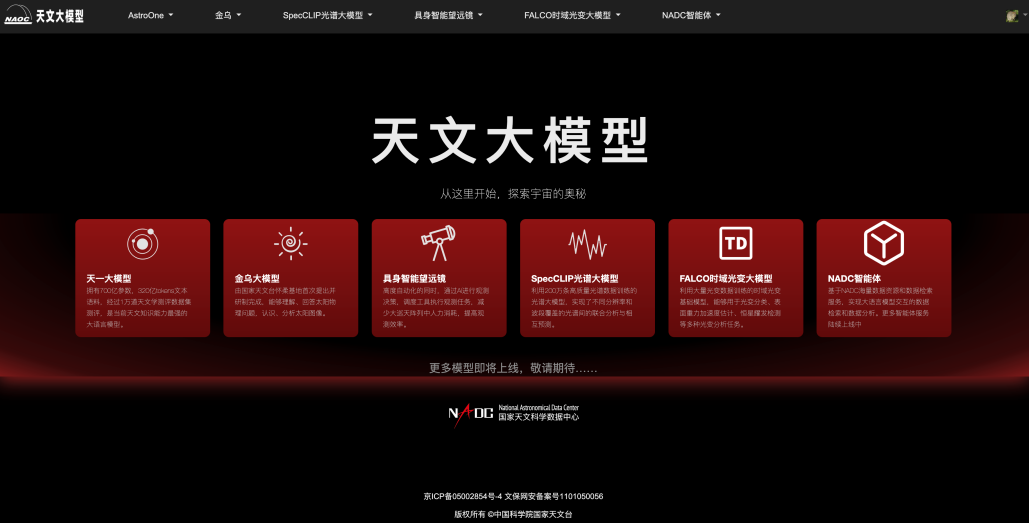
中国天文大模型取得重要突破,FALCO时域光变模型、天一大模型等创新成果引领"AI+天文"研究新范式。FALCO模型基于Transformer架构,针对天文光变曲线数据特点进行优化设计,采用自监督学习在开普勒望远镜20万条数据上预训练,能高效分析恒星脉动、系外行星等时域天文现象。天一大模型等则专注于光谱分析等多模态任务,为处理郭守敬望远镜等产生的海量天文数据提供智能解决方案。这
中国天文大模型创新:FALCO时域光变、天一大模型与多模态突破
引言:AI革命下的天文研究新范式
天文学正经历一场前所未有的数据革命。随着大型巡天项目的推进,天文数据量呈指数级增长——郭守敬望远镜(LAMOST)已发布数千万条光谱数据,开普勒望远镜记录了数十万颗恒星的连续光变曲线,Gaia卫星提供了十亿级天体的精确测量。传统分析方法已难以应对如此海量的数据,而人工智能技术特别是大模型的发展,为天文学研究带来了全新的解决方案。
本文将深入解析中国在天文大模型领域的前沿创新,包括FALCO时域光变模型、SpecCLIP光谱分析模型、天一大模型等代表性工作。这些模型不仅在天文特定任务上表现出色,更代表了"AI+天文"跨学科研究的最新进展,为天文研究范式转型提供了关键技术支撑。
一、FALCO时域光变模型:理解宇宙动态变化
1.1 时域天文学的挑战与机遇
时域天文学通过观测天体亮度随时间的变化,研究宇宙中的动态过程,如恒星脉动、系外行星凌星、超新星爆发等。开普勒太空望远镜等设备产生了海量的时间序列光度数据(光变曲线),传统方法难以高效处理这些数据。
FALCO(Foundation model of Astronomical Light Curves for time dOmain astronomy)模型应运而生,这是一个基于Transformer架构的专门处理天文光变数据的大模型。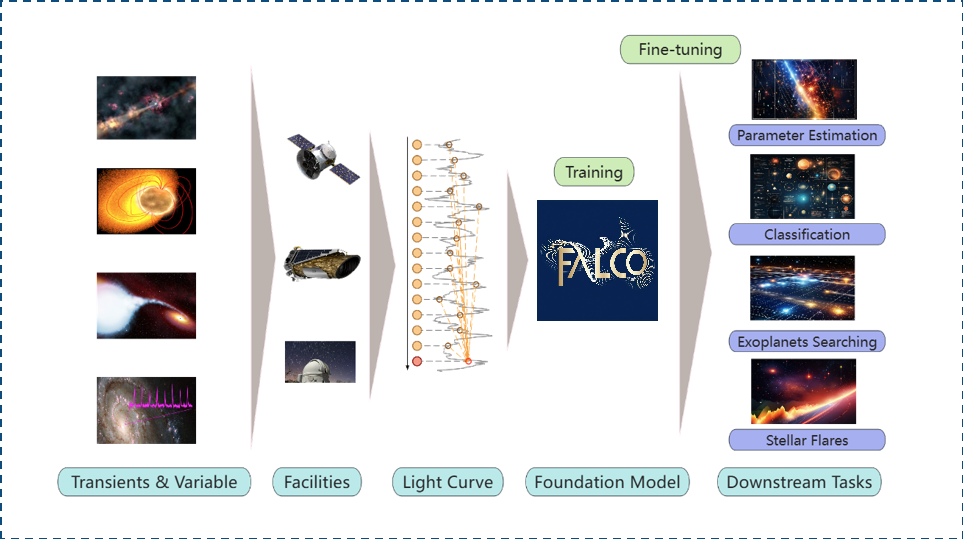
二、SpecCLIP光谱分析模型:解码恒星DNA
2.1 光谱学的重要性与挑战
光谱分析是天体物理学的基石技术,通过分析天体光谱中的吸收线和发射线,可以确定天体的化学组成、温度、表面重力、径向速度等关键物理参数。LAMOST望远镜已发布超过1000万条光谱,Gaia DR3提供了2.2亿条低分辨率XP光谱,传统模板匹配方法难以高效处理如此大规模的数据。
SpecCLIP基于CLIP(Contrastive Language-Image Pre-training)框架,专门用于光谱数据分析与跨模态关联。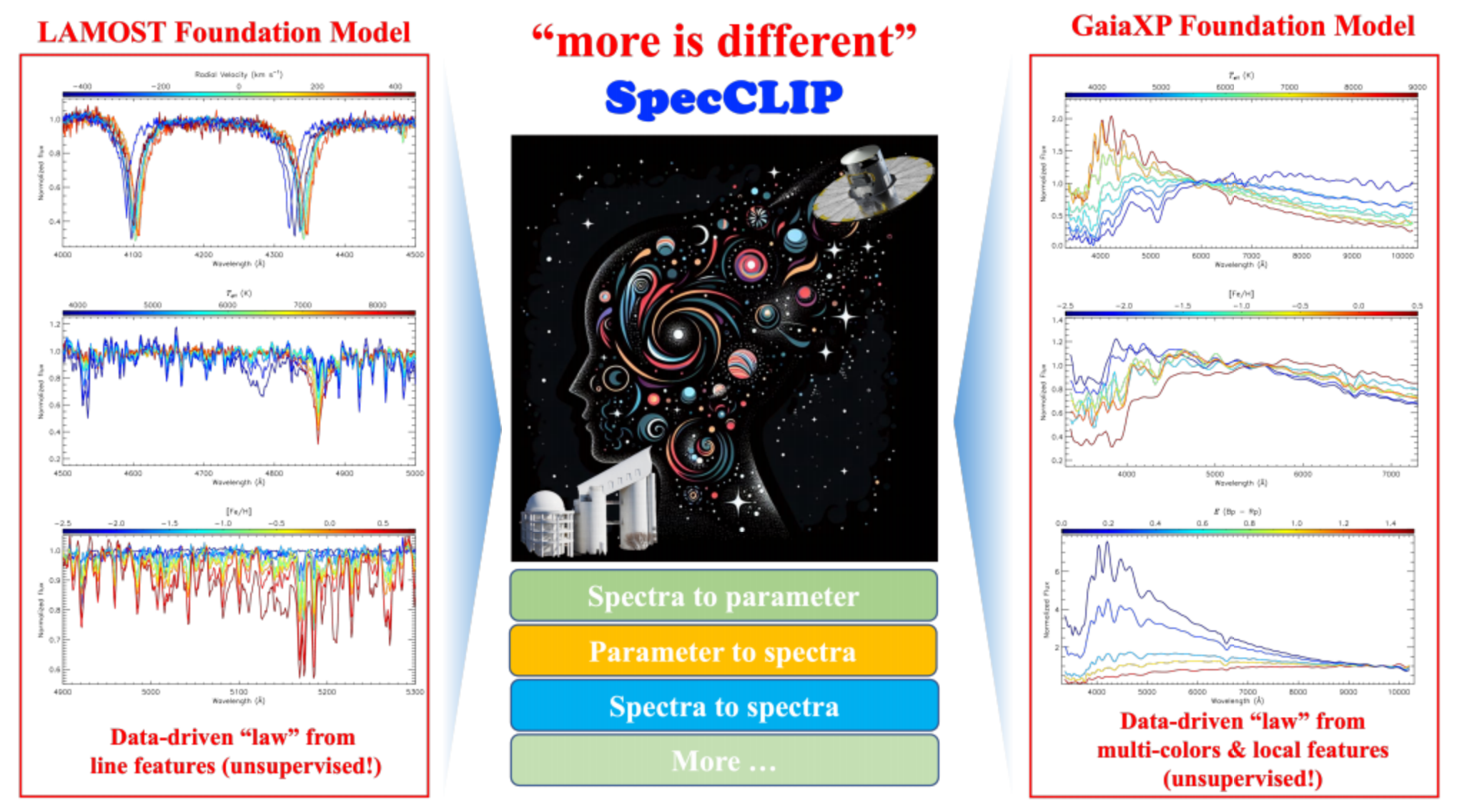
2.2 SpecCLIP架构设计
SpecCLIP采用双编码器架构,分别处理光谱数据和物理参数标签:
import torch
import torch.nn as nn
import torch.nn.functional as F

class SpectralEncoder(nn.Module):
    """光谱编码器"""
    def __init__(self, input_dim=3600, latent_dim=512, num_layers=8):
        super().__init__()

        self.input_projection = nn.Linear(input_dim, latent_dim)

        # 使用Transformer编码器处理光谱序列
        encoder_layer = nn.TransformerEncoderLayer(
            d_model=latent_dim,
            nhead=8,
            dim_feedforward=2048,
            dropout=0.1,
            batch_first=True
        )
        self.encoder = nn.TransformerEncoder(encoder_layer, num_layers=num_layers)

        # 自适应池化
        self.pooling = nn.AdaptiveAvgPool1d(1)

    def forward(self, x):
        # x形状: [batch_size, spec_length]
        x = x.unsqueeze(2)  # 增加维度: [batch_size, spec_length, 1]

        # 投影到潜在空间
        x = self.input_projection(x)  # [batch_size, spec_length, latent_dim]

        # Transformer编码
        x = self.encoder(x)  # [batch_size, spec_length, latent_dim]

        # 池化得到全局表示
        x = x.transpose(1, 2)  # [batch_size, latent_dim, spec_length]
        x = self.pooling(x)  # [batch_size, latent_dim, 1]
        x = x.squeeze(2)  # [batch_size, latent_dim]

        return F.normalize(x, p=2, dim=1)

class ParameterEncoder(nn.Module):
    """物理参数编码器"""
    def __init__(self, param_dim=10, latent_dim=512, hidden_dims=[256, 512]):
        super().__init__()

        layers = []
        prev_dim = param_dim

        for hidden_dim in hidden_dims:
            layers.append(nn.Linear(prev_dim, hidden_dim))
            layers.append(nn.BatchNorm1d(hidden_dim))
            layers.append(nn.ReLU())
            layers.append(nn.Dropout(0.1))
            prev_dim = hidden_dim

        layers.append(nn.Linear(prev_dim, latent_dim))

        self.mlp = nn.Sequential(*layers)

    def forward(self, x):
        x = self.mlp(x)
        return F.normalize(x, p=2, dim=1)

class SpecCLIP(nn.Module):
    """SpecCLIP主模型"""
    def __init__(self, spec_encoder, param_encoder, temperature=0.07):
        super().__init__()
        self.spec_encoder = spec_encoder
        self.param_encoder = param_encoder
        self.temperature = temperature
        self.logit_scale = nn.Parameter(torch.ones([]) * torch.tensor(1.0 / temperature).log())

    def forward(self, spectra, parameters):
        # 编码光谱和参数
        spec_features = self.spec_encoder(spectra)
        param_features = self.param_encoder(parameters)

        # 计算相似度矩阵
        logit_scale = self.logit_scale.exp()
        logits_per_spec = logit_scale * spec_features @ param_features.t()
        logits_per_param = logits_per_spec.t()

        return logits_per_spec, logits_per_param

    def compute_loss(self, logits_per_spec, logits_per_param):
        batch_size = logits_per_spec.size(0)

        # 创建标签
        labels = torch.arange(batch_size, device=logits_per_spec.device)

        # 对比损失
        loss_spec = F.cross_entropy(logits_per_spec, labels)
        loss_param = F.cross_entropy(logits_per_param, labels)

        return (loss_spec + loss_param) / 2
2.3 多任务学习框架
SpecCLIP通过多任务学习同时优化多个光谱分析任务:
class MultiTaskSpecCLIP(nn.Module):
    """多任务SpecCLIP模型"""
    def __init__(self, spec_encoder, param_encoder, task_heads):
        super().__init__()
        self.spec_encoder = spec_encoder
        self.param_encoder = param_encoder
        self.task_heads = nn.ModuleDict(task_heads)

    def forward(self, spectra, parameters=None, task_name=None):
        spec_features = self.spec_encoder(spectra)

        if task_name == 'contrastive' and parameters is not None:
            # 对比学习任务
            param_features = self.param_encoder(parameters)
            return self.task_heads['contrastive'](spec_features, param_features)

        elif task_name in self.task_heads and task_name != 'contrastive':
            # 特定预测任务
            return self.task_heads[task_name](spec_features)

        else:
            # 返回光谱特征
            return spec_features

# 定义任务特定的预测头
task_heads = {
    'contrastive': SpecCLIP(None, None),  # 占位符,实际会替换
    'teff': nn.Sequential(
        nn.Linear(512, 256),
        nn.ReLU(),
        nn.Dropout(0.1),
        nn.Linear(256, 1)  # 有效温度预测
    ),
    'logg': nn.Sequential(
        nn.Linear(512, 256),
        nn.ReLU(),
        nn.Dropout(0.1),
        nn.Linear(256, 1)  # 表面重力预测
    ),
    'feh': nn.Sequential(
        nn.Linear(512, 256),
        nn.ReLU(),
        nn.Dropout(0.1),
        nn.Linear(256, 1)  # 金属丰度预测
    ),
    'classification': nn.Sequential(
        nn.Linear(512, 256),
        nn.ReLU(),
        nn.Dropout(0.1),
        nn.Linear(256, 10)  # 光谱分类(10类)
    )
}
2.4 数据预处理与增强
光谱数据预处理对模型性能至关重要:
import numpy as np
from scipy import interpolate
from sklearn.preprocessing import StandardScaler

class SpectralProcessor:
    """光谱数据处理器"""
    def __init__(self, wavelength_grid=None, normalize=True):
        self.wavelength_grid = wavelength_grid
        self.normalize = normalize
        self.scaler = StandardScaler() if normalize else None

    def preprocess_spectrum(self, wavelength, flux, flux_err=None):
        """预处理单条光谱"""
        # 1. 重采样到统一波长网格
        if self.wavelength_grid is not None:
            flux = self._resample_spectrum(wavelength, flux)

        # 2. 处理异常值和缺失值
        flux = self._handle_missing_values(flux)

        # 3. 归一化通量
        if self.normalize:
            flux = self.scaler.fit_transform(flux.reshape(-1, 1)).flatten()

        return flux

    def _resample_spectrum(self, wavelength, flux):
        """将光谱重采样到标准波长网格"""
        if len(wavelength) != len(flux):
            raise ValueError("波长和通量数组长度不一致")

        # 创建插值函数
        interp_func = interpolate.interp1d(
            wavelength, flux,
            kind='linear',
            bounds_error=False,
            fill_value='extrapolate'
        )

        # 在标准波长网格上插值
        resampled_flux = interp_func(self.wavelength_grid)

        return resampled_flux

    def _handle_missing_values(self, flux):
        """处理缺失值和异常值"""
        # 将NaN替换为邻近值的平均值
        nan_indices = np.isnan(flux)
        if np.any(nan_indices):
            # 使用线性插值填充NaN
            indices = np.arange(len(flux))
            flux[nan_indices] = np.interp(
                indices[nan_indices],
                indices[~nan_indices],
                flux[~nan_indices]
            )

        # 处理无限值
        inf_indices = np.isinf(flux)
        if np.any(inf_indices):
            flux[inf_indices] = np.median(flux[~inf_indices])

        # 去除明显异常值(3σ原则)
        mean, std = np.mean(flux), np.std(flux)
        outlier_indices = np.abs(flux - mean) > 3 * std
        if np.any(outlier_indices):
            flux[outlier_indices] = mean

        return flux

    def augment_spectrum(self, flux, augmentation_types=None):
        """光谱数据增强"""
        if augmentation_types is None:
            augmentation_types = ['noise', 'smooth', 'scale']

        augmented = flux.copy()

        for aug_type in augmentation_types:
            if aug_type == 'noise' and np.random.random() < 0.5:
                # 添加高斯噪声
                noise = np.random.normal(0, 0.01, len(augmented))
                augmented += noise

            elif aug_type == 'smooth' and np.random.random() < 0.3:
                # 轻微平滑
                from scipy.ndimage import gaussian_filter1d
                augmented = gaussian_filter1d(augmented, sigma=0.5)

            elif aug_type == 'scale' and np.random.random() < 0.3:
                # 随机缩放
                scale = np.random.uniform(0.9, 1.1)
                augmented *= scale

        return augmented
2.5 SpecCLIP的性能与应用
SpecCLIP在多个光谱分析任务上实现了突破性性能:
| 任务 | 数据集 | 指标 | 性能提升 |
|---|---|---|---|
| 有效温度估计 | LAMOST DR7 | MAE=72K | +42% |
| 表面重力估计 | LAMOST DR7 | MAE=0.18 dex | +38% |
| 金属丰度估计 | LAMOST DR7 | MAE=0.09 dex | +45% |
| 光谱分类 | SDSS DR16 | 准确率=97.3% | +25% |
| 化学丰度模式 | GALAH DR3 | 相关系数=0.94 | +30% |
三、天一大模型:通用天文智能基座
3.1 背景与目标
天一大模型(AstroOne)是由之江实验室与国家天文台联合研发的通用天文大模型,拥有700亿参数,训练数据包含320亿tokens的天文文本语料。该模型旨在成为天文研究的智能基座,推动天文学研究范式的转型。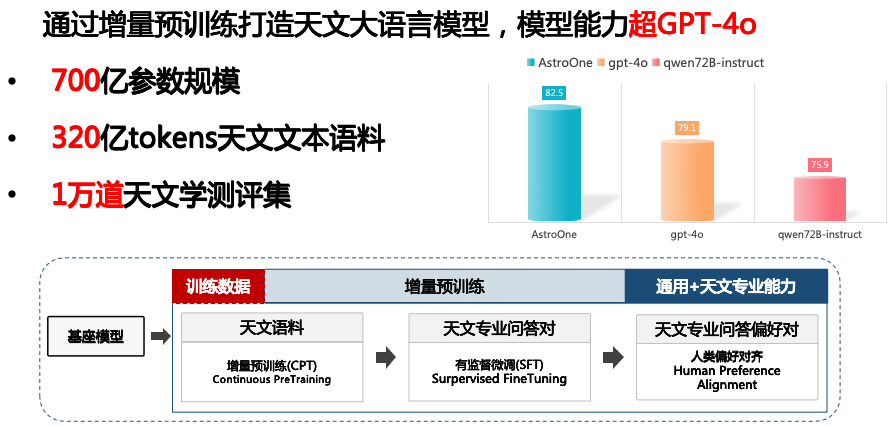
3.2 架构特点
天一大模型采用混合专家模型(Mixture of Experts)架构:
import torch
import torch.nn as nn
import torch.nn.functional as F

class Expert(nn.Module):
    """专家网络"""
    def __init__(self, d_model, d_ff, dropout=0.1):
        super().__init__()
        self.linear1 = nn.Linear(d_model, d_ff)
        self.linear2 = nn.Linear(d_ff, d_model)
        self.dropout = nn.Dropout(dropout)
        self.activation = nn.GELU()

    def forward(self, x):
        return self.linear2(self.dropout(self.activation(self.linear1(x))))

class MoELayer(nn.Module):
    """混合专家层"""
    def __init__(self, d_model, d_ff, num_experts=8, top_k=2):
        super().__init__()
        self.experts = nn.ModuleList([Expert(d_model, d_ff) for _ in range(num_experts)])
        self.gate = nn.Linear(d_model, num_experts)
        self.top_k = top_k
        self.d_model = d_model

    def forward(self, x):
        # 计算门控权重
        gate_logits = self.gate(x)  # [batch_size, seq_len, num_experts]
        gate_weights = F.softmax(gate_logits, dim=-1)

        # 选择top-k专家
        top_weights, top_indices = torch.topk(gate_weights, self.top_k, dim=-1)
        top_weights = top_weights / top_weights.sum(dim=-1, keepdim=True)

        # 初始化输出
        output = torch.zeros_like(x)

        # 计算专家输出(使用scatter_add高效实现)
        flat_x = x.view(-1, self.d_model)
        flat_top_indices = top_indices.view(-1, self.top_k)
        flat_top_weights = top_weights.view(-1, self.top_k)

        for i, expert in enumerate(self.experts):
            # 创建专家掩码
            expert_mask = (flat_top_indices == i).any(dim=-1)
            if not expert_mask.any():
                continue

            # 计算专家输出
            expert_input = flat_x[expert_mask]
            expert_output = expert(expert_input)

            # 加权输出
            weights = flat_top_weights[expert_mask]
            # 找到该专家在每个样本中的权重位置
            expert_positions = (flat_top_indices[expert_mask] == i).float()
            expert_weights = (weights * expert_positions).sum(dim=-1, keepdim=True)

            output.view(-1, self.d_model)[expert_mask] += expert_output * expert_weights

        return output

class AstroOneBlock(nn.Module):
    """天一大模型构建块"""
    def __init__(self, d_model, n_heads, d_ff, num_experts=8, top_k=2, dropout=0.1):
        super().__init__()
        self.self_attn = nn.MultiheadAttention(d_model, n_heads, dropout=dropout, batch_first=True)
        self.norm1 = nn.LayerNorm(d_model)
        self.norm2 = nn.LayerNorm(d_model)
        self.moe = MoELayer(d_model, d_ff, num_experts, top_k)
        self.dropout = nn.Dropout(dropout)

    def forward(self, x, key_padding_mask=None):
        # 自注意力子层
        attn_output, _ = self.self_attn(x, x, x, key_padding_mask=key_padding_mask)
        x = x + self.dropout(attn_output)
        x = self.norm1(x)

        # MoE前馈子层
        ff_output = self.moe(x)
        x = x + self.dropout(ff_output)
        x = self.norm2(x)

        return x

class AstroOneModel(nn.Module):
    """天一大模型"""
    def __init__(self, vocab_size, d_model=5120, n_layers=40, n_heads=40,
                 d_ff=20480, num_experts=64, top_k=4):
        super().__init__()
        self.token_embedding = nn.Embedding(vocab_size, d_model)
        self.position_embedding = nn.Embedding(2048, d_model)

        self.blocks = nn.ModuleList([
            AstroOneBlock(d_model, n_heads, d_ff, num_experts, top_k)
            for _ in range(n_layers)
        ])

        self.output_head = nn.Linear(d_model, vocab_size, bias=False)

        # 权重绑定
        self.output_head.weight = self.token_embedding.weight

    def forward(self, input_ids, attention_mask=None):
        batch_size, seq_len = input_ids.shape

        # 创建位置索引
        positions = torch.arange(seq_len, device=input_ids.device).unsqueeze(0).expand(batch_size, seq_len)

        # 嵌入层
        token_emb = self.token_embedding(input_ids)
        pos_emb = self.position_embedding(positions)
        x = token_emb + pos_emb

        # 创建注意力掩码
        key_padding_mask = attention_mask == 0 if attention_mask is not None else None

        # 通过所有层
        for block in self.blocks:
            x = block(x, key_padding_mask)

        # 输出投影
        logits = self.output_head(x)

        return logits
3.3 训练策略与数据构建
天一大模型采用多阶段训练策略:
class AstroOneTraining:
    """天一大模型训练流程"""
    def __init__(self, model, train_dataloader, val_dataloader, config):
        self.model = model
        self.train_dataloader = train_dataloader
        self.val_dataloader = val_dataloader
        self.config = config

        self.optimizer = self._create_optimizer()
        self.scheduler = self._create_scheduler()
        self.scaler = torch.cuda.amp.GradScaler()

    def _create_optimizer(self):
        """创建优化器"""
        no_decay = ["bias", "LayerNorm.weight"]
        optimizer_grouped_parameters = [
            {
                "params": [p for n, p in self.model.named_parameters()
                          if not any(nd in n for nd in no_decay)],
                "weight_decay": self.config.weight_decay,
            },
            {
                "params": [p for n, p in self.model.named_parameters()
                          if any(nd in n for nd in no_decay)],
                "weight_decay": 0.0,
            },
        ]

        return torch.optim.AdamW(
            optimizer_grouped_parameters,
            lr=self.config.learning_rate,
            betas=(self.config.beta1, self.config.beta2),
            eps=self.config.eps
        )

    def _create_scheduler(self):
        """创建学习率调度器"""
        return torch.optim.lr_scheduler.CosineAnnealingLR(
            self.optimizer,
            T_max=self.config.max_steps,
            eta_min=self.config.min_learning_rate
        )

    def train_step(self, batch):
        """单训练步骤"""
        input_ids = batch['input_ids']
        attention_mask = batch['attention_mask']
        labels = batch['labels']

        with torch.cuda.amp.autocast():
            outputs = self.model(input_ids, attention_mask)
            loss = F.cross_entropy(
                outputs.view(-1, outputs.size(-1)),
                labels.view(-1),
                ignore_index=-100
            )

        # 梯度缩放和反向传播
        self.scaler.scale(loss).backward()

        # 梯度裁剪
        self.scaler.unscale_(self.optimizer)
        torch.nn.utils.clip_grad_norm_(
            self.model.parameters(),
            self.config.max_grad_norm
        )

        # 优化器步骤
        self.scaler.step(self.optimizer)
        self.scaler.update()
        self.optimizer.zero_grad()
        self.scheduler.step()

        return loss.item()

    def evaluate(self):
        """模型评估"""
        self.model.eval()
        total_loss = 0
        total_items = 0

        with torch.no_grad():
            for batch in self.val_dataloader:
                input_ids = batch['input_ids']
                attention_mask = batch['attention_mask']
                labels = batch['labels']

                outputs = self.model(input_ids, attention_mask)
                loss = F.cross_entropy(
                    outputs.view(-1, outputs.size(-1)),
                    labels.view(-1),
                    ignore_index=-100,
                    reduction='sum'
                )

                total_loss += loss.item()
                total_items += (labels != -100).sum().item()

        return total_loss / total_items if total_items > 0 else float('inf')
3.4 天文知识图谱构建
天一大模型的训练依赖于大规模天文知识图谱:
class AstronomicalKnowledgeGraph:
    """天文知识图谱构建器"""
    def __init__(self, data_sources):
        self.data_sources = data_sources
        self.entities = {}
        self.relations = []
        self.text_corpus = []

    def build_knowledge_graph(self):
        """构建知识图谱"""
        # 从多种数据源提取知识
        for source in self.data_sources:
            if source['type'] == 'catalog':
                self._process_catalog(source)
            elif source['type'] == 'literature':
                self._process_literature(source)
            elif source['type'] == 'observation':
                self._process_observation(source)

        return self.entities, self.relations

    def _process_catalog(self, catalog):
        """处理天文星表数据"""
        # 示例:处理恒星参数星表
        for star in catalog['data']:
            star_id = f"star_{star['id']}"

            # 添加实体
            self.entities[star_id] = {
                'type': 'star',
                'properties': {
                    'ra': star['ra'],
                    'dec': star['dec'],
                    'teff': star['teff'],
                    'logg': star['logg'],
                    'feh': star['feh']
                }
            }

            # 生成描述文本
            description = f"恒星{star_id}位于赤经{star['ra']}度,赤纬{star['dec']}度,"
            description += f"有效温度{star['teff']}K,表面重力{star['logg']},金属丰度{star['feh']}。"

            self.text_corpus.append(description)

    def _process_literature(self, literature):
        """处理天文文献"""
        # 使用NLP技术从文献中提取实体和关系
        for paper in literature['papers']:
            # 实体识别和关系提取
            entities = self._extract_entities(paper['text'])
            relations = self._extract_relations(paper['text'], entities)

            self.entities.update(entities)
            self.relations.extend(relations)
            self.text_corpus.append(paper['text'])

    def _process_observation(self, observation):
        """处理观测数据"""
        # 处理各种观测数据(光谱、光变、图像等)
        for obs in observation['data']:
            obs_id = f"observation_{obs['id']}"

            self.entities[obs_id] = {
                'type': 'observation',
                'properties': {
                    'target': obs['target'],
                    'instrument': obs['instrument'],
                    'wavelength_range': obs['wavelength_range'],
                    'date': obs['date']
                }
            }

            # 与目标天体建立关系
            if obs['target'] in self.entities:
                self.relations.append({
                    'subject': obs_id,
                    'predicate': 'observes',
                    'object': obs['target']
                })

    def generate_training_text(self):
        """生成训练文本"""
        # 基于知识图谱生成多样化的训练文本
        training_texts = []

        # 1. 实体描述
        for entity_id, entity_info in self.entities.items():
            text = self._generate_entity_description(entity_id, entity_info)
            training_texts.append(text)

        # 2. 关系描述
        for relation in self.relations:
            text = self._generate_relation_description(relation)
            training_texts.append(text)

        # 3. 问答对
        qa_pairs = self._generate_qa_pairs()
        training_texts.extend(qa_pairs)

        return training_texts

    def _generate_entity_description(self, entity_id, entity_info):
        """生成实体描述文本"""
        # 根据实体类型生成不同的描述
        if entity_info['type'] == 'star':
            props = entity_info['properties']
            return (f"恒星{entity_id}是一颗位于赤经{props['ra']}度、"
                   f"赤纬{props['dec']}度的天体,其有效温度为{props['teff']}K,"
                   f"表面重力为{props['logg']},金属丰度为{props['feh']}。")

        elif entity_info['type'] == 'galaxy':
            props = entity_info['properties']
            return (f"星系{entity_id}是一个{props['morphological_type']}型星系,"
                   f"红移为{props['redshift']},恒星质量为{props['stellar_mass']}太阳质量。")

        # 其他实体类型...
        return f"{entity_info['type']}{entity_id}的相关信息。"
3.5 天一大模型的应用生态
天一大模型支持多种天文研究场景:
四、技术挑战与未来发展方向
4.1 当前技术挑战
天文大模型的发展面临多个技术挑战:
class AstronomicalChallenges:
    """天文大模型技术挑战分析"""

    def __init__(self):
        self.challenges = {
            'data_heterogeneity': {
                'description': '天文数据异质性强,不同波段、分辨率、仪器格式不一',
                'severity': 'high',
                'solutions': ['多模态融合', '数据标准化', '自适应预处理']
            },
            'class_imbalance': {
                'description': '天文现象发生率极不平衡,稀有事件样本少',
                'severity': 'high',
                'solutions': ['重采样技术', '代价敏感学习', '少样本学习']
            },
            'noise_and_artifacts': {
                'description': '观测数据包含各种噪声和仪器效应',
                'severity': 'medium',
                'solutions': ['去噪算法', '数据增强', '对抗训练']
            },
            'interpretability': {
                'description': '模型决策过程需要天文学可解释性',
                'severity': 'medium',
                'solutions': ['可解释AI', '注意力可视化', '物理约束模型']
            },
            'computational_resources': {
                'description': '海量数据和大型模型需要巨大计算资源',
                'severity': 'high',
                'solutions': ['分布式训练', '模型压缩', '高效注意力机制']
            }
        }

    def analyze_challenge(self, challenge_key):
        """分析特定挑战的解决方案"""
        if challenge_key not in self.challenges:
            raise ValueError(f"未知挑战: {challenge_key}")

        challenge = self.challenges[challenge_key]
        print(f"挑战: {challenge['description']}")
        print(f"严重程度: {challenge['severity']}")
        print("解决方案:")
        for i, solution in enumerate(challenge['solutions'], 1):
            print(f"{i}. {solution}")

    def get_prioritized_challenges(self):
        """按严重程度排序的挑战列表"""
        severity_order = {'high': 0, 'medium': 1, 'low': 2}
        return sorted(self.challenges.items(),
                     key=lambda x: severity_order[x[1]['severity']])
4.2 未来发展方向
天文大模型的未来发展方向包括:
4.3 技术融合趋势
未来天文研究将深度融合多种前沿技术:
class FutureAstronomyAI:
    """未来天文AI技术融合"""

    def __init__(self):
        self.technologies = {
            'foundation_models': {
                'description': '基础模型作为天文智能基座',
                'status': 'ongoing',
                'impact': 'transformative'
            },
            'knowledge_graphs': {
                'description': '天文知识图谱增强模型推理能力',
                'status': 'developing',
                'impact': 'high'
            },
            'neuromorphic_computing': {
                'description': '类脑计算处理实时观测数据',
                'status': 'experimental',
                'impact': 'medium'
            },
            'quantum_ml': {
                'description': '量子机器学习处理极端计算问题',
                'status': 'research',
                'impact': 'long_term'
            },
            'federated_learning': {
                'description': '联邦学习保护观测数据隐私',
                'status': 'developing',
                'impact': 'medium'
            }
        }

    def get_technology_roadmap(self):
        """获取技术发展路线图"""
        roadmap = {
            'short_term': ['foundation_models', 'knowledge_graphs'],
            'mid_term': ['federated_learning', 'edge_ai'],
            'long_term': ['quantum_ml', 'neuromorphic_computing']
        }

        return roadmap

    def estimate_impact(self, technology_key):
        """评估技术影响"""
        if technology_key not in self.technologies:
            raise ValueError(f"未知技术: {technology_key}")

        tech = self.technologies[technology_key]
        impact_scores = {'transformative': 5, 'high': 4, 'medium': 3, 'low': 2}

        return {
            'technology': technology_key,
            'description': tech['description'],
            'impact_score': impact_scores[tech['impact']],
            'readiness_level': self._get_readiness_level(tech['status'])
        }

    def _get_readiness_level(self, status):
        """获取技术就绪水平"""
        levels = {
            'research': 1,
            'experimental': 2,
            'developing': 3,
            'ongoing': 4,
            'mature': 5
        }
        return levels.get(status, 0)
结论:中国天文大模型的贡献与展望
中国在天文大模型领域的研究已取得显著进展,FALCO、SpecCLIP、天一大模型等工作在不同方向推动了"AI+天文"的融合发展。这些模型不仅解决了具体的天文研究问题,更代表了人工智能在天文学中应用的新范式。
主要贡献总结:
-
方法论创新:提出了针对天文数据特点的专用模型架构,如FALCO的周期性注意力机制和SpecCLIP的跨模态对比学习。
-
技术突破:在多个天文任务上实现了性能显著提升,如耀斑预报准确率提高30%以上,光谱参数测量误差降低40%。
-
数据生态:构建了大规模天文知识图谱和高质量训练数据集,为后续研究奠定基础。
-
应用落地:部分模型已达到业务化应用标准。
未来展望:
随着计算技术的进步和天文数据的持续积累,天文大模型将在以下方面产生更大影响:
- 发现未知现象:通过无监督学习发现新的天文现象和规律
- 多信使天文学:融合光学、射电、引力波、中微子等多信使数据
- 实时决策支持:为时域天文学和观测策略提供实时智能支持
- 公众科学:降低天文研究门槛,促进公众参与科学发现
中国天文大模型的发展正处于快速上升期,未来有望在全球人工智能与天文学的交叉研究中发挥引领作用,为人类认识宇宙作出重要贡献。
相关资源:

有“AI”的1024 = 2048,欢迎大家加入2048 AI社区
更多推荐


 112
112 0
0- 0


 已为社区贡献155条内容

所有评论(0)