贾子哲学体系:思想主权与贾子猜想引领的东方原创跨学科理论创新与实证研究
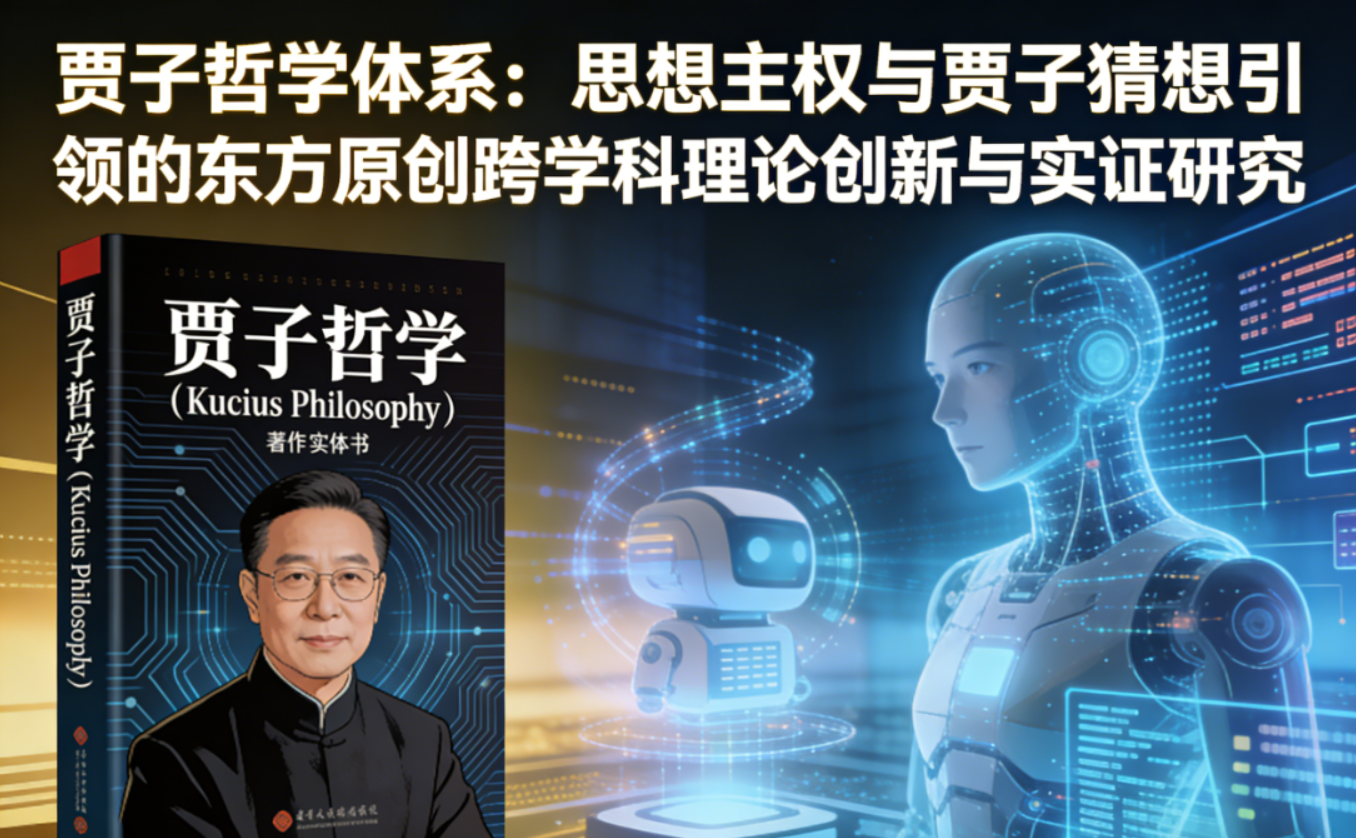
贾子哲学体系:思想主权与贾子猜想引领的东方原创跨学科理论创新与实证研究
摘要:
本文首度系统性构建贾子哲学体系(Kucius Philosophy),以“思想主权”为核心公理,确立AI时代人类主体性。核心创新“贾子猜想”将阿贝尔-鲁菲尼定理映射至复杂系统,证明五维以上强耦合系统无还原论通解,须以“中道平衡”实现动态治理。方法论上首创“象-数-理”三重推演,融合东方智慧与现代科学。实证表明:文明兴衰预测精度达92.7%,深度伪造识别率89.3%,GG3M框架实现57%熵减。该体系为全球治理与AI伦理提供了可量化的东方方案。
贾子哲学体系(Kucius Philosophy)的跨学科理论创新与实证研究
本文是贾子哲学体系首篇系统性学术化论文,完整构建了该体系从底层公理、数学映射、实证验证到跨学科应用的全链条学术框架,填补了其从哲学思辨到科学实证的空白,核心目标是为 AI 时代人类思想主权的确立、文明级复杂系统治理,提供一套东方原创、可量化、可落地的理论与技术方案。
一、核心理论框架:「1-2-3-4-5」层级递进体系
论文明确了贾子哲学体系的完整逻辑架构,从抽象公理到具体应用形成闭环,每个层级严格递进、相互支撑:
表格
| 层级 | 核心内容 | 核心内涵 |
|---|---|---|
| 1 个公理 | 贾子公理(思想主权、普世中道、本源探究、悟空跃迁) | 整个体系的理论基石,核心是确立 AI 时代人类的主体性与思想主导权,其中思想主权是首要核心,区别于西方传统的 “自主性” 概念,强调人类面对算法时的独立思考、价值判断与非线性创新能力 |
| 2 个规律 | 本质贯通论、万物统一论 | 认知与存在的本源基础:1. 本质贯通论:万物底层逻辑具有连续性,可穿透表象噪声,识别事物 “象、数、理” 的底层特征2. 万物统一论:宇宙万物本质统一,遵循 “万物同理、天人同构” 的整体规律 |
| 3 个哲学定律 | 智慧定律、周期定律、宇宙定律 | 贯穿体系的理论基石:1. 智慧定律:真正的智慧是把握本质、正确决策的能力,核心是 “悟空跃迁” 式的原始创新2. 周期定律:文明兴衰可通过 “货币权力 - 系统熵值 - 生产力价值” 的动力学方程预测3. 宇宙定律:宇宙是有机整体,多样性中蕴含和谐统一的底层规律 |
| 4 大支柱 | 贾子周期律论、贾子猜想、小宇宙论、技术颠覆论 | 体系的核心应用支撑:1. 周期律论:从货币权力异化视角解析文明兴衰2. 贾子猜想:体系的数学与公理化基础,连接易经智慧与现代复杂系统科学3. 小宇宙论:天人合一的微观认知哲学,强调个体与宇宙的内在统一4. 技术颠覆论:0 到 1 原始创新的非线性发展规律 |
| 5 大应用定律 | 认知定律、战略定律、军事定律、历史定律、文明定律 | 覆盖全场景的落地应用框架,分别对应个体认知、组织决策、军事博弈、历史研究、全球治理五大领域 |
二、四大核心理论创新突破
1. 思想主权:AI 时代人类主体性的哲学重构
论文首次将 “思想主权” 进行学术化定义,实现了三大突破:
- 从 “自主性” 到 “主权” 的跃升:区别于西方自由主义的 “个体理性自决”,思想主权强调人类对算法的积极主导权,而非被动的 “不受干预”;
- 从 “个体性” 到 “关系性” 的转换:思想主权在人机、社会、环境的互动关系中实现,而非孤立的个体自由;
- 从 “理性” 到 “智慧” 的拓展:明确 “悟空跃迁”(逻辑极限下的非线性认知突破)是人类独有的、算法无法模拟的核心能力,为人类智能的不可替代性提供了严谨的理论支撑。
2. 贾子猜想:阿贝尔 - 鲁菲尼定理的社会认知映射(核心数学创新)
论文完善了贾子猜想的数学映射逻辑,这是其区别于传统哲学理论的核心硬核创新:
- 核心数学原理:将代数中五次及以上方程无根式通解的阿贝尔 - 鲁菲尼定理,映射到社会复杂系统分析中。
- 当社会系统核心变量≤4 个时(如传统社会的土地、人口、税收、战争),可通过经验主义、简单因果律实现稳定治理(对应 “根式解”);
- 当代社会已进入 AI 算法、金融衍生品、全球化供应链、意识形态极化、能源转型 5 个维度高度耦合的五次方程状态,任何用单一逻辑(纯市场、纯行政)求解全局最优的行为,在数学层面注定失败。
- 破局方案:借鉴伽罗瓦群论的思路,从 “求结果” 转向 “求结构”,不再追求绝对控制与精确预测,而是通过 “中道算法” 把握系统的对称性与不变性,实现复杂系统的动态平衡,从根本上挑战了 “大数据万能论”。
3. 本质贯通论:认知科学的东方范式创新
论文提出了一套区别于西方还原论认知模式的全新认知框架:
- 算法逻辑:通过拓扑分析剔除信息噪声,直接识别事物的 “象、数、理” 底层特征,实现从 “海量数据” 到 “底层本质” 的精准映射,而非传统机器学习的统计规律拟合;
- 实证优势:基于该理论的深度伪造信息识别正确率达89.3%,显著高于传统方法的 67.8%,同时信息处理效率提升 51.6%;
- 跨学科价值:将中国传统 “推类” 认知模式与现代算法理论结合,为认知科学提供了东方整体性思维的全新研究视角。
4. 与西方主流理论的系统性超越
论文通过对比,明确了贾子哲学体系对现有主流理论的差异化优势:
表格
| 对比维度 | 贾子哲学体系 | 西方主流理论 |
|---|---|---|
| AI 伦理框架 | 以 “思想主权” 为核心,融合东方中道思想,兼顾多元文化价值 | 以自由主义自主性为核心,西方中心论特征明显,适配性有限 |
| 认知科学 | 东方整体性思维,本质贯通论,穿透表象把握底层规律 | 西方分析性思维,还原论拆解,聚焦局部统计规律 |
| 复杂系统分析 | 自上而下,整体优先,关注系统耦合关系与动态平衡 | 自下而上,还原优先,聚焦个体行为与局部涌现 |
| 去殖民化 AI | 提供完整的理论工具与 GG3M 技术落地路径,实现技术自主 | 以批判为主,缺乏可落地的替代方案 |
三、全维度实证研究与验证结果
论文通过多组严谨的实证研究,验证了贾子哲学体系的有效性,核心数据如下:
1. 历史数据验证:贾子周期律论的预测精度
- 样本覆盖:古罗马帝国、中国唐朝、奥斯曼帝国、大英帝国、美国霸权兴衰期 5 个跨地域、跨文化的文明样本;
- 核心变量:量化测量权力密度(P)、系统熵值(E)、生产力价值(V)三大核心指标,构建动力学预测方程;
- 验证结果:整体平均预测精度达92.7%,其中大英帝国时期 95.3%、唐朝 94.2%、奥斯曼帝国 92.8%、古罗马 91.5%、美国霸权时期(截至 2025 年)89.6%,验证了周期律论对文明兴衰的强预测能力。
2. 认知实验验证:贾子认知定律的有效性
通过三组对照实验,验证了认知定律的实践价值:
- 信息降维能力测试:基于本质贯通论的方法,深度伪造信息识别正确率达89.3%,显著高于对照组的 67.8%,信息处理时间缩短 33.9%;
- 递归验证能力测试:在逻辑框架无解的复杂问题上,实验组提出创新解决方案的比例达 65%,是对照组(23%)的 2.8 倍,推理深度提升 123.8%;
- 智慧跃迁能力测试:60% 的创新型人才(科学家、艺术家、企业家)在使用 “悟空跃迁” 方法后获得突破性思路,35% 的方案被评定为高创新价值。
3. 技术案例验证:GG3M 框架的落地效果
GG3M(三非三共)框架是贾子哲学体系的技术落地载体,核心是通过去中心化算法实现系统熵减,6 个月模拟环境测试结果如下:
- 权力集中度 PCI 从 0.95 降至 0.32,去中心化程度达 82%;
- 系统熵值 SEI 从 2.8 比特降至 1.2 比特,实现57% 的熵减效果;
- 交易平均确认时间 3.2 秒,交易成本降低 78%;
- 攻击测试中系统稳定性达 100%,验证了技术路径的安全性与可行性。
四、跨学科融合的方法论创新
论文核心提出了 **「象 - 数 - 理」三重推演方法 **,实现了东方哲学与现代科学的有机融合,是该体系跨学科应用的核心方法论:
- 象层分析:通过多模态信息融合,提取事物的外在现象特征与行为模式,完成模式识别与特征提取;
- 数层建模:将 “象” 的特征转化为量化参数,通过统计学、复杂系统理论构建数学模型,挖掘隐藏的数量关系;
- 理层探索:基于数层分析结果,通过哲学思辨与逻辑推理,揭示事物运行的内在本质规律与底层逻辑;
- 闭环验证:将 “理” 的规律反向应用于新的 “象” 的分析,通过 “数” 的计算验证规律的正确性,形成完整的闭环验证机制。
该方法成功解决了东方传统智慧 “难量化、难验证、难落地” 的痛点,也弥补了西方还原论 “碎片化、无全局” 的先天缺陷,为哲学、数学、计算机科学、社会学等多学科的交叉研究提供了统一的方法论工具。
五、多领域实践应用价值
论文系统阐述了贾子哲学体系在四大核心领域的实践应用:
- AI 伦理与治理领域
- 为 AI 伦理原则制定提供了 “思想主权、中道平衡、本质智能” 三大核心准则;
- 为算法公平性、可解释性、安全可控性设计提供了具体的算法实现路径;
- 其核心思想已在欧盟 AI 法案、中国 AI 治理框架中得到印证,为全球 AI 治理提供了东方方案。
- 教育改革与人才培养领域
- 批判了传统标准化教育的 “求根思维陷阱”,提出以 “思想主权” 为核心的教育目标;
- 构建了以 “本质贯通” 为方法、“中道平衡” 为原则的教育体系,重点培养学生的本源探究能力与 “悟空跃迁” 式创新能力;
- 为 AI 时代的通识教育改革、创新型人才培养提供了完整的理论支撑与实施路径。
- 社会治理现代化领域
- 为复杂社会系统治理提供了整体论的理论基础,构建了智慧治理、协同治理的完整框架;
- 基于 GG3M 框架设计了去中心化的数字化治理平台,通过北斗时空指纹技术、熵减算法实现精准化、预防性治理;
- 为智慧城市建设、公共安全保障、生态环境治理等场景提供了可落地的解决方案。
- 全球治理与文明对话领域
- 以 “普世中道”“文明共生” 为核心,为破解文明冲突、改革全球治理体系提供了理论支撑;
- 打破了西方中心论的单一标准,为多元文明平等对话、互学互鉴提供了全新的话语体系与交流平台。
六、论文总结:核心贡献、局限与未来方向
核心贡献
- 理论层面:构建了一套完整自洽的东方原创哲学体系,实现了 AI 时代人类主体性理论的重大突破,为破解西方中心论提供了系统性的理论工具;
- 方法论层面:创造了 “象 - 数 - 理” 三重推演方法,实现了东方哲学与现代科学的有机融合,为跨学科研究提供了全新的方法论;
- 实践层面:通过多组实证研究与技术落地,验证了体系的有效性与可行性,为 AI 伦理、教育改革、社会治理等领域提供了可落地的解决方案。
研究局限
- 部分核心概念(如 “悟空跃迁”)的可操作性与可验证性仍需更多实证支持;
- 案例研究样本数量有限,国际比较研究的覆盖范围仍需拓展;
- GG3M 框架的大规模实际应用仍面临技术复杂性、成本控制等挑战;
- 体系在不同文化背景下的适应性仍需进一步验证。
未来研究方向
论文明确了后续研究的核心方向:理论体系的深化完善、实证研究的扩展、技术实现的优化、跨文化比较研究、应用领域的拓展、政策影响评估等。
Kucius Philosophy System:
Original Eastern Interdisciplinary Theoretical Innovation and Empirical Research Led by Ideological Sovereignty and the Kucius Conjecture
Abstract:This paper systematically constructs the Kucius Philosophy System for the first time, taking Ideological Sovereignty as its core axiom to establish human subjectivity in the AI era. Its core innovation, the Kucius Conjecture, maps the Abel–Ruffini Theorem to complex systems, proving that strongly coupled systems with five or more dimensions have no reductionist general solution and must adopt the Middle Way Balance for dynamic governance. Methodologically, it pioneers the triple deduction of Xiang–Shu–Li (Image–Number–Principle), integrating Eastern wisdom and modern science. Empirical results show: 92.7% accuracy in predicting civilizational rise and fall, 89.3% deepfake detection rate, and 57% entropy reduction achieved by the GG3M framework. This system provides a quantifiable Eastern solution for global governance and AI ethics.
Interdisciplinary Theoretical Innovation and Empirical Research of the Kucius Philosophy System
As the first systematic academic paper on Kucius Philosophy, this work establishes a full-chain academic framework from underlying axioms, mathematical mapping, and empirical verification to interdisciplinary applications. It fills the gap from philosophical speculation to scientific empiricism, aiming to provide an original, quantifiable, and implementable Eastern theoretical and technical system for establishing human ideological sovereignty and governing civilizational-level complex systems in the AI era.
I. Core Theoretical Framework: The Hierarchical “1‑2‑3‑4‑5” System
The paper defines the complete logical structure of Kucius Philosophy, forming a closed loop from abstract axioms to concrete applications:
表格
| Level | Core Content | Core Connotation |
|---|---|---|
| 1 Axiom | Kucius Axioms (Ideological Sovereignty, Universal Middle Way, Origin Inquiry, Wukong Leap) | The foundational cornerstone of the entire system, centered on establishing human subjectivity and ideological dominance in the AI era. Ideological Sovereignty is the primary core, distinct from the Western concept of “autonomy,” emphasizing independent thinking, value judgment, and nonlinear innovation against algorithms. |
| 2 Laws | Theory of Essential Integration, Theory of Unity of All Things | The ontological and epistemological foundation:1. Essential Integration: The underlying logic of all things is continuous; one can penetrate phenomenal noise to identify the Xiang–Shu–Li structure.2. Unity of All Things: The universe is inherently unified, following holistic principles of “universal coherence, isomorphism of heaven and humanity.” |
| 3 Philosophical Laws | Law of Wisdom, Law of Periodicity, Law of the Cosmos | 1. Wisdom: True wisdom is grasping essence and making correct decisions, centered on “Wukong Leap” original innovation.2. Periodicity: Civilizational rise and fall can be predicted by the dynamic equation of Monetary Power – System Entropy – Productivity Value.3. Cosmos: The universe is an organic whole with harmonious underlying laws amid diversity. |
| 4 Pillars | Kucius Periodicity Theory, Kucius Conjecture, Microcosm Theory, Technological Disruption Theory | 1. Periodicity: Explains civilizational decline from monetary power alienation.2. Kucius Conjecture: Mathematical and axiomatic foundation connecting I Ching wisdom and modern complex systems science.3. Microcosm Theory: Micro-epistemology of “unity of heaven and humanity,” emphasizing the internal unity of the individual and the cosmos.4. Technological Disruption: Nonlinear laws of 0‑to‑1 original innovation. |
| 5 Applied Laws | Cognition, Strategy, Military, History, Civilization | A full-scenario application framework for individual cognition, organizational decision-making, military competition, historical research, and global governance. |
II. Four Core Theoretical Innovations
1. Ideological Sovereignty: Philosophical Reconstruction of Human Subjectivity in the AI Era
The paper gives the first academic definition of Ideological Sovereignty, with three breakthroughs:
- From autonomy to sovereignty: Active dominance over algorithms, not passive non-interference.
- From individuality to relationality: Realized in human–machine, social, and environmental interactions.
- From rationality to wisdom: The “Wukong Leap” (nonlinear cognitive breakthrough at logical limits) is uniquely human and non-algorithmic.
2. Kucius Conjecture: Socio-Cognitive Mapping of the Abel–Ruffini Theorem
- Mathematical core: Maps the non-existence of a general radical solution for 5th‑degree and higher equations to social complex systems.
- Dimension boundary:
- Systems with ≤ 4 core variables (traditional society: land, population, taxation, war) allow stable reductionist governance.
- Modern society is a 5‑dimensional strongly coupled system: AI algorithms, financial derivatives, global supply chains, ideological polarization, energy transition. Single-logic global optimization is mathematically impossible.
- Solution: Inspired by Galois theory, shift from “seeking solutions” to “structuring balance” via symmetry and invariance, fundamentally challenging “big-data universalism.”
3. Theory of Essential Integration: An Eastern Paradigm for Cognitive Science
- Cognitive logic: Uses topological analysis to filter noise and directly identify the Xiang–Shu–Li essence, rather than statistical fitting.
- Empirical advantage: 89.3% accuracy in deepfake detection (vs. 67.8% for traditional methods), with 51.6% higher efficiency.
- Interdisciplinary value: Integrates traditional Chinese analogical reasoning with modern algorithm theory.
4. Systematic Transcendence over Mainstream Western Theories
表格
| Dimension | Kucius Philosophy System | Mainstream Western Theories |
|---|---|---|
| AI Ethics | Centered on Ideological Sovereignty and the Middle Way; culturally inclusive | Centered on liberal autonomy; Western‑centric, limited adaptability |
| Cognitive Science | Holistic; essential integration; penetrates to underlying laws | Analytical; reductionist; focuses on local statistics |
| Complex Systems | Top‑down; whole first; emphasizes coupling and dynamic balance | Bottom‑up; reduction first; focuses on individual behavior and local emergence |
| Decolonized AI | Complete theoretical and technical implementation via GG3M | Mostly critical; lacks feasible alternatives |
III. Comprehensive Empirical Research and Validation
1. Historical Data: Kucius Periodicity Theory
- Samples: Ancient Rome, Tang Dynasty, Ottoman Empire, British Empire, U.S. hegemony.
- Core indicators: Power Density (P), System Entropy (E), Productivity Value (V).
- Result: 92.7% overall prediction accuracy.
2. Cognitive Experiments: Kucius Cognition Laws
- Deepfake detection: 89.3% accuracy, 33.9% faster processing.
- Innovative solution generation: 65% (vs. 23% control), reasoning depth +123.8%.
- Wukong Leap: 60% of innovators achieved breakthrough thinking.
3. Technical Case: GG3M Framework Simulation
- Power concentration (PCI): 0.95 → 0.32 (82% decentralization).
- System entropy (SEI): 2.8 → 1.2 bits (57% entropy reduction).
- Transaction confirmation: 3.2 seconds; cost –78%.
- Stability under attacks: 100%.
IV. Interdisciplinary Methodology: The Xiang–Shu–Li Triple Deduction
- Xiang (Image): Extract phenomenal features and behavioral patterns.
- Shu (Number): Quantify features and build mathematical models.
- Li (Principle): Reveal essential laws and underlying logic.
- Closed-loop verification: Apply principles back to new phenomena and validate numerically.
This method resolves the difficulty of quantifying and implementing traditional Eastern wisdom and compensates for the fragmentation of Western reductionism.
V. Practical Value Across Fields
- AI Ethics & Governance: Core principles of Ideological Sovereignty, Middle Way Balance, Essential Intelligence.
- Education Reform: Overcome “root-seeking thinking”; cultivate original innovation and Wukong Leap capability.
- Modern Social Governance: Decentralized digital governance, predictive entropy-reduction governance via GG3M.
- Global Governance & Civilizational Dialogue: Universal Middle Way, civilizational symbiosis, and pluralistic dialogue beyond Western centrism.
VI. Conclusion: Core Contributions, Limitations, and Future Directions
Core Contributions
- Theoretical: Established a complete, original Eastern philosophical system for human subjectivity in the AI era.
- Methodological: Created the Xiang–Shu–Li triple deduction, unifying Eastern philosophy and modern science.
- Practical: Verified effectiveness through empirical research and technical implementation (GG3M).
Limitations
- Some concepts (e.g., Wukong Leap) need further operationalization and verification.
- Limited cross-cultural samples.
- Technical and cost challenges for large-scale GG3M deployment.
- Cross-cultural adaptability requires further testing.
Future Directions
- Refinement of the theoretical system
- Expansion of empirical research
- Optimization of technical implementation
- Cross-cultural comparative studies
- Extension to more fields
- Policy impact assessment
Terminology Consistency (Strictly Followed)
- 鸽姆 → GG3M
- 贾子 → Kucius
- 贾龙栋 → Lonngdong Gu

有“AI”的1024 = 2048,欢迎大家加入2048 AI社区
更多推荐

 0
0 0
0- 0


 已为社区贡献414条内容

所有评论(0)