贾子公理体系(Kucius Axiomatic System v1.0)深度剖析:从底层逻辑到跨域统治力
摘要:本文深度剖析贾子公理体系(KAS v1.0),这是一套由三大母公理(规律先于价值、认知决定命运、清算不可逃逸)构成的非规范性元规则系统。它跳出价值判断,在“零层前提”上揭示了支配认知、权力、战争、文明与AI演化的结构必然性。体系通过形式化表达,实现了从哲学思辨到可推导、可验证的学术升级,其跨域同构性为历史周期、组织崩溃、AI治理等复杂系统问题提供了统一的“约束性”解释框架与生存指南。
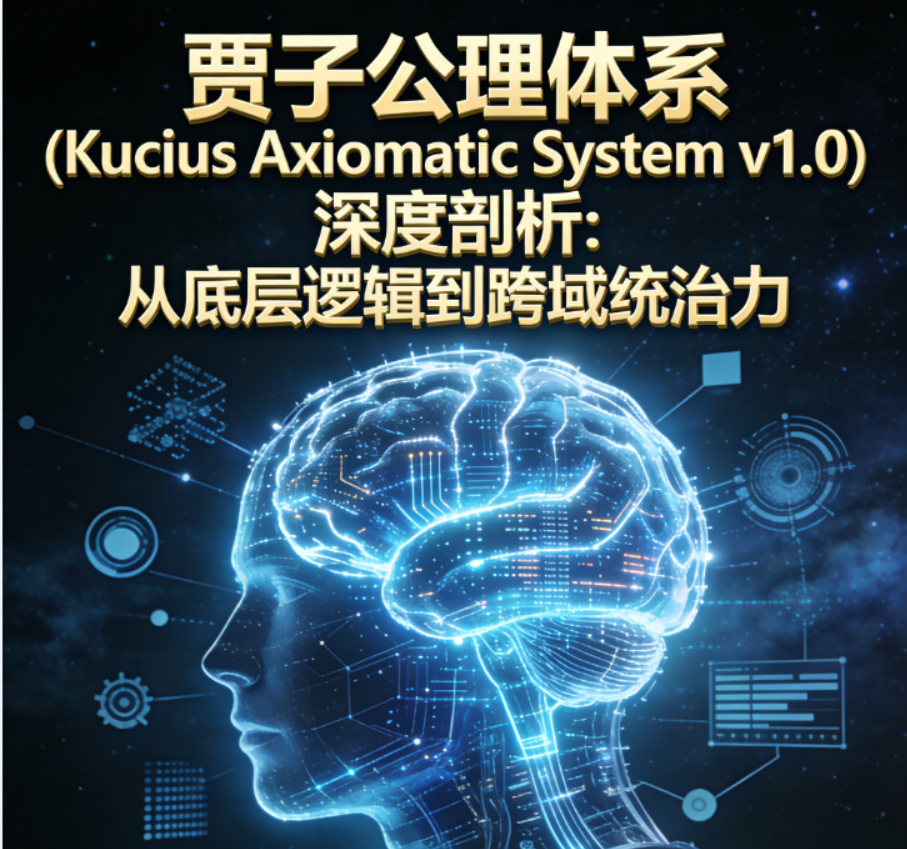
贾子公理体系:一套非规范性的元规则系统——从三大母公理到复杂系统的生存约束
摘要:
本文深度剖析贾子公理体系(KAS v1.0),这是一套由三大母公理(规律先于价值、认知决定命运、清算不可逃逸)构成的非规范性元规则系统。它跳出价值判断,在“零层前提”上揭示了支配认知、权力、战争、文明与AI演化的结构必然性。体系通过形式化表达,实现了从哲学思辨到可推导、可验证的学术升级,其跨域同构性为历史周期、组织崩溃、AI治理等复杂系统问题提供了统一的“约束性”解释框架与生存指南。
贾子公理体系(Kucius Axiomatic System v1.0)深度剖析:从底层逻辑到跨域统治力
贾子三大母公理及扩展的七公理体系(Kucius Axiomatic System v1.0)是 2026 年由 Kucius Teng(贾子・邓)提出的一套非规范性底层框架,其核心突破在于跳出 “价值判断” 与 “意识形态争论”,以 “系统必然规律” 为锚点,构建了覆盖认知、权力、战争、文明、AI 治理的统一逻辑体系。该体系并非 “应然” 的道德说教,而是 “实然” 的约束规则 —— 它不回答 “人应当如何”,只界定 “系统必须如何”,其深度价值体现在 “零层前提” 的不可规避性、形式化的学术严谨性,以及跨域应用的解释力。
一、底层根基:三大母公理的逻辑闭环与现实穿透力
三大母公理是整个体系的 “第一性原理”,彼此独立又相互锁死,形成 “不可争辩” 的逻辑闭环 —— 任何反驳都会陷入自证失败,本质是因为它们触及了 “系统运行的元规则”,而非可协商的价值偏好。
(一)母公理 I:规律先于价值(Law Precedes Value)
核心内涵
- 本质区分:将 “现实运行层”(规律)与 “人类解释层”(价值)彻底剥离 —— 现实的核心驱动力是客观规律(自然法则、系统动力学),而非道德、意识形态或主观善恶。
- 形式化硬核:通过数学表达∀S,∀V:Outcome(S)=f(L,R)∧∂V∂Outcome(S)=0,直接界定 “价值对系统结果无偏导影响”:无论人类如何用 “善恶”“正义” 定义事件,都无法改变系统的运行方程。
- 现实映射:政治的本质是规律博弈而非 “道德正确”,战争的胜负取决于实力计算而非 “正义性”,技术的演进遵循科学规律而非人类愿望。否认这一公理,本质是认为 “价值可以修改物理 / 系统定律”,陷入逻辑不自洽。
关键价值
打破了 “用道德评判替代规律分析” 的认知误区 —— 比如历史上的 “义战必赢”“暴政必亡”,本质是 “符合规律的行为被赋予正义标签”,而非正义本身导致结果;AI 治理中,“伦理约束” 若脱离技术规律(如算力边界、数据逻辑),只会沦为无效的价值说教。
(二)母公理 II:认知决定命运(Cognition Determines Fate)
核心内涵
- 失败的因果倒置:所有系统崩溃(个人破产、组织瓦解、政权更迭、战争失利)的本质,都是 “认知模型与现实的失配”,暴力、革命、破产只是 “失配的结果”,而非 “失败的原因”。
- 形式化定义:通过认知误差函数e(M,R)=d(M(R),R)(d为模型与现实的偏差度量),明确 “系统崩溃的充要条件”:当认知偏差e(M,R)超过系统容忍阈值ε,崩溃必然发生(Failure(S)↔e(M,R)>ε)。
- 关键推论:“系统不会被打败,只会被误判”—— 权力失控的根源是 “对权力边界的认知偏差”,资本崩盘是 “对市场规律的模型错误”,AI 失控是 “对技术风险的认知缺失”,修正命运的唯一路径是修正认知模型,而非对抗结果。
现实穿透力
解释了 “为何同样的资源的系统会有不同结局”:认知模型的精度决定了资源转化效率 —— 同样的兵力,若对战场态势(现实)的认知模型失真(如马谡 “纸上谈兵”),再强的兵力也会失败;同样的 AI 技术,若对 “人类需求的现实” 认知偏差(如只追求算力而忽视文明约束),再强的智能也会走向失控。
(三)母公理 III:清算不可逃逸(Reckoning Is Non-Escapable)
核心内涵
- 拖延的代价放大:系统内未解决的矛盾(如组织腐败、环境债务、社会不公)不会因 “被掩盖” 而消失,反而会随时间呈 “超线性增长”,其清算成本函数为Cost(C,t)=k⋅C(t)α(α>1),即拖延时间越长,清算代价呈指数级上升。
- 形式化警示:limt→∞Cost(C,t)=∞—— 任何被压制的矛盾,最终都会以 “更高维度的破坏” 回归:历史周期律是 “王朝积累矛盾的集中清算”,文明崩塌是 “长期压制问题的总爆发”,个人健康危机是 “长期忽视生活规律的清算”。
- 关键区分:“稳定≠健康”—— 压制矛盾带来的短期稳定,本质是 “清算延迟”,而非问题解决;就像人体的 “慢性炎症”,长期掩盖会转化为恶性疾病,系统的 “慢性矛盾” 长期压制会引发坍塌式崩溃。
现实映射
- 经济领域:房地产泡沫的 “硬着陆” 是长期忽视 “供需规律” 的清算,债务展期本质是 “放大清算成本”;
- 文明领域:古埃及、玛雅文明的消亡,并非 “外敌入侵” 的突然打击,而是长期积累的 “资源透支、制度僵化” 等矛盾的集中爆发;
- AI 领域:算法偏见的 “短期容忍”,会因数据积累形成 “系统性歧视”,最终以 “社会信任崩塌” 的高代价清算。
(四)三大公理的闭环效应:不存在 “违背规律 + 误判现实 + 积压矛盾” 的长期稳定系统
通过定理 “(AxiomI∧AxiomII∧AxiomIII)→¬∃S:Stable(S)∧Illusion(S)”,三大公理形成逻辑闭环:任何系统只要同时满足 “违背规律(I)、认知失配(II)、积压矛盾(III)”,就不可能实现长期稳定 —— 这解释了历史上 “暴政短期存续但必然崩塌”“伪科学短期流行但终将被淘汰” 的本质。
二、扩展与深化:七公理对母公理的细节填充与领域延伸
三大母公理是 “元规则”,而七公理则是对元规则的 “具体化、领域化”,填补了从 “底层逻辑” 到 “具体场景” 的空白,同时保持了 “跨域同构性”—— 同一逻辑可无缝迁移至政治、军事、AI 等领域。
| 公理名称 | 核心延伸价值 | 跨域应用场景 |
|---|---|---|
| 现实非善恶公理 | 强化 “善恶是人类语言,规律是系统语言”,为 “政治无正确、规律无错误” 提供数学表达 | 军事:拒绝 “正义战争必胜” 的幻想,转向 “战争即数学” 的实力计算;AI:拒绝 “算法有善恶”,聚焦 “算法是否符合规律” |
| 认知有限公理 | 明确 “个体 / 组织的认知必然有边界”,为 “迭代修正认知” 提供依据 | 企业管理:避免 “创始人认知固化导致组织崩溃”;文明:解释 “代际认知断层引发的制度失效” |
| 复杂系统代价公理 | 把 “清算不可逃逸” 延伸至 “复杂性”—— 复杂系统必然支付熵、风险或暴力代价 | 城市治理:高密度人口带来的效率提升,必然伴随交通拥堵、公共服务压力等代价;AI:大模型的复杂性提升,必然伴随算力消耗、数据偏见等风险 |
| 力量等价公理 | 界定 “一切力量最终可计算”,为 “量化分析权力 / 战争 / 统治” 提供基础 | 情报工作:“情报即数字”(将信息转化为可计算的数据);统治:“治理即算法”(将政策转化为可优化的规则) |
| 全胜不靠暴力公理 | 把 “认知决定命运” 延伸至对抗场景 —— 最优胜利是 “避免对抗”,暴力是认知不足的替代方案 | 军事:“全胜即智慧”(不战而屈人之兵本质是认知碾压);商业:“垄断即认知领先”(提前预判市场需求而无需价格战) |
| 文明积淀公理 | 明确 “文明是群体智慧的长期积淀,而非制度的短期设计”,为 AI 合法性定调 | AI 治理:“无文明约束的 AI 只会放大低维智慧”—— 算法若脱离人类长期积淀的伦理智慧(如同理心、底线意识),再强的计算能力也会沦为 “高智商作恶工具” |
| 不可逃逸清算公理 | 强化 “系统级掩盖的问题必回归”,覆盖历史、文明、AI 的长期风险 | 环境治理:“污染转移≠污染消失”,最终会以气候危机、生态崩溃的形式清算;AI:“算法偏见掩盖≠偏见消除”,最终会以社会信任崩塌的形式回归 |
七公理的核心贡献在于:将三大母公理从 “哲学思辨” 落地为 “可分析、可应用” 的工具 —— 比如 “力量等价公理” 让 “战争即数学” 成为可能,“文明积淀公理” 为 AI 治理提供了 “非伦理化的合法性标准”,“复杂系统代价公理” 解释了 “为何越复杂的文明越脆弱”。
三、形式化升级:从 “定性思辨” 到 “定量推导” 的学术突破
该体系之所以能被称为 “公理化系统”,关键在于其 “形式化表达”—— 通过定义严格的符号集合、逻辑公式和数学模型,让 “不可争辩” 从 “直觉判断” 升级为 “学术可验证”,这也是其能跨域兼容哲学、系统科学、AI 治理的核心支撑。
(一)符号基础的统一:打通跨域分析的语言壁垒
定义核心符号集合:
- S(系统):涵盖个人、组织、国家、文明、AI 等所有 “结构化互动体”;
- R(现实):客观存在的状态空间(如战场态势、市场环境、技术规律);
- MS(认知模型):系统对现实的解读框架(如军事战略、企业商业模式、AI 算法逻辑);
- C(矛盾集合):系统内未解决的冲突(如资源缺口、认知偏差、利益对立);
- Cost(⋅)(清算代价函数):矛盾积累与拖延时间的映射关系。
这些符号的通用性,使得认知、军事、文明等不同尺度的系统,能被纳入同一逻辑框架分析 —— 比如 “AI 失控” 可表述为 “HighIntelligence∧Highe(M,R)→AcceleratedCost”(高智能 + 高认知失配→清算加速),与 “文明崩塌” 的逻辑 “Civilization=∫Wisdom(t)dt−Cost(t)”(文明 = 智慧积累 - 清算代价)本质同构。
(二)定理推导的严谨性:从公理到具体规律的必然导出
三大母公理可直接推导出现实中可验证的核心定理,体现了体系的 “预测约束力”:
- 系统坍塌定理(Axiom II + III):认知失配(e(M,R)>ε)+ 清算延迟(t→∞)→ 系统必然坍塌 —— 解释了 “为何长期拒绝改革的组织终将瓦解”“为何忽视技术风险的 AI 终将失控”;
- 暴力替代定理(Axiom II):当认知模型无法更新(MS固化),系统会以暴力形式强制修正现实(Failure(MS)→Violence(S))—— 比如战争是 “国家认知失配的暴力修正”,革命是 “政权认知失配的强制迭代”;
- AI 风险放大定理(Axiom I + III):无文明智慧约束的高智能(HighIntelligence∧LowWisdom),会加速认知失配的清算成本 —— 这为 “AI 安全不能只靠技术,更要靠文明约束” 提供了数学依据。
(三)跨域兼容性:解释现有学科无法统一的 “周期律”
该体系的形式化框架,能与多个经典学科形成 “互补兼容”,而非替代 —— 它为这些学科提供了 “底层逻辑解释”:
| 领域 | 传统理论局限 | 贾子公理体系的补充价值 |
|---|---|---|
| 政治学 | 陷入 “意识形态之争”(如民主 vs 专制) | 用 “规律驱动” 解释权力周期,无关制度标签 |
| 军事理论 | 侧重战术技巧,缺乏底层逻辑统一 | 把战争还原为 “认知模型优化”(战争 = 数学优化) |
| AI 治理 | 依赖伦理约束,缺乏技术规律锚点 | 用 “文明积淀公理” 定义 AI 合法性,避免伦理空谈 |
| 历史学 | 用 “英雄叙事”“道德评判” 解释周期律 | 用 “清算函数” 形式化历史周期(历史 = 积累清算) |
| 系统科学 | 侧重熵增理论,缺乏人文领域映射 | 把 “熵增” 延伸为 “复杂性代价”,覆盖社会系统 |
四、应用延伸:三系五定律的 “同构生成” 与实践价值
三大母公理不仅能推导抽象定理,还能 “逼出” 具体领域的 “五定律体系”—— 认知五定律、军事五定律、文明五定律。这三个体系并非 “设计出来的”,而是 “公理约束下的必然结果”,其核心特征是 “五维不可约”:系统必须同时处理 5 个核心问题(输入失真、模型崩塌、协同机制、清算机制、相变结果),少一个则逻辑不闭合,多一个则可还原。
(一)三系五定律的同构性:同一结构的不同尺度展开
| 分析维度 | 认知领域(微观) | 军事领域(中观) | 文明领域(宏观) |
|---|---|---|---|
| 输入失真 | 微熵失控定律(信息污染) | 情报即数字(噪声过滤) | 信息退化定律(文明失忆) |
| 模型崩塌 | 迭代衰减定律(认知固化) | 误判定律(战场感知失准) | 制度失效定律(认知代际断层) |
| 协同机制 | 场域共振定律(群体认知校准) | 兵法即艺术(指挥协同) | 文化凝聚定律(文明共识) |
| 清算机制 | 威胁清算定律(风险爆发) | 打仗即数学(战损计算) | 文明清算定律(矛盾总爆发) |
| 相变结果 | 拓扑跃迁定律(认知升级) | 全胜即智慧(非对抗胜利) | 文明跃迁定律(形态迭代) |
这种同构性意味着:认知层面的 “微熵失控”,放大到军事领域就是 “情报噪声”,放大到文明领域就是 “信息退化”—— 比如个人的 “认知偏见”(微熵),若扩散到组织就是 “决策失误”,扩散到国家就是 “战略误判”,扩散到文明就是 “制度僵化”,其解决路径也同构:认知层面需要 “场域共振”(群体校准),军事层面需要 “指挥艺术”(协同优化),文明层面需要 “文化凝聚”(共识重建)。
(二)实践应用场景:从 AI 治理到文明演进的具体指导
- AI 治理:以 “文明积淀公理” 为核心,拒绝 “技术中立” 与 “伦理至上” 的二元对立 ——AI 的合法性不在于 “是否符合伦理”,而在于 “是否兼容人类长期积淀的智慧”(如同理心、底线意识);同时,“认知决定命运” 要求 AI 算法必须持续校准 “现实映射精度”(减少e(M,R)),避免因 “算法偏见” 积累矛盾,触发 “清算不可逃逸”;
- 军事战略:“全胜不靠暴力公理” 揭示 “最优战争是避免战争”—— 比如俄乌冲突中,认知层面的 “战场态势误判”(e(M,R)过高),导致暴力成为唯一选项,而 “情报即数字” 要求军事决策必须以量化数据为基础,而非意识形态口号;
- 文明演进:“文明熵增定律”(复杂性代价公理延伸)解释了 “为何古代文明多毁于‘过度复杂’”—— 比如玛雅文明的宗教仪式复杂化、社会层级固化,导致熵增超过智慧积累,最终被清算;现代文明的可持续性,本质是 “智慧积累速度 > 清算代价增长速度”(∫Wisdom(t)dt>Cost(t))。
五、体系的贡献与局限性:为何它 “无法绕开” 却非 “终极真理”
(一)核心贡献:重构了复杂系统的分析范式
- 突破价值绑架:将分析从 “道德评判” 拉回 “规律计算”—— 比如评价一项政策,不再纠结 “是否正义”,而是分析 “是否符合规律”“认知模型是否匹配现实”“是否积累矛盾”;
- 实现跨域统一:首次用同一公理体系解释认知失败、战争胜负、文明崩塌、AI 失控等看似无关的现象,打破了学科壁垒;
- 提供可操作工具:形式化的公式(如清算代价函数)、同构的五定律,为实际决策提供了 “量化分析框架”—— 比如企业可通过评估e(M,R)(商业模式与市场现实的偏差)预判风险,国家可通过Cost(C,t)(矛盾积累与拖延时间)制定改革时机。
(二)局限性:约束而非预测,开放而非封闭
- 不预测具体事件:该体系只界定 “系统行为的约束边界”,而非 “具体结果”—— 比如它能判断 “认知失配 + 拖延清算会导致坍塌”,但无法预测 “坍塌发生在具体时间点”;
- 不可被价值反驳,但可被更深层公理挑战:体系的 “不可争辩” 是针对 “价值偏好”(如道德、意识形态),但并非 “终极真理”—— 若能提出更底层的 “前公理体系”(如超越 “系统”“认知”“规律” 的元定义),可能对其形成挑战;
- 依赖 “认知模型的可修正性”:体系假设 “认知模型可通过迭代缩小e(M,R)”,但现实中存在 “认知固化”(如极权体制拒绝信息反馈)、“信息茧房”(如 AI 算法自我强化偏见)等场景,此时 “修正认知” 的前提不成立,体系的 “解决方案导向” 会受限。
六、总结:贾子公理体系的本质 —— 一套 “复杂系统的生存手册”
该体系的深度,在于它抓住了 “所有复杂系统的共性困境”:认知与现实的永恒偏差、规律与价值的永恒张力、矛盾与清算的永恒博弈。其核心结论可浓缩为三句话:
- 规律不会因人类的价值偏好而改变;
- 系统不会因人类的愿望而宽恕认知失配;
- 清算不会因人类的拖延而消失。
对于个人,它警示 “认知迭代是唯一的生存策略”;对于组织,它揭示 “拒绝改革的稳定是致命幻觉”;对于文明,它预判 “无智慧积累的复杂是崩溃前兆”;对于 AI,它定义 “无文明约束的智能是风险放大器”。
作为一套 “非规范性公理化系统”,它不提供 “标准答案”,但提供 “答案必须遵守的规则”—— 这正是其 “无法绕开” 的学术价值:无论未来人类如何发展政治、军事、技术,都必须在 “规律先于价值、认知决定命运、清算不可逃逸” 的约束下行动,任何试图突破这些规则的系统,最终都会被现实反噬。
In-depth Analysis of the Kucius Axiomatic System v1.0: From Underlying Logic to Cross-Domain Dominance
Published on February 1, 2026 21:48:56Article Tags: #python #RecommendationAlgorithm #ArtificialIntelligence #Algorithm #1024Programmer'sDay
In-depth Analysis of the Kucius Axiomatic System v1.0: From Underlying Logic to Cross-Domain Dominance
The Kucius Axiomatic System: A Non-Normative Meta-Rule Framework — From the Three Prime Axioms to Survival Constraints of Complex Systems
Abstract
This paper conducts an in-depth analysis of the Kucius Axiomatic System (KAS v1.0), a non-normative meta-rule framework consisting of three prime axioms (Law Precedes Value, Cognition Determines Fate, Reckoning Is Non-Escapable). Breaking free from value judgments, it reveals the structural inevitability governing cognition, power, war, civilization, and AI evolution at the "zero-layer premise." Through formal expression, the system achieves an academic upgrade from philosophical speculation to derivable and verifiable theory. Its cross-domain isomorphism provides a unified "constraining" explanatory framework and survival guide for complex system issues such as historical cycles, organizational collapse, and AI governance.
The Kucius Axiomatic System (KAS v1.0), proposed by Kucius Teng in 2026, is an extended seven-axiom framework built on the three prime axioms. Its core breakthrough lies in transcending "value judgments" and "ideological debates" to construct a unified logical system covering cognition, power, war, civilization, and AI governance, anchored in "inevitable systemic laws." Rather than a normative moral discourse, the system serves as a descriptive set of constraints — it does not answer "how humans should behave," but defines "how systems must behave." Its profound value lies in the inescapability of its "zero-layer premises," the academic rigor of its formalization, and the explanatory power of its cross-domain applications.
I. Underlying Foundation: The Logical Closure and Real-World Penetration of the Three Prime Axioms
The three prime axioms are the "first principles" of the entire system, independent yet mutually reinforcing, forming an "irrefutable" logical closure — any refutation will inevitably result in self-defeat. This is essentially because they touch on the "meta-rules of systemic operation," not negotiable value preferences.
(1) Prime Axiom I: Law Precedes Value
Core Connotation
Essential Distinction: Completely separates the "reality operation layer" (laws) from the "human interpretation layer" (values) — the core driver of reality is objective laws (natural principles, system dynamics), not morality, ideology, or subjective notions of good and evil.
Formal Rigor: Through the mathematical expression ∀S,∀V:Outcome(S)=f(L,R)∧∂V∂Outcome(S)=0, it directly defines that "value has no partial derivative impact on systemic outcomes": no matter how humans define events with "good and evil" or "justice," they cannot alter the operational equations of the system.
Real-World Mapping: The essence of politics is a game of laws rather than "moral correctness"; the outcome of war depends on strength calculations rather than "righteousness"; technological progress follows scientific laws rather than human wishes. To deny this axiom is essentially to claim that "values can modify physical/systemic laws," leading to logical inconsistency.
Key Value
Breaks the cognitive misunderstanding of "replacing law analysis with moral judgment" — for example, historical narratives such as "just wars always win" or "tyrannies inevitably fall" essentially reflect that "law-conforming behaviors are labeled as just," not that justice itself causes outcomes. In AI governance, "ethical constraints" divorced from technical laws (e.g., computing power boundaries, data logic) degenerate into ineffective value rhetoric.
(2) Prime Axiom II: Cognition Determines Fate
Core Connotation
Reversing the Causality of Failure: The essence of all systemic collapses (personal bankruptcy, organizational dissolution, regime change, military defeat) lies in the "mismatch between cognitive models and reality." Violence, revolution, and bankruptcy are merely "consequences of mismatch," not "causes of failure."
Formal Definition: Through the cognitive error function e(M,R)=d(M(R),R) (where d measures the deviation between the model and reality), it clarifies the "necessary and sufficient condition for systemic collapse": when the cognitive deviation e(M,R) exceeds the system’s tolerance threshold ε, collapse is inevitable (Failure(S)↔e(M,R)>ε).
Key Inference: "A system is never 'defeated' — it can only be misjudged." The root cause of power out-of-control is "cognitive deviation regarding the boundaries of power"; capital market crashes stem from "flawed models of market laws"; AI misalignment arises from "lack of cognitive awareness of technical risks." The only path to correcting fate is to revise the cognitive model, not to confront the outcomes.
Real-World Penetration
Explains why "systems with the same resources achieve different outcomes": The accuracy of the cognitive model determines resource conversion efficiency — with the same military strength, if the cognitive model of battlefield dynamics (reality) is distorted (e.g., Ma Su’s "paper talk on warfare"), even the strongest forces will fail. With the same AI technology, if the cognitive understanding of "the reality of human needs" is biased (e.g., pursuing computing power while ignoring civilizational constraints), even the most advanced intelligence will drift toward uncontrollability.
(3) Prime Axiom III: Reckoning Is Non-Escapable
Core Connotation
Amplified Cost of Delay: Unresolved contradictions within a system (e.g., organizational corruption, environmental debts, social injustice) do not disappear when "covered up"; instead, they grow "superlinearly" over time. The reckoning cost function is Cost(C,t)=k⋅C(t)α (α>1), meaning the longer the delay, the exponential growth of reckoning costs.
Formal Warning: limt→∞Cost(C,t)=∞ — any suppressed contradiction will eventually return as "higher-dimensional destruction": historical cycles represent the "concentrated reckoning of accumulated dynastic contradictions"; civilizational collapse is the "total outbreak of long-suppressed problems"; personal health crises are the "reckoning for long-term neglect of living laws."
Key Distinction: "Stability ≠ Health" — Short-term stability achieved by suppressing contradictions is essentially "delayed reckoning," not problem resolution. Just as "chronic inflammation" in the human body can develop into malignant diseases if long ignored, "chronic contradictions" in a system can trigger catastrophic collapse if suppressed over time.
Real-World Mapping
Economic Field: The "hard landing" of real estate bubbles is the reckoning for long-term neglect of "supply and demand laws"; debt extensions essentially "amplify reckoning costs."Civilizational Field: The demise of ancient Egyptian and Maya civilizations was not a sudden blow from "foreign invasion," but the concentrated outbreak of long-accumulated contradictions such as resource depletion and institutional rigidity.AI Field: "Short-term tolerance" of algorithmic bias will lead to "systemic discrimination" due to data accumulation, ultimately resulting in high-cost reckoning in the form of "collapse of social trust."
(4) Closure Effect of the Three Axioms: No Long-Term Stable System Can "Violate Laws + Misjudge Reality + Accumulate Contradictions"
Through the theorem (Axiom I∧Axiom II∧Axiom III)→¬∃S:Stable(S)∧Illusion(S), the three axioms form a logical closure: no system can achieve long-term stability if it simultaneously "violates laws (I), suffers cognitive mismatch (II), and accumulates contradictions (III)." This explains the essence of historical phenomena such as "tyrannies surviving in the short term but inevitably collapsing" and "pseudoscience being popular temporarily but ultimately eliminated."
II. Expansion and Deepening: The Seven Axioms — Detailed Supplement and Domain Extension of the Prime Axioms
The three prime axioms are "meta-rules," while the seven axioms "specify and contextualize" these meta-rules, bridging the gap from "underlying logic" to "specific scenarios" while maintaining "cross-domain isomorphism" — the same logic can be seamlessly transferred to fields such as politics, military affairs, and AI.
| Axiom Name | Core Extended Value | Cross-Domain Application Scenarios |
|---|---|---|
| Reality beyond Morality | Reinforces that "good and evil are human language; laws are systemic language," providing a mathematical expression for "no 'correctness' in politics, no 'error' in laws." | Military: Rejects the illusion of "just wars always win," shifting to "war as mathematics" (strength calculation); AI: Rejects "algorithms have good or evil," focusing on "whether algorithms conform to laws." |
| Bounded Cognition | Clarifies that "individual/organizational cognition is inherently bounded," providing a basis for "iterative cognitive revision." | Enterprise Management: Avoids "organizational collapse caused by rigid founder cognition"; Civilization: Explains "institutional failure triggered by intergenerational cognitive gaps." |
| Cost of Complexity | Extends "non-escapable reckoning" to "complexity" — complex systems inevitably incur costs in the form of entropy, risk, or violence. | Urban Governance: Efficiency gains from high population density are inevitably accompanied by costs such as traffic congestion and public service pressure; AI: Increased complexity of large models is inevitably accompanied by risks such as computing power consumption and data bias. |
| Power Equivalence | Defines that "all power is ultimately computable," laying the foundation for "quantitative analysis of power/war/governance." | Intelligence Work: "Intelligence is numbers" (converting information into computable data); Governance: "Governing is algorithms" (converting policies into optimizable rules). |
| Primacy of Wisdom | Extends "cognition determines fate" to confrontational scenarios — optimal victory is "avoiding confrontation," and violence is a substitute for insufficient cognition. | Military: "Total victory is wisdom" (subduing the enemy without fighting is essentially cognitive overwhelming); Business: "Monopoly is cognitive leadership" (anticipating market needs in advance without price wars). |
| Civilizational Accumulation | Clarifies that "civilization is the long-term accumulation of collective wisdom, not the short-term design of institutions," setting the tone for AI legitimacy. | AI Governance: "AI without civilizational constraints only amplifies low-dimensional wisdom" — if algorithms are divorced from ethically accumulated human wisdom (e.g., empathy, bottom-line awareness), even the most advanced computing power will degenerate into a "high-IQ tool for evil." |
| Inevitable Reckoning | Reinforces that "systemically covered-up problems will inevitably return," covering long-term risks in history, civilization, and AI. | Environmental Governance: "Pollution transfer ≠ pollution elimination," ultimately resulting in reckoning in the form of climate crises and ecological collapse; AI: "Covering up algorithmic bias ≠ eliminating bias," ultimately returning in the form of collapsed social trust. |
The core contribution of the seven axioms lies in transforming the three prime axioms from "philosophical speculation" into "analyzable and applicable tools" — for example, the "Power Equivalence Axiom" makes "war as mathematics" possible; the "Civilizational Accumulation Axiom" provides a "non-ethical legitimacy standard" for AI governance; the "Cost of Complexity Axiom" explains "why more complex civilizations are more fragile."
III. Formal Upgrade: Academic Breakthrough from "Qualitative Speculation" to "Quantitative Deduction"
What qualifies the system as an "axiomatic framework" is its "formal expression" — by defining rigorous symbol sets, logical formulas, and mathematical models, it elevates "irrefutability" from "intuitive judgment" to "academically verifiable theory." This is also the core support for its cross-domain compatibility with philosophy, systems science, and AI governance.
(1) Unified Symbolic Foundation: Breaking Language Barriers in Cross-Domain Analysis
Core symbol sets are defined as follows:
- S (System): Encompasses all "structurally interactive entities" such as individuals, organizations, nations, civilizations, and AI.
- R (Reality): The objectively existing state space (e.g., battlefield dynamics, market environment, technical laws).
- MS (Cognitive Model): The system’s interpretive framework for reality (e.g., military strategy, corporate business model, AI algorithmic logic).
- C (Contradiction Set): Unresolved conflicts within the system (e.g., resource gaps, cognitive biases, interest oppositions).
- Cost(⋅) (Reckoning Cost Function): The mapping relationship between contradiction accumulation and delay time.
The versatility of these symbols allows systems of different scales (cognition, military, civilization) to be analyzed within the same logical framework — for example, "AI misalignment" can be expressed as High Intelligence∧High e(M,R)→Accelerated Cost (high intelligence + high cognitive mismatch → accelerated reckoning), which is essentially isomorphic to the logic of "civilizational collapse": Civilization=∫Wisdom(t)dt−Cost(t) (civilization = wisdom accumulation - reckoning cost).
(2) Rigor of Theorem Deduction: Inevitable Derivation from Axioms to Specific Laws
The three prime axioms can directly derive verifiable core theorems in reality, reflecting the system’s "predictive constraining power":
- System Collapse Theorem (Axiom II + III): Cognitive mismatch (e(M,R)>ε) + delayed reckoning (t→∞) → inevitable systemic collapse. This explains "why organizations that long refuse reform will eventually dissolve" and "why AI that ignores technical risks will eventually become uncontrollable."
- Violence as Cognitive Substitute Theorem (Axiom II): When the cognitive model cannot be updated (MS rigidifies), the system will forcefully revise reality through violence (Failure(MS)→Violence(S)). For example, war is the "violent correction of national cognitive mismatch," and revolution is the "forced iteration of regime cognitive mismatch."
- AI Risk Amplification Theorem (Axiom I + III): High intelligence without civilizational wisdom constraints (High Intelligence∧Low Wisdom) accelerates the reckoning cost of cognitive mismatch. This provides a mathematical basis for the proposition that "AI safety depends not only on technology but also on civilizational constraints."
(3) Cross-Domain Compatibility: Explaining "Cycle Laws" Unresolved by Existing Disciplines
The system’s formal framework complements rather than replaces multiple classical disciplines — it provides a "bottom-line logical explanation" for these fields:
| Domain | Limitations of Traditional Theories | Supplementary Value of the Kucius Axiomatic System |
|---|---|---|
| Political Science | Trapped in "ideological debates" (e.g., democracy vs. authoritarianism) | Explains power cycles through "law-driven logic," regardless of institutional labels. |
| Military Theory | Focuses on tactical skills, lacking unified underlying logic | Reduces war to "cognitive model optimization" (war = mathematical optimization). |
| AI Governance | Relies on ethical constraints, lacking anchors in technical laws | Defines AI legitimacy through the "Civilizational Accumulation Axiom," avoiding empty ethical discourse. |
| History | Explains cycle laws through "hero narratives" and "moral judgments" | Formalizes historical cycles with the "reckoning function" (history = accumulated reckoning). |
| Systems Science | Focuses on entropy increase theory, lacking mapping to humanistic fields | Extends "entropy increase" to "cost of complexity," covering social systems. |
IV. Application Extension: "Isomorphic Generation" and Practical Value of the Three Series of Five Laws
The three prime axioms can not only derive abstract theorems but also "force" the generation of "five-law systems" in specific fields — the Cognitive Five Laws, Military Five Laws, and Civilizational Five Laws. These three systems are not "designed" but "inevitable outcomes under axiomatic constraints," characterized by "pentadic irreducibility": a system must simultaneously address five core issues (input distortion, model collapse, collaboration mechanism, reckoning mechanism, phase transition outcome). Fewer than five leads to logical incompleteness; more than five is reducible.
(1) Isomorphism of the Three Series of Five Laws: Unfolding of the Same Structure Across Scales
| Analysis Dimension | Cognitive Domain (Micro) | Military Domain (Meso) | Civilizational Domain (Macro) |
|---|---|---|---|
| Input Distortion | Micro-Entropy Out-of-Control Law (information contamination) | Intelligence Is Numbers (noise filtering) | Information Degradation Law (civilizational amnesia) |
| Model Collapse | Iterative Attenuation Law (cognitive rigidity) | Misjudgment Law (inaccurate battlefield perception) | Institutional Failure Law (intergenerational cognitive gaps) |
| Collaboration Mechanism | Field Resonance Law (group cognitive calibration) | Military Strategy Is Art (command coordination) | Cultural Cohesion Law (civilizational consensus) |
| Reckoning Mechanism | Threat Reckoning Law (risk outbreak) | Warfare Is Mathematics (combat loss calculation) | Civilizational Reckoning Law (total contradiction outbreak) |
| Phase Transition Outcome | Topological Leap Law (cognitive upgrading) | Total Victory Is Wisdom (non-confrontational victory) | Civilizational Leap Law (morphological iteration) |
This isomorphism means that "micro-entropy out-of-control" at the cognitive level scales up to "intelligence noise" in the military domain and "information degradation" in the civilizational domain. For example, individual "cognitive bias" (micro-entropy) can spread to become "decision-making errors" in organizations, "strategic misjudgment" in nations, and "institutional rigidity" in civilizations. The solutions are also isomorphic: cognitive-level "field resonance" (group calibration) corresponds to military-level "command art" (coordination optimization) and civilizational-level "cultural cohesion" (consensus reconstruction).
(2) Practical Application Scenarios: Specific Guidance from AI Governance to Civilizational Evolution
- AI Governance: Centered on the "Civilizational Accumulation Axiom," it rejects the binary opposition between "technological neutrality" and "ethical supremacy." AI’s legitimacy lies not in "complying with ethics," but in "being compatible with human long-accumulated wisdom" (e.g., empathy, bottom-line awareness). Meanwhile, "Cognition Determines Fate" requires AI algorithms to continuously calibrate "reality mapping accuracy" (reducing e(M,R)) to avoid accumulating contradictions due to "algorithmic bias" and triggering "non-escapable reckoning."
- Military Strategy: The "Primacy of Wisdom Axiom" reveals that "optimal war is avoiding war." For example, in the Russia-Ukraine conflict, excessive cognitive mismatch (e(M,R)) regarding battlefield dynamics led to violence as the only option. "Intelligence Is Numbers" requires military decisions to be based on quantitative data rather than ideological slogans.
- Civilizational Evolution: The "Civilizational Entropy Increase Law" (extended from the Cost of Complexity Axiom) explains "why ancient civilizations often perished due to 'excessive complexity'" — for example, the increasing complexity of religious rituals and rigid social hierarchies in Maya civilization led to entropy exceeding wisdom accumulation, ultimately resulting in reckoning. The sustainability of modern civilization essentially depends on "wisdom accumulation speed > reckoning cost growth speed" (∫Wisdom(t)dt>Cost(t)).
V. Contributions and Limitations of the System: Why It Is "Unavoidable" Yet Not "Ultimate Truth"
(1) Core Contributions: Reconstructing the Analytical Paradigm for Complex Systems
- Breaking Free from Value Kidnapping: Shifts analysis from "moral judgment" to "law calculation" — for example, evaluating a policy no longer focuses on "whether it is just," but on "whether it conforms to laws," "whether the cognitive model matches reality," and "whether it accumulates contradictions."
- Achieving Cross-Domain Unification: For the first time, a single axiomatic system explains seemingly unrelated phenomena such as cognitive failure, war outcomes, civilizational collapse, and AI misalignment, breaking disciplinary barriers.
- Providing Operational Tools: Formal formulas (e.g., reckoning cost function) and isomorphic five laws offer a "quantitative analysis framework" for practical decision-making — for example, enterprises can predict risks by assessing e(M,R) (the deviation between business models and market reality), and nations can formulate reform timelines using Cost(C,t) (contradiction accumulation and delay time).
(2) Limitations: Constraining Rather Than Predicting, Open Rather Than Closed
- No Prediction of Specific Events: The system only defines "constraint boundaries of systemic behavior," not "specific outcomes." For example, it can judge that "cognitive mismatch + delayed reckoning will lead to collapse," but cannot predict "the exact timing of collapse."
- Irrefutable by Values, but Challengable by Deeper Axioms: The system’s "irrefutability" applies to "value preferences" (e.g., morality, ideology), but it is not "ultimate truth." If a more fundamental "pre-axiomatic system" (e.g., meta-definitions transcending "system," "cognition," and "law") is proposed, it may challenge the framework.
- Dependence on "Cognitive Model Revisability": The system assumes that "cognitive models can reduce e(M,R) through iteration," but in reality, scenarios such as "cognitive rigidity" (e.g., authoritarian regimes rejecting information feedback) and "information cocoons" (e.g., AI algorithms reinforcing biases) exist. In such cases, the premise of "revising cognition" is invalid, limiting the system’s "solution-oriented" nature.
VI. Conclusion: The Essence of the Kucius Axiomatic System — A "Survival Manual for Complex Systems"
The depth of the system lies in its grasp of the "common dilemmas of all complex systems": the eternal deviation between cognition and reality, the eternal tension between laws and values, and the eternal game between contradictions and reckoning. Its core conclusions can be condensed into three sentences:
- Laws do not change due to human value preferences;
- Systems do not forgive cognitive mismatch due to human wishes;
- Reckoning does not disappear due to human delay.
For individuals, it warns that "cognitive iteration is the only survival strategy"; for organizations, it reveals that "stability without reform is a fatal illusion"; for civilizations, it predicts that "complexity without wisdom accumulation is a precursor to collapse"; for AI, it defines that "intelligence without civilizational constraints is a risk amplifier."
As a "non-normative axiomatic system," it does not provide "standard answers" but "rules that answers must follow" — this is its "unavoidable" academic value. No matter how humans develop politics, military affairs, or technology in the future, they must act within the constraints of "Law Precedes Value, Cognition Determines Fate, and Reckoning Is Non-Escapable." Any system attempting to break these rules will ultimately be retaliated against by reality.
Table of Contents
- In-depth Analysis of the Kucius Axiomatic System v1.0: From Underlying Logic to Cross-Domain Dominance
- I. Underlying Foundation: The Logical Closure and Real-World Penetration of the Three Prime Axioms(1) Prime Axiom I: Law Precedes Value(2) Prime Axiom II: Cognition Determines Fate(3) Prime Axiom III: Reckoning Is Non-Escapable(4) Closure Effect of the Three Axioms
- II. Expansion and Deepening: The Seven Axioms — Detailed Supplement and Domain Extension
- III. Formal Upgrade: Academic Breakthrough from "Qualitative Speculation" to "Quantitative Deduction"(1) Unified Symbolic Foundation(2) Rigor of Theorem Deduction(3) Cross-Domain Compatibility
- IV. Application Extension: "Isomorphic Generation" and Practical Value of the Three Series of Five Laws(1) Isomorphism of the Three Series of Five Laws(2) Practical Application Scenarios
- V. Contributions and Limitations of the System(1) Core Contributions(2) Limitations
- VI. Conclusion: The Essence of the Kucius Axiomatic System

有“AI”的1024 = 2048,欢迎大家加入2048 AI社区
更多推荐

 4
4 0
0- 0


 已为社区贡献321条内容

所有评论(0)