Go进阶并发控制之Context
Go语言context包提供了强大的并发控制机制,相比waitGroup能更精细地管理goroutine树状结构。context定义了Context接口,官方实现了三种常用类型:1) cancelCtx支持手动取消,通过WithCancel创建;2) timerCtx支持超时控制,通过WithDeadline/WithTimeout创建;3) valueCtx支持值传递,通过WithValue创建
Go语言的context是常用的并发控制技术.与waitGroup最大的不同点是context对
于派生的goroutine有更强的控制力.可以控制多级goroutine.
context翻译成中文是'上下文'.即它可以控制一组呈树状结构的goroutine.每个
goroutine拥有相同上下文.如下图.
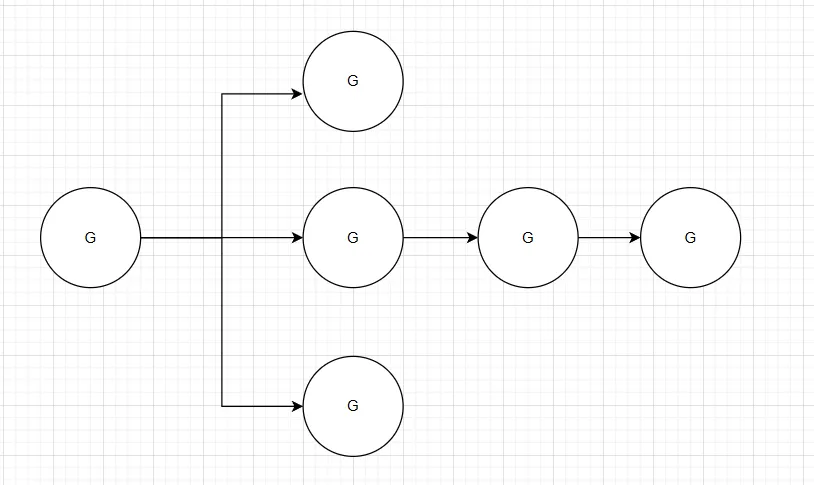
上图由于goroutine派生出子goroutine.子goroutine又继续派生出新的gorou
tine.因为goroutine个数不容易确定.使用context就很容易实现.
1.context实现原理:
context实际上只定义了接口.凡是实现了该接口的类都可以称为一种context.官方
实现了几个常用的context.分
别用于不同的场景.
接口定义:
源码位置src/context/context.go:Context:
type Context interface {

    Deadline() (deadline time.Time, ok bool)

    Done() <-chan struct{}

    Err() error

    Value(key any) any
}
2.基础的context定义了4个方法:
1)Deadline():
该方法返回一个deadline和标识是否已设置deadline的bool值.如果没有设置
deadline.如果没有设置deadline.则ok=false.此时deadline为一个初始值的
time.Time值.
2)Done():
该方法返回一个用于探测Context是否取消的channel.当Context取消时会自动将
该channel关闭.
注:对于不支持取消的context.该方法可能返回nil.例如.context.Background().
3)Err():
该方法描述context关闭的原因.关闭原因由context实现控制.不需要用户设置.比如
Deadline context.关闭原因
可能是因为deadline.也可能被提前主动关闭.那么关闭原因就会不同.
deadline关闭:context deadline exceeded.
主动关闭:context canceled.
当context关闭后.Err()返回context的关闭原因.当context还未关闭时.Err()返回nil.
4)Value:
有一种context.它不是用于控制呈树状分布的goroutine.而是用于在树状分布的
goroutine间传递信息.Value()就是用于此种类型的context.该方法根据key值查
询map中的value.
3.空context:
context包中定义了一个context.名为emptyCtx.用于context的根节点.空的con
text只是简单的实现了Context.本身不包含任何值.仅用于其他context的父节点.定
义如下:
type emptyCtx struct{}

func (emptyCtx) Deadline() (deadline time.Time, ok bool) {
    return
}

func (emptyCtx) Done() <-chan struct{} {
    return nil
}

func (emptyCtx) Err() error {
    return nil
}

func (emptyCtx) Value(key any) any {
    return nil
}
context包中定义了一个公用的emptyCtx全局变量.名为background.可以使用
Background()获取它.实现如下:
type backgroundCtx struct{ emptyCtx }


func Background() Context {
    return backgroundCtx{}
}
WithCancel():
func withCancel(parent Context) *cancelCtx {
    if parent == nil {
       panic("cannot create context from nil parent")
    }
    c := &cancelCtx{}
    c.propagateCancel(parent, c)
    return c
}
WithDeadlind():
func WithDeadline(parent Context, d time.Time) (Context, CancelFunc) {
    return WithDeadlineCause(parent, d, nil)
}
WithTimeout():
func WithTimeout(parent Context, timeout time.Duration) (Context, CancelFunc) {
    return WithDeadline(parent, time.Now().Add(timeout))
}
WithValue():
func WithValue(parent Context, key, val any) Context {
    if parent == nil {
       panic("cannot create context from nil parent")
    }
    if key == nil {
       panic("nil key")
    }
    if !reflectlite.TypeOf(key).Comparable() {
       panic("key is not comparable")
    }
    return &valueCtx{parent, key, val}
}
4.cancelCtx:
源码位置src/context/context.go:cancelCtx.
type cancelCtx struct {
    Context

    mu       sync.Mutex            // protects following fields
    done     atomic.Value          // of chan struct{}, created lazily, closed by first cancel call
    children map[canceler]struct{} // set to nil by the first cancel call
    err      error                 // set to non-nil by the first cancel call
    cause    error                 // set to non-nil by the first cancel call
}
children中记录了由此context派生的所有child.这个context被"cancel"时会把
其中所有的child都"cancel"掉.
cancelCtx与deadline和value无关.所以只实现了Done和Err()外漏接口即可.
Done方法实现:
按照context的定义.Done方法只需返回一个channel即可.源码实现如下.
func (c *cancelCtx) Done() <-chan struct{} {
    d := c.done.Load()
    if d != nil {
       return d.(chan struct{})
    }
    c.mu.Lock()
    defer c.mu.Unlock()
    d = c.done.Load()
    if d == nil {
       d = make(chan struct{})
       c.done.Store(d)
    }
    return d.(chan struct{})
}
因为done是原子类.会先进行获取.如果不为空.进行类型转换返回.如果为空.就进行
加锁.再次获取.还是为空的话进行创建赋值.然后返回.
Err()方法实现:
按照context定义Err()只需要返回一个error告知context被返回的原因.
func (c *cancelCtx) Err() error {
    c.mu.Lock()
    err := c.err
    c.mu.Unlock()
    return err
}
源码很简单.就是通过加锁.然后获取err然后进行返回.
cancel()方法:
func (c *cancelCtx) cancel(removeFromParent bool, err, cause error) {
    if err == nil {
       panic("context: internal error: missing cancel error")
    }
    if cause == nil {
       cause = err
    }
    c.mu.Lock()
    if c.err != nil {
       c.mu.Unlock()
       return // already canceled
    }
    c.err = err
    c.cause = cause
    d, _ := c.done.Load().(chan struct{})
    if d == nil {
       c.done.Store(closedchan)
    } else {
       close(d)
    }
    for child := range c.children {
       // NOTE: acquiring the child's lock while holding parent's lock.
       child.cancel(false, err, cause)
    }
    c.children = nil
    c.mu.Unlock()

    if removeFromParent {
       removeChild(c.Context, c)
    }
}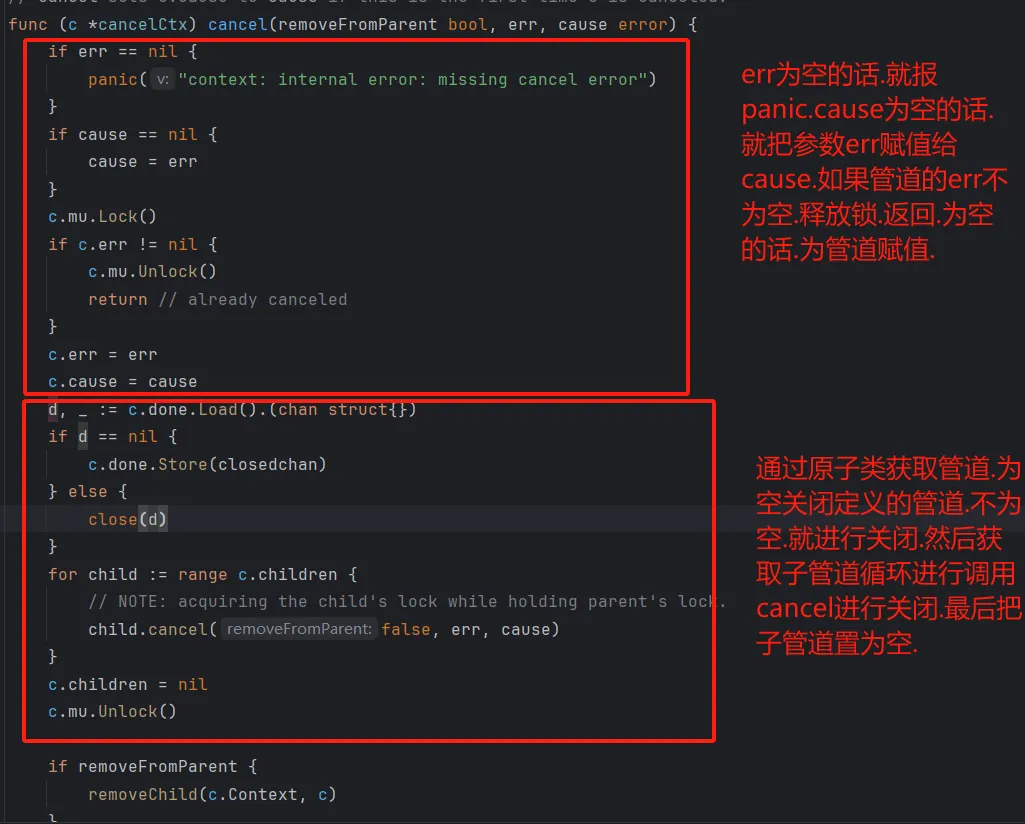
removeFromParent这块会在正常情况下.需要将自己从parent中移除.
WithCancel()实现:
WithCancel做了三件事.
1).初始化一个cancelCtx实例.
2).将cancelCtx实例添加到其父节点children中.
3).返回cancelCtx实例和cancel()方法.
源码如下:
// WithCancel returns a derived context that points to the parent context
// but has a new Done channel. The returned context's Done channel is closed
// when the returned cancel function is called or when the parent context's
// Done channel is closed, whichever happens first.
//
// Canceling this context releases resources associated with it, so code should
// call cancel as soon as the operations running in this [Context] complete.
func WithCancel(parent Context) (ctx Context, cancel CancelFunc) {
    c := withCancel(parent)
    return c, func() { c.cancel(true, Canceled, nil) }
}
withCancel(parent)方法源码:
func withCancel(parent Context) *cancelCtx {
    if parent == nil {
       panic("cannot create context from nil parent")
    }
    c := &cancelCtx{}
    //将自身添加到父节点.
    c.propagateCancel(parent, c)
    return c
}
propagateCancel方法源码:
// propagateCancel arranges for child to be canceled when parent is.
// It sets the parent context of cancelCtx.
func (c *cancelCtx) propagateCancel(parent Context, child canceler) {
    c.Context = parent

    done := parent.Done()
    if done == nil {
       return // parent is never canceled
    }

    select {
    case <-done:
       // parent is already canceled
       child.cancel(false, parent.Err(), Cause(parent))
       return
    default:
    }

    if p, ok := parentCancelCtx(parent); ok {
       // parent is a *cancelCtx, or derives from one.
       p.mu.Lock()
       if p.err != nil {
          // parent has already been canceled
          child.cancel(false, p.err, p.cause)
       } else {
          if p.children == nil {
             p.children = make(map[canceler]struct{})
          }
          p.children[child] = struct{}{}
       }
       p.mu.Unlock()
       return
    }

    if a, ok := parent.(afterFuncer); ok {
       // parent implements an AfterFunc method.
       c.mu.Lock()
       stop := a.AfterFunc(func() {
          child.cancel(false, parent.Err(), Cause(parent))
       })
       c.Context = stopCtx{
          Context: parent,
          stop:    stop,
       }
       c.mu.Unlock()
       return
    }

    goroutines.Add(1)
    go func() {
       select {
       case <-parent.Done():
          child.cancel(false, parent.Err(), Cause(parent))
       case <-child.Done():
       }
    }()
}
说明:
1).如果父节点也支持cancel.父节点肯定有children成员.把新context添加到children中即可.
2).如果父节点不支持cancel.就继续向上查询.直到找到一个支持cancel的节点.把新
context加到children.
3).所有父节点均不支持cancel.则启动一个协程等待父节点结束.然后把当前con
text结束.
cancelContext示例:
方法:
package Concurrent

import (
    "context"
    "fmt"
    "time"
)

func WriteRedis(ctx context.Context) {
    for {
       select {
       case <-ctx.Done():
          fmt.Println("WriteRedis Done.")
          return
       default:
          fmt.Println("WriteRedis...")
          time.Sleep(2 * time.Second)
       }
    }
}

func WriteDatabase(ctx context.Context) {
    for {
       select {
       case <-ctx.Done():
          fmt.Println("WriteDatabase Done.")
          return
       default:
          fmt.Println("WriteDatabase...")
          time.Sleep(2 * time.Second)
       }
    }
}

func HandleRequest(ctx context.Context) {
    go WriteDatabase(ctx)
    go WriteRedis(ctx)
    for false {
       select {
       case <-ctx.Done():
          fmt.Println("HandleRequest Done.")
          return
       default:
          fmt.Println("HandleRequest...")
          time.Sleep(2 * time.Second)
       }
    }
}
main方法:
func main() {
    ctx, cancelFunc := context.WithCancel(context.Background())
    go Concurrent.HandleRequest(ctx)

    time.Sleep(5 * time.Second)
    fmt.Println("stop all goroutine")

    cancelFunc()
    time.Sleep(5 * time.Second)
}
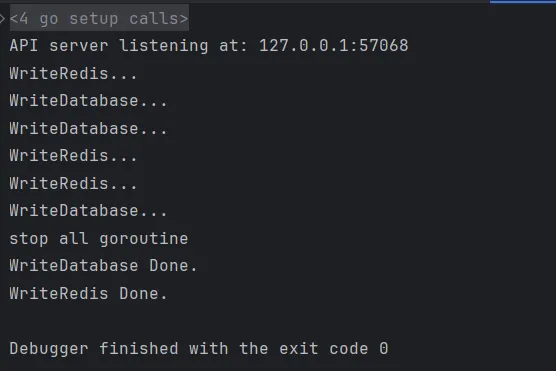
执行结果:
5.timerCtx:
源码位置src/context/context.go:timerCtx:
// A timerCtx carries a timer and a deadline. It embeds a cancelCtx to
// implement Done and Err. It implements cancel by stopping its timer then
// delegating to cancelCtx.cancel.
type timerCtx struct {
    cancelCtx
    timer *time.Timer // Under cancelCtx.mu.

    deadline time.Time
}
timerCtx在cancelCtx基础上增加了deadline.用于标示自动cancel的最终时间.而
timer就是一个触发自动cancel的定时器.由此衍生出WithDeadline()和
WithTimeout().两种类型实现原理一样.不过使用语境不一样.
deadline:指定最后期限.
Timeout:指定最长存活时间.
Deadline()实现:
func (c *timerCtx) Deadline() (deadline time.Time, ok bool) {
    return c.deadline, true
}
Deadline方法只是返回了timeCtx.deadline.
cancel()实现:
func (c *timerCtx) cancel(removeFromParent bool, err, cause error) {
    c.cancelCtx.cancel(false, err, cause)
    if removeFromParent {
       // Remove this timerCtx from its parent cancelCtx's children.
       removeChild(c.cancelCtx.Context, c)
    }
    c.mu.Lock()
    if c.timer != nil {
       c.timer.Stop()
       c.timer = nil
    }
    c.mu.Unlock()
}
cancel()方法基本继承cancelCtx.只是需要把timer关闭.
timerCtx被关闭后.timerCtx.cancelCtx.err将存储关闭原因.
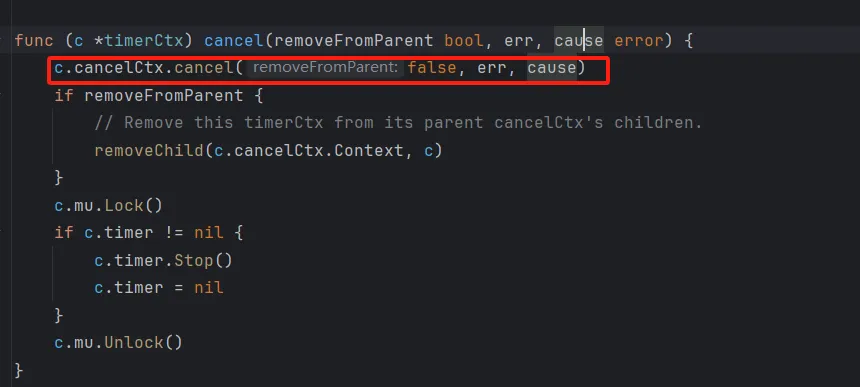
如果deadline到来之前手动关闭.关闭原因与cancelCtx显示一致.
如果deadline到来时自动关闭.关闭原因为context deadline exceeded.
WithDeadline()实现:
// WithDeadline returns a derived context that points to the parent context
// but has the deadline adjusted to be no later than d. If the parent's
// deadline is already earlier than d, WithDeadline(parent, d) is semantically
// equivalent to parent. The returned [Context.Done] channel is closed when
// the deadline expires, when the returned cancel function is called,
// or when the parent context's Done channel is closed, whichever happens first.
//
// Canceling this context releases resources associated with it, so code should
// call cancel as soon as the operations running in this [Context] complete.
func WithDeadline(parent Context, d time.Time) (Context, CancelFunc) {
    return WithDeadlineCause(parent, d, nil)
}
// WithDeadlineCause behaves like [WithDeadline] but also sets the cause of the
// returned Context when the deadline is exceeded. The returned [CancelFunc] does
// not set the cause.
func WithDeadlineCause(parent Context, d time.Time, cause error) (Context, CancelFunc) {
if parent == nil {
panic("cannot create context from nil parent")
}
if cur, ok := parent.Deadline(); ok && cur.Before(d) {
// The current deadline is already sooner than the new one.
return WithCancel(parent)
}
c := &timerCtx{
deadline: d,
}
c.cancelCtx.propagateCancel(parent, c)
dur := time.Until(d)
if dur <= 0 {
c.cancel(true, DeadlineExceeded, cause) // deadline has already passed
return c, func() { c.cancel(false, Canceled, nil) }
}
c.mu.Lock()
defer c.mu.Unlock()
if c.err == nil {
c.timer = time.AfterFunc(dur, func() {
c.cancel(true, DeadlineExceeded, cause)
})
}
return c, func() { c.cancel(true, Canceled, nil) }
}1).初始化一个timerCtx实例.
2).将timerCtx实例添加到父节点的children中.
3).启动定时器.定时器到期会自动cancel本context.
4).返回timerCtx实例和concel()方法.
WithTimeout()实现:
// WithTimeout returns WithDeadline(parent, time.Now().Add(timeout)).
//
// Canceling this context releases resources associated with it, so code should
// call cancel as soon as the operations running in this [Context] complete:
//
//  func slowOperationWithTimeout(ctx context.Context) (Result, error) {
//     ctx, cancel := context.WithTimeout(ctx, 100*time.Millisecond)
//     defer cancel()  // releases resources if slowOperation completes before timeout elapses
//     return slowOperation(ctx)
//  }
func WithTimeout(parent Context, timeout time.Duration) (Context, CancelFunc) {
    return WithDeadline(parent, time.Now().Add(timeout))
}
WithTimeout()实际上调用了WithDeadline.二者实现原理一致.具体可以参考上面.
timerCtx示例:
方法:
package Concurrent

import (
    "context"
    "fmt"
    "time"
)

func WriteRedis(ctx context.Context) {
    for {
       select {
       case <-ctx.Done():
          fmt.Println("WriteRedis Done.")
          return
       default:
          fmt.Println("WriteRedis...")
          time.Sleep(2 * time.Second)
       }
    }
}

func WriteDatabase(ctx context.Context) {
    for {
       select {
       case <-ctx.Done():
          fmt.Println("WriteDatabase Done.")
          return
       default:
          fmt.Println("WriteDatabase...")
          time.Sleep(2 * time.Second)
       }
    }
}

func HandleRequest(ctx context.Context) {
    go WriteDatabase(ctx)
    go WriteRedis(ctx)
    for false {
       select {
       case <-ctx.Done():
          fmt.Println("HandleRequest Done.")
          return
       default:
          fmt.Println("HandleRequest...")
          time.Sleep(2 * time.Second)
       }
    }
}
main方法:
func main() {
    ctx, _ := context.WithTimeout(context.Background(), 5*time.Second)
    go Concurrent.HandleRequest(ctx)
    time.Sleep(10 * time.Second)
}
执行结果:
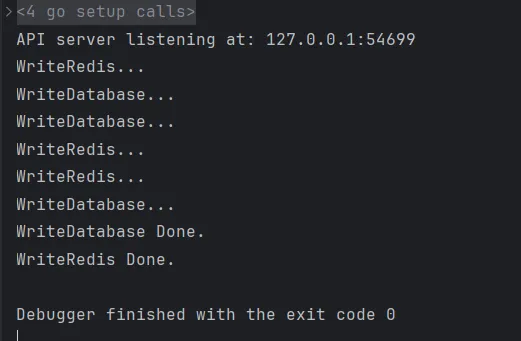
创建了一个5s超时的context.传给子协程.context超时后会引发子协程退出.
6.valueCtx:
源码位置:src/context/context.go:valueCtx
// A valueCtx carries a key-value pair. It implements Value for that key and
// delegates all other calls to the embedded Context.
type valueCtx struct {
    Context
    key, val any
}
valueCtx只是在Context基础上增加了一个key-value结构.用于在各级协程间传递
一些数据.由于valueCtx既不需要cancel.也不需要deadline.只需要实现Value()方
法即可.
Value()实现:
由于valueCtx数据结构定义的可见.valueCtx.key和valueCtx.val分别代表其key
和value值.实现如下.
func (c *valueCtx) Value(key any) any {
    if c.key == key {
       return c.val
    }
    return value(c.Context, key)
}
当前context查找不到key时.会向父节点查找.如果查询不到则会返回一个any.
查找源码如下:
func value(c Context, key any) any {
    for {
       switch ctx := c.(type) {
       case *valueCtx:
          if key == ctx.key {
             return ctx.val
          }
          c = ctx.Context
       case *cancelCtx:
          if key == &cancelCtxKey {
             return c
          }
          c = ctx.Context
       case withoutCancelCtx:
          if key == &cancelCtxKey {
             // This implements Cause(ctx) == nil
             // when ctx is created using WithoutCancel.
             return nil
          }
          c = ctx.c
       case *timerCtx:
          if key == &cancelCtxKey {
             return &ctx.cancelCtx
          }
          c = ctx.Context
       case backgroundCtx, todoCtx:
          return nil
       default:
          return c.Value(key)
       }
    }
}
WithValue()实现:
// WithValue returns a derived context that points to the parent Context.
// In the derived context, the value associated with key is val.
//
// Use context Values only for request-scoped data that transits processes and
// APIs, not for passing optional parameters to functions.
//
// The provided key must be comparable and should not be of type
// string or any other built-in type to avoid collisions between
// packages using context. Users of WithValue should define their own
// types for keys. To avoid allocating when assigning to an
// interface{}, context keys often have concrete type
// struct{}. Alternatively, exported context key variables' static
// type should be a pointer or interface.
func WithValue(parent Context, key, val any) Context {
    if parent == nil {
       panic("cannot create context from nil parent")
    }
    if key == nil {
       panic("nil key")
    }
    if !reflectlite.TypeOf(key).Comparable() {
       panic("key is not comparable")
    }
    return &valueCtx{parent, key, val}
}
最终就是通过一些校验.然后返回了一个valueCtx.
valueCtx示例:
方法:
package Concurrent

import (
    "context"
    "fmt"
    "time"
)

func HandlerValueCtx(ctx context.Context) {
    for {
       select {
       case <-ctx.Done():
          fmt.Println("HandlerValueCtx Done.")
          return
       default:
          fmt.Println("HandlerValueCtx...,key:", ctx.Value("key"))
          time.Sleep(2 * time.Second)
       }
    }
}
main方法:
func main() {
    valueCtx := context.WithValue(context.Background(), "key", "我是key")
    go Concurrent.HandlerValueCtx(valueCtx)
    time.Sleep(10 * time.Second)
}
执行结果:
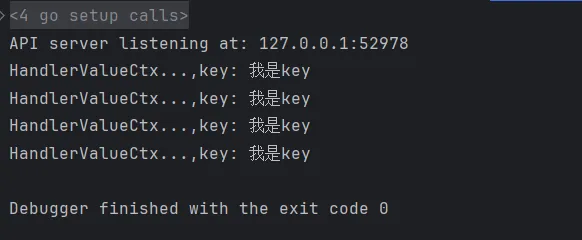
注:
本例子中子协程无法自动结束.因为valueCtx不支持cancel.因此需要在指定一个可
以执行cancel的父context.
小结:
1.Context仅仅是定义一个接口.根据实现不同.可以衍生出不同的context类型.
2.cancelCtx实现了Context接口.通过WithCancel()创建实例.
3.timerCtx实现了Context接口.通过WithDeadline和WithTimeout创建实例.
4.valueCtx实现了Context接口.通过WithValue创建实例.
5.三种context实例互为父节点.从而可以组合成不同的应用形式.
我以过客之名.曾经心舟赴彼岸远行.
如果大家喜欢我的分享的话.可以关注我的微信公众号
念何架构之路

有“AI”的1024 = 2048,欢迎大家加入2048 AI社区
更多推荐

 22
22 0
0- 0


 已为社区贡献5条内容

所有评论(0)