作为AI工程师,你必须掌握这些智能体系统工作流模式
https://x.com/Aurimas_Gr/status/2003116206782402769?s=20
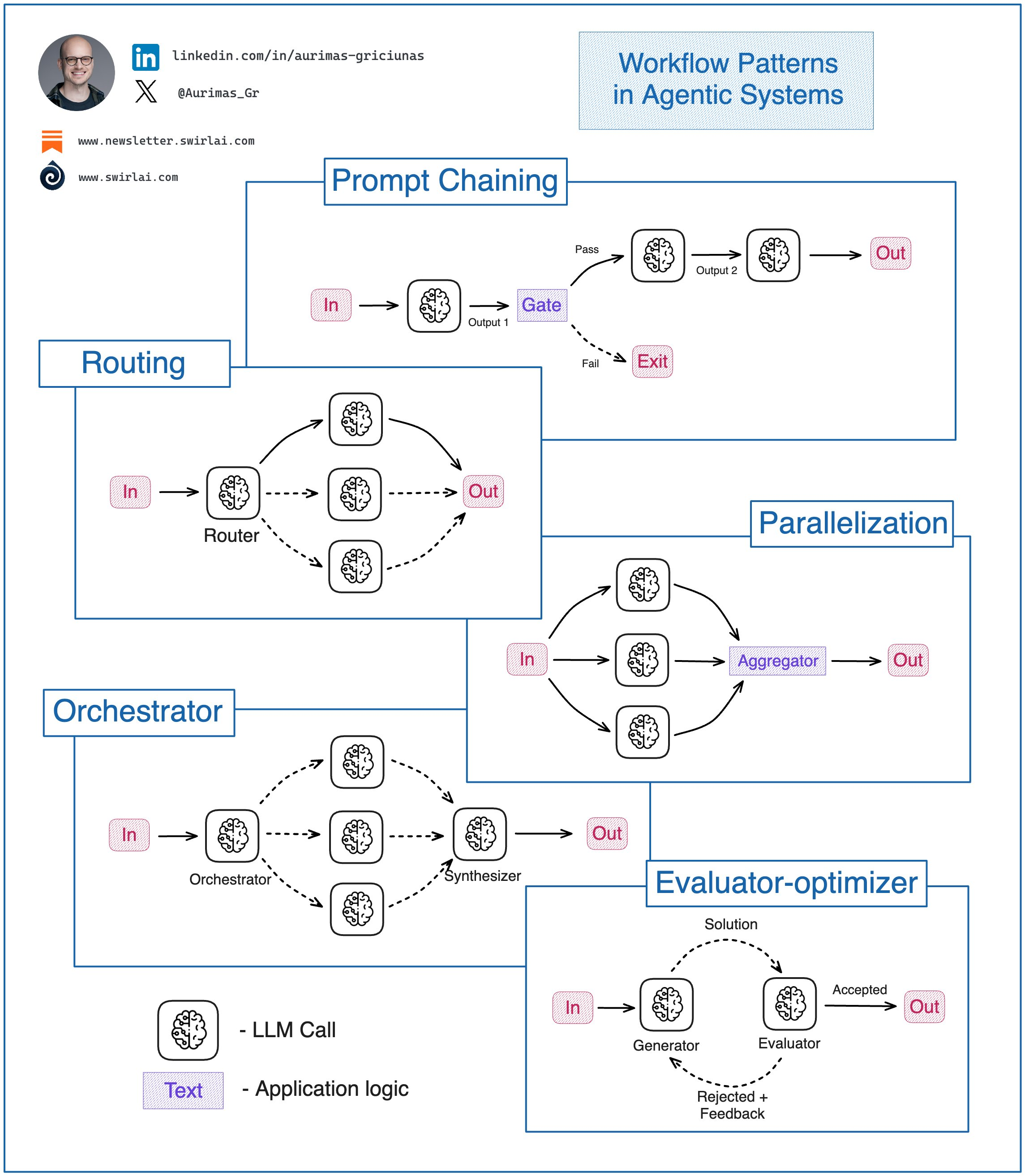
You must know these 𝗔𝗴𝗲𝗻𝘁𝗶𝗰 𝗦𝘆𝘀𝘁𝗲𝗺 𝗪𝗼𝗿𝗸𝗳𝗹𝗼𝘄 𝗣𝗮𝘁𝘁𝗲𝗿𝗻𝘀 as an 𝗔𝗜 𝗘𝗻𝗴𝗶𝗻𝗲𝗲𝗿. If you are building Agentic Systems in an Enterprise setting you will soon discover that the simplest workflow patterns work the best and bring the most business value. At the end of last year Anthropic did a great job summarising the top patterns for these workflows and they still hold strong. Let’s explore what they are and where each can be useful: 𝟭. 𝗣𝗿𝗼𝗺𝗽𝘁 𝗖𝗵𝗮𝗶𝗻𝗶𝗻𝗴: This pattern decomposes a complex task and tries to solve it in manageable pieces by chaining them together. Output of one LLM call becomes an input to another.
In most cases such decomposition results in higher accuracy with sacrifice for latency.
In heavy production use cases Prompt Chaining would be combined with following patterns, a pattern replace an LLM Call node in Prompt Chaining pattern. 𝟮. 𝗥𝗼𝘂𝘁𝗶𝗻𝗴: In this pattern, the input is classified into multiple potential paths and the appropriate is taken.
Useful when the workflow is complex and specific topology paths could be more efficiently solved by a specialized workflow.
Example: Agentic Chatbot - should I answer the question with RAG or should I perform some actions that a user has prompted for? 𝟯. 𝗣𝗮𝗿𝗮𝗹𝗹𝗲𝗹𝗶𝘇𝗮𝘁𝗶𝗼𝗻: Initial input is split into multiple queries to be passed to the LLM, then the answers are aggregated to produce the final answer.
Useful when speed is important and multiple inputs can be processed in parallel without needing to wait for other outputs. Also, when additional accuracy is required.
Example 1: Query rewrite in Agentic RAG to produce multiple different queries for majority voting. Improves accuracy.
Example 2: Multiple items are extracted from an invoice, all of them can be processed further in parallel for better speed. 𝟰. 𝗢𝗿𝗰𝗵𝗲𝘀𝘁𝗿𝗮𝘁𝗼𝗿: An orchestrator LLM dynamically breaks down tasks and delegates to other LLMs or sub-workflows.
Useful when the system is complex and there is no clear hardcoded topology path to achieve the final result.
Example: Choice of datasets to be used in Agentic RAG. 𝟱. 𝗘𝘃𝗮𝗹𝘂𝗮𝘁𝗼𝗿-𝗼𝗽𝘁𝗶𝗺𝗶𝘇𝗲𝗿: Generator LLM produces a result then Evaluator LLM evaluates it and provides feedback for further improvement if necessary.
Useful for tasks that require continuous refinement.
Example: Deep Research Agent workflow when refinement of a report paragraph via continuous web search is required. 𝗧𝗶𝗽𝘀:
Before going for full fledged Agents you should always try to solve a problem with simpler Workflows described in the article. Learn how to leverage these patterns hands-on in my End-to-end AI Engineering Bootcamp. Next cohort kicking off on January 12th: https://maven.com/swirl-ai/end-to-end-ai-engineering
作为AI工程师,你必须掌握这些智能体系统工作流模式。在企业环境中构建智能体系统时,你会发现最简单的流程模式往往效果最佳且能带来最大商业价值。去年底Anthropic出色地总结了这些工作流的顶级模式,至今依然适用。让我们探讨这些模式及其适用场景:
𝟭. 提示链:该模式将复杂任务分解,通过链式调用分步解决。一个LLM调用的输出成为另一个调用的输入。
多数情况下,这种分解能提高准确率,但会牺牲延迟性能。
在高强度生产场景中,提示链常与后续模式结合使用——用其他模式替代提示链中的LLM调用节点。
𝟮. 路由:对输入进行分类后选择最优路径。
适用于复杂工作流场景,特定路径由专用流程处理更高效。
例:智能聊天机器人判断——该用RAG回答问题还是执行用户指令的操作?
𝟯. 并行化:将初始输入拆分为多个并发查询,聚合结果生成最终答案。
适用于时效敏感场景,或需通过多输入并行处理提升准确率。
例1:智能RAG中的查询重写,生成多个差异查询进行多数表决,提高准确率。
例2:从发票中提取多个条目,并行处理以提升速度。
𝟰. 协调器:由协调型LLM动态分解任务并分配给其他LLM或子工作流。
适用于系统复杂且无固定拓扑路径达成目标的场景。
例:智能RAG中动态选择数据集。
𝟱. 评估优化器:生成型LLM产出结果后,评估型LLM进行校验并提供改进反馈。
适用于需要持续优化的任务。

有“AI”的1024 = 2048,欢迎大家加入2048 AI社区
更多推荐

 19
19 0
0- 0


 已为社区贡献69条内容

所有评论(0)