AI编程革命:自动化代码生成、低代码开发与算法优化实践
1. 概述:AI编程的范式转变
人工智能正在彻底改变软件开发的本质。传统的手工编码方式正逐渐被AI增强的开发流程所取代,这一转变涉及三个关键领域:自动化代码生成、低代码/无代码开发平台以及智能算法优化。这些技术不仅提高了开发效率,还降低了技术门槛,使更多人能够参与软件开发过程。
1.1 AI编程的核心技术栈
text
AI编程生态系统 = {
    自然语言处理(NLP):理解开发者意图
    代码理解与分析:解析现有代码库
    模式识别:识别常见编程模式
    机器学习模型:学习编码最佳实践
    强化学习:优化代码性能
    知识图谱:构建编程知识网络
}
2. 自动化代码生成
2.1 基于AI的代码生成原理
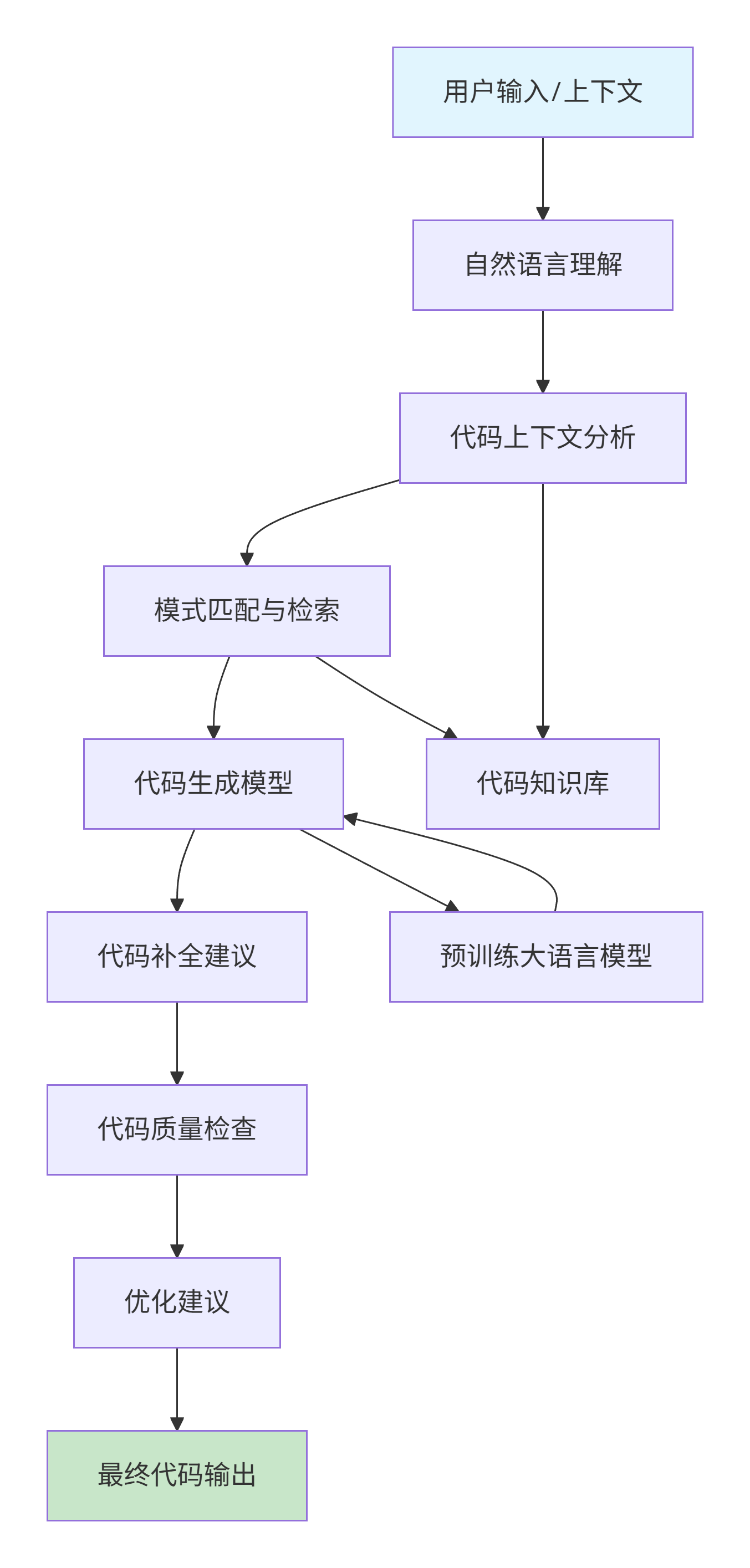
自动化代码生成的核心是理解开发者意图并将其转化为有效的代码。现代AI代码助手如GitHub Copilot、Amazon CodeWhisperer等,基于大规模代码库训练,能够提供上下文感知的代码建议。
2.1.1 技术架构
graph TB
    A[用户输入/上下文] --> B[自然语言理解]
    B --> C[代码上下文分析]
    C --> D[模式匹配与检索]
    D --> E[代码生成模型]
    E --> F[代码补全建议]
    F --> G[代码质量检查]
    G --> H[优化建议]
    H --> I[最终代码输出]

    C --> J[代码知识库]
    D --> J
    E --> K[预训练大语言模型]
    K --> E

    style A fill:#e1f5fe
    style I fill:#c8e6c9
2.2 实践案例:AI辅助Python开发
2.2.1 数据预处理自动化
python
"""
AI生成的自动化数据预处理管道
基于自然语言描述生成完整的数据处理代码
"""

# 用户Prompt: "创建一个数据预处理管道,处理缺失值、标准化数值特征、对分类变量进行独热编码,并处理日期时间特征"

import pandas as pd
import numpy as np
from sklearn.preprocessing import StandardScaler, OneHotEncoder
from sklearn.impute import SimpleImputer
from sklearn.compose import ColumnTransformer
from sklearn.pipeline import Pipeline
from datetime import datetime

class AutomatedDataPreprocessor:
    """AI生成的智能数据预处理器"""

    def __init__(self, numerical_strategy='mean', categorical_strategy='most_frequent'):
        """
        初始化预处理管道

        参数:
        numerical_strategy: 数值特征缺失值处理策略
        categorical_strategy: 分类特征缺失值处理策略
        """
        self.numerical_strategy = numerical_strategy
        self.categorical_strategy = categorical_strategy
        self.preprocessor = None
        self.feature_names = None

    def analyze_data(self, df):
        """自动分析数据特征"""
        analysis_report = {
            'total_samples': len(df),
            'total_features': len(df.columns),
            'numerical_features': df.select_dtypes(include=[np.number]).columns.tolist(),
            'categorical_features': df.select_dtypes(include=['object', 'category']).columns.tolist(),
            'datetime_features': df.select_dtypes(include=['datetime64']).columns.tolist(),
            'missing_values': df.isnull().sum().to_dict(),
            'missing_percentage': (df.isnull().sum() / len(df) * 100).to_dict()
        }
        return analysis_report

    def create_preprocessing_pipeline(self, df, target_column=None):
        """创建自动化预处理管道"""

        # 分离特征和目标变量
        if target_column and target_column in df.columns:
            X = df.drop(columns=[target_column])
            y = df[target_column]
        else:
            X = df
            y = None

        # 自动识别特征类型
        numerical_features = X.select_dtypes(include=[np.number]).columns.tolist()
        categorical_features = X.select_dtypes(include=['object', 'category']).columns.tolist()

        # 创建数值特征管道
        numerical_pipeline = Pipeline([
            ('imputer', SimpleImputer(strategy=self.numerical_strategy)),
            ('scaler', StandardScaler())
        ])

        # 创建分类特征管道
        categorical_pipeline = Pipeline([
            ('imputer', SimpleImputer(strategy=self.categorical_strategy, fill_value='missing')),
            ('onehot', OneHotEncoder(handle_unknown='ignore', sparse_output=False))
        ])

        # 组合预处理步骤
        self.preprocessor = ColumnTransformer([
            ('num', numerical_pipeline, numerical_features),
            ('cat', categorical_pipeline, categorical_features)
        ])

        # 训练预处理管道
        X_processed = self.preprocessor.fit_transform(X)

        # 获取特征名称
        num_features = numerical_features
        cat_features = self.preprocessor.named_transformers_['cat'].named_steps['onehot'].get_feature_names_out(categorical_features)
        self.feature_names = np.concatenate([num_features, cat_features])

        return X_processed, y, self.feature_names

    def transform_new_data(self, df):
        """转换新数据"""
        if self.preprocessor is None:
            raise ValueError("必须先调用create_preprocessing_pipeline方法训练管道")
        return self.preprocessor.transform(df)

    def generate_code_snippet(self):
        """生成可重用的代码片段"""
        code = '''
# 数据预处理管道代码
from sklearn.preprocessing import StandardScaler, OneHotEncoder
from sklearn.impute import SimpleImputer
from sklearn.compose import ColumnTransformer
from sklearn.pipeline import Pipeline

# 定义预处理管道
preprocessor = ColumnTransformer([
    ('numerical', Pipeline([
        ('imputer', SimpleImputer(strategy='mean')),
        ('scaler', StandardScaler())
    ]), {}),
    ('categorical', Pipeline([
        ('imputer', SimpleImputer(strategy='most_frequent')),
        ('onehot', OneHotEncoder(handle_unknown='ignore'))
    ]), {})
])

# 使用示例
# X_processed = preprocessor.fit_transform(X)
'''
        return code

# 使用示例
if __name__ == "__main__":
    # 创建示例数据
    data = {
        'age': [25, 30, np.nan, 35, 40],
        'salary': [50000, 60000, 55000, np.nan, 70000],
        'department': ['HR', 'IT', 'IT', 'Finance', 'HR'],
        'join_date': pd.date_range('2023-01-01', periods=5),
        'performance_score': [85, 90, 88, 92, 95]
    }

    df = pd.DataFrame(data)

    # 创建并运行预处理器
    preprocessor = AutomatedDataPreprocessor()
    analysis = preprocessor.analyze_data(df)
    print("数据分析报告:")
    for key, value in analysis.items():
        print(f"{key}: {value}")

    # 创建预处理管道
    X_processed, y, feature_names = preprocessor.create_preprocessing_pipeline(
        df, target_column='performance_score'
    )

    print(f"\n处理后的特征形状: {X_processed.shape}")
    print(f"特征名称: {feature_names}")
2.2.2 Prompt工程示例
text
# 代码生成Prompt模板

模板1:功能实现
"""
请实现一个{语言}函数,功能是{具体功能描述}。
要求:
1. 包含完整的错误处理
2. 添加详细的文档字符串
3. 包含单元测试示例
4. 时间复杂度不超过O({复杂度})
输入示例:{示例输入}
输出示例:{示例输出}
"""

模板2:代码优化
"""
请优化以下{语言}代码:
{原始代码}

优化目标:
1. 提高性能,特别关注{特定方面}
2. 改进代码可读性
3. 添加适当的注释
4. 确保向后兼容性
请解释每个优化步骤的原因。
"""

模板3:代码转换
"""
将以下{源语言}代码转换为{目标语言}:
{源代码}

转换要求:
1. 保持功能完全一致
2. 使用目标语言的最佳实践
3. 处理语言特定的特性差异
4. 添加必要的适配层
"""

# 实际Prompt示例
"""
请实现一个Python函数,功能是从多个数据源(CSV、JSON、数据库)异步加载数据,
并进行实时聚合分析。

要求:
1. 使用asyncio进行异步处理
2. 支持增量数据加载
3. 实现错误重试机制(最多3次重试)
4. 添加内存使用监控
5. 输出聚合统计报告

输入示例:{
    "sources": [
        {"type": "csv", "path": "data/sales.csv"},
        {"type": "json", "path": "data/users.json"},
        {"type": "database", "connection": "postgresql://..."}
    ],
    "aggregations": ["sum", "average", "count"],
    "group_by": ["category", "region"]
}

输出示例:{
    "summary": {
        "total_records": 10000,
        "processing_time": "2.5s",
        "memory_usage": "256MB"
    },
    "results": [...]
}
"""
2.3 企业级代码生成架构
python
"""
企业级AI代码生成系统架构
"""

from typing import List, Dict, Any, Optional
import ast
import inspect
import hashlib
import json
from dataclasses import dataclass
from enum import Enum
import asyncio

class CodeGenerationLevel(Enum):
    """代码生成级别"""
    SYNTAX = "syntax"          # 语法补全
    FUNCTION = "function"      # 函数级生成
    MODULE = "module"          # 模块级生成
    ARCHITECTURE = "architecture"  # 架构级生成

@dataclass
class CodeContext:
    """代码上下文信息"""
    file_path: str
    imports: List[str]
    functions: List[str]
    classes: List[str]
    variables: Dict[str, Any]
    cursor_position: tuple  # (line, column)
    project_type: str  # web, mobile, data_science, etc.

class EnterpriseCodeGenerator:
    """企业级代码生成器"""

    def __init__(self, model_provider: str = "openai"):
        self.model_provider = model_provider
        self.code_cache = {}  # 缓存生成的代码
        self.quality_rules = self._load_quality_rules()

    def _load_quality_rules(self) -> Dict:
        """加载代码质量规则"""
        return {
            "security": [
                "no_hardcoded_secrets",
                "sql_injection_protection",
                "input_validation"
            ],
            "performance": [
                "time_complexity_check",
                "memory_usage_optimization",
                "database_query_optimization"
            ],
            "maintainability": [
                "function_length_limit",
                "naming_conventions",
                "comment_coverage"
            ]
        }

    async def generate_code(self,
                           prompt: str,
                           context: CodeContext,
                           level: CodeGenerationLevel = CodeGenerationLevel.FUNCTION) -> Dict:
        """生成代码"""

        # 检查缓存
        cache_key = self._create_cache_key(prompt, context)
        if cache_key in self.code_cache:
            return self.code_cache[cache_key]

        # 构建增强的上下文
        enhanced_prompt = self._enhance_prompt(prompt, context, level)

        # 调用AI模型生成代码
        generated_code = await self._call_ai_model(enhanced_prompt)

        # 分析和验证代码
        analysis = self._analyze_code(generated_code)

        # 质量检查
        quality_report = self._check_quality(generated_code, context.project_type)

        # 优化建议
        optimizations = self._suggest_optimizations(generated_code, analysis)

        result = {
            "code": generated_code,
            "analysis": analysis,
            "quality_report": quality_report,
            "optimizations": optimizations,
            "cache_key": cache_key
        }

        # 缓存结果
        self.code_cache[cache_key] = result

        return result

    def _create_cache_key(self, prompt: str, context: CodeContext) -> str:
        """创建缓存键"""
        content = f"{prompt}{context.file_path}{context.project_type}"
        return hashlib.md5(content.encode()).hexdigest()

    def _enhance_prompt(self, prompt: str, context: CodeContext, level: CodeGenerationLevel) -> str:
        """增强Prompt"""

        base_template = """
        # 代码生成请求

        原始请求:{prompt}

        上下文信息:
        文件路径:{file_path}
        项目类型:{project_type}
        现有导入:{imports}
        现有函数:{functions}
        现有类:{classes}

        生成级别:{level}

        要求:
        1. 遵循{project_type}项目的最佳实践
        2. 与现有代码风格一致
        3. 包含适当的错误处理
        4. 添加必要的注释
        5. 考虑性能优化

        请生成完整、可运行的代码。
        """

        return base_template.format(
            prompt=prompt,
            file_path=context.file_path,
            project_type=context.project_type,
            imports=", ".join(context.imports),
            functions=", ".join(context.functions),
            classes=", ".join(context.classes),
            level=level.value
        )

    async def _call_ai_model(self, prompt: str) -> str:
        """调用AI模型生成代码"""
        # 这里模拟AI模型调用
        # 实际实现会调用OpenAI API、GitHub Copilot等

        # 模拟异步延迟
        await asyncio.sleep(0.1)

        # 示例生成代码
        if "data pipeline" in prompt.lower():
            return self._generate_data_pipeline_code()
        elif "api endpoint" in prompt.lower():
            return self._generate_api_code()
        else:
            return self._generate_general_code()

    def _generate_data_pipeline_code(self) -> str:
        """生成数据管道代码示例"""
        return '''
import pandas as pd
import numpy as np
from datetime import datetime
from typing import Optional, List, Dict
import asyncio
from dataclasses import dataclass

@dataclass
class DataQualityMetrics:
    """数据质量指标"""
    total_rows: int
    valid_rows: int
    missing_values: Dict[str, int]
    data_types: Dict[str, str]

class DataPipeline:
    """智能数据管道"""

    def __init__(self, config: Dict):
        self.config = config
        self.quality_metrics = None
        self.processed_data = None

    async def extract(self) -> pd.DataFrame:
        """异步数据提取"""
        sources = self.config.get('sources', [])

        tasks = []
        for source in sources:
            if source['type'] == 'csv':
                task = self._extract_csv(source['path'])
            elif source['type'] == 'api':
                task = self._extract_api(source['url'], source.get('params', {}))
            tasks.append(task)

        data_frames = await asyncio.gather(*tasks, return_exceptions=True)
        return pd.concat([df for df in data_frames if isinstance(df, pd.DataFrame)], ignore_index=True)

    def transform(self, df: pd.DataFrame) -> pd.DataFrame:
        """数据转换"""
        # 清理缺失值
        df_clean = self._handle_missing_values(df)

        # 标准化数据类型
        df_clean = self._standardize_data_types(df_clean)

        # 计算衍生特征
        df_clean = self._calculate_features(df_clean)

        # 验证数据质量
        self.quality_metrics = self._calculate_quality_metrics(df_clean)

        return df_clean

    def load(self, df: pd.DataFrame, destination: Dict):
        """数据加载"""
        if destination['type'] == 'database':
            self._load_to_database(df, destination['connection'])
        elif destination['type'] == 'data_lake':
            self._load_to_data_lake(df, destination['path'])

        self.processed_data = df
        return True

    async def run(self) -> Dict:
        """运行完整管道"""
        try:
            # 提取
            raw_data = await self.extract()

            # 转换
            transformed_data = self.transform(raw_data)

            # 加载
            success = self.load(transformed_data, self.config['destination'])

            return {
                'status': 'success' if success else 'failed',
                'records_processed': len(transformed_data),
                'quality_metrics': self.quality_metrics,
                'timestamp': datetime.now().isoformat()
            }
        except Exception as e:
            return {
                'status': 'error',
                'error': str(e),
                'timestamp': datetime.now().isoformat()
            }

    # 私有方法实现...
'''

    def _analyze_code(self, code: str) -> Dict:
        """分析生成的代码"""
        try:
            tree = ast.parse(code)

            analysis = {
                "ast_valid": True,
                "functions": [],
                "classes": [],
                "imports": [],
                "complexity": {
                    "lines": len(code.split('\n')),
                    "functions": 0,
                    "classes": 0
                }
            }

            for node in ast.walk(tree):
                if isinstance(node, ast.FunctionDef):
                    analysis["functions"].append(node.name)
                    analysis["complexity"]["functions"] += 1
                elif isinstance(node, ast.ClassDef):
                    analysis["classes"].append(node.name)
                    analysis["complexity"]["classes"] += 1
                elif isinstance(node, ast.Import) or isinstance(node, ast.ImportFrom):
                    analysis["imports"].append(ast.unparse(node))

            return analysis
        except SyntaxError as e:
            return {
                "ast_valid": False,
                "error": str(e),
                "line": e.lineno,
                "offset": e.offset
            }

    def _check_quality(self, code: str, project_type: str) -> Dict:
        """检查代码质量"""
        quality_report = {
            "security": [],
            "performance": [],
            "maintainability": [],
            "score": 0
        }

        # 安全检查
        security_issues = self._check_security(code)
        quality_report["security"] = security_issues

        # 性能检查
        performance_issues = self._check_performance(code)
        quality_report["performance"] = performance_issues

        # 可维护性检查
        maintainability_issues = self._check_maintainability(code)
        quality_report["maintainability"] = maintainability_issues

        # 计算质量分数
        total_issues = len(security_issues) + len(performance_issues) + len(maintainability_issues)
        quality_report["score"] = max(0, 100 - total_issues * 10)

        return quality_report

    def _suggest_optimizations(self, code: str, analysis: Dict) -> List[str]:
        """提供优化建议"""
        suggestions = []

        # 基于分析结果的优化建议
        if analysis.get("complexity", {}).get("functions", 0) > 10:
            suggestions.append("考虑将大型函数拆分为更小的、单一职责的函数")

        if len(analysis.get("imports", [])) > 15:
            suggestions.append("考虑优化导入语句,移除未使用的依赖")

        # 代码模式优化
        if "for loop" in code and "list comprehension" not in code:
            suggestions.append("考虑使用列表推导式替代for循环以提高性能")

        return suggestions
3. 低代码/无代码开发平台
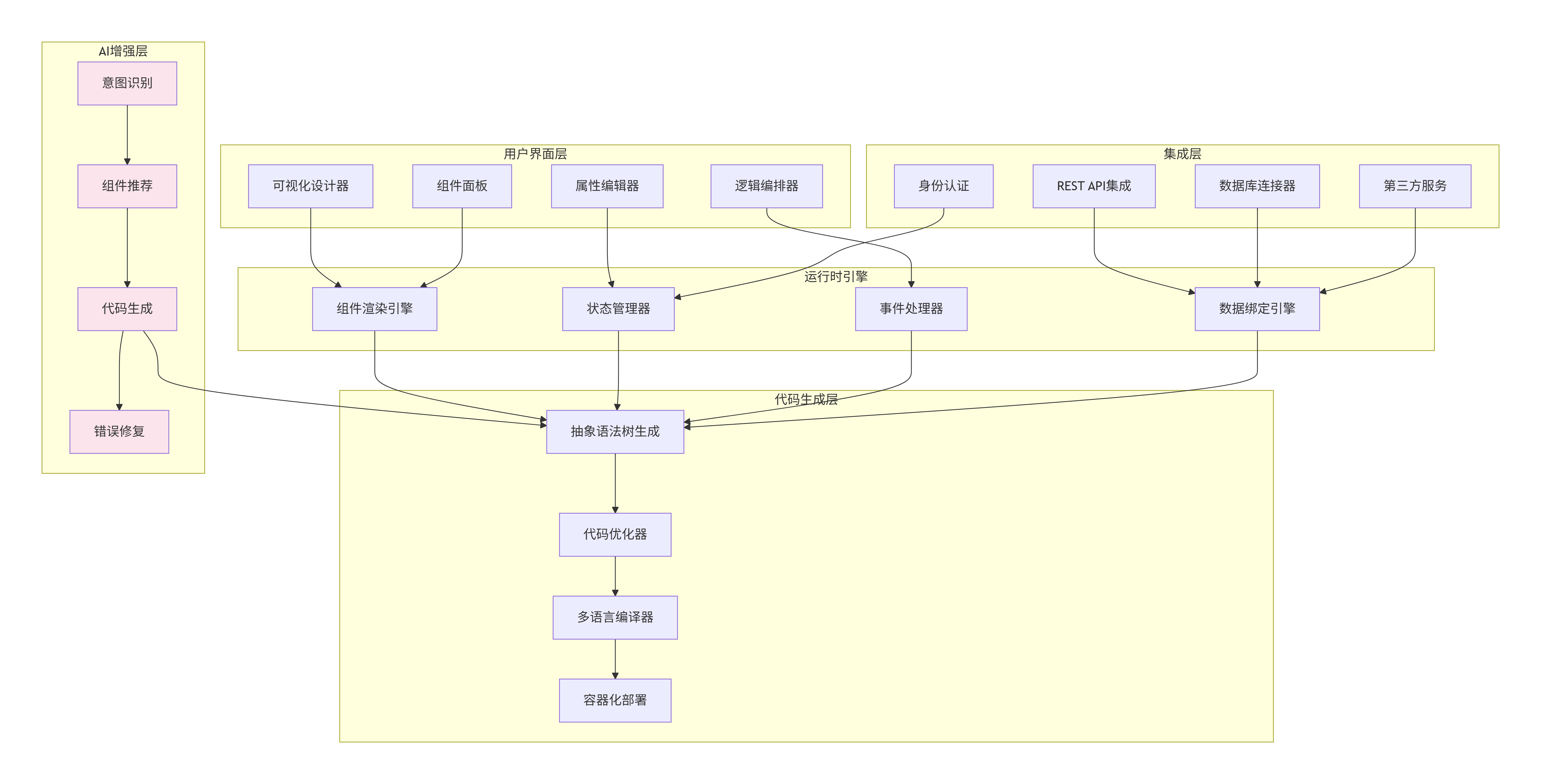
3.1 低代码平台架构
graph TB
    subgraph "用户界面层"
        A[可视化设计器]
        B[组件面板]
        C[属性编辑器]
        D[逻辑编排器]
    end

    subgraph "运行时引擎"
        E[组件渲染引擎]
        F[状态管理器]
        G[事件处理器]
        H[数据绑定引擎]
    end

    subgraph "代码生成层"
        I[抽象语法树生成]
        J[代码优化器]
        K[多语言编译器]
        L[容器化部署]
    end

    subgraph "AI增强层"
        M[意图识别]
        N[组件推荐]
        O[代码生成]
        P[错误修复]
    end

    subgraph "集成层"
        Q[REST API集成]
        R[数据库连接器]
        S[第三方服务]
        T[身份认证]
    end

    A --> E
    B --> E
    C --> F
    D --> G

    E --> I
    F --> I
    G --> I
    H --> I

    I --> J --> K --> L

    M --> N --> O --> P
    O --> I

    Q --> H
    R --> H
    S --> H
    T --> F

    style M fill:#fce4ec
    style N fill:#fce4ec
    style O fill:#fce4ec
    style P fill:#fce4ec
3.2 低代码平台实践:企业应用生成器
python
"""
企业级低代码应用生成器
支持可视化构建复杂的企业应用
"""
import json
from typing import Dict, List, Any, Optional
from enum import Enum
from dataclasses import dataclass, asdict
import yaml
class ComponentType(Enum):
"""组件类型枚举"""
FORM = "form"
TABLE = "table"
CHART = "chart"
BUTTON = "button"
INPUT = "input"
SELECT = "select"
NAVIGATION = "navigation"
LAYOUT = "layout"
@dataclass
class ComponentConfig:
"""组件配置"""
id: str
type: ComponentType
properties: Dict[str, Any]
events: List[Dict[str, str]]
data_bindings: Dict[str, str]
children: List['ComponentConfig']
@classmethod
def from_dict(cls, data: Dict) -> 'ComponentConfig':
"""从字典创建配置"""
children = [cls.from_dict(child) for child in data.get('children', [])]
return cls(
id=data['id'],
type=ComponentType(data['type']),
properties=data.get('properties', {}),
events=data.get('events', []),
data_bindings=data.get('data_bindings', {}),
children=children
)
class LowCodeAppGenerator:
"""低代码应用生成器"""
def __init__(self):
self.components = {}
self.templates = self._load_templates()
self.code_generators = {
'react': ReactCodeGenerator(),
'vue': VueCodeGenerator(),
'angular': AngularCodeGenerator(),
'flutter': FlutterCodeGenerator()
}
def _load_templates(self) -> Dict:
"""加载应用模板"""
return {
'crud_app': {
'name': 'CRUD应用模板',
'components': [
{
'type': 'table',
'config': {
'data_source': '/api/entities',
'columns': [],
'actions': ['create', 'edit', 'delete']
}
},
{
'type': 'form',
'config': {
'fields': [],
'submit_url': '/api/entities'
}
}
]
},
'dashboard': {
'name': '数据仪表板',
'components': [
{
'type': 'chart',
'config': {'type': 'line', 'data_source': '/api/metrics'}
},
{
'type': 'chart',
'config': {'type': 'bar', 'data_source': '/api/stats'}
}
]
}
}
def create_from_template(self, template_name: str, config: Dict) -> 'Application':
"""从模板创建应用"""
if template_name not in self.templates:
raise ValueError(f"模板不存在: {template_name}")
template = self.templates[template_name]
app_config = self._merge_template_with_config(template, config)
return Application(app_config)
def generate_ui_component(self, component_config: Dict) -> str:
"""生成UI组件代码"""
config = ComponentConfig.from_dict(component_config)
# 根据组件类型生成代码
if config.type == ComponentType.FORM:
return self._generate_form_component(config)
elif config.type == ComponentType.TABLE:
return self._generate_table_component(config)
elif config.type == ComponentType.CHART:
return self._generate_chart_component(config)
else:
return self._generate_generic_component(config)
def _generate_form_component(self, config: ComponentConfig) -> str:
"""生成表单组件"""
fields_code = []
for field_id, field_props in config.properties.get('fields', {}).items():
field_code = self._generate_form_field(field_id, field_props)
fields_code.append(field_code)
form_code = f'''
import React, {{ useState }} from 'react';
import {{ Form, Input, Button, message }} from 'antd';
const {config.id}Form = () => {{
const [form] = Form.useForm();
const [loading, setLoading] = useState(false);
const handleSubmit = async (values) => {{
setLoading(true);
try {{
const response = await fetch('{config.properties.get("submit_url", "/api/submit")}', {{
method: 'POST',
headers: {{
'Content-Type': 'application/json',
}},
body: JSON.stringify(values),
}});
if (response.ok) {{
message.success('提交成功');
form.resetFields();
}} else {{
message.error('提交失败');
}}
}} catch (error) {{
message.error('网络错误');
}} finally {{
setLoading(false);
}}
}};
return (
<Form
form={{form}}
layout="vertical"
onFinish={{handleSubmit}}
>
{chr(10).join(fields_code)}
<Form.Item>
<Button type="primary" htmlType="submit" loading={{loading}}>
提交
</Button>
</Form.Item>
</Form>
);
}};
export default {config.id}Form;
'''
return form_code
def _generate_form_field(self, field_id: str, props: Dict) -> str:
"""生成表单字段"""
field_type = props.get('type', 'text')
label = props.get('label', field_id)
required = props.get('required', False)
if field_type == 'text':
return f'''
<Form.Item
label="{label}"
name="{field_id}"
rules={[{{
required: {str(required).lower()},
message: '请输入{label}'
}}]}
>
<Input placeholder="请输入{label}" />
</Form.Item>
'''
elif field_type == 'select':
options = props.get('options', [])
options_code = chr(10).join(
[f' <Option value="{opt["value"]}">{opt["label"]}</Option>'
for opt in options]
)
return f'''
<Form.Item
label="{label}"
name="{field_id}"
rules={[{{
required: {str(required).lower()},
message: '请选择{label}'
}}]}
>
<Select placeholder="请选择{label}">
{options_code}
</Select>
</Form.Item>
'''
def _generate_table_component(self, config: ComponentConfig) -> str:
"""生成表格组件"""
columns = config.properties.get('columns', [])
data_source = config.properties.get('data_source', '/api/data')
columns_code = []
for col in columns:
column_code = f'''
{{
title: '{col.get("title", col["key"])}',
dataIndex: '{col["key"]}',
key: '{col["key"]}',
}},'''
columns_code.append(column_code)
table_code = f'''
import React, {{ useState, useEffect }} from 'react';
import {{ Table, Button, Space, message }} from 'antd';
import {{ PlusOutlined, EditOutlined, DeleteOutlined }} from '@ant-design/icons';
const {config.id}Table = () => {{
const [data, setData] = useState([]);
const [loading, setLoading] = useState(false);
const [pagination, setPagination] = useState({{
current: 1,
pageSize: 10,
total: 0,
}});
const fetchData = async (params = {}) => {{
setLoading(true);
try {{
const queryParams = new URLSearchParams({{
page: params.current || pagination.current,
pageSize: params.pageSize || pagination.pageSize,
...params,
}}).toString();
const response = await fetch(`${{{data_source}}}?${{queryParams}}`);
const result = await response.json();
setData(result.data);
setPagination({{
...pagination,
total: result.total,
current: result.page,
pageSize: result.pageSize,
}});
}} catch (error) {{
message.error('加载数据失败');
}} finally {{
setLoading(false);
}}
}};
useEffect(() => {{
fetchData();
}}, []);
const handleTableChange = (newPagination, filters, sorter) => {{
fetchData({{
current: newPagination.current,
pageSize: newPagination.pageSize,
...filters,
sortField: sorter.field,
sortOrder: sorter.order,
}});
}};
const columns = [
{chr(10).join(columns_code)}
{{
title: '操作',
key: 'action',
render: (_, record) => (
<Space size="middle">
<Button
type="link"
icon={<EditOutlined />}
onClick={() => handleEdit(record)}
>
编辑
</Button>
<Button
type="link"
danger
icon={<DeleteOutlined />}
onClick={() => handleDelete(record)}
>
删除
</Button>
</Space>
),
}},
];
const handleEdit = (record) => {{
// 编辑逻辑
console.log('编辑:', record);
}};
const handleDelete = (record) => {{
// 删除逻辑
console.log('删除:', record);
}};
const handleAdd = () => {{
// 添加逻辑
console.log('添加新记录');
}};
return (
<div>
<div style={{ marginBottom: 16 }}>
<Button
type="primary"
icon={<PlusOutlined />}
onClick={{handleAdd}}
>
添加
</Button>
</div>
<Table
columns={{columns}}
dataSource={{data}}
rowKey="id"
pagination={{pagination}}
loading={{loading}}
onChange={{handleTableChange}}
/>
</div>
);
}};
export default {config.id}Table;
'''
return table_code
def generate_full_application(self, app_config: Dict, target_framework: str = 'react') -> Dict:
"""生成完整应用"""
generator = self.code_generators.get(target_framework)
if not generator:
raise ValueError(f"不支持的目标框架: {target_framework}")
# 生成应用结构
app_structure = {
'package_json': generator.generate_package_json(app_config),
'app_js': generator.generate_app_js(app_config),
'components': {},
'services': generator.generate_services(app_config),
'styles': generator.generate_styles(app_config),
'config': generator.generate_config(app_config)
}
# 生成组件
for component in app_config.get('components', []):
component_code = self.generate_ui_component(component)
app_structure['components'][component['id']] = component_code
# 生成路由配置
app_structure['routes'] = generator.generate_routes(app_config)
# 生成Docker配置
app_structure['docker'] = generator.generate_docker_config(app_config)
return app_structure
class ReactCodeGenerator:
"""React代码生成器"""
def generate_package_json(self, config: Dict) -> str:
"""生成package.json"""
dependencies = {
'react': '^18.2.0',
'react-dom': '^18.2.0',
'antd': '^5.8.0',
'@ant-design/icons': '^5.2.6',
'axios': '^1.4.0',
'react-router-dom': '^6.14.0',
'recharts': '^2.8.0'
}
package_json = {
'name': config.get('name', 'low-code-app'),
'version': '1.0.0',
'private': True,
'dependencies': dependencies,
'scripts': {
'start': 'react-scripts start',
'build': 'react-scripts build',
'test': 'react-scripts test',
'eject': 'react-scripts eject'
}
}
return json.dumps(package_json, indent=2)
def generate_app_js(self, config: Dict) -> str:
"""生成主应用文件"""
app_name = config.get('name', 'App')
return f'''
import React from 'react';
import {{ BrowserRouter as Router, Routes, Route }} from 'react-router-dom';
import {{ ConfigProvider }} from 'antd';
import zhCN from 'antd/locale/zh_CN';
import './App.css';
// 导入页面组件
{chr(10).join([f"import {page['name']} from './pages/{page['path']}';"
for page in config.get('pages', [])])}
function {app_name}() {{
return (
<ConfigProvider locale={{zhCN}}>
<Router>
<div className="App">
<Routes>
{chr(10).join([f" <Route path=\"{page['route']}\" element={<{page['name']} />} />"
for page in config.get('pages', [])])}
<Route path="*" element={<h1>404 - 页面未找到</h1>} />
</Routes>
</div>
</Router>
</ConfigProvider>
);
}}
export default {app_name};
'''
def generate_services(self, config: Dict) -> Dict:
"""生成服务层代码"""
services = {}
api_endpoints = config.get('api_endpoints', [])
for endpoint in api_endpoints:
service_name = endpoint['name']
service_code = f'''
import axios from 'axios';
const API_BASE = '{endpoint.get('base_url', 'http://localhost:3000/api')}';
export const {service_name}Service = {{
async getAll(params = {}) {{
const response = await axios.get(`${{API_BASE}}/{endpoint['path']}`, {{ params }});
return response.data;
}},
async getById(id) {{
const response = await axios.get(`${{API_BASE}}/{endpoint['path']}/${{id}}`);
return response.data;
}},
async create(data) {{
const response = await axios.post(`${{API_BASE}}/{endpoint['path']}`, data);
return response.data;
}},
async update(id, data) {{
const response = await axios.put(`${{API_BASE}}/{endpoint['path']}/${{id}}`, data);
return response.data;
}},
async delete(id) {{
const response = await axios.delete(`${{API_BASE}}/{endpoint['path']}/${{id}}`);
return response.data;
}},
}};
'''
services[f'{service_name}Service.js'] = service_code
return services
class Application:
"""应用实例"""
def __init__(self, config: Dict):
self.config = config
self.components = {}
self.services = {}
self.pages = []
def add_component(self, component: ComponentConfig):
"""添加组件"""
self.components[component.id] = component
def generate_code(self, framework: str = 'react') -> Dict:
"""生成应用代码"""
generator = LowCodeAppGenerator()
return generator.generate_full_application(self.config, framework)
def export(self, format: str = 'json') -> str:
"""导出应用配置"""
if format == 'json':
return json.dumps(asdict(self), indent=2, ensure_ascii=False)
elif format == 'yaml':
return yaml.dump(asdict(self), allow_unicode=True)
else:
raise ValueError(f"不支持的格式: {format}")
# 使用示例
if __name__ == "__main__":
# 创建低代码应用
generator = LowCodeAppGenerator()
# 定义应用配置
app_config = {
'name': '员工管理系统',
'description': '用于管理员工信息的低代码应用',
'pages': [
{
'name': 'EmployeeList',
'route': '/employees',
'path': 'EmployeeList',
'components': [
{
'id': 'employeeTable',
'type': 'table',
'properties': {
'data_source': '/api/employees',
'columns': [
{'key': 'id', 'title': 'ID'},
{'key': 'name', 'title': '姓名'},
{'key': 'department', 'title': '部门'},
{'key': 'position', 'title': '职位'},
{'key': 'salary', 'title': '薪资'}
]
}
}
]
},
{
'name': 'EmployeeForm',
'route': '/employees/new',
'path': 'EmployeeForm',
'components': [
{
'id': 'employeeForm',
'type': 'form',
'properties': {
'submit_url': '/api/employees',
'fields': {
'name': {
'type': 'text',
'label': '姓名',
'required': True
},
'department': {
'type': 'select',
'label': '部门',
'options': [
{'value': 'it', 'label': '技术部'},
{'value': 'hr', 'label': '人力资源部'},
{'value': 'finance', 'label': '财务部'}
]
}
}
}
}
]
}
],
'api_endpoints': [
{
'name': 'employee',
'path': 'employees',
'base_url': 'http://localhost:3000/api'
}
]
}
# 生成应用代码
app_code = generator.generate_full_application(app_config, 'react')
# 输出生成的代码结构
print("生成的应用结构:")
for file_name, content in app_code.items():
if isinstance(content, str):
print(f"\n{file_name} ({len(content)} 字符)")
if len(content) < 500: # 只显示短文件内容
print(content)
elif isinstance(content, dict):
print(f"\n{file_name}:")
for sub_file, sub_content in content.items():
print(f" - {sub_file} ({len(sub_content) if isinstance(sub_content, str) else 'dict'} 字符)")
3.3 无代码业务流程自动化
python
"""
无代码业务流程自动化引擎
允许用户通过可视化界面定义和执行复杂业务流程
"""

from typing import Dict, List, Any, Optional
from enum import Enum
from dataclasses import dataclass
import asyncio
from datetime import datetime
import json

class NodeType(Enum):
    """节点类型"""
    TRIGGER = "trigger"
    ACTION = "action"
    CONDITION = "condition"
    LOOP = "loop"
    DELAY = "delay"
    WEBHOOK = "webhook"
    DATABASE = "database"
    EMAIL = "email"
    NOTIFICATION = "notification"

@dataclass
class WorkflowNode:
    """工作流节点"""
    id: str
    type: NodeType
    config: Dict[str, Any]
    next_nodes: List[str]

class WorkflowEngine:
    """工作流引擎"""

    def __init__(self):
        self.workflows = {}
        self.node_handlers = self._register_node_handlers()
        self.execution_history = {}

    def _register_node_handlers(self) -> Dict:
        """注册节点处理器"""
        return {
            NodeType.TRIGGER: self._handle_trigger,
            NodeType.ACTION: self._handle_action,
            NodeType.CONDITION: self._handle_condition,
            NodeType.LOOP: self._handle_loop,
            NodeType.DELAY: self._handle_delay,
            NodeType.WEBHOOK: self._handle_webhook,
            NodeType.DATABASE: self._handle_database,
            NodeType.EMAIL: self._handle_email,
            NodeType.NOTIFICATION: self._handle_notification
        }

    def create_workflow(self, name: str, nodes: List[Dict]) -> str:
        """创建工作流"""
        workflow_id = f"wf_{len(self.workflows) + 1}"

        workflow_nodes = []
        for node_data in nodes:
            node = WorkflowNode(
                id=node_data['id'],
                type=NodeType(node_data['type']),
                config=node_data.get('config', {}),
                next_nodes=node_data.get('next_nodes', [])
            )
            workflow_nodes.append(node)

        self.workflows[workflow_id] = {
            'id': workflow_id,
            'name': name,
            'nodes': {node.id: node for node in workflow_nodes},
            'start_node': nodes[0]['id'] if nodes else None,
            'created_at': datetime.now(),
            'updated_at': datetime.now()
        }

        return workflow_id

    async def execute_workflow(self, workflow_id: str, initial_data: Dict = None) -> Dict:
        """执行工作流"""
        if workflow_id not in self.workflows:
            raise ValueError(f"工作流不存在: {workflow_id}")

        workflow = self.workflows[workflow_id]
        execution_id = f"exec_{datetime.now().strftime('%Y%m%d_%H%M%S')}_{workflow_id}"

        execution_data = {
            'workflow_id': workflow_id,
            'execution_id': execution_id,
            'status': 'running',
            'start_time': datetime.now(),
            'current_node': workflow['start_node'],
            'data': initial_data or {},
            'history': []
        }

        self.execution_history[execution_id] = execution_data

        try:
            # 执行工作流
            result = await self._execute_node_chain(
                workflow_id,
                workflow['start_node'],
                execution_data
            )

            execution_data['status'] = 'completed'
            execution_data['end_time'] = datetime.now()
            execution_data['result'] = result

        except Exception as e:
            execution_data['status'] = 'failed'
            execution_data['error'] = str(e)
            execution_data['end_time'] = datetime.now()

        return execution_data

    async def _execute_node_chain(self, workflow_id: str, node_id: str, execution_data: Dict) -> Any:
        """执行节点链"""
        if node_id is None:
            return execution_data['data']

        workflow = self.workflows[workflow_id]
        node = workflow['nodes'].get(node_id)

        if not node:
            raise ValueError(f"节点不存在: {node_id}")

        # 记录执行历史
        node_start_time = datetime.now()

        # 执行当前节点
        handler = self.node_handlers.get(node.type)
        if not handler:
            raise ValueError(f"不支持的节点类型: {node.type}")

        try:
            result = await handler(node.config, execution_data['data'])

            # 更新执行数据
            execution_data['data'].update(result or {})

            # 记录节点执行历史
            node_history = {
                'node_id': node_id,
                'node_type': node.type.value,
                'start_time': node_start_time,
                'end_time': datetime.now(),
                'config': node.config,
                'result': result
            }
            execution_data['history'].append(node_history)

            # 执行下一个节点
            if node.next_nodes:
                # 如果有多个下一个节点,并行执行
                if len(node.next_nodes) > 1:
                    tasks = [
                        self._execute_node_chain(workflow_id, next_node, execution_data)
                        for next_node in node.next_nodes
                    ]
                    await asyncio.gather(*tasks)
                else:
                    await self._execute_node_chain(workflow_id, node.next_nodes[0], execution_data)

            return execution_data['data']

        except Exception as e:
            error_history = {
                'node_id': node_id,
                'node_type': node.type.value,
                'start_time': node_start_time,
                'end_time': datetime.now(),
                'error': str(e),
                'config': node.config
            }
            execution_data['history'].append(error_history)
            raise

    async def _handle_trigger(self, config: Dict, data: Dict) -> Dict:
        """处理触发器节点"""
        trigger_type = config.get('type', 'manual')

        if trigger_type == 'schedule':
            # 定时触发器
            schedule = config.get('schedule', {})
            return {'triggered_by': 'schedule', 'schedule': schedule}

        elif trigger_type == 'webhook':
            # Webhook触发器
            webhook_data = config.get('data', {})
            return {'triggered_by': 'webhook', 'data': webhook_data}

        elif trigger_type == 'database':
            # 数据库触发器
            db_event = config.get('event', {})
            return {'triggered_by': 'database', 'event': db_event}

        else:
            # 手动触发器
            return {'triggered_by': 'manual'}

    async def _handle_action(self, config: Dict, data: Dict) -> Dict:
        """处理动作节点"""
        action_type = config.get('action_type')

        if action_type == 'transform_data':
            # 数据转换
            transformation = config.get('transformation', {})
            transformed = self._apply_transformation(data, transformation)
            return {'transformed_data': transformed}

        elif action_type == 'call_api':
            # 调用API
            import aiohttp
            url = config.get('url')
            method = config.get('method', 'GET')
            headers = config.get('headers', {})
            body = config.get('body', {})

            async with aiohttp.ClientSession() as session:
                async with session.request(method, url, headers=headers, json=body) as response:
                    result = await response.json()
                    return {'api_response': result}

        elif action_type == 'calculate':
            # 计算
            expression = config.get('expression')
            result = eval(expression, {'data': data})
            return {'calculation_result': result}

        return {}

    async def _handle_condition(self, config: Dict, data: Dict) -> Dict:
        """处理条件节点"""
        condition = config.get('condition')
        condition_met = eval(condition, {'data': data})

        return {
            'condition_evaluated': condition,
            'condition_result': condition_met
        }

    async def _handle_loop(self, config: Dict, data: Dict) -> Dict:
        """处理循环节点"""
        loop_over = config.get('loop_over', [])
        loop_var = config.get('loop_var', 'item')

        results = []
        for item in loop_over:
            # 为每次迭代创建新的数据上下文
            iteration_data = data.copy()
            iteration_data[loop_var] = item

            # 执行循环体(如果有的话)
            loop_actions = config.get('actions', [])
            for action in loop_actions:
                # 这里简化为直接应用动作
                pass

            results.append(iteration_data)

        return {
            'loop_results': results,
            'items_processed': len(results)
        }

    async def _handle_delay(self, config: Dict, data: Dict) -> Dict:
        """处理延迟节点"""
        delay_seconds = config.get('seconds', 0)
        await asyncio.sleep(delay_seconds)

        return {
            'delayed_seconds': delay_seconds,
            'delay_completed_at': datetime.now().isoformat()
        }

    async def _handle_webhook(self, config: Dict, data: Dict) -> Dict:
        """处理Webhook节点"""
        # 发送Webhook
        import aiohttp
        url = config.get('url')
        payload = config.get('payload', data)

        async with aiohttp.ClientSession() as session:
            async with session.post(url, json=payload) as response:
                return {
                    'webhook_sent_to': url,
                    'response_status': response.status
                }

    async def _handle_database(self, config: Dict, data: Dict) -> Dict:
        """处理数据库节点"""
        operation = config.get('operation')

        if operation == 'query':
            # 查询数据库
            query = config.get('query')
            # 这里简化为返回模拟数据
            return {
                'database_operation': 'query',
                'query': query,
                'results': [{'id': 1, 'data': 'example'}]
            }

        elif operation == 'insert':
            # 插入数据
            table = config.get('table')
            values = config.get('values', {})

            return {
                'database_operation': 'insert',
                'table': table,
                'inserted_values': values
            }

        return {}

    async def _handle_email(self, config: Dict, data: Dict) -> Dict:
        """处理邮件节点"""
        to = config.get('to')
        subject = config.get('subject')
        body = config.get('body')

        # 这里简化为记录日志
        print(f"[Email] To: {to}, Subject: {subject}")

        return {
            'email_sent_to': to,
            'subject': subject
        }

    async def _handle_notification(self, config: Dict, data: Dict) -> Dict:
        """处理通知节点"""
        channel = config.get('channel')
        message = config.get('message')

        # 这里简化为记录日志
        print(f"[Notification] Channel: {channel}, Message: {message}")

        return {
            'notification_channel': channel,
            'message': message
        }

    def _apply_transformation(self, data: Dict, transformation: Dict) -> Dict:
        """应用数据转换"""
        result = data.copy()

        for key, transform in transformation.items():
            if isinstance(transform, str) and transform.startswith('$'):
                # 引用其他字段
                ref_key = transform[1:]
                if ref_key in data:
                    result[key] = data[ref_key]
            elif callable(transform):
                # 函数转换
                result[key] = transform(data)
            else:
                # 直接赋值
                result[key] = transform

        return result

# 使用示例:创建订单处理工作流
async def create_order_processing_workflow():
    """创建订单处理工作流示例"""

    engine = WorkflowEngine()

    # 定义工作流节点
    workflow_nodes = [
        {
            'id': 'order_received',
            'type': 'trigger',
            'config': {'type': 'webhook'},
            'next_nodes': ['validate_order']
        },
        {
            'id': 'validate_order',
            'type': 'condition',
            'config': {'condition': 'data.get("amount", 0) > 0'},
            'next_nodes': ['process_payment', 'reject_order']
        },
        {
            'id': 'process_payment',
            'type': 'action',
            'config': {'action_type': 'call_api', 'url': 'https://api.payment.com/charge'},
            'next_nodes': ['check_inventory']
        },
        {
            'id': 'check_inventory',
            'type': 'database',
            'config': {'operation': 'query', 'query': 'SELECT * FROM inventory WHERE product_id = :product_id'},
            'next_nodes': ['update_inventory', 'backorder']
        },
        {
            'id': 'update_inventory',
            'type': 'database',
            'config': {'operation': 'update'},
            'next_nodes': ['send_confirmation']
        },
        {
            'id': 'send_confirmation',
            'type': 'email',
            'config': {'to': '{{customer_email}}', 'subject': '订单确认', 'body': '您的订单已确认'},
            'next_nodes': ['complete_order']
        },
        {
            'id': 'complete_order',
            'type': 'action',
            'config': {'action_type': 'transform_data'},
            'next_nodes': []
        },
        {
            'id': 'reject_order',
            'type': 'email',
            'config': {'to': '{{customer_email}}', 'subject': '订单被拒绝', 'body': '抱歉,您的订单无法处理'},
            'next_nodes': []
        },
        {
            'id': 'backorder',
            'type': 'notification',
            'config': {'channel': 'slack', 'message': '产品缺货,需要补货'},
            'next_nodes': []
        }
    ]

    # 创建工作流
    workflow_id = engine.create_workflow("订单处理流程", workflow_nodes)

    # 执行工作流
    order_data = {
        'order_id': 'ORD12345',
        'customer_email': 'customer@example.com',
        'amount': 199.99,
        'product_id': 'PROD001'
    }

    result = await engine.execute_workflow(workflow_id, order_data)

    print("工作流执行结果:")
    print(json.dumps(result, indent=2, default=str))

# 运行示例
if __name__ == "__main__":
    asyncio.run(create_order_processing_workflow())
4. 算法优化实践
4.1 基于AI的算法优化框架
graph LR
    A[问题定义] --> B[算法选择]
    B --> C[参数空间定义]
    C --> D[优化目标设定]
    D --> E[AI优化器]

    E --> F[贝叶斯优化]
    E --> G[遗传算法]
    E --> H[强化学习]
    E --> I[元学习]

    F --> J[参数采样]
    G --> J
    H --> J
    I --> J

    J --> K[算法评估]
    K --> L[性能分析]
    L --> M{满足停止条件?}

    M -->|否| N[更新优化策略]
    N --> J

    M -->|是| O[最优算法配置]
    O --> P[部署]

    style E fill:#fff3e0
    style O fill:#c8e6c9

4.2 智能超参数优化系统
python
"""
智能超参数优化系统
使用AI算法自动寻找最优的超参数配置
"""
import numpy as np
from typing import Dict, List, Tuple, Any, Optional
from dataclasses import dataclass, field
from enum import Enum
import optuna
from sklearn.model_selection import cross_val_score
from sklearn.ensemble import RandomForestClassifier
from xgboost import XGBClassifier
from lightgbm import LGBMClassifier
import warnings
warnings.filterwarnings('ignore')
class OptimizerType(Enum):
"""优化器类型"""
BAYESIAN = "bayesian"
GENETIC = "genetic"
RANDOM = "random"
GRID = "grid"
@dataclass
class HyperparameterSpace:
"""超参数空间定义"""
name: str
param_type: str # 'int', 'float', 'categorical'
bounds: Tuple[Any, Any] = None
choices: List[Any] = field(default_factory=list)
log_scale: bool = False
class AIHyperparameterOptimizer:
"""AI超参数优化器"""
def __init__(self,
model_type: str,
X: np.ndarray,
y: np.ndarray,
cv: int = 5,
n_trials: int = 100,
optimizer_type: OptimizerType = OptimizerType.BAYESIAN):
self.model_type = model_type
self.X = X
self.y = y
self.cv = cv
self.n_trials = n_trials
self.optimizer_type = optimizer_type
# 定义不同模型的超参数空间
self.param_spaces = self._define_parameter_spaces()
# 优化历史
self.optimization_history = []
self.best_params = None
self.best_score = -np.inf
def _define_parameter_spaces(self) -> Dict[str, List[HyperparameterSpace]]:
"""定义参数空间"""
spaces = {
'random_forest': [
HyperparameterSpace('n_estimators', 'int', (50, 500)),
HyperparameterSpace('max_depth', 'int', (3, 20)),
HyperparameterSpace('min_samples_split', 'int', (2, 20)),
HyperparameterSpace('min_samples_leaf', 'int', (1, 10)),
HyperparameterSpace('max_features', 'categorical', choices=['sqrt', 'log2', None]),
HyperparameterSpace('bootstrap', 'categorical', choices=[True, False])
],
'xgboost': [
HyperparameterSpace('n_estimators', 'int', (50, 500)),
HyperparameterSpace('max_depth', 'int', (3, 10)),
HyperparameterSpace('learning_rate', 'float', (0.01, 0.3), log_scale=True),
HyperparameterSpace('subsample', 'float', (0.6, 1.0)),
HyperparameterSpace('colsample_bytree', 'float', (0.6, 1.0)),
HyperparameterSpace('gamma', 'float', (0, 5)),
HyperparameterSpace('reg_alpha', 'float', (0, 10), log_scale=True),
HyperparameterSpace('reg_lambda', 'float', (1, 10))
],
'lightgbm': [
HyperparameterSpace('n_estimators', 'int', (50, 500)),
HyperparameterSpace('max_depth', 'int', (3, 12)),
HyperparameterSpace('learning_rate', 'float', (0.01, 0.3), log_scale=True),
HyperparameterSpace('num_leaves', 'int', (20, 150)),
HyperparameterSpace('subsample', 'float', (0.6, 1.0)),
HyperparameterSpace('colsample_bytree', 'float', (0.6, 1.0)),
HyperparameterSpace('reg_alpha', 'float', (0, 10), log_scale=True),
HyperparameterSpace('reg_lambda', 'float', (0, 10))
]
}
return spaces
def _create_model(self, params: Dict) -> Any:
"""创建模型实例"""
if self.model_type == 'random_forest':
return RandomForestClassifier(**params, random_state=42)
elif self.model_type == 'xgboost':
return XGBClassifier(**params, random_state=42, verbosity=0)
elif self.model_type == 'lightgbm':
return LGBMClassifier(**params, random_state=42, verbosity=-1)
else:
raise ValueError(f"不支持的模型类型: {self.model_type}")
def _objective(self, trial) -> float:
"""优化目标函数"""
params = {}
# 根据参数空间生成参数
for param_space in self.param_spaces[self.model_type]:
if param_space.param_type == 'int':
if param_space.log_scale:
params[param_space.name] = trial.suggest_int(
param_space.name,
param_space.bounds[0],
param_space.bounds[1],
log=True
)
else:
params[param_space.name] = trial.suggest_int(
param_space.name,
param_space.bounds[0],
param_space.bounds[1]
)
elif param_space.param_type == 'float':
if param_space.log_scale:
params[param_space.name] = trial.suggest_float(
param_space.name,
param_space.bounds[0],
param_space.bounds[1],
log=True
)
else:
params[param_space.name] = trial.suggest_float(
param_space.name,
param_space.bounds[0],
param_space.bounds[1]
)
elif param_space.param_type == 'categorical':
params[param_space.name] = trial.suggest_categorical(
param_space.name,
param_space.choices
)
# 创建模型
model = self._create_model(params)
# 交叉验证评估
scores = cross_val_score(model, self.X, self.y, cv=self.cv, scoring='accuracy')
mean_score = np.mean(scores)
# 记录历史
self.optimization_history.append({
'trial': len(self.optimization_history),
'params': params.copy(),
'score': mean_score
})
# 更新最佳参数
if mean_score > self.best_score:
self.best_score = mean_score
self.best_params = params.copy()
return mean_score
def optimize(self) -> Dict:
"""执行优化"""
if self.optimizer_type == OptimizerType.BAYESIAN:
# 使用Optuna进行贝叶斯优化
study = optuna.create_study(
direction='maximize',
sampler=optuna.samplers.TPESampler(seed=42)
)
study.optimize(self._objective, n_trials=self.n_trials)
# 获取最佳参数
self.best_params = study.best_params
self.best_score = study.best_value
elif self.optimizer_type == OptimizerType.GENETIC:
# 遗传算法优化
self._genetic_optimization()
elif self.optimizer_type == OptimizerType.RANDOM:
# 随机搜索
self._random_search()
elif self.optimizer_type == OptimizerType.GRID:
# 网格搜索(简化版)
self._grid_search()
return {
'best_params': self.best_params,
'best_score': self.best_score,
'history': self.optimization_history
}
def _genetic_optimization(self):
"""遗传算法优化"""
from sklearn.model_selection import ParameterSampler
# 遗传算法参数
population_size = 20
generations = 10
mutation_rate = 0.1
# 初始化种群
population = []
for _ in range(population_size):
params = {}
for param_space in self.param_spaces[self.model_type]:
if param_space.param_type == 'int':
params[param_space.name] = np.random.randint(
param_space.bounds[0], param_space.bounds[1] + 1
)
elif param_space.param_type == 'float':
params[param_space.name] = np.random.uniform(
param_space.bounds[0], param_space.bounds[1]
)
elif param_space.param_type == 'categorical':
params[param_space.name] = np.random.choice(param_space.choices)
# 评估个体
model = self._create_model(params)
scores = cross_val_score(model, self.X, self.y, cv=self.cv, scoring='accuracy')
score = np.mean(scores)
population.append((params, score))
self.optimization_history.append({
'trial': len(self.optimization_history),
'params': params,
'score': score
})
# 进化过程
for generation in range(generations):
# 选择
population.sort(key=lambda x: x[1], reverse=True)
selected = population[:population_size // 2]
# 交叉和变异产生新个体
new_population = selected.copy()
while len(new_population) < population_size:
# 选择父母
parent1 = np.random.choice(range(len(selected)))
parent2 = np.random.choice(range(len(selected)))
# 交叉
child_params = {}
for param_space in self.param_spaces[self.model_type]:
if np.random.random() < 0.5:
child_params[param_space.name] = selected[parent1][0][param_space.name]
else:
child_params[param_space.name] = selected[parent2][0][param_space.name]
# 变异
if np.random.random() < mutation_rate:
if param_space.param_type == 'int':
child_params[param_space.name] = np.random.randint(
param_space.bounds[0], param_space.bounds[1] + 1
)
elif param_space.param_type == 'float':
child_params[param_space.name] = np.random.uniform(
param_space.bounds[0], param_space.bounds[1]
)
elif param_space.param_type == 'categorical':
child_params[param_space.name] = np.random.choice(param_space.choices)
# 评估子代
model = self._create_model(child_params)
scores = cross_val_score(model, self.X, self.y, cv=self.cv, scoring='accuracy')
score = np.mean(scores)
new_population.append((child_params, score))
self.optimization_history.append({
'trial': len(self.optimization_history),
'params': child_params,
'score': score
})
population = new_population
# 获取最佳个体
population.sort(key=lambda x: x[1], reverse=True)
self.best_params = population[0][0]
self.best_score = population[0][1]
def _random_search(self):
"""随机搜索"""
from sklearn.model_selection import ParameterSampler
# 定义搜索空间
search_space = {}
for param_space in self.param_spaces[self.model_type]:
if param_space.param_type == 'int':
search_space[param_space.name] = range(
param_space.bounds[0], param_space.bounds[1] + 1
)
elif param_space.param_type == 'float':
search_space[param_space.name] = (
param_space.bounds[0], param_space.bounds[1]
)
elif param_space.param_type == 'categorical':
search_space[param_space.name] = param_space.choices
# 随机采样
for i in range(self.n_trials):
params = {}
for param_name, param_space in search_space.items():
if isinstance(param_space, tuple): # 浮点数范围
params[param_name] = np.random.uniform(param_space[0], param_space[1])
elif isinstance(param_space, range): # 整数范围
params[param_name] = np.random.choice(param_space)
else: # 分类变量
params[param_name] = np.random.choice(param_space)
# 评估
model = self._create_model(params)
scores = cross_val_score(model, self.X, self.y, cv=self.cv, scoring='accuracy')
score = np.mean(scores)
self.optimization_history.append({
'trial': i,
'params': params,
'score': score
})
if score > self.best_score:
self.best_score = score
self.best_params = params.copy()
def _grid_search(self):
"""网格搜索(简化版)"""
# 由于完整网格搜索可能非常耗时,这里实现一个简化的版本
from itertools import product
# 为每个参数定义搜索值
param_values = {}
for param_space in self.param_spaces[self.model_type]:
if param_space.param_type == 'int':
# 选择几个值
start, end = param_space.bounds
step = max(1, (end - start) // 3)
param_values[param_space.name] = list(range(start, end + 1, step))
elif param_space.param_type == 'float':
# 选择几个值
start, end = param_space.bounds
param_values[param_space.name] = [
start, (start + end) / 2, end
]
elif param_space.param_type == 'categorical':
param_values[param_space.name] = param_space.choices
# 生成所有参数组合
param_names = list(param_values.keys())
param_combinations = list(product(*param_values.values()))
# 限制搜索数量
max_combinations = min(self.n_trials, len(param_combinations))
indices = np.random.choice(range(len(param_combinations)), max_combinations, replace=False)
for i, idx in enumerate(indices):
params = dict(zip(param_names, param_combinations[idx]))
# 评估
model = self._create_model(params)
scores = cross_val_score(model, self.X, self.y, cv=self.cv, scoring='accuracy')
score = np.mean(scores)
self.optimization_history.append({
'trial': i,
'params': params,
'score': score
})
if score > self.best_score:
self.best_score = score
self.best_params = params.copy()
def visualize_optimization(self):
"""可视化优化过程"""
import matplotlib.pyplot as plt
import seaborn as sns
# 提取历史数据
trials = [h['trial'] for h in self.optimization_history]
scores = [h['score'] for h in self.optimization_history]
# 创建图表
fig, axes = plt.subplots(2, 2, figsize=(12, 10))
# 1. 分数随试验次数的变化
axes[0, 0].plot(trials, scores, 'b-', alpha=0.5)
axes[0, 0].plot(trials, np.maximum.accumulate(scores), 'r-', linewidth=2)
axes[0, 0].set_xlabel('试验次数')
axes[0, 0].set_ylabel('交叉验证分数')
axes[0, 0].set_title('优化进度')
axes[0, 0].legend(['每次试验', '最佳分数'])
axes[0, 0].grid(True, alpha=0.3)
# 2. 分数分布直方图
axes[0, 1].hist(scores, bins=20, edgecolor='black', alpha=0.7)
axes[0, 1].axvline(self.best_score, color='red', linestyle='--', linewidth=2)
axes[0, 1].set_xlabel('分数')
axes[0, 1].set_ylabel('频率')
axes[0, 1].set_title('分数分布')
axes[0, 1].grid(True, alpha=0.3)
# 3. 参数重要性分析(简化)
if self.optimization_history:
# 分析每个参数对分数的相关性
param_names = list(self.optimization_history[0]['params'].keys())
param_data = {name: [] for name in param_names}
for history in self.optimization_history:
for name in param_names:
param_data[name].append(history['params'][name])
# 计算相关系数
correlations = {}
for name in param_names:
if len(set(param_data[name])) > 1: # 确保不是常数
corr = np.corrcoef(param_data[name], scores)[0, 1]
correlations[name] = abs(corr)
# 绘制相关性条形图
if correlations:
names = list(correlations.keys())
values = list(correlations.values())
indices = np.argsort(values)[::-1]
axes[1, 0].bar(range(len(names)), [values[i] for i in indices])
axes[1, 0].set_xticks(range(len(names)))
axes[1, 0].set_xticklabels([names[i] for i in indices], rotation=45, ha='right')
axes[1, 0].set_ylabel('绝对相关系数')
axes[1, 0].set_title('参数重要性')
axes[1, 0].grid(True, alpha=0.3)
# 4. 最佳参数值
axes[1, 1].axis('off')
if self.best_params:
text = f"最佳分数: {self.best_score:.4f}\n\n最佳参数:\n"
for key, value in self.best_params.items():
text += f"{key}: {value}\n"
axes[1, 1].text(0.1, 0.5, text, fontsize=10,
verticalalignment='center', family='monospace')
plt.tight_layout()
plt.show()
# 使用示例
if __name__ == "__main__":
# 创建示例数据
from sklearn.datasets import make_classification
from sklearn.model_selection import train_test_split
# 生成分类数据
X, y = make_classification(
n_samples=1000,
n_features=20,
n_informative=15,
n_redundant=5,
random_state=42
)
# 划分训练测试集
X_train, X_test, y_train, y_test = train_test_split(
X, y, test_size=0.2, random_state=42
)
print("开始超参数优化...")
print("=" * 50)
# 对不同模型进行优化
models_to_optimize = ['random_forest', 'xgboost', 'lightgbm']
results = {}
for model_type in models_to_optimize:
print(f"\n优化 {model_type}...")
# 创建优化器
optimizer = AIHyperparameterOptimizer(
model_type=model_type,
X=X_train,
y=y_train,
cv=5,
n_trials=50,
optimizer_type=OptimizerType.BAYESIAN
)
# 执行优化
result = optimizer.optimize()
# 保存结果
results[model_type] = {
'best_params': result['best_params'],
'best_score': result['best_score']
}
print(f"最佳分数: {result['best_score']:.4f}")
print("最佳参数:")
for param, value in result['best_params'].items():
print(f" {param}: {value}")
# 可视化优化过程
optimizer.visualize_optimization()
# 比较不同模型的结果
print("\n" + "=" * 50)
print("模型比较结果:")
print("=" * 50)
for model_type, result in results.items():
print(f"{model_type}: {result['best_score']:.4f}")
# 选择最佳模型
best_model_type = max(results.items(), key=lambda x: x[1]['best_score'])[0]
print(f"\n最佳模型: {best_model_type}")
print(f"最佳验证分数: {results[best_model_type]['best_score']:.4f}")
4.3 深度学习模型架构搜索
python
"""
神经架构搜索(NAS)系统
使用强化学习自动搜索最优的神经网络架构
"""

import numpy as np
import tensorflow as tf
from tensorflow import keras
from typing import Dict, List, Tuple, Any, Optional
from dataclasses import dataclass
from enum import Enum
import random

class LayerType(Enum):
    """层类型枚举"""
    CONV2D = "conv2d"
    DEPTHWISE_CONV2D = "depthwise_conv2d"
    SEPARABLE_CONV2D = "separable_conv2d"
    MAX_POOL2D = "max_pool2d"
    AVG_POOL2D = "avg_pool2d"
    DENSE = "dense"
    DROPOUT = "dropout"
    BATCH_NORM = "batch_norm"
    FLATTEN = "flatten"
    GLOBAL_AVG_POOL2D = "global_avg_pool2d"

@dataclass
class LayerConfig:
    """层配置"""
    layer_type: LayerType
    parameters: Dict[str, Any]

class NeuralArchitectureSearch:
    """神经架构搜索系统"""

    def __init__(self,
                 input_shape: Tuple,
                 num_classes: int,
                 max_layers: int = 10,
                 population_size: int = 20,
                 num_generations: int = 50):

        self.input_shape = input_shape
        self.num_classes = num_classes
        self.max_layers = max_layers
        self.population_size = population_size
        self.num_generations = num_generations

        # 可用的层配置
        self.layer_options = self._create_layer_options()

        # 遗传算法参数
        self.mutation_rate = 0.1
        self.crossover_rate = 0.8

        # 搜索历史
        self.history = []
        self.best_architecture = None
        self.best_accuracy = 0.0

    def _create_layer_options(self) -> List[LayerConfig]:
        """创建层选项"""
        options = []

        # 卷积层选项
        conv_filters = [16, 32, 64, 128]
        conv_kernels = [1, 3, 5]

        for filters in conv_filters:
            for kernel in conv_kernels:
                options.append(LayerConfig(
                    layer_type=LayerType.CONV2D,
                    parameters={
                        'filters': filters,
                        'kernel_size': kernel,
                        'activation': 'relu',
                        'padding': 'same'
                    }
                ))

        # 深度可分离卷积
        for filters in conv_filters:
            options.append(LayerConfig(
                layer_type=LayerType.SEPARABLE_CONV2D,
                parameters={
                    'filters': filters,
                    'kernel_size': 3,
                    'activation': 'relu',
                    'padding': 'same'
                }
            ))

        # 池化层
        pool_sizes = [2, 3]
        for pool_size in pool_sizes:
            options.append(LayerConfig(
                layer_type=LayerType.MAX_POOL2D,
                parameters={'pool_size': pool_size}
            ))
            options.append(LayerConfig(
                layer_type=LayerType.AVG_POOL2D,
                parameters={'pool_size': pool_size}
            ))

        # 全连接层
        dense_units = [64, 128, 256, 512]
        for units in dense_units:
            options.append(LayerConfig(
                layer_type=LayerType.DENSE,
                parameters={'units': units, 'activation': 'relu'}
            ))

        # 正则化层
        dropout_rates = [0.2, 0.3, 0.5]
        for rate in dropout_rates:
            options.append(LayerConfig(
                layer_type=LayerType.DROPOUT,
                parameters={'rate': rate}
            ))

        # 批归一化
        options.append(LayerConfig(
            layer_type=LayerType.BATCH_NORM,
            parameters={}
        ))

        # 展平层
        options.append(LayerConfig(
            layer_type=LayerType.FLATTEN,
            parameters={}
        ))

        # 全局平均池化
        options.append(LayerConfig(
            layer_type=LayerType.GLOBAL_AVG_POOL2D,
            parameters={}
        ))

        return options

    def _create_random_architecture(self) -> List[LayerConfig]:
        """创建随机架构"""
        num_layers = random.randint(3, self.max_layers)
        architecture = []

        for _ in range(num_layers):
            layer = random.choice(self.layer_options)
            architecture.append(layer)

        return architecture

    def _build_model(self, architecture: List[LayerConfig]) -> keras.Model:
        """从架构构建模型"""
        model = keras.Sequential()
        model.add(keras.layers.Input(shape=self.input_shape))

        for layer_config in architecture:
            if layer_config.layer_type == LayerType.CONV2D:
                model.add(keras.layers.Conv2D(**layer_config.parameters))
            elif layer_config.layer_type == LayerType.SEPARABLE_CONV2D:
                model.add(keras.layers.SeparableConv2D(**layer_config.parameters))
            elif layer_config.layer_type == LayerType.MAX_POOL2D:
                model.add(keras.layers.MaxPool2D(**layer_config.parameters))
            elif layer_config.layer_type == LayerType.AVG_POOL2D:
                model.add(keras.layers.AveragePooling2D(**layer_config.parameters))
            elif layer_config.layer_type == LayerType.DENSE:
                model.add(keras.layers.Dense(**layer_config.parameters))
            elif layer_config.layer_type == LayerType.DROPOUT:
                model.add(keras.layers.Dropout(**layer_config.parameters))
            elif layer_config.layer_type == LayerType.BATCH_NORM:
                model.add(keras.layers.BatchNormalization())
            elif layer_config.layer_type == LayerType.FLATTEN:
                model.add(keras.layers.Flatten())
            elif layer_config.layer_type == LayerType.GLOBAL_AVG_POOL2D:
                model.add(keras.layers.GlobalAveragePooling2D())

        # 添加输出层
        model.add(keras.layers.Dense(self.num_classes, activation='softmax'))

        return model

    def _evaluate_architecture(self,
                               architecture: List[LayerConfig],
                               X_train: np.ndarray,
                               y_train: np.ndarray,
                               X_val: np.ndarray,
                               y_val: np.ndarray,
                               epochs: int = 10) -> Dict:
        """评估架构性能"""

        try:
            # 构建模型
            model = self._build_model(architecture)

            # 编译模型
            model.compile(
                optimizer='adam',
                loss='categorical_crossentropy',
                metrics=['accuracy']
            )

            # 训练模型(使用小批量快速评估)
            history = model.fit(
                X_train, y_train,
                validation_data=(X_val, y_val),
                epochs=epochs,
                batch_size=32,
                verbose=0
            )

            # 获取验证准确率
            val_accuracy = history.history['val_accuracy'][-1]

            # 计算模型复杂度(参数数量)
            trainable_params = model.count_params()

            # 计算推理速度(近似)
            import time
            start_time = time.time()
            _ = model.predict(X_val[:10])
            inference_time = time.time() - start_time

            return {
                'accuracy': val_accuracy,
                'params': trainable_params,
                'inference_time': inference_time,
                'architecture': architecture,
                'model': model
            }

        except Exception as e:
            # 如果架构无效,返回低分数
            return {
                'accuracy': 0.0,
                'params': 0,
                'inference_time': float('inf'),
                'architecture': architecture,
                'error': str(e)
            }

    def _crossover(self, parent1: List[LayerConfig], parent2: List[LayerConfig]) -> List[LayerConfig]:
        """交叉操作"""
        if len(parent1) < 2 or len(parent2) < 2:
            return parent1

        # 选择交叉点
        crossover_point = random.randint(1, min(len(parent1), len(parent2)) - 1)

        # 执行交叉
        child = parent1[:crossover_point] + parent2[crossover_point:]

        return child

    def _mutate(self, architecture: List[LayerConfig]) -> List[LayerConfig]:
        """变异操作"""
        mutated = architecture.copy()

        # 随机变异类型
        mutation_type = random.choice(['add', 'remove', 'change', 'swap'])

        if mutation_type == 'add' and len(mutated) < self.max_layers:
            # 添加新层
            new_layer = random.choice(self.layer_options)
            insert_pos = random.randint(0, len(mutated))
            mutated.insert(insert_pos, new_layer)

        elif mutation_type == 'remove' and len(mutated) > 2:
            # 移除层
            remove_pos = random.randint(0, len(mutated) - 1)
            mutated.pop(remove_pos)

        elif mutation_type == 'change':
            # 改变层
            if mutated:
                change_pos = random.randint(0, len(mutated) - 1)
                mutated[change_pos] = random.choice(self.layer_options)

        elif mutation_type == 'swap' and len(mutated) >= 2:
            # 交换层
            pos1, pos2 = random.sample(range(len(mutated)), 2)
            mutated[pos1], mutated[pos2] = mutated[pos2], mutated[pos1]

        return mutated

    def search(self,
               X_train: np.ndarray,
               y_train: np.ndarray,
               X_val: np.ndarray,
               y_val: np.ndarray) -> Dict:
        """执行架构搜索"""

        # 初始化种群
        population = []
        for _ in range(self.population_size):
            architecture = self._create_random_architecture()
            population.append(architecture)

        # 进化循环
        for generation in range(self.num_generations):
            print(f"第 {generation + 1}/{self.num_generations} 代")

            # 评估种群
            evaluations = []
            for i, architecture in enumerate(population):
                print(f"  评估架构 {i + 1}/{len(population)}", end='\r')
                evaluation = self._evaluate_architecture(
                    architecture, X_train, y_train, X_val, y_val, epochs=5
                )
                evaluations.append(evaluation)

            print()

            # 按准确率排序
            evaluations.sort(key=lambda x: x['accuracy'], reverse=True)

            # 记录最佳架构
            if evaluations[0]['accuracy'] > self.best_accuracy:
                self.best_accuracy = evaluations[0]['accuracy']
                self.best_architecture = evaluations[0]['architecture']

            # 记录历史
            self.history.append({
                'generation': generation,
                'best_accuracy': evaluations[0]['accuracy'],
                'avg_accuracy': np.mean([e['accuracy'] for e in evaluations]),
                'best_architecture': evaluations[0]['architecture']
            })

            print(f"  最佳准确率: {evaluations[0]['accuracy']:.4f}")
            print(f"  平均准确率: {np.mean([e['accuracy'] for e in evaluations]):.4f}")

            # 选择父代(轮盘赌选择)
            total_fitness = sum(e['accuracy'] for e in evaluations)
            probabilities = [e['accuracy'] / total_fitness for e in evaluations]

            # 创建新一代
            new_population = []

            # 保留精英
            elite_count = max(1, self.population_size // 10)
            new_population.extend([e['architecture'] for e in evaluations[:elite_count]])

            # 生成子代
            while len(new_population) < self.population_size:
                # 选择父代
                parent1_idx = np.random.choice(range(len(evaluations)), p=probabilities)
                parent2_idx = np.random.choice(range(len(evaluations)), p=probabilities)

                parent1 = evaluations[parent1_idx]['architecture']
                parent2 = evaluations[parent2_idx]['architecture']

                # 交叉
                if random.random() < self.crossover_rate:
                    child = self._crossover(parent1, parent2)
                else:
                    child = parent1.copy()

                # 变异
                if random.random() < self.mutation_rate:
                    child = self._mutate(child)

                new_population.append(child)

            population = new_population

        # 最终评估最佳架构
        print("\n最终评估最佳架构...")
        final_evaluation = self._evaluate_architecture(
            self.best_architecture, X_train, y_train, X_val, y_val, epochs=20
        )

        return {
            'best_architecture': self.best_architecture,
            'best_accuracy': self.best_accuracy,
            'final_evaluation': final_evaluation,
            'history': self.history
        }

    def visualize_architecture(self, architecture: List[LayerConfig]):
        """可视化架构"""
        model = self._build_model(architecture)

        print("=" * 50)
        print("神经网络架构:")
        print("=" * 50)

        for i, layer_config in enumerate(architecture):
            print(f"层 {i + 1}: {layer_config.layer_type.value}")
            if layer_config.parameters:
                for param, value in layer_config.parameters.items():
                    print(f"  {param}: {value}")
            print()

        print("输出层: Dense (softmax)")
        print(f"总参数: {model.count_params():,}")
        print("=" * 50)

        # 绘制模型结构图
        try:
            keras.utils.plot_model(
                model,
                to_file='model_architecture.png',
                show_shapes=True,
                show_layer_names=True,
                dpi=96
            )
            print("架构图已保存为 'model_architecture.png'")
        except:
            print("无法生成架构图,请确保安装了graphviz")

    def export_architecture_code(self, architecture: List[LayerConfig]) -> str:
        """导出架构代码"""
        code = "import tensorflow as tf\nfrom tensorflow import keras\n\n"
        code += "def create_model(input_shape, num_classes):\n"
        code += "    model = keras.Sequential()\n"
        code += f"    model.add(keras.layers.Input(shape={self.input_shape}))\n\n"

        for i, layer_config in enumerate(architecture):
            if layer_config.layer_type == LayerType.CONV2D:
                params = layer_config.parameters
                code += f"    # 卷积层 {i + 1}\n"
                code += f"    model.add(keras.layers.Conv2D(\n"
                code += f"        filters={params['filters']},\n"
                code += f"        kernel_size={params['kernel_size']},\n"
                code += f"        activation='{params['activation']}',\n"
                code += f"        padding='{params['padding']}'\n"
                code += f"    ))\n\n"

            elif layer_config.layer_type == LayerType.MAX_POOL2D:
                params = layer_config.parameters
                code += f"    # 最大池化层 {i + 1}\n"
                code += f"    model.add(keras.layers.MaxPool2D(\n"
                code += f"        pool_size={params['pool_size']}\n"
                code += f"    ))\n\n"

            elif layer_config.layer_type == LayerType.DENSE:
                params = layer_config.parameters
                code += f"    # 全连接层 {i + 1}\n"
                code += f"    model.add(keras.layers.Dense(\n"
                code += f"        units={params['units']},\n"
                code += f"        activation='{params['activation']}'\n"
                code += f"    ))\n\n"

            elif layer_config.layer_type == LayerType.DROPOUT:
                params = layer_config.parameters
                code += f"    # Dropout层 {i + 1}\n"
                code += f"    model.add(keras.layers.Dropout(\n"
                code += f"        rate={params['rate']}\n"
                code += f"    ))\n\n"

            elif layer_config.layer_type == LayerType.BATCH_NORM:
                code += f"    # 批归一化层 {i + 1}\n"
                code += f"    model.add(keras.layers.BatchNormalization())\n\n"

            elif layer_config.layer_type == LayerType.FLATTEN:
                code += f"    # 展平层\n"
                code += f"    model.add(keras.layers.Flatten())\n\n"

        # 添加输出层
        code += "    # 输出层\n"
        code += f"    model.add(keras.layers.Dense(num_classes, activation='softmax'))\n\n"
        code += "    return model\n"

        return code

# 使用示例
if __name__ == "__main__":
    # 加载CIFAR-10数据集
    print("加载CIFAR-10数据集...")
    (X_train, y_train), (X_test, y_test) = keras.datasets.cifar10.load_data()

    # 数据预处理
    X_train = X_train.astype('float32') / 255.0
    X_test = X_test.astype('float32') / 255.0

    # 转换为one-hot编码
    y_train = keras.utils.to_categorical(y_train, 10)
    y_test = keras.utils.to_categorical(y_test, 10)

    # 划分验证集
    from sklearn.model_selection import train_test_split
    X_train, X_val, y_train, y_val = train_test_split(
        X_train, y_train, test_size=0.2, random_state=42
    )

    print(f"训练集: {X_train.shape}")
    print(f"验证集: {X_val.shape}")
    print(f"测试集: {X_test.shape}")

    # 创建NAS实例
    print("\n初始化神经架构搜索...")
    nas = NeuralArchitectureSearch(
        input_shape=(32, 32, 3),
        num_classes=10,
        max_layers=8,
        population_size=10,  # 为演示使用较小的种群
        num_generations=5    # 为演示使用较少的代数
    )

    # 执行搜索
    print("\n开始架构搜索...")
    results = nas.search(X_train, y_train, X_val, y_val)

    # 显示结果
    print("\n" + "=" * 50)
    print("搜索完成!")
    print("=" * 50)

    print(f"最佳准确率: {results['best_accuracy']:.4f}")
    print(f"最终验证准确率: {results['final_evaluation']['accuracy']:.4f}")
    print(f"模型参数: {results['final_evaluation']['params']:,}")

    # 可视化最佳架构
    nas.visualize_architecture(results['best_architecture'])

    # 导出代码
    code = nas.export_architecture_code(results['best_architecture'])
    print("\n生成的模型代码:")
    print("=" * 50)
    print(code)

    # 在测试集上评估最终模型
    print("\n在测试集上评估最佳模型...")
    best_model = results['final_evaluation']['model']
    test_loss, test_accuracy = best_model.evaluate(X_test, y_test, verbose=0)
    print(f"测试集准确率: {test_accuracy:.4f}")
5. 集成与实践建议
5.1 AI编程最佳实践
graph TD
    A[开始AI编程项目] --> B[需求分析与定义]
    B --> C[选择合适工具]

    C --> D{问题类型}
    D -->|代码生成| E[选择AI代码助手<br>GitHub Copilot/Amazon CodeWhisperer]
    D -->|低代码开发| F[选择低代码平台<br>Mendix/OutSystems/Power Apps]
    D -->|算法优化| G[选择优化框架<br>Optuna/Hyperopt/AutoKeras]

    E --> H[Prompt工程]
    F --> I[可视化设计]
    G --> J[参数空间定义]

    H --> K[迭代与优化]
    I --> K
    J --> K

    K --> L[测试与验证]
    L --> M[部署与监控]
    M --> N[持续优化]

    style A fill:#e3f2fd
    style N fill:#c8e6c9

5.2 安全与伦理考虑
-
代码安全
-
AI生成的代码可能存在安全漏洞
-
需要人工审查和安全测试
-
实现自动化的安全扫描
-
-
知识产权
-
明确AI生成代码的版权归属
-
遵守开源许可证
-
避免训练数据中的版权问题
-
-
偏见与公平性
-
AI模型可能放大训练数据中的偏见
-
需要公平性评估和去偏处理
-
建立伦理审查机制
-
5.3 未来发展趋势
-
全自动软件开发
-
从需求到部署的完全自动化
-
自主修复和优化代码
-
实时架构调整
-
-
个性化开发体验
-
基于开发者习惯的个性化代码生成
-
自适应界面和工具链
-
预测性代码补全
-
-
AI驱动的DevOps
-
智能部署策略
-
自动化性能调优
-
预测性维护
-
6. 结论
AI编程正在彻底改变软件开发的范式。自动化代码生成提高了开发效率,低代码/无代码平台降低了技术门槛,算法优化技术提升了软件性能。这些技术不是要取代开发者,而是增强开发者的能力,让开发者能够更专注于创造性工作。
成功的AI编程实践需要:
-
深入理解业务需求
-
选择合适的AI工具和技术
-
建立有效的质量控制流程
-
持续学习和适应新技术
-
关注安全和伦理问题
随着AI技术的不断发展,未来的软件开发将变得更加智能、高效和普惠。开发者需要拥抱这一变化,不断学习和适应新的工具和方法,以在AI时代保持竞争力。

有“AI”的1024 = 2048,欢迎大家加入2048 AI社区
更多推荐

 28
28 0
0- 0


 已为社区贡献323条内容

所有评论(0)