AI工具全景:从数据标注到智能编程的完整技术栈
本文深入探讨了现代AI开发工具链的三大核心组件:智能编码工具、数据标注平台和模型训练系统。以GitHub Copilot为例,详细解析了智能编码工具的架构原理、工作流程和Prompt工程实践,展示了如何通过上下文理解和代码模式识别提升开发效率。在数据标注方面,系统介绍了标注平台架构、流程管理以及计算机视觉和NLP领域的标注工具实现。针对模型训练,文章阐述了分布式训练平台设计、完整训练流程和超参数优
引言
人工智能正在重塑软件开发和数据分析的各个层面。从辅助程序员编写代码的智能编码工具,到为机器学习准备数据的数据标注平台,再到训练复杂模型的模型训练系统,AI工具链已经形成了一个完整的生态系统。这些工具不仅提高了开发效率,更重要的是降低了AI技术的应用门槛,使得更多开发者能够参与到AI应用的构建中来。
本文将深入探讨三大类AI工具:智能编码工具、数据标注工具和模型训练平台,通过代码示例、流程图、Prompt示例和具体案例分析,全面展示现代AI开发工具链的技术实现和应用场景。
一、智能编码工具:GitHub Copilot深度解析
1.1 GitHub Copilot架构与工作原理
GitHub Copilot是基于OpenAI Codex模型的AI编程助手,它能够根据上下文自动生成代码建议。其核心技术架构如下:
python
# Copilot工作流程模拟
class GitHubCopilot:
    def __init__(self):
        self.context_analyzer = ContextAnalyzer()
        self.codex_model = CodexModel()
        self.suggestion_filter = SuggestionFilter()

    def get_suggestion(self, file_content, cursor_position, file_type):
        # 分析代码上下文
        context = self.context_analyzer.analyze(
            file_content,
            cursor_position,
            file_type
        )

        # 生成候选建议
        raw_suggestions = self.codex_model.generate(
            prompt=context.prompt,
            max_tokens=100,
            temperature=0.7
        )

        # 过滤和排序建议
        filtered_suggestions = self.suggestion_filter.filter(
            raw_suggestions,
            context=context
        )

        return filtered_suggestions

# 上下文分析器
class ContextAnalyzer:
    def analyze(self, file_content, cursor_position, file_type):
        # 提取当前行和前几行代码
        lines = file_content.split('\n')
        current_line_index = self._get_line_index(cursor_position, lines)

        # 构建上下文窗口
        context_window = self._build_context_window(
            lines, current_line_index, window_size=10
        )

        # 识别代码模式
        patterns = self._detect_patterns(context_window, file_type)

        return Context(
            prompt=self._build_prompt(context_window, patterns),
            file_type=file_type,
            patterns=patterns
        )

    def _build_prompt(self, context_window, patterns):
        # 构建给模型的提示
        prompt = "// 基于以下上下文生成代码:\n"
        for line in context_window:
            prompt += f"{line}\n"

        if patterns.get('function_def'):
            prompt += f"// 正在定义函数: {patterns['function_def']}\n"

        prompt += "// 建议的代码:"
        return prompt
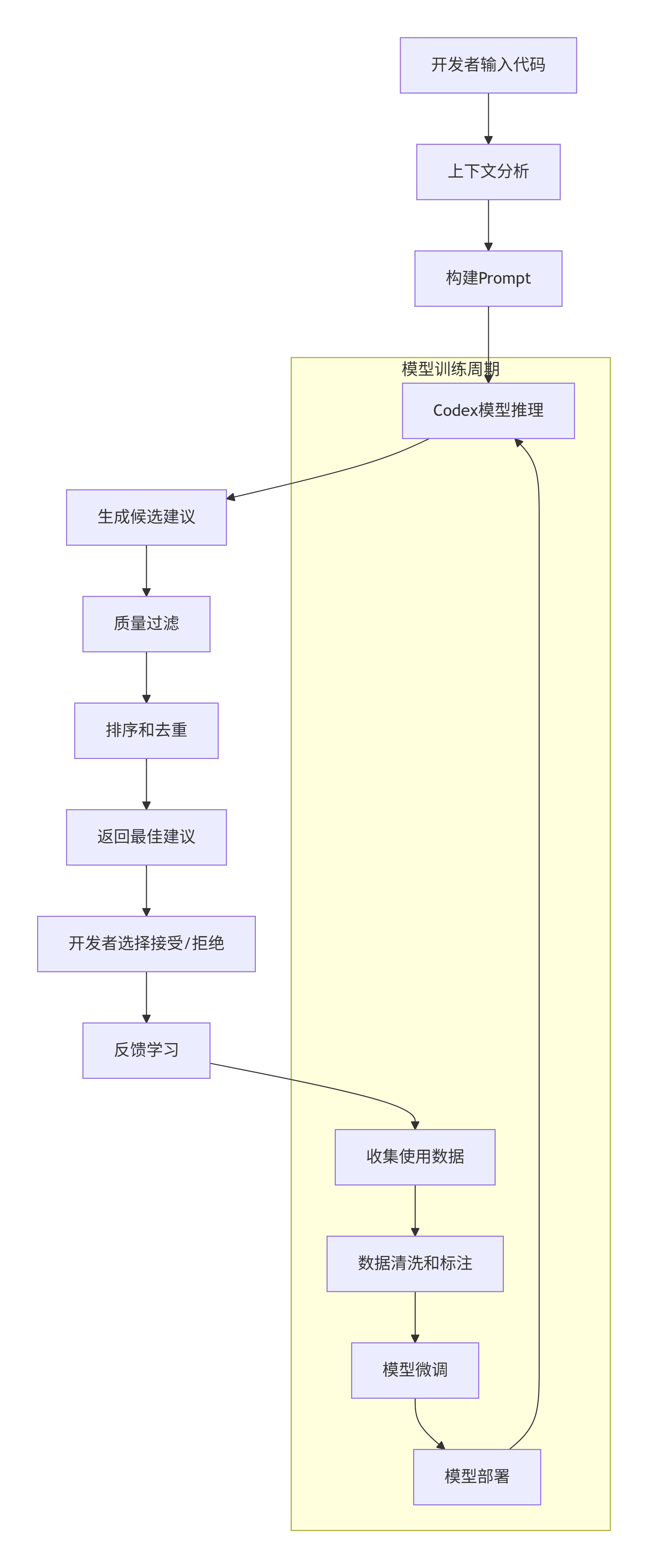
1.2 Copilot工作流程
graph TD
    A[开发者输入代码] --> B[上下文分析]
    B --> C[构建Prompt]
    C --> D[Codex模型推理]
    D --> E[生成候选建议]
    E --> F[质量过滤]
    F --> G[排序和去重]
    G --> H[返回最佳建议]
    H --> I[开发者选择接受/拒绝]
    I --> J[反馈学习]

    subgraph "模型训练周期"
        K[收集使用数据] --> L[数据清洗和标注]
        L --> M[模型微调]
        M --> N[模型部署]
        N --> D
    end

    J --> K
1.3 Copilot Prompt工程示例
Copilot的成功很大程度上依赖于精心设计的Prompt。以下是一些有效的Prompt模式:
python
# 1. 函数级Prompt示例
def test_copilot_prompts():
    """
    Prompt模式1: 清晰的函数描述
    """
    # 当输入这样的注释时,Copilot会生成相应的函数实现
    # 计算两个向点积
    def dot_product(vector1, vector2):
        return sum(x * y for x, y in zip(vector1, vector2))

    """
    Prompt模式2: 示例驱动
    """
    # 像这样使用:
    # result = process_data(input_data, threshold=0.5)
    # 实现process_data函数:
    def process_data(data, threshold=0.5):
        return [x for x in data if x > threshold]

    """
    Prompt模式3: 测试驱动开发
    """
    # 先写测试,再实现函数
    def test_fibonacci():
        assert fibonacci(0) == 0
        assert fibonacci(1) == 1
        assert fibonacci(5) == 5
        assert fibonacci(10) == 55

    # 实现fibonacci函数
    def fibonacci(n):
        if n <= 1:
            return n
        a, b = 0, 1
        for _ in range(2, n + 1):
            a, b = b, a + b
        return b

# 2. 类级别Prompt示例
class DataProcessor:
    """
    数据处理类,用于清洗和转换数据
    功能包括:
    - 数据标准化
    - 缺失值处理
    - 特征编码
    """

    def __init__(self, config):
        self.config = config
        self.scaler = None
        self.encoders = {}

    def fit(self, data):
        """训练数据处理参数"""
        # Copilot会根据上下文生成完整的方法实现
        self.scaler = StandardScaler()
        self.scaler.fit(data['numerical_features'])

        for column in data['categorical_features'].columns:
            encoder = LabelEncoder()
            encoder.fit(data['categorical_features'][column])
            self.encoders[column] = encoder

    def transform(self, data):
        """转换数据"""
        transformed_data = data.copy()

        # 数值特征标准化
        transformed_data['numerical_features'] = self.scaler.transform(
            data['numerical_features']
        )

        # 分类特征编码
        for column, encoder in self.encoders.items():
            transformed_data[column] = encoder.transform(data[column])

        return transformed_data
1.4 Copilot集成开发实践
以下展示如何在真实项目中集成Copilot:
python
# web开发示例:Flask API开发
from flask import Flask, request, jsonify
from typing import Dict, List, Optional

app = Flask(__name__)

class TaskManager:
    """简单的任务管理器"""

    def __init__(self):
        self.tasks = []
        self.next_id = 1

    def create_task(self, title: str, description: str, priority: int = 1) -> Dict:
        """创建新任务"""
        task = {
            'id': self.next_id,
            'title': title,
            'description': description,
            'priority': priority,
            'completed': False,
            'created_at': '2024-01-01T00:00:00Z'  # 实际应该用datetime.now()
        }
        self.tasks.append(task)
        self.next_id += 1
        return task

    def get_task(self, task_id: int) -> Optional[Dict]:
        """根据ID获取任务"""
        for task in self.tasks:
            if task['id'] == task_id:
                return task
        return None

    def update_task(self, task_id: int, updates: Dict) -> Optional[Dict]:
        """更新任务"""
        task = self.get_task(task_id)
        if task:
            task.update(updates)
            return task
        return None

    def delete_task(self, task_id: int) -> bool:
        """删除任务"""
        global tasks
        initial_length = len(self.tasks)
        self.tasks = [task for task in self.tasks if task['id'] != task_id]
        return len(self.tasks) < initial_length

# 初始化任务管理器
task_manager = TaskManager()

# API路由
@app.route('/tasks', methods=['POST'])
def create_task():
    """创建新任务"""
    data = request.get_json()

    if not data or 'title' not in data:
        return jsonify({'error': '缺少标题'}), 400

    task = task_manager.create_task(
        title=data['title'],
        description=data.get('description', ''),
        priority=data.get('priority', 1)
    )

    return jsonify(task), 201

@app.route('/tasks', methods=['GET'])
def get_tasks():
    """获取所有任务"""
    # 支持过滤和排序
    status_filter = request.args.get('status')
    priority_filter = request.args.get('priority')

    tasks = task_manager.tasks.copy()

    # 应用过滤器
    if status_filter == 'completed':
        tasks = [task for task in tasks if task['completed']]
    elif status_filter == 'active':
        tasks = [task for task in tasks if not task['completed']]

    if priority_filter:
        tasks = [task for task in tasks if task['priority'] == int(priority_filter)]

    # 排序
    sort_by = request.args.get('sort_by', 'id')
    if sort_by in ['id', 'priority', 'created_at']:
        tasks.sort(key=lambda x: x[sort_by])

    return jsonify({'tasks': tasks, 'count': len(tasks)})

@app.route('/tasks/<int:task_id>', methods=['GET'])
def get_task(task_id):
    """获取特定任务"""
    task = task_manager.get_task(task_id)
    if task:
        return jsonify(task)
    return jsonify({'error': '任务未找到'}), 404

@app.route('/tasks/<int:task_id>', methods=['PUT'])
def update_task(task_id):
    """更新任务"""
    data = request.get_json()
    task = task_manager.update_task(task_id, data)
    if task:
        return jsonify(task)
    return jsonify({'error': '任务未找到'}), 404

@app.route('/tasks/<int:task_id>', methods=['DELETE'])
def delete_task(task_id):
    """删除任务"""
    if task_manager.delete_task(task_id):
        return jsonify({'message': '任务已删除'})
    return jsonify({'error': '任务未找到'}), 404

if __name__ == '__main__':
    app.run(debug=True)
二、数据标注工具:机器学习的数据基石
2.1 数据标注平台架构
数据标注工具是机器学习项目中的重要环节,以下是一个完整的数据标注系统设计:
python
# 数据标注平台核心架构
import json
from enum import Enum
from typing import List, Dict, Any, Optional
from datetime import datetime
from dataclasses import dataclass

class AnnotationType(Enum):
    CLASSIFICATION = "classification"
    BOUNDING_BOX = "bounding_box"
    POLYGON = "polygon"
    SEGMENTATION = "segmentation"
    NER = "named_entity_recognition"

@dataclass
class Annotation:
    id: str
    data_id: str
    annotator_id: str
    annotation_type: AnnotationType
    labels: List[str]
    metadata: Dict[str, Any]
    created_at: datetime
    updated_at: datetime

class DataAnnotationPlatform:
    """数据标注平台核心类"""

    def __init__(self, storage_backend, ml_backend=None):
        self.storage = storage_backend
        self.ml_backend = ml_backend
        self.projects = {}
        self.annotators = {}

    def create_project(self, name, description, annotation_type,
                      classes, guidelines):
        """创建标注项目"""
        project_id = f"project_{len(self.projects) + 1}"

        project = {
            'id': project_id,
            'name': name,
            'description': description,
            'annotation_type': annotation_type,
            'classes': classes,
            'guidelines': guidelines,
            'created_at': datetime.now(),
            'status': 'active'
        }

        self.projects[project_id] = project
        return project

    def upload_dataset(self, project_id, dataset_files, file_type='image'):
        """上传数据集"""
        project = self.projects.get(project_id)
        if not project:
            raise ValueError(f"项目 {project_id} 不存在")

        # 处理上传的文件
        data_items = []
        for file_info in dataset_files:
            data_id = f"data_{len(data_items) + 1}"
            data_item = {
                'id': data_id,
                'project_id': project_id,
                'file_path': file_info['path'],
                'file_type': file_type,
                'metadata': file_info.get('metadata', {}),
                'status': 'pending',
                'uploaded_at': datetime.now()
            }
            data_items.append(data_item)

        # 存储到后端
        self.storage.batch_save(data_items)
        return len(data_items)

    def assign_tasks(self, project_id, annotator_ids, items_per_annotator=100):
        """分配标注任务"""
        # 获取未标注的数据
        pending_items = self.storage.get_pending_items(project_id, limit=1000)

        assignments = []
        for annotator_id in annotator_ids:
            # 为每个标注员分配任务
            assigned_items = pending_items[:items_per_annotator]
            pending_items = pending_items[items_per_annotator:]

            for item in assigned_items:
                assignment = {
                    'annotator_id': annotator_id,
                    'data_id': item['id'],
                    'project_id': project_id,
                    'assigned_at': datetime.now(),
                    'status': 'assigned'
                }
                assignments.append(assignment)

            if not pending_items:
                break

        self.storage.batch_save_assignments(assignments)
        return assignments

    def submit_annotation(self, data_id, annotator_id, labels, metadata=None):
        """提交标注结果"""
        annotation = Annotation(
            id=f"annotation_{datetime.now().timestamp()}",
            data_id=data_id,
            annotator_id=annotator_id,
            annotation_type=AnnotationType.CLASSIFICATION,
            labels=labels,
            metadata=metadata or {},
            created_at=datetime.now(),
            updated_at=datetime.now()
        )

        # 保存标注
        self.storage.save_annotation(annotation)

        # 更新数据项状态
        self.storage.update_item_status(data_id, 'annotated')

        return annotation

    def get_annotation_quality(self, project_id):
        """计算标注质量指标"""
        annotations = self.storage.get_project_annotations(project_id)

        # 计算标注者一致性
        consistency_metrics = self._calculate_consistency(annotations)

        # 计算标注进度
        progress_metrics = self._calculate_progress(project_id)

        return {
            'consistency': consistency_metrics,
            'progress': progress_metrics,
            'total_annotations': len(annotations),
            'unique_annotators': len(set(a.annotator_id for a in annotations))
        }

    def _calculate_consistency(self, annotations):
        """计算标注一致性"""
        # 实现一致性计算逻辑
        pass

    def _calculate_progress(self, project_id):
        """计算标注进度"""
        total_items = self.storage.get_project_item_count(project_id)
        annotated_items = self.storage.get_annotated_item_count(project_id)

        return {
            'total': total_items,
            'annotated': annotated_items,
            'progress_percentage': (annotated_items / total_items * 100) if total_items > 0 else 0
        }

# 存储后端抽象
class StorageBackend:
    def batch_save(self, items):
        pass

    def get_pending_items(self, project_id, limit=100):
        pass

    def batch_save_assignments(self, assignments):
        pass

    def save_annotation(self, annotation):
        pass

    def update_item_status(self, data_id, status):
        pass

    def get_project_annotations(self, project_id):
        pass

    def get_project_item_count(self, project_id):
        pass

    def get_annotated_item_count(self, project_id):
        pass
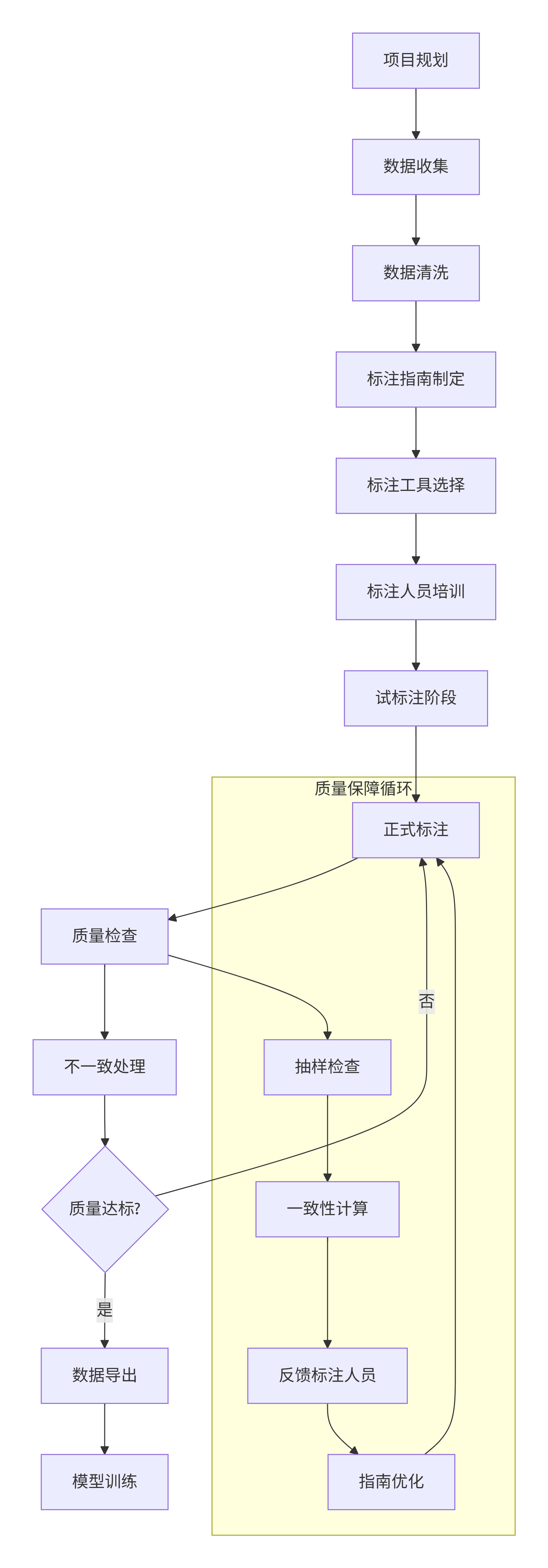
2.2 数据标注流程
graph TD
    A[项目规划] --> B[数据收集]
    B --> C[数据清洗]
    C --> D[标注指南制定]
    D --> E[标注工具选择]
    E --> F[标注人员培训]
    F --> G[试标注阶段]
    G --> H[正式标注]
    H --> I[质量检查]
    I --> J[不一致处理]
    J --> K{质量达标?}
    K -->|否| H
    K -->|是| L[数据导出]
    L --> M[模型训练]

    subgraph "质量保障循环"
        N[抽样检查] --> O[一致性计算]
        O --> P[反馈标注人员]
        P --> Q[指南优化]
        Q --> H
    end

    I --> N
2.3 计算机视觉数据标注示例
python
# 计算机视觉标注工具实现
import cv2
import numpy as np
from PIL import Image, ImageDraw
import json

class CVAnnotationTool:
    """计算机视觉标注工具"""

    def __init__(self, image_width=800, image_height=600):
        self.image_width = image_width
        self.image_height = image_height
        self.current_image = None
        self.annotations = []
        self.current_annotation = None
        self.selected_tool = 'bbox'  # bbox, polygon, etc.

    def load_image(self, image_path):
        """加载图像"""
        self.current_image = Image.open(image_path)
        self.annotations = []
        return self.current_image

    def start_annotation(self, annotation_type='bbox'):
        """开始标注"""
        self.current_annotation = {
            'type': annotation_type,
            'points': [],
            'label': '',
            'confidence': 1.0
        }

    def add_point(self, x, y):
        """添加标注点"""
        if not self.current_annotation:
            return

        self.current_annotation['points'].append((x, y))

        # 如果是边界框,需要2个点
        if (self.current_annotation['type'] == 'bbox' and
            len(self.current_annotation['points']) == 2):
            self.finish_annotation()

    def finish_annotation(self):
        """完成当前标注"""
        if self.current_annotation and self.current_annotation['points']:
            self.annotations.append(self.current_annotation)
            self.current_annotation = None

    def set_label(self, label):
        """设置标注标签"""
        if self.current_annotation:
            self.current_annotation['label'] = label

    def draw_annotations(self):
        """绘制标注结果"""
        if not self.current_image:
            return None

        # 创建副本进行绘制
        draw_image = self.current_image.copy()
        draw = ImageDraw.Draw(draw_image)

        # 绘制已有标注
        for annotation in self.annotations:
            self._draw_single_annotation(draw, annotation)

        # 绘制当前进行中的标注
        if self.current_annotation:
            self._draw_single_annotation(draw, self.current_annotation)

        return draw_image

    def _draw_single_annotation(self, draw, annotation):
        """绘制单个标注"""
        points = annotation['points']
        label = annotation['label']

        if annotation['type'] == 'bbox' and len(points) == 2:
            # 绘制边界框
            x1, y1 = points[0]
            x2, y2 = points[1]
            draw.rectangle([x1, y1, x2, y2], outline='red', width=2)

            # 绘制标签
            if label:
                draw.text((x1, y1 - 10), label, fill='red')

        elif annotation['type'] == 'polygon':
            # 绘制多边形
            if len(points) > 1:
                draw.line(points + [points[0]], fill='blue', width=2)

            # 绘制点
            for point in points:
                x, y = point
                draw.ellipse([x-2, y-2, x+2, y+2], fill='blue')

    def export_annotations(self, format='coco'):
        """导出标注结果"""
        if format == 'coco':
            return self._export_coco_format()
        elif format == 'voc':
            return self._export_voc_format()
        elif format == 'yolo':
            return self._export_yolo_format()
        else:
            return self._export_json_format()

    def _export_coco_format(self):
        """COCO格式导出"""
        coco_data = {
            "images": [{
                "id": 1,
                "width": self.current_image.width,
                "height": self.current_image.height,
                "file_name": "image.jpg"
            }],
            "annotations": [],
            "categories": []
        }

        # 收集所有类别
        categories = set()
        for ann in self.annotations:
            categories.add(ann['label'])

        # 构建类别映射
        category_map = {cat: i+1 for i, cat in enumerate(categories)}
        coco_data["categories"] = [{"id": idx, "name": name}
                                 for name, idx in category_map.items()]

        # 构建标注
        for i, ann in enumerate(self.annotations):
            if ann['type'] == 'bbox' and len(ann['points']) == 2:
                x1, y1 = ann['points'][0]
                x2, y2 = ann['points'][1]

                coco_ann = {
                    "id": i + 1,
                    "image_id": 1,
                    "category_id": category_map[ann['label']],
                    "bbox": [x1, y1, x2 - x1, y2 - y1],
                    "area": (x2 - x1) * (y2 - y1),
                    "iscrowd": 0
                }
                coco_data["annotations"].append(coco_ann)

        return coco_data

# 使用示例
def demo_annotation_tool():
    """演示标注工具使用"""
    tool = CVAnnotationTool()

    # 模拟标注流程
    tool.load_image("sample.jpg")

    # 标注第一个对象
    tool.start_annotation('bbox')
    tool.add_point(100, 100)  # 左上角
    tool.add_point(200, 200)  # 右下角
    tool.set_label('person')

    # 标注第二个对象
    tool.start_annotation('bbox')
    tool.add_point(300, 150)
    tool.add_point(400, 250)
    tool.set_label('car')

    # 导出结果
    coco_data = tool.export_annotations('coco')
    print(json.dumps(coco_data, indent=2))

    return tool
2.4 自然语言处理标注工具
python
# NLP数据标注工具
import spacy
from typing import List, Tuple

class NLPAnnotationTool:
    """自然语言处理标注工具"""

    def __init__(self):
        self.documents = []
        self.annotations = []
        self.entity_types = ['PERSON', 'ORG', 'LOC', 'DATE', 'MONEY']

    def load_text(self, text: str, doc_id: str = None):
        """加载文本"""
        if not doc_id:
            doc_id = f"doc_{len(self.documents) + 1}"

        document = {
            'id': doc_id,
            'text': text,
            'tokens': self._tokenize(text),
            'entities': []
        }

        self.documents.append(document)
        return document

    def _tokenize(self, text: str) -> List[dict]:
        """简单的分词"""
        # 实际应用中可以使用spacy等专业工具
        tokens = []
        words = text.split()
        start = 0

        for word in words:
            # 找到单词在原文中的位置
            start = text.find(word, start)
            if start == -1:
                continue
            end = start + len(word)

            tokens.append({
                'text': word,
                'start': start,
                'end': end,
                'index': len(tokens)
            })

            start = end

        return tokens

    def add_entity(self, doc_id: str, start: int, end: int,
                  entity_type: str, text: str):
        """添加实体标注"""
        annotation = {
            'doc_id': doc_id,
            'start': start,
            'end': end,
            'entity_type': entity_type,
            'text': text,
            'annotator_id': 'user_1',
            'created_at': datetime.now()
        }

        self.annotations.append(annotation)

        # 更新文档实体列表
        for doc in self.documents:
            if doc['id'] == doc_id:
                doc['entities'].append({
                    'start': start,
                    'end': end,
                    'type': entity_type
                })
                break

        return annotation

    def export_conll_format(self, doc_id: str) -> List[str]:
        """导出CONLL格式"""
        doc = next((d for d in self.documents if d['id'] == doc_id), None)
        if not doc:
            return []

        # 获取该文档的实体标注
        doc_annotations = [a for a in self.annotations if a['doc_id'] == doc_id]

        # 为每个token分配标签
        token_labels = ['O'] * len(doc['tokens'])

        for ann in doc_annotations:
            # 找到与实体重叠的tokens
            for i, token in enumerate(doc['tokens']):
                if (token['start'] >= ann['start'] and
                    token['end'] <= ann['end']):

                    # 确定BIO标签
                    if token['start'] == ann['start']:
                        token_labels[i] = f'B-{ann["entity_type"]}'
                    else:
                        token_labels[i] = f'I-{ann["entity_type"]}'

        # 生成CONLL格式
        conll_lines = []
        for token, label in zip(doc['tokens'], token_labels):
            conll_lines.append(f"{token['text']} {label}")

        return conll_lines

    def calculate_iaa(self, doc_id: str, annotator1: str, annotator2: str) -> float:
        """计算标注者间一致性"""
        # 获取两个标注者的标注
        ann1_annotations = [
            a for a in self.annotations
            if a['doc_id'] == doc_id and a['annotator_id'] == annotator1
        ]
        ann2_annotations = [
            a for a in self.annotations
            if a['doc_id'] == doc_id and a['annotator_id'] == annotator2
        ]

        # 计算F1分数作为一致性指标
        precision = self._calculate_precision(ann1_annotations, ann2_annotations)
        recall = self._calculate_recall(ann1_annotations, ann2_annotations)

        if precision + recall == 0:
            return 0.0

        f1 = 2 * precision * recall / (precision + recall)
        return f1

    def _calculate_precision(self, ann1: List, ann2: List) -> float:
        """计算精确率"""
        if not ann1:
            return 0.0

        matches = 0
        for a1 in ann1:
            for a2 in ann2:
                if (a1['start'] == a2['start'] and
                    a1['end'] == a2['end'] and
                    a1['entity_type'] == a2['entity_type']):
                    matches += 1
                    break

        return matches / len(ann1)

    def _calculate_recall(self, ann1: List, ann2: List) -> float:
        """计算召回率"""
        return self._calculate_precision(ann2, ann1)

# 使用示例
def demo_nlp_annotation():
    """演示NLP标注工具"""
    tool = NLPAnnotationTool()

    # 加载文本
    text = "苹果公司于2023年9月12日在加利福尼亚发布了新款iPhone。"
    doc = tool.load_text(text, "doc_1")

    # 添加实体标注
    tool.add_entity("doc_1", 0, 2, "ORG", "苹果公司")
    tool.add_entity("doc_1", 3, 11, "DATE", "2023年9月12日")
    tool.add_entity("doc_1", 12, 17, "LOC", "加利福尼亚")
    tool.add_entity("doc_1", 20, 27, "PRODUCT", "新款iPhone")

    # 导出CONLL格式
    conll_lines = tool.export_conll_format("doc_1")

    print("CONLL格式输出:")
    for line in conll_lines:
        print(line)

    return tool
三、模型训练平台:规模化机器学习
3.1 分布式训练平台架构
python
# 分布式训练平台核心组件
import torch
import torch.distributed as dist
from torch.nn.parallel import DistributedDataParallel as DDP
from torch.utils.data import DataLoader, DistributedSampler
import argparse
import os
from datetime import datetime
import json

class DistributedTrainingPlatform:
    """分布式训练平台"""

    def __init__(self, config):
        self.config = config
        self.setup_distributed()
        self.model = None
        self.optimizer = None
        self.scheduler = None

    def setup_distributed(self):
        """初始化分布式训练环境"""
        if 'RANK' in os.environ and 'WORLD_SIZE' in os.environ:
            self.rank = int(os.environ['RANK'])
            self.world_size = int(os.environ['WORLD_SIZE'])
            self.local_rank = int(os.environ['LOCAL_RANK'])
        else:
            # 单机训练
            self.rank = 0
            self.world_size = 1
            self.local_rank = 0

        # 设置GPU
        if torch.cuda.is_available():
            torch.cuda.set_device(self.local_rank)

        # 初始化进程组
        if self.world_size > 1:
            dist.init_process_group(backend='nccl')

        print(f"初始化进程 {self.rank}/{self.world_size}, local_rank: {self.local_rank}")

    def setup_model(self, model_class, model_config):
        """设置模型"""
        self.model = model_class(**model_config)

        if torch.cuda.is_available():
            self.model = self.model.cuda()

        # 分布式数据并行
        if self.world_size > 1:
            self.model = DDP(self.model, device_ids=[self.local_rank])

        return self.model

    def setup_optimizer(self, optimizer_class, optimizer_config):
        """设置优化器"""
        self.optimizer = optimizer_class(
            self.model.parameters(), **optimizer_config
        )
        return self.optimizer

    def setup_scheduler(self, scheduler_class, scheduler_config):
        """设置学习率调度器"""
        self.scheduler = scheduler_class(self.optimizer, **scheduler_config)
        return self.scheduler

    def setup_dataloader(self, dataset, batch_size, num_workers=4):
        """设置数据加载器"""
        if self.world_size > 1:
            sampler = DistributedSampler(
                dataset,
                num_replicas=self.world_size,
                rank=self.rank,
                shuffle=True
            )
        else:
            sampler = None

        dataloader = DataLoader(
            dataset,
            batch_size=batch_size,
            sampler=sampler,
            num_workers=num_workers,
            pin_memory=True
        )

        return dataloader

    def train_epoch(self, train_loader, criterion, epoch):
        """训练一个epoch"""
        self.model.train()
        total_loss = 0.0
        total_samples = 0

        for batch_idx, (data, target) in enumerate(train_loader):
            # 移动数据到GPU
            if torch.cuda.is_available():
                data, target = data.cuda(), target.cuda()

            # 前向传播
            self.optimizer.zero_grad()
            output = self.model(data)
            loss = criterion(output, target)

            # 反向传播
            loss.backward()
            self.optimizer.step()

            # 统计信息
            total_loss += loss.item() * data.size(0)
            total_samples += data.size(0)

            if batch_idx % self.config['log_interval'] == 0 and self.rank == 0:
                print(f'Epoch: {epoch} [{batch_idx * len(data)}/{len(train_loader.dataset)} '
                      f'({100. * batch_idx / len(train_loader):.0f}%)]\tLoss: {loss.item():.6f}')

        # 计算平均损失
        avg_loss = total_loss / total_samples

        # 同步所有进程的损失
        if self.world_size > 1:
            avg_loss_tensor = torch.tensor(avg_loss).cuda()
            dist.all_reduce(avg_loss_tensor)
            avg_loss = avg_loss_tensor.item() / self.world_size

        return avg_loss

    def validate(self, val_loader, criterion):
        """验证模型"""
        self.model.eval()
        total_loss = 0.0
        total_correct = 0
        total_samples = 0

        with torch.no_grad():
            for data, target in val_loader:
                if torch.cuda.is_available():
                    data, target = data.cuda(), target.cuda()

                output = self.model(data)
                loss = criterion(output, target)

                total_loss += loss.item() * data.size(0)
                pred = output.argmax(dim=1, keepdim=True)
                total_correct += pred.eq(target.view_as(pred)).sum().item()
                total_samples += data.size(0)

        avg_loss = total_loss / total_samples
        accuracy = total_correct / total_samples

        # 同步所有进程的指标
        if self.world_size > 1:
            avg_loss_tensor = torch.tensor(avg_loss).cuda()
            accuracy_tensor = torch.tensor(accuracy).cuda()
            dist.all_reduce(avg_loss_tensor)
            dist.all_reduce(accuracy_tensor)
            avg_loss = avg_loss_tensor.item() / self.world_size
            accuracy = accuracy_tensor.item() / self.world_size

        return avg_loss, accuracy

    def save_checkpoint(self, epoch, metrics, filepath):
        """保存检查点"""
        if self.rank != 0:
            return

        checkpoint = {
            'epoch': epoch,
            'model_state_dict': self.model.state_dict(),
            'optimizer_state_dict': self.optimizer.state_dict(),
            'scheduler_state_dict': self.scheduler.state_dict() if self.scheduler else None,
            'metrics': metrics,
            'config': self.config,
            'timestamp': datetime.now().isoformat()
        }

        torch.save(checkpoint, filepath)
        print(f"检查点已保存: {filepath}")

    def load_checkpoint(self, filepath):
        """加载检查点"""
        checkpoint = torch.load(filepath, map_location='cpu')

        self.model.load_state_dict(checkpoint['model_state_dict'])
        self.optimizer.load_state_dict(checkpoint['optimizer_state_dict'])

        if self.scheduler and checkpoint['scheduler_state_dict']:
            self.scheduler.load_state_dict(checkpoint['scheduler_state_dict'])

        print(f"加载检查点: {filepath}, epoch: {checkpoint['epoch']}")
        return checkpoint['epoch'], checkpoint['metrics']

# 训练配置管理
class TrainingConfig:
    """训练配置管理"""

    def __init__(self, config_file=None):
        self.default_config = {
            'model': {
                'type': 'resnet50',
                'num_classes': 1000,
                'pretrained': True
            },
            'training': {
                'batch_size': 32,
                'epochs': 100,
                'learning_rate': 0.001,
                'weight_decay': 1e-4,
                'momentum': 0.9
            },
            'optimizer': {
                'type': 'adam',
                'lr': 0.001,
                'betas': [0.9, 0.999]
            },
            'scheduler': {
                'type': 'cosine',
                'T_max': 100
            },
            'data': {
                'train_dir': './data/train',
                'val_dir': './data/val',
                'num_workers': 4
            },
            'distributed': {
                'world_size': 1,
                'backend': 'nccl'
            },
            'logging': {
                'log_interval': 10,
                'checkpoint_interval': 5,
                'experiment_name': 'default'
            }
        }

        if config_file:
            self.load_config(config_file)
        else:
            self.config = self.default_config

    def load_config(self, config_file):
        """从文件加载配置"""
        with open(config_file, 'r') as f:
            user_config = json.load(f)

        # 深度合并配置
        self.config = self._deep_merge(self.default_config, user_config)

    def _deep_merge(self, base, user):
        """深度合并字典"""
        result = base.copy()

        for key, value in user.items():
            if (key in result and isinstance(result[key], dict)
                and isinstance(value, dict)):
                result[key] = self._deep_merge(result[key], value)
            else:
                result[key] = value

        return result

    def save_config(self, filepath):
        """保存配置到文件"""
        with open(filepath, 'w') as f:
            json.dump(self.config, f, indent=2)

    def get(self, key, default=None):
        """获取配置值"""
        keys = key.split('.')
        value = self.config

        for k in keys:
            if isinstance(value, dict) and k in value:
                value = value[k]
            else:
                return default

        return value

# 示例训练脚本
def main_training_script():
    """主训练脚本示例"""
    # 解析参数
    parser = argparse.ArgumentParser()
    parser.add_argument('--config', type=str, required=True,
                       help='配置文件路径')
    parser.add_argument('--resume', type=str, default=None,
                       help='恢复训练的检查点路径')
    args = parser.parse_args()

    # 加载配置
    config_manager = TrainingConfig(args.config)
    config = config_manager.config

    # 初始化训练平台
    platform = DistributedTrainingPlatform(config)

    # 设置模型
    model_class = get_model_class(config['model']['type'])
    model = platform.setup_model(model_class, config['model'])

    # 设置优化器和调度器
    optimizer = platform.setup_optimizer(
        get_optimizer_class(config['optimizer']['type']),
        config['optimizer']
    )

    if 'scheduler' in config:
        scheduler = platform.setup_scheduler(
            get_scheduler_class(config['scheduler']['type']),
            config['scheduler']
        )

    # 设置数据集和数据加载器
    train_dataset = create_dataset(config['data']['train_dir'], is_train=True)
    val_dataset = create_dataset(config['data']['val_dir'], is_train=False)

    train_loader = platform.setup_dataloader(
        train_dataset,
        config['training']['batch_size'],
        config['data']['num_workers']
    )
    val_loader = platform.setup_dataloader(
        val_dataset,
        config['training']['batch_size'],
        config['data']['num_workers']
    )

    # 损失函数
    criterion = torch.nn.CrossEntropyLoss()

    # 恢复训练
    start_epoch = 0
    best_accuracy = 0.0

    if args.resume:
        start_epoch, metrics = platform.load_checkpoint(args.resume)
        best_accuracy = metrics.get('best_accuracy', 0.0)

    # 训练循环
    for epoch in range(start_epoch, config['training']['epochs']):
        if platform.world_size > 1:
            train_loader.sampler.set_epoch(epoch)

        # 训练
        train_loss = platform.train_epoch(train_loader, criterion, epoch)

        # 验证
        val_loss, accuracy = platform.validate(val_loader, criterion)

        # 学习率调度
        if scheduler:
            scheduler.step()

        # 记录指标
        if platform.rank == 0:
            print(f'Epoch {epoch}: Train Loss: {train_loss:.4f}, '
                  f'Val Loss: {val_loss:.4f}, Accuracy: {accuracy:.4f}')

            # 保存最佳模型
            if accuracy > best_accuracy:
                best_accuracy = accuracy
                platform.save_checkpoint(
                    epoch,
                    {'best_accuracy': best_accuracy},
                    f'best_model_epoch_{epoch}.pth'
                )

            # 定期保存检查点
            if epoch % config['logging']['checkpoint_interval'] == 0:
                platform.save_checkpoint(
                    epoch,
                    {'best_accuracy': best_accuracy},
                    f'checkpoint_epoch_{epoch}.pth'
                )

    # 清理分布式训练
    if platform.world_size > 1:
        dist.destroy_process_group()

def get_model_class(model_type):
    """根据类型获取模型类"""
    models = {
        'resnet50': torchvision.models.resnet50,
        'resnet101': torchvision.models.resnet101,
        'vit': torchvision.models.vit_b_16,
    }
    return models.get(model_type, torchvision.models.resnet50)

def get_optimizer_class(optimizer_type):
    """根据类型获取优化器类"""
    optimizers = {
        'adam': torch.optim.Adam,
        'sgd': torch.optim.SGD,
        'adamw': torch.optim.AdamW,
    }
    return optimizers.get(optimizer_type, torch.optim.Adam)

def get_scheduler_class(scheduler_type):
    """根据类型获取调度器类"""
    schedulers = {
        'cosine': torch.optim.lr_scheduler.CosineAnnealingLR,
        'step': torch.optim.lr_scheduler.StepLR,
        'multi_step': torch.optim.lr_scheduler.MultiStepLR,
    }
    return schedulers.get(scheduler_type, torch.optim.lr_scheduler.StepLR)
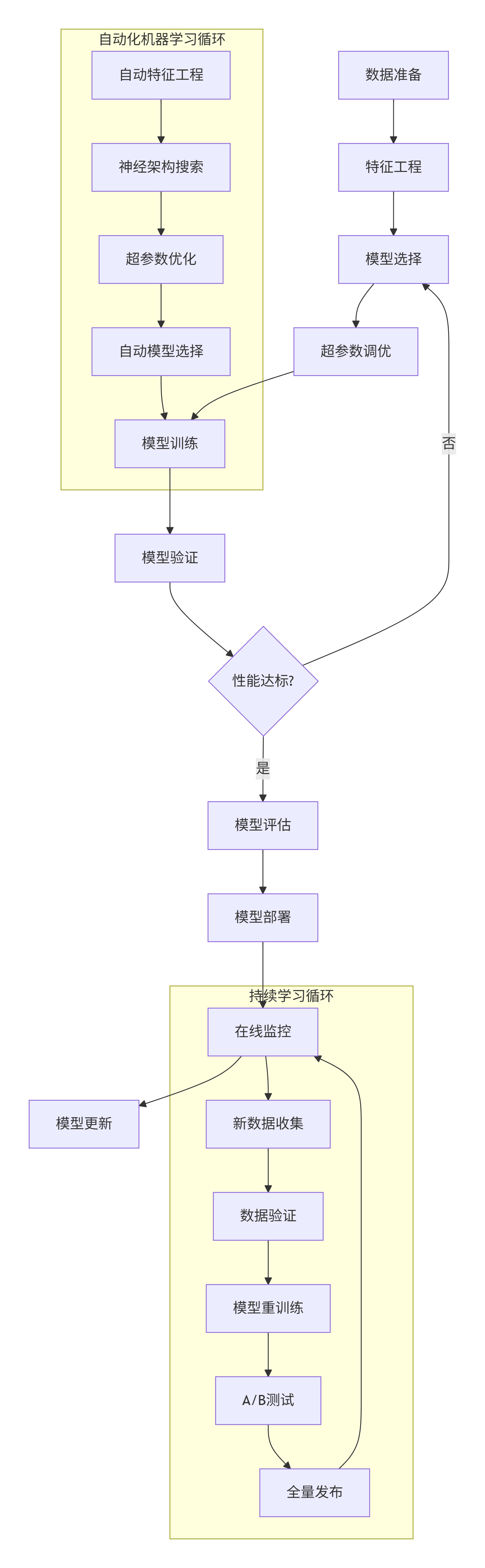
3.2 模型训练完整流程
graph TD
    A[数据准备] --> B[特征工程]
    B --> C[模型选择]
    C --> D[超参数调优]
    D --> E[模型训练]
    E --> F[模型验证]
    F --> G{性能达标?}
    G -->|否| C
    G -->|是| H[模型评估]
    H --> I[模型部署]
    I --> J[在线监控]
    J --> K[模型更新]

    subgraph "自动化机器学习循环"
        L[自动特征工程] --> M[神经架构搜索]
        M --> N[超参数优化]
        N --> O[自动模型选择]
        O --> E
    end

    subgraph "持续学习循环"
        P[新数据收集] --> Q[数据验证]
        Q --> R[模型重训练]
        R --> S[A/B测试]
        S --> T[全量发布]
        T --> J
    end

    J --> P
3.3 超参数优化框架
python
# 超参数优化系统
import optuna
from optuna.trial import Trial
import numpy as np
from sklearn.model_selection import cross_val_score
from sklearn.ensemble import RandomForestClassifier
import warnings
warnings.filterwarnings('ignore')

class HyperparameterOptimizer:
    """超参数优化器"""

    def __init__(self, estimator, X, y, cv=5, scoring='accuracy'):
        self.estimator = estimator
        self.X = X
        self.y = y
        self.cv = cv
        self.scoring = scoring
        self.study = None
        self.best_params = None
        self.best_score = None

    def objective(self, trial: Trial):
        """优化目标函数"""
        # 定义超参数搜索空间
        if hasattr(self.estimator, 'n_estimators'):
            # 随机森林参数
            n_estimators = trial.suggest_int('n_estimators', 50, 500)
            max_depth = trial.suggest_int('max_depth', 3, 15)
            min_samples_split = trial.suggest_int('min_samples_split', 2, 20)
            min_samples_leaf = trial.suggest_int('min_samples_leaf', 1, 10)
            max_features = trial.suggest_categorical('max_features',
                                                   ['auto', 'sqrt', 'log2'])

            model = self.estimator(
                n_estimators=n_estimators,
                max_depth=max_depth,
                min_samples_split=min_samples_split,
                min_samples_leaf=min_samples_leaf,
                max_features=max_features,
                random_state=42
            )

        elif hasattr(self.estimator, 'C'):
            # SVM参数
            C = trial.suggest_loguniform('C', 1e-5, 1e5)
            kernel = trial.suggest_categorical('kernel',
                                             ['linear', 'rbf', 'poly'])
            gamma = trial.suggest_loguniform('gamma', 1e-5, 1e5)

            model = self.estimator(
                C=C,
                kernel=kernel,
                gamma=gamma,
                random_state=42
            )

        else:
            # 通用参数
            model = self.estimator()

        # 交叉验证
        scores = cross_val_score(model, self.X, self.y,
                               cv=self.cv, scoring=self.scoring)

        return scores.mean()

    def optimize(self, n_trials=100, direction='maximize'):
        """执行优化"""
        self.study = optuna.create_study(direction=direction)
        self.study.optimize(self.objective, n_trials=n_trials)

        self.best_params = self.study.best_params
        self.best_score = self.study.best_value

        return self.best_params, self.best_score

    def get_optimization_history(self):
        """获取优化历史"""
        if not self.study:
            return None

        trials = self.study.trials
        history = {
            'values': [t.value for t in trials if t.value is not None],
            'params': [t.params for t in trials if t.value is not None],
            'timestamps': [t.datetime_start for t in trials if t.value is not None]
        }

        return history

    def plot_optimization_history(self):
        """绘制优化历史"""
        if not self.study:
            return None

        return optuna.visualization.plot_optimization_history(self.study)

    def plot_parallel_coordinate(self):
        """绘制平行坐标图"""
        if not self.study:
            return None

        return optuna.visualization.plot_parallel_coordinate(self.study)

    def plot_param_importances(self):
        """绘制参数重要性"""
        if not self.study:
            return None

        return optuna.visualization.plot_param_importances(self.study)

# 神经网络超参数优化
class NeuralNetworkOptimizer:
    """神经网络超参数优化"""

    def __init__(self, input_dim, output_dim, X_train, y_train,
                 X_val, y_val, epochs=50):
        self.input_dim = input_dim
        self.output_dim = output_dim
        self.X_train = X_train
        self.y_train = y_train
        self.X_val = X_val
        self.y_val = y_val
        self.epochs = epochs

    def create_model(self, trial: Trial):
        """创建模型"""
        # 网络结构参数
        n_layers = trial.suggest_int('n_layers', 1, 5)

        model = tf.keras.Sequential()
        model.add(tf.keras.layers.Input(shape=(self.input_dim,)))

        # 添加隐藏层
        for i in range(n_layers):
            units = trial.suggest_int(f'units_layer_{i}', 32, 512)
            dropout_rate = trial.suggest_float(f'dropout_layer_{i}', 0.0, 0.5)

            model.add(tf.keras.layers.Dense(units, activation='relu'))
            model.add(tf.keras.layers.Dropout(dropout_rate))

        # 输出层
        if self.output_dim == 1:
            model.add(tf.keras.layers.Dense(1, activation='sigmoid'))
            loss = 'binary_crossentropy'
        else:
            model.add(tf.keras.layers.Dense(self.output_dim, activation='softmax'))
            loss = 'sparse_categorical_crossentropy'

        # 优化器参数
        optimizer_name = trial.suggest_categorical('optimizer',
                                                 ['adam', 'sgd', 'rmsprop'])
        learning_rate = trial.suggest_loguniform('learning_rate', 1e-5, 1e-2)

        if optimizer_name == 'adam':
            optimizer = tf.keras.optimizers.Adam(learning_rate=learning_rate)
        elif optimizer_name == 'sgd':
            optimizer = tf.keras.optimizers.SGD(learning_rate=learning_rate)
        else:
            optimizer = tf.keras.optimizers.RMSprop(learning_rate=learning_rate)

        model.compile(optimizer=optimizer,
                     loss=loss,
                     metrics=['accuracy'])

        return model

    def objective(self, trial: Trial):
        """优化目标函数"""
        # 创建模型
        model = self.create_model(trial)

        # 训练参数
        batch_size = trial.suggest_categorical('batch_size', [16, 32, 64, 128])

        # 训练模型
        history = model.fit(
            self.X_train, self.y_train,
            validation_data=(self.X_val, self.y_val),
            epochs=self.epochs,
            batch_size=batch_size,
            verbose=0
        )

        # 返回验证集上的最佳准确率
        best_val_accuracy = max(history.history['val_accuracy'])
        return best_val_accuracy

# 使用示例
def demo_hyperparameter_optimization():
    """演示超参数优化"""
    from sklearn.datasets import load_iris
    from sklearn.ensemble import RandomForestClassifier
    from sklearn.model_selection import train_test_split

    # 加载数据
    data = load_iris()
    X, y = data.data, data.target

    X_train, X_test, y_train, y_test = train_test_split(
        X, y, test_size=0.2, random_state=42
    )

    # 初始化优化器
    optimizer = HyperparameterOptimizer(
        estimator=RandomForestClassifier,
        X=X_train,
        y=y_train,
        cv=5,
        scoring='accuracy'
    )

    # 执行优化
    best_params, best_score = optimizer.optimize(n_trials=50)

    print(f"最佳参数: {best_params}")
    print(f"最佳分数: {best_score:.4f}")

    # 使用最佳参数训练最终模型
    best_model = RandomForestClassifier(**best_params, random_state=42)
    best_model.fit(X_train, y_train)

    test_score = best_model.score(X_test, y_test)
    print(f"测试集分数: {test_score:.4f}")

    return optimizer, best_model
四、综合案例:端到端AI项目实战
4.1 智能客服系统开发
以下是一个结合了智能编码、数据标注和模型训练的完整案例:
python
# 智能客服系统端到端实现
import pandas as pd
import numpy as np
from transformers import (AutoTokenizer, AutoModelForSequenceClassification,
                         Trainer, TrainingArguments, pipeline)
from sklearn.model_selection import train_test_split
import datasets
from typing import Dict, List, Any
import json

class CustomerServiceAI:
    """智能客服AI系统"""

    def __init__(self, model_name="bert-base-uncased"):
        self.model_name = model_name
        self.tokenizer = None
        self.model = None
        self.classifier = None
        self.label_encoder = {}
        self.label_decoder = {}

    def prepare_data(self, data_file: str) -> datasets.Dataset:
        """准备训练数据"""
        # 加载数据
        df = pd.read_csv(data_file)

        # 数据清洗
        df = self._clean_data(df)

        # 编码标签
        unique_labels = df['category'].unique()
        self.label_encoder = {label: idx for idx, label in enumerate(unique_labels)}
        self.label_decoder = {idx: label for label, idx in self.label_encoder.items()}

        df['label'] = df['category'].map(self.label_encoder)

        # 分割数据集
        train_df, val_df = train_test_split(
            df, test_size=0.2, random_state=42, stratify=df['label']
        )

        # 转换为HuggingFace数据集格式
        train_dataset = datasets.Dataset.from_pandas(train_df)
        val_dataset = datasets.Dataset.from_pandas(val_df)

        return train_dataset, val_dataset

    def _clean_data(self, df: pd.DataFrame) -> pd.DataFrame:
        """数据清洗"""
        # 去除空值
        df = df.dropna(subset=['text', 'category'])

        # 文本清洗
        df['text'] = df['text'].str.lower().str.strip()

        # 过滤过短的文本
        df = df[df['text'].str.len() > 5]

        return df

    def tokenize_function(self, examples):
        """分词函数"""
        return self.tokenizer(
            examples["text"],
            padding="max_length",
            truncation=True,
            max_length=128
        )

    def setup_model(self, num_labels: int):
        """设置模型"""
        self.tokenizer = AutoTokenizer.from_pretrained(self.model_name)
        self.model = AutoModelForSequenceClassification.from_pretrained(
            self.model_name,
            num_labels=num_labels
        )

    def train(self, train_dataset, val_dataset, output_dir="./results"):
        """训练模型"""
        # 分词
        tokenized_train = train_dataset.map(self.tokenize_function, batched=True)
        tokenized_val = val_dataset.map(self.tokenize_function, batched=True)

        # 训练参数
        training_args = TrainingArguments(
            output_dir=output_dir,
            num_train_epochs=3,
            per_device_train_batch_size=16,
            per_device_eval_batch_size=16,
            warmup_steps=500,
            weight_decay=0.01,
            logging_dir='./logs',
            logging_steps=10,
            evaluation_strategy="epoch",
            save_strategy="epoch",
            load_best_model_at_end=True,
            metric_for_best_model="accuracy",
            greater_is_better=True
        )

        # 训练器
        trainer = Trainer(
            model=self.model,
            args=training_args,
            train_dataset=tokenized_train,
            eval_dataset=tokenized_val,
            compute_metrics=self.compute_metrics
        )

        # 开始训练
        trainer.train()

        # 保存模型
        trainer.save_model()
        self.tokenizer.save_pretrained(output_dir)

        # 创建分类管道
        self.classifier = pipeline(
            "text-classification",
            model=self.model,
            tokenizer=self.tokenizer,
            device=0 if torch.cuda.is_available() else -1
        )

        return trainer

    def compute_metrics(self, eval_pred):
        """计算评估指标"""
        predictions, labels = eval_pred
        predictions = np.argmax(predictions, axis=1)

        return {
            'accuracy': (predictions == labels).mean(),
            'precision': self._calculate_precision(predictions, labels),
            'recall': self._calculate_recall(predictions, labels),
            'f1': self._calculate_f1(predictions, labels)
        }

    def _calculate_precision(self, predictions, labels):
        """计算精确率"""
        from sklearn.metrics import precision_score
        return precision_score(labels, predictions, average='weighted')

    def _calculate_recall(self, predictions, labels):
        """计算召回率"""
        from sklearn.metrics import recall_score
        return recall_score(labels, predictions, average='weighted')

    def _calculate_f1(self, predictions, labels):
        """计算F1分数"""
        from sklearn.metrics import f1_score
        return f1_score(labels, predictions, average='weighted')

    def predict(self, text: str) -> Dict[str, Any]:
        """预测类别"""
        if not self.classifier:
            raise ValueError("模型未训练,请先训练模型")

        result = self.classifier(text)[0]
        label_idx = int(result['label'].split('_')[-1])

        return {
            'category': self.label_decoder[label_idx],
            'confidence': result['score'],
            'label_id': label_idx
        }

    def batch_predict(self, texts: List[str]) -> List[Dict[str, Any]]:
        """批量预测"""
        return [self.predict(text) for text in texts]

    def save_system(self, directory: str):
        """保存系统"""
        import os
        os.makedirs(directory, exist_ok=True)

        # 保存模型和tokenizer
        self.model.save_pretrained(directory)
        self.tokenizer.save_pretrained(directory)

        # 保存标签映射
        with open(f"{directory}/label_mapping.json", 'w') as f:
            json.dump({
                'encoder': self.label_encoder,
                'decoder': self.label_decoder
            }, f, indent=2)

        # 保存配置
        config = {
            'model_name': self.model_name,
            'timestamp': datetime.now().isoformat()
        }

        with open(f"{directory}/config.json", 'w') as f:
            json.dump(config, f, indent=2)

    @classmethod
    def load_system(cls, directory: str):
        """加载系统"""
        # 加载配置
        with open(f"{directory}/config.json", 'r') as f:
            config = json.load(f)

        # 创建实例
        instance = cls(model_name=config['model_name'])

        # 加载模型和tokenizer
        instance.tokenizer = AutoTokenizer.from_pretrained(directory)
        instance.model = AutoModelForSequenceClassification.from_pretrained(directory)

        # 加载标签映射
        with open(f"{directory}/label_mapping.json", 'r') as f:
            label_mapping = json.load(f)
            instance.label_encoder = label_mapping['encoder']
            instance.label_decoder = {int(k): v for k, v in label_mapping['decoder'].items()}

        # 创建分类管道
        instance.classifier = pipeline(
            "text-classification",
            model=instance.model,
            tokenizer=instance.tokenizer,
            device=0 if torch.cuda.is_available() else -1
        )

        return instance

# 数据标注界面集成
class CustomerServiceAnnotator:
    """客服数据标注工具"""

    def __init__(self, ai_system: CustomerServiceAI):
        self.ai_system = ai_system
        self.pending_data = []
        self.annotations = []

    def load_unlabeled_data(self, data_file: str):
        """加载未标注数据"""
        df = pd.read_csv(data_file)
        self.pending_data = df.to_dict('records')

    def get_suggestion(self, text: str) -> Dict[str, Any]:
        """获取AI建议"""
        return self.ai_system.predict(text)

    def annotate_with_ai_assistance(self, data_index: int,
                                  user_confirmation: bool = True) -> Dict[str, Any]:
        """AI辅助标注"""
        if data_index >= len(self.pending_data):
            raise IndexError("数据索引超出范围")

        data = self.pending_data[data_index]
        text = data['text']

        # 获取AI建议
        suggestion = self.get_suggestion(text)

        # 如果用户确认,使用AI建议
        if user_confirmation:
            annotation = {
                'text': text,
                'category': suggestion['category'],
                'confidence': suggestion['confidence'],
                'ai_suggested': True,
                'user_confirmed': True,
                'timestamp': datetime.now().isoformat()
            }

            self.annotations.append(annotation)
            self.pending_data.pop(data_index)

            return annotation

        return suggestion

    def manual_annotation(self, data_index: int, category: str) -> Dict[str, Any]:
        """手动标注"""
        if data_index >= len(self.pending_data):
            raise IndexError("数据索引超出范围")

        data = self.pending_data[data_index]
        text = data['text']

        annotation = {
            'text': text,
            'category': category,
            'confidence': 1.0,
            'ai_suggested': False,
            'user_confirmed': True,
            'timestamp': datetime.now().isoformat()
        }

        self.annotations.append(annotation)
        self.pending_data.pop(data_index)

        return annotation

    def export_annotations(self, output_file: str):
        """导出标注结果"""
        df = pd.DataFrame(self.annotations)
        df.to_csv(output_file, index=False)
        return len(self.annotations)

# 使用示例
def demo_customer_service_ai():
    """演示智能客服系统"""
    # 初始化系统
    cs_ai = CustomerServiceAI()

    # 准备数据(假设有标注数据)
    try:
        train_dataset, val_dataset = cs_ai.prepare_data("customer_service_data.csv")
        print(f"训练数据: {len(train_dataset)} 条")
        print(f"验证数据: {len(val_dataset)} 条")

        # 设置模型
        num_labels = len(cs_ai.label_encoder)
        cs_ai.setup_model(num_labels)

        # 训练模型
        trainer = cs_ai.train(train_dataset, val_dataset)

        # 测试预测
        test_text = "我的订单什么时候能发货?"
        prediction = cs_ai.predict(test_text)
        print(f"预测结果: {prediction}")

        # 保存系统
        cs_ai.save_system("./customer_service_model")

    except FileNotFoundError:
        print("未找到数据文件,跳过训练演示")

    # 演示数据标注
    annotator = CustomerServiceAnnotator(cs_ai)

    # 加载未标注数据
    try:
        annotator.load_unlabeled_data("unlabeled_customer_queries.csv")
        print(f"加载未标注数据: {len(annotator.pending_data)} 条")

        # AI辅助标注
        if annotator.pending_data:
            suggestion = annotator.annotate_with_ai_assistance(0, user_confirmation=False)
            print(f"AI建议: {suggestion}")

            # 手动确认或修改
            final_annotation = annotator.manual_annotation(0, "shipping_inquiry")
            print(f"最终标注: {final_annotation}")

    except FileNotFoundError:
        print("未找到未标注数据文件,跳过标注演示")

    return cs_ai, annotator
结论
AI工具链的成熟正在彻底改变我们开发软件和构建智能系统的方式。GitHub Copilot等智能编码工具通过理解上下文和代码模式,显著提高了开发效率;数据标注工具通过自动化和质量保障机制,解决了机器学习的数据瓶颈问题;模型训练平台通过分布式计算和自动化超参数优化,使得训练高性能模型变得更加容易。
这些工具的协同工作形成了一个完整的AI开发生态系统。开发者可以使用Copilot快速原型化数据预处理代码,利用标注工具准备高质量的训练数据,通过训练平台高效训练模型,最后再使用Copilot部署和监控模型。这种无缝的工作流程极大地加速了AI应用的开发周期。
未来,我们可以预见这些工具将进一步集成和智能化。编码助手将更加理解领域特定的需求,数据标注工具将结合主动学习减少人工标注工作量,训练平台将实现更加自动化的模型选择和优化。随着这些技术的发展,AI应用的开发将变得更加普及和高效,推动整个人工智能领域向前发展。
随着AI工具的不断进化,我们也需要关注相关的伦理和社会影响。自动化工具可能带来的偏见放大、技能需求变化、以及人机协作的新模式都需要我们认真思考和应对。只有在技术和人文之间找到平衡,我们才能充分发挥AI工具的潜力,创造更加美好的未来。

有“AI”的1024 = 2048,欢迎大家加入2048 AI社区
更多推荐


 3
3 0
0- 0


 已为社区贡献326条内容

所有评论(0)