指标孤岛与认知碎片:云原生可观测性融合与 AI 运维决策实践
指标孤岛与认知碎片:云原生可观测性融合与 AI 运维决策实践
一、三支柱割裂的排障困境:数据有了,洞见缺失
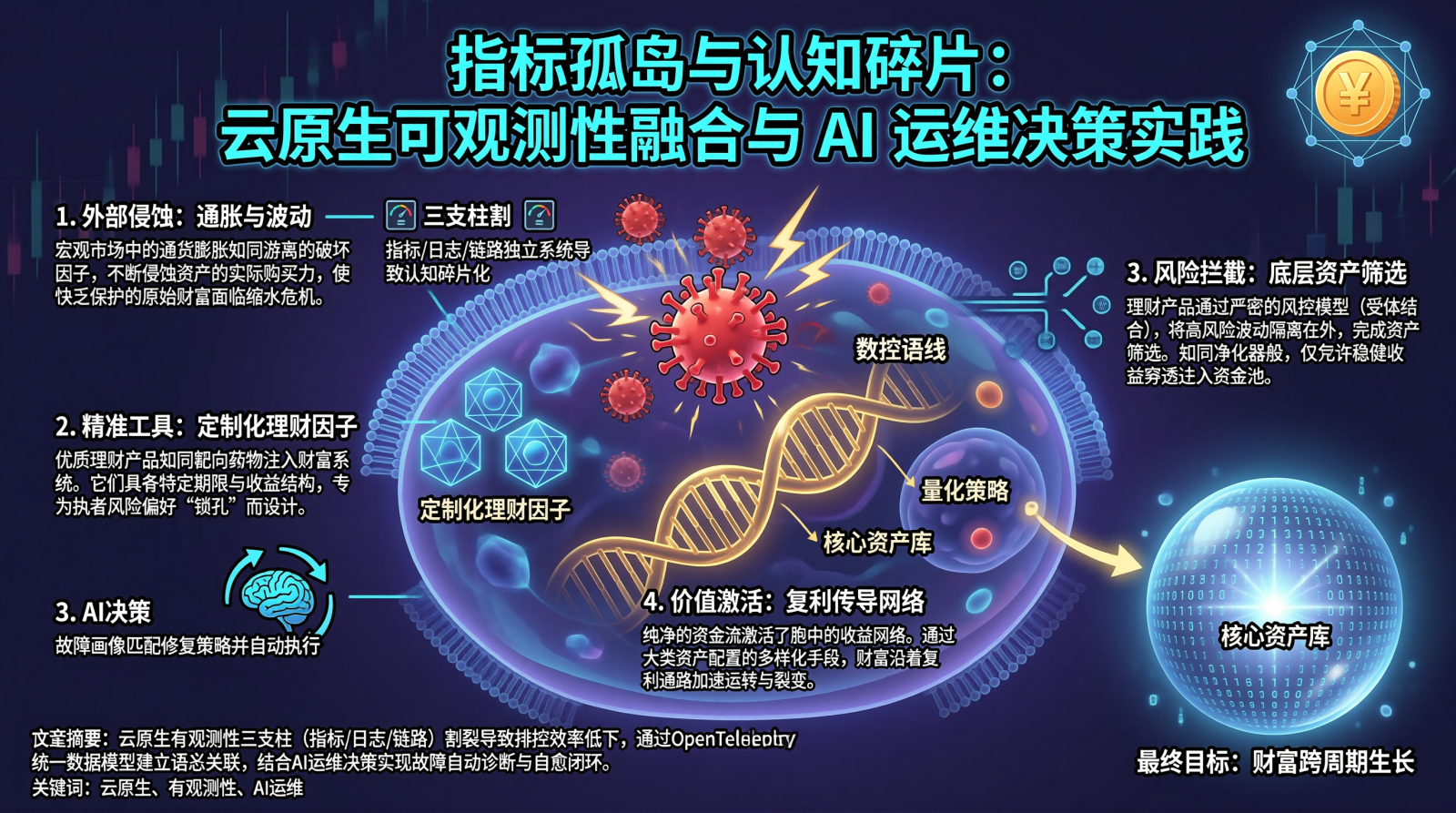
云原生可观测性的三大支柱——指标(Metrics)、日志(Logs)、链路(Traces)——在大多数团队中是三套独立的系统。Prometheus 管指标,ELK 管日志,Jaeger 管链路。排障时,工程师需要在三个系统之间反复切换:先在 Grafana 看到延迟飙升,再去 Kibana 搜日志,最后到 Jaeger 查链路。每次切换都是一次认知中断,排障效率大打折扣。
更深层的问题是"认知碎片化"。三个系统各自产生告警,指标告警说"延迟高",日志告警说"ERROR 增多",链路告警说"调用超时"——三条独立的信息,需要人工在脑中拼凑成完整的故障画面。当故障涉及 5 个以上服务时,这种人工拼凑几乎不可能完成。
可观测性融合的目标,不是把三个系统合并为一个,而是建立三者之间的语义关联,让工程师(和 AI)能够从一个入口查询到完整的故障上下文。AI 运维决策则更进一步——基于融合后的可观测性数据,自动生成修复建议甚至执行自愈动作。
二、从数据融合到决策闭环:AI 运维的可观测性架构
可观测性融合需要在数据层、查询层、决策层三个层面打通。
flowchart TD
    subgraph 数据融合层
        A[Prometheus<br/>指标数据] --> D[统一数据模型<br/>OpenTelemetry]
        B[Elasticsearch<br/>日志数据] --> D
        C[Jaeger<br/>链路数据] --> D
        D --> E[关联索引构建<br/>trace_id + service + timestamp]
    end

    subgraph 语义融合层
        E --> F[故障语义模型<br/>将原始数据映射为故障概念]
        F --> G[异常检测引擎<br/>多维度联合检测]
        G --> H[故障画像生成<br/>时间线+影响面+根因候选]
    end

    subgraph 决策层
        H --> I[修复策略匹配<br/>基于故障画像检索知识库]
        I --> J{置信度评估}
        J -->|高置信度| K[自动执行自愈脚本]
        J -->|低置信度| L[生成诊断报告<br/>人工审批后执行]
        K --> M[执行结果验证<br/>对比修复前后指标]
        L --> M
        M --> N[反馈学习<br/>更新知识库和模型]
    end

    N --> F
数据融合层的核心是 OpenTelemetry 统一数据模型。OpenTelemetry 定义了指标、日志、链路三种信号的统一语义规范,通过 Resource 和 Attribute 将三者关联起来。关键关联字段是 trace_id(日志与链路关联)和 service.name(指标与日志关联)。时间戳对齐是另一个关键——三种信号的时间精度不同,需要定义统一的时间窗口进行关联查询。
语义融合层将原始可观测性数据映射为故障概念。例如,"P99 延迟 > 500ms + ERROR 日志增多 + 数据库 Span 超时"映射为"数据库性能瓶颈"故障概念。这一层需要领域知识定义故障语义模型,将技术指标转化为业务含义。
决策层基于故障画像匹配修复策略。故障画像包含:故障类型、影响范围(哪些服务受影响)、严重程度、持续时间、根因候选。修复策略库存储了历史故障的修复方案,按故障类型和严重程度索引。匹配到策略后,根据置信度决定自动执行还是人工审批。
三、可观测性融合与 AI 决策的生产级实现
3.1 OpenTelemetry Collector 统一采集配置
# otel-collector-config.yaml
# OpenTelemetry Collector 配置——统一采集指标、日志、链路

receivers:
  # 接收 Prometheus 指标
  prometheus:
    config:
      scrape_configs:
        - job_name: 'kubernetes-pods'
          kubernetes_sd_configs:
            - role: pod
          relabel_configs:
            - source_labels: [__meta_kubernetes_pod_annotation_prometheus_io_scrape]
              action: keep
              regex: true

  # 接收 Jaeger 链路数据
  jaeger:
    protocols:
      grpc:
        endpoint: 0.0.0.0:14250

  # 接收 OTLP 日志和链路
  otlp:
    protocols:
      grpc:
        endpoint: 0.0.0.0:4317
      http:
        endpoint: 0.0.0.0:4318

processors:
  # 关键处理器:为日志注入 trace_id 关联
  attributes/trace_link:
    actions:
      - key: trace_id
        from_attribute: trace_id
        action: upsert

  # 资源属性注入——统一服务标识
  resource/env:
    attributes:
      - key: deployment.environment
        value: production
        action: upsert

  # 批量处理——减少网络请求次数
  batch:
    send_batch_size: 1024
    timeout: 5s

  # 采样策略——降低链路数据量
  probabilistic_sampler:
    sampling_percentage: 10  # 10% 采样率

exporters:
  # 指标导出到 Prometheus
  prometheusremotewrite:
    endpoint: http://prometheus:9090/api/v1/write

  # 日志导出到 Elasticsearch
  elasticsearch:
    endpoints:
      - http://elasticsearch:9200
    logs_index: otel-logs-%{yyyy.MM.dd}

  # 链路导出到 Jaeger
  jaeger:
    endpoint: jaeger-collector:14250
    tls:
      insecure: true

service:
  pipelines:
    metrics:
      receivers: [prometheus]
      processors: [resource/env, batch]
      exporters: [prometheusremotewrite]

    logs:
      receivers: [otlp]
      processors: [attributes/trace_link, resource/env, batch]
      exporters: [elasticsearch]

    traces:
      receivers: [otlp, jaeger]
      processors: [resource/env, probabilistic_sampler, batch]
      exporters: [jaeger]
3.2 故障画像生成与关联查询
from dataclasses import dataclass, field
from datetime import datetime
from typing import List, Dict, Optional

@dataclass
class FaultProfile:
    """故障画像——融合指标、日志、链路三维度信息"""
    fault_id: str
    fault_type: str              # 故障类型:如"数据库瓶颈"、"网络分区"
    severity: str                # 严重度:P1/P2/P3
    start_time: datetime
    affected_services: List[str] # 受影响服务列表
    root_cause_candidates: List[Dict]  # 根因候选列表
    metric_anomalies: List[Dict]       # 指标异常列表
    log_patterns: List[Dict]           # 异常日志模式
    trace_anomalies: List[Dict]        # 链路异常列表
    timeline: List[Dict] = field(default_factory=list)  # 故障时间线

class FaultProfileGenerator:
    """故障画像生成器

    融合三维度数据生成统一的故障画像:
    1. 从指标异常中提取受影响服务和时间范围
    2. 从日志异常中提取错误模式和关联 trace_id
    3. 从链路异常中提取慢调用和错误 Span
    4. 三维度交叉验证,生成根因候选
    """

    def __init__(self, topology: Dict[str, List[str]]):
        self.topology = topology

    def generate(
        self,
        metric_anomalies: List[Dict],
        log_anomalies: List[Dict],
        trace_anomalies: List[Dict],
        time_window_sec: int = 300
    ) -> FaultProfile:
        """生成故障画像"""
        # 步骤 1:提取受影响服务
        affected_services = set()
        for anomaly in metric_anomalies:
            affected_services.add(anomaly.get("service", ""))
        for anomaly in log_anomalies:
            affected_services.add(anomaly.get("service", ""))
        for anomaly in trace_anomalies:
            affected_services.add(anomaly.get("service", ""))
        affected_services.discard("")

        # 步骤 2:构建故障时间线
        all_events = []
        for anomaly in metric_anomalies:
            all_events.append({
                "time": anomaly["timestamp"],
                "type": "metric",
                "service": anomaly.get("service", ""),
                "detail": f"{anomaly['metric']}: {anomaly['value']}",
            })
        for anomaly in log_anomalies:
            all_events.append({
                "time": anomaly["timestamp"],
                "type": "log",
                "service": anomaly.get("service", ""),
                "detail": anomaly.get("template", ""),
            })
        for anomaly in trace_anomalies:
            all_events.append({
                "time": anomaly["timestamp"],
                "type": "trace",
                "service": anomaly.get("service", ""),
                "detail": f"Span {anomaly.get('operation', '')} 耗时 {anomaly.get('duration', 0)}ms",
            })

        timeline = sorted(all_events, key=lambda x: x["time"])

        # 步骤 3:交叉验证根因候选
        # 在三个维度中都出现异常的服务更可能是根因
        service_anomaly_count = {}
        for svc in affected_services:
            count = 0
            if any(a.get("service") == svc for a in metric_anomalies):
                count += 1
            if any(a.get("service") == svc for a in log_anomalies):
                count += 1
            if any(a.get("service") == svc for a in trace_anomalies):
                count += 1
            service_anomaly_count[svc] = count

        # 按异常维度数排序,维度越多越可能是根因
        root_cause_candidates = sorted(
            [{"service": svc, "dimensions": cnt} for svc, cnt in service_anomaly_count.items()],
            key=lambda x: x["dimensions"],
            reverse=True
        )

        # 步骤 4:确定严重度
        severity = "P3"
        if any(a.get("severity") == "critical" for a in metric_anomalies):
            severity = "P1"
        elif len(affected_services) >= 3:
            severity = "P2"

        return FaultProfile(
            fault_id=f"fault-{datetime.now().strftime('%Y%m%d%H%M%S')}",
            fault_type=self._classify_fault(root_cause_candidates, metric_anomalies),
            severity=severity,
            start_time=timeline[0]["time"] if timeline else datetime.now(),
            affected_services=list(affected_services),
            root_cause_candidates=root_cause_candidates,
            metric_anomalies=metric_anomalies,
            log_patterns=log_anomalies,
            trace_anomalies=trace_anomalies,
            timeline=timeline,
        )

    def _classify_fault(
        self, candidates: List[Dict], metrics: List[Dict]
    ) -> str:
        """基于异常模式分类故障类型"""
        metric_names = {m.get("metric", "") for m in metrics}
        if any("db" in m or "database" in m for m in metric_names):
            return "数据库瓶颈"
        if any("network" in m or "tcp" in m for m in metric_names):
            return "网络异常"
        if any("cpu" in m or "memory" in m for m in metric_names):
            return "资源耗尽"
        return "未知类型"
3.3 AI 决策引擎与自愈执行
from typing import Dict, List, Optional, Callable
import subprocess

class AIOpsDecisionEngine:
    """AI 运维决策引擎

    基于故障画像匹配修复策略,根据置信度决定自动执行或人工审批
    """

    def __init__(
        self,
        remediation_library: Dict[str, Dict],
        auto_execute_threshold: float = 0.85
    ):
        # remediation_library: {故障类型: {策略详情}}
        self.remediation_library = remediation_library
        self.auto_execute_threshold = auto_execute_threshold
        self._execution_history: List[Dict] = []

    def decide(self, fault_profile: FaultProfile) -> Dict:
        """基于故障画像做出修复决策"""
        fault_type = fault_profile.fault_type

        # 查找匹配的修复策略
        strategy = self.remediation_library.get(fault_type)
        if not strategy:
            return {
                "action": "escalate",
                "reason": f"未找到故障类型 '{fault_type}' 的修复策略",
                "fault_id": fault_profile.fault_id,
            }

        # 计算置信度
        confidence = self._calculate_confidence(fault_profile, strategy)

        decision = {
            "fault_id": fault_profile.fault_id,
            "fault_type": fault_type,
            "strategy": strategy["name"],
            "confidence": confidence,
            "affected_services": fault_profile.affected_services,
        }

        if confidence >= self.auto_execute_threshold:
            decision["action"] = "auto_execute"
            decision["steps"] = strategy["steps"]
            # 执行自愈脚本
            result = self._execute_remediation(strategy["steps"])
            decision["execution_result"] = result
        else:
            decision["action"] = "manual_approval"
            decision["reason"] = f"置信度 {confidence:.2f} 低于自动执行阈值 {self.auto_execute_threshold}"
            decision["suggested_steps"] = strategy["steps"]

        self._execution_history.append(decision)
        return decision

    def _calculate_confidence(
        self, fault_profile: FaultProfile, strategy: Dict
    ) -> float:
        """计算修复策略的置信度

        置信度因素:
        1. 故障画像与策略的匹配度(故障类型是否一致)
        2. 根因候选的维度覆盖度(三维度交叉验证的维度数)
        3. 历史成功率(该策略在历史执行中的成功率)
        """
        # 因素 1:类型匹配度(已通过类型查找,默认 1.0)
        type_match = 1.0

        # 因素 2:维度覆盖度
        if fault_profile.root_cause_candidates:
            max_dims = max(c["dimensions"] for c in fault_profile.root_cause_candidates)
            dimension_coverage = max_dims / 3.0  # 三维度满分
        else:
            dimension_coverage = 0.3

        # 因素 3:历史成功率
        history = strategy.get("execution_history", [])
        if history:
            success_rate = sum(1 for h in history if h["success"]) / len(history)
        else:
            success_rate = 0.5  # 无历史数据时使用默认值

        # 加权平均
        confidence = (
            type_match * 0.3 +
            dimension_coverage * 0.4 +
            success_rate * 0.3
        )
        return round(confidence, 3)

    def _execute_remediation(self, steps: List[Dict]) -> Dict:
        """执行修复步骤(生产环境中应通过审批后执行)"""
        results = []
        for step in steps:
            try:
                # 通过子进程执行修复脚本
                result = subprocess.run(
                    step["command"],
                    shell=True,
                    capture_output=True,
                    text=True,
                    timeout=step.get("timeout", 60),
                )
                results.append({
                    "step": step["name"],
                    "success": result.returncode == 0,
                    "output": result.stdout[:500],  # 截断输出
                })
            except subprocess.TimeoutExpired:
                results.append({
                    "step": step["name"],
                    "success": False,
                    "output": "执行超时",
                })
            except Exception as e:
                results.append({
                    "step": step["name"],
                    "success": False,
                    "output": str(e)[:500],
                })

        overall_success = all(r["success"] for r in results)
        return {
            "success": overall_success,
            "step_results": results,
        }
四、AI 运维决策的风险与适用边界
自动执行的爆炸半径:自动自愈的最大风险是错误执行导致故障扩大。例如,误判数据库瓶颈为连接池不足,自动重启数据库,反而导致所有依赖服务断连。必须对自愈脚本设置爆炸半径限制——单次自愈只影响一个服务实例,执行后验证效果,确认改善后再扩大范围。
反馈学习的冷启动:决策引擎的置信度计算依赖历史执行记录。初期没有历史数据时,所有策略的置信度都偏低,大部分决策需要人工审批。建议在上线初期,将所有自动执行改为"建议执行",由工程师确认后手动触发,积累历史数据后再逐步开放自动执行。
可观测性数据的时效性:AI 决策的准确性依赖数据的实时性。如果指标采集延迟 30 秒、日志延迟 1 分钟、链路延迟 2 分钟,决策引擎基于过时数据做出的判断可能已经不适用。需要确保三种信号的数据延迟在可接受范围内(建议 < 30 秒),否则应降低自动执行的置信度阈值。
适用边界:AI 运维决策最适合以下场景——重复性高的已知故障类型(如磁盘满、连接池耗尽、OOM)、有明确修复步骤的故障(如重启服务、清理缓存、扩容)。对于首次出现的未知故障、涉及数据一致性的故障(如数据库主从切换)、安全相关的故障,不应启用自动执行。
禁用场景:金融交易系统、医疗系统等对误操作零容忍的场景,AI 决策引擎只能以只读模式运行,提供诊断建议但不执行任何修复动作。所有修复必须由人工确认后执行。
五、总结
云原生可观测性融合与 AI 运维决策,是将"数据驱动排障"升级为"AI 驱动运维"的关键路径。可观测性融合解决了"数据孤岛"问题,让指标、日志、链路三种信号在语义层面关联起来,形成完整的故障画像。AI 决策引擎基于故障画像匹配修复策略,根据置信度决定自动执行或人工审批,将排障到修复的闭环时间从数十分钟缩短到秒级。
落地步骤:第一步,部署 OpenTelemetry Collector 统一采集三种信号,建立 trace_id 关联索引;第二步,实现故障画像生成器,将三维度异常数据融合为结构化的故障描述;第三步,构建修复策略库,从历史工单中提取 Top 20 高频故障的修复步骤;第四步,以只读模式运行决策引擎,对比人工排障结果验证准确率;第五步,对准确率超过 85% 的故障类型开放自动执行,设置爆炸半径限制和回滚机制。AI 运维不是替代工程师,而是让工程师从重复性排障中解放出来,专注于架构优化和系统设计。

有“AI”的1024 = 2048,欢迎大家加入2048 AI社区
更多推荐

 12
12 0
0- 0


 已为社区贡献5条内容

所有评论(0)