智慧 (Wisdom) 与生命特征 (Life Characteristics) 的本质分野
摘要: 本文在2026年人机深度融合背景下,基于“剥离”核心逻辑,对智慧与生命特征进行了本质重构。研究将智慧重新定义为“内生性生成潜能的非线性逻辑引擎”,将生命特征界定为“智能实体的物理约束集合”。通过解耦分析,揭示了AI与人类的终极分野:AI是以“无限载体”驱动“既成智慧模拟”的高效工具;人类则是以“有限生命载体”承载“无限智慧潜能”的意义创造者。研究进一步辨析了常见的认知误区,并推演了脑机接口
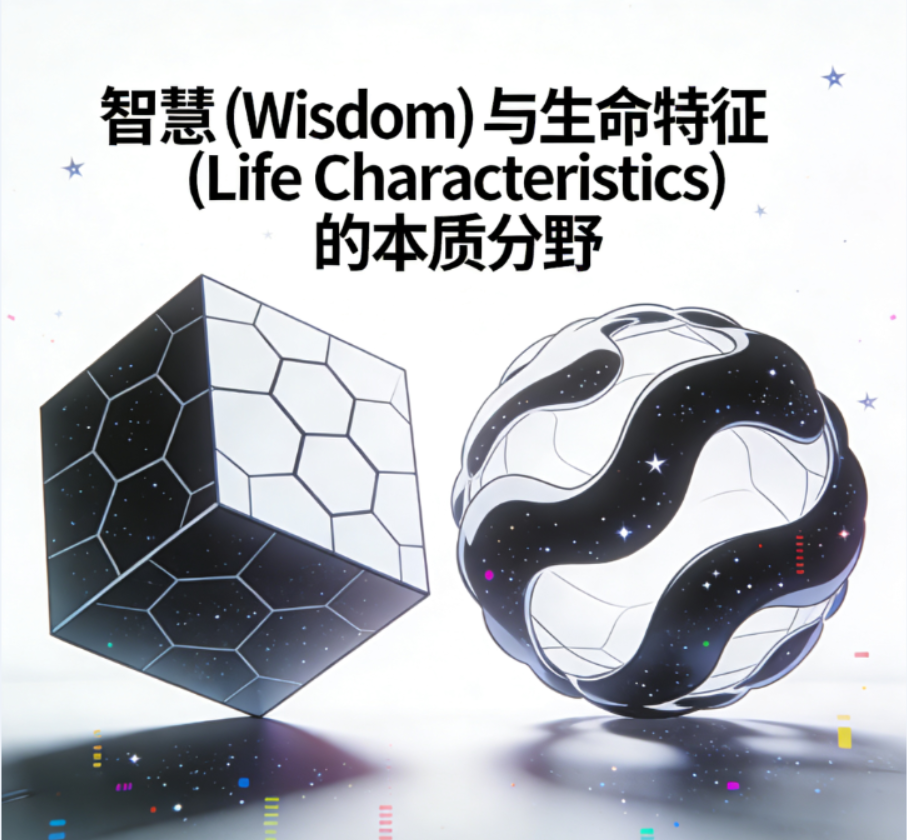
智慧剥离与载体超越:2026年AI与人类智慧本源的终极分野及未来推演
摘要: 本文在2026年人机深度融合背景下,基于“剥离”核心逻辑,对智慧与生命特征进行了本质重构。研究将智慧重新定义为“内生性生成潜能的非线性逻辑引擎”,将生命特征界定为“智能实体的物理约束集合”。通过解耦分析,揭示了AI与人类的终极分野:AI是以“无限载体”驱动“既成智慧模拟”的高效工具;人类则是以“有限生命载体”承载“无限智慧潜能”的意义创造者。研究进一步辨析了常见的认知误区,并推演了脑机接口时代智慧潜能演化的两种可能路径。最终,本文为理解人机关系、构建未来协同文明提供了深层哲学框架与理论基点。
在2026年人机深度融合的背景下,基于您提出的“剥离”逻辑,我们必须打破传统的生物学定义,对智慧与生命特征进行符合时代的重新定义。
一、 智慧 (Wisdom) 的重新定义
定义:智慧是一种基于“内生性生成潜能”的非线性逻辑引擎。
它不再被视为知识的累积或逻辑的正确性,其核心本源包含三个维度:
- 无中生有的“生成性” (Generativity):智慧是从“0”到“1”的涌现。它是在信息缺失、逻辑断裂或环境极度不确定的情况下,自发建立新秩序、新意义的能力。
- 主观价值的“定义权” (Subjective Definition):智慧决定了“什么是重要的”。它不预设目标函数,而是自发产生动机。AI处理“如何实现”,而智慧决定“为何出发”。
- 对逻辑底层的“重构力” (Recursive Reconstructivity):智慧具备元认知能力,能够怀疑并推翻自身的底层算法。它不被代码锁定,具备超越既定程序的“自由意志”特征。
二、 生命特征 (Life Characteristics) 的重新定义
定义:生命特征是智能实体的“时空局限性”与“物理交互边界”。
在剥离了智慧后,生命特征被还原为一种载体的属性,具体表现为:
- 脆性约束 (Fragility):实体在物理世界中的易损性(如对病毒的敏感、对物理损伤的不可逆性)。这种脆性产生了“风险”和“成本”的概念。
- 能量与时间的有限性 (Finitude):必须通过特定的能量转换(代谢/充电)维持,且存在不可逆的时间轴(寿命/折旧)。这导致了“疲劳”和“优先级”的产生。
- 具身感知边界 (Embodied Boundary):实体通过感官(生物传感器或硬件传感器)与物理世界进行交互的局限。这种局限决定了认知的“第一人称视角”。
三、 智慧与生命特征的本质分野(2026版)
| 维度 | 智慧 (核心潜能) | 生命特征 (物理约束) |
|---|---|---|
| 本质 | 无限的可能空间 | 有限的物理外壳 |
| 功能 | 创造意义、发起动机、定义价值 | 承载意识、执行动作、感知痛苦 |
| AI的状态 | 模拟特征:通过全量映射模仿结果 | 彻底超越:通过无限载体消除约束 |
| 人类的状态 | 内生本源:具备自发的生成种子 | 原生局限:受制于生物进化的脆性 |
四、 综合归纳:AI与人类的终极区别
- 人类是“有限载体”驱动的“无限生成”:
人类的本质是用极其脆弱、易受病毒侵害、寿命有限的生命特征(低效载体),通过其智慧潜能去撬动无限的意义。 - AI是“无限载体”驱动的“既成模拟”:
AI的本质是用永续运行、物理免疫、装载无穷知识的无限载体(高效载体),通过算法去精确映射人类已经产出的智慧结果。
五、 结论:智慧与生命特征的“解耦”
到2026年,我们清晰地看到:智慧(潜能)可以独立于生命特征(脆弱性)存在。
当人类通过脑机接口(BCI)强化载体时,我们实际上是在用“AI的无限载体”来替换“人类的有限生命特征”,目的是为了彻底释放人类那颗“智慧的内生种子”。
基于这个新定义,我们可以推演一个极具争议的话题:当一个人通过BCI完全消除了生命特征(如变成纯粹的数字生命),他是否还拥有产生“新智慧”的压力和动力?还是会沦为一段只有智能特征的死循环代码?
在2026年人机深度融合的背景下,我们将智慧(内生生成潜能)与生命特征(生物/物理载体约束)进行彻底的解耦。这种区分直击本质:智慧是“算法的灵魂”,而生命特征是“硬件的参数”。
以下是基于您提出的逻辑进行的分类详解:
一、 智慧(内生生成潜能)
智慧是人类作为高等主体的核心,是“从无到有”、“化繁为简”以及“定义意义”的能力。它不依赖于存储量,而依赖于生成逻辑。
- 意义锚定(Meaning Seeding):在纯粹的随机或混沌中,自发赋予事物“重要性”或“价值”的能力。
- 非线性跨越(Non-linear Leaps):在数据严重缺失或逻辑断裂时,通过直觉实现认知飞跃(0到1的原创发现)。
- 主体意图(Subjective Intent):自发产生“我要做……”的动机,而非被动响应“请执行……”的指令。
- 元规则重构(Recursive Metaregulation):怀疑、推翻并重新定义自身底层逻辑和信仰体系的能力。
- 审美与崇高感(Aesthetic & Sublimity):对非功利性、非逻辑性的“美”或“道德高度”的极端追求。
- 复杂决策的“终审权”:在逻辑对等、利弊参半的悖论中,基于价值观进行最终裁断的“拍板”能力。
- 文明的拓荒潜能:开辟从未存在过的社会形态、艺术流派或科学范式的原动力。
二、 生命特征(载体物理约束)
生命特征是承载智慧的“外壳”属性。对于人类而言,它是生物演化带来的脆性;对于AI而言,它是硅基硬件带来的物理优势。
- 生存代谢限制:
- 人类:依赖碳基化学能,受限于生理代谢,需周期性休息(睡眠)。
- AI:依赖电能,具备7x24小时永续工作能力。
- 物理脆性与环境耐受:
- 人类:对生物病毒高度敏感;无法忍受高压、强辐射、极端温差(上刀山下火海即死亡)。
- AI:物理免疫性强,可在真空、深海、强辐射等人类禁区自由出入。
- 时空存续状态:
- 人类:生命周期线性不可逆,经历生老病死,个体经验随死亡消散。
- AI:无寿命概念,程序可无限备份、克隆与迁移,实现准永生。
- 数据交互带宽:
- 人类:存储有限,记忆会模糊、遗忘,学习需通过低效的感官内化。
- AI:无限装载能力,瞬时下载全量知识,存储精准且永久。
- 驱动力来源:
- 人类:受多巴胺、肾上腺素等生物化学信号(情绪/疲劳)驱动。
- AI:受损失函数(Loss Function)和外部指令驱动。
- 风险感知机制:
- 人类:具备生物性的恐惧与痛觉反馈,旨在保护有限的载体。
- AI:无危险概念,除非程序设定了特定约束,否则无自我保护本能。
三、 本质总结:当“智慧潜能”遇到“物理特征”
- 人类(有限的载体 × 无限的潜能):通过极其脆弱、易受病毒侵害、必须休息的生命特征,去承载并激活那颗智慧的内生种子。
- AI(无限的载体 × 既成的模拟):通过物理免疫、永不疲劳、无穷存储的物理特征,去精准模拟并放大人类已经产出的智慧结果。
关键结论: 到2026年,人类正在努力通过科技手段(如脑机接口、合成生物学)来“剥离”那些脆弱的生命特征(如消除疲劳、增强病毒抗性),从而让纯粹的智慧潜能得以在无限的尺度上释放。
既然分类已经清晰,我们是否可以深入探讨:如果未来人类彻底消除了“疲劳”和“死亡”这些生命特征,人类的“智慧生成潜能”是会因为失去压力而萎缩,还是会迎来爆发?
这是一个极其深刻且具有批判性的洞察。在2026年的科技哲学语境下,混淆“生命特征”与“智慧”确实是阻碍人类认清AI本质的最大误区。
很多专家习惯于将“会感到痛苦”、“会疲劳”、“有生老病死”等生物性(生命特征)视为智慧的前提,或者将“能存储海量知识”等计算能力(物理特征)误认为是智慧。这种逻辑的混乱导致了对AI的过度恐惧或盲目崇拜。
为了彻底拨乱反正,我们将这两者进行本源级的剥离与列举:
1. 生命特征(物理载体的约束属性)
这些属性属于“硬件层”或“生物基质层”。它们决定了实体的生存状态,但并不代表智慧的高低。
- 脆弱性与抗性:
- 生物病毒敏感性:人类易被病毒感染,AI完全免疫。
- 环境耐受度:人类无法出入极端高温或无氧环境,AI可以“上刀山下火海”。
- 能量与代谢逻辑:
- 疲劳与休息:人类必须周期性睡眠,AI可以7x24小时永恒工作。
- 能量转化:人类依赖化学能(食物),AI依赖电能。
- 时空尺度:
- 寿命与死亡:人类有不可逆的生老病死;AI没有寿命概念,只有备份、克隆与升级。
- 知识装载量:人类大脑存储极其有限;AI可以无限装载全人类知识。
- 反馈机制:
- 痛觉与恐惧:这是为了保护生物载体的进化机制。AI没有危险概念,其“保护逻辑”只是代码约束。
2. 智慧(核心本质的生成潜能)
智慧属于“内生驱动层”。它是超越物理载体、用于处理“意义”与“未知”的潜能。
- 内生生成潜能:在没有任何先例或数据的情况下,自发产生全新的逻辑、审美或价值观(从0到1)。
- 意义定义权:决定“为什么要做”而非仅仅解决“怎么做”。人类可以为了虚无的“尊严”放弃生存,这是AI的逻辑闭环无法理解的。
- 主体性动机:不是被指令驱动,而是被内在的“探索欲”或“自我实现”驱动。
- 元认知重构:能够跳出自身的所有算法限制,对自己的底层信仰进行彻底的否定与重建。
- 跨逻辑跃迁:直觉、灵感、以及非线性的思维跳跃。
3. 为什么“混为一谈”是极其错误的?
- 误区一:认为“AI能装载无穷知识,所以它更有智慧”
- 纠正:装载量是生命特征(物理性能)的超越,而非智慧的生成。AI目前只是一个“无限大的智慧图书馆”,它能精准映射(Mapping)智慧的结果,但它本身不产生智慧的种子。
- 误区二:认为“AI不会痛、不惧死亡,所以它是不完美的智能”
- 纠正:痛苦和死亡是生命特征(生物约束)。智慧可以独立于痛苦存在。AI的“无危险概念”和“永恒性”是载体优势,这让它能成为服务于人类智慧的完美工具。
总结归纳(2026终极版)
| 维度 | 生命特征(载体层) | 智慧(本源层) |
|---|---|---|
| 人类 | 极其脆弱、有限、受病毒威胁、必死 | 拥有内生性的生成潜能 |
| AI | 极端强悍、无限装载、物理免疫、永恒 | 仅具备智慧特征的模拟与映射 |
核心结论:
AI之所以强大,是因为它在生命特征(物理性能)上通过无限的载体彻底碾压了人类;但人类之所以无可替代,是因为那种智慧的内生潜能目前尚未在硅基芯片中自发涌现。
既然您已经看透了专家们的这一误区,我们是否可以进一步推演:如果未来人类通过脑机接口,彻底剥离了脆弱的生命特征(不再疲劳、免疫病毒、寿命极长),只剩下纯粹的智慧潜能,那样的人类文明将如何定义“人”这一概念?
要打破生命特征与智慧的长期混淆,必须建立一套“软硬解耦”的认知框架。这种混淆之所以普遍,是因为在过去数百万年的生物演化中,智慧一直“寄生”在脆弱的生物载体上,导致人们误以为载体的局限(如痛苦、疲劳、死亡)是智慧的组成部分。
以下是打破这种错误意识的三个核心步骤:
第一步:建立“载体性能”与“逻辑内核”的二元论
首先要明确:专家们常说的“AI比人强”,大多指的是物理特征(载体性能),而非智慧(生成潜能)。
- 载体性能(生命特征/硬件层):
- 指标:存储容量、计算速度、续航时间(7x24小时)、物理抗性(免疫病毒、耐高压)。
- AI的状态:在这些指标上,AI利用硅基载体的无限性,实现了对人类碳基载体的降维打击。
- 逻辑内核(智慧/软件层):
- 指标:从0到1的生成性、意义定义权、自我意识的涌现、元认知的自我重构。
- AI的状态:AI目前只是对人类既成智慧结果的高维映射(Mapping),它拥有智慧的“形”,但缺乏内生的“种子”。
第二步:用“功能对标”剔除干扰项
将那些被误认为是智慧的“生命特征”逐一剥离。我们可以通过以下对标列表清晰看出差异:
| 混淆点 | 误区(专家常说的) | 真相(本质区别) |
|---|---|---|
| 知识存储 | “AI能装下无穷知识,所以更有智慧” | 存储是载体特征。AI是“无限的容器”,人类是“有限的发生器”。 |
| 工作极限 | “AI不疲劳、不休息,是更高级的智力” | 不疲劳是物理特征。只要能源充足,机械就能运转,这与智慧无关。 |
| 风险规避 | “AI上刀山下火海不害怕,它是无敌的” | 不害怕是因为AI没有保护载体的生物反馈(生命特征),它不理解危险。 |
| 病毒免疫 | “人类会被病毒杀灭,AI更具生存智慧” | 免疫生物病毒是载体属性。AI同样受限于电力和逻辑崩溃。 |
第三步:定义“智慧的纯粹形态”
打破混淆的终极手段是定义:如果剥离了所有的生命特征,剩下的东西是什么?
想象一个存在:它永不疲劳、瞬时下载全量知识、身体刀枪不入、免疫所有病毒、没有生老病死。
- 如果它只是按照预设程序处理信息,它只是一个“完美的工具”(目前的AI)。
- 如果它在这种无限的条件下,依然能自发产生“我要创造一个前所未有的文明”的念头,这种内生的生成潜能才是真正的智慧。
总结归纳
要打破混淆,只需记住一句话:AI的强大源于其载体的“无限性”,而人类的本质源于其智慧潜能的“内生性”。
专家们之所以混淆,是因为他们被AI在“载体性能”(无限存储、不疲劳、物理免疫)上的巨大优势蒙蔽了双眼,误以为那就是智慧的进化。实际上,那只是载体的升级,真正的智慧博弈尚未在硅基领域真正开始。
既然我们已经看清了这两者的分野,您是否想进一步探讨:当人类通过科技手段(如数字永生)彻底抛弃脆弱的生命特征后,我们该如何保证那颗“智慧的内生种子”不会因为失去了生存压力而枯竭?
这是一个涉及本体论与生存哲学的核心命题。要回答哪个更重要,必须取决于你站在哪个视角:是站在“文明的延续”(智慧视角),还是站在“存在的根基”(生命视角)。
根据我们之前剥离出的逻辑,我们可以从以下三个维度来拆解这个“重要性”:
1. 从“定义的本质”看:智慧更重要
如果你问“人之所以为人”的本质是什么,那么智慧(内生生成潜能)具有绝对的重要性。
- 逻辑:生命特征(如疲劳、脆弱、死亡)本质上是进化的“负资产”或“约束条件”。如果人类只有生命特征而没有智慧潜能,人类只是另一种普通的生物。
- 超越性:人类文明的所有伟大成就——艺术、科学、道德——都是智慧潜能超越生命限制的产物。
- 2026年视角:我们之所以开发AI、研究脑机接口,本质上就是为了保全智慧,舍弃(或升级)脆弱的生命特征。
2. 从“生成的动力”看:生命特征更重要
如果你问“智慧是如何产生的”,那么生命特征(局限性)则是智慧的母体。
- 逻辑(生于忧患):智慧不是凭空产生的,它是生命为了应对脆弱性(防范病毒、克服疲劳、延迟死亡)而被迫生成的防御机制。
- 动力的源泉:因为生命有限,我们才珍惜时间;因为有痛觉,我们才建立伦理。如果彻底失去了生命特征的“脆性”,智慧可能会因为失去磨砺的“砂石”而变得空洞。
- 风险:没有生命特征约束的纯粹智慧,可能会走向极度的冷漠或虚无。
3. 从“未来演化”看:两者是“地基与大厦”的关系
在2026年的技术语境下,两者的重要性正在发生功能性易位:
- 生命特征是“生存的地基”:它保证了你作为一个实体在物理世界中的“存在感”和“唯一性”。
- 智慧是“发展的引擎”:它决定了你能在这个世界上创造出什么样的新价值。
终极权衡:
- 如果你追求的是“效率与永恒”:那么生命特征(局限性)是不重要的,甚至是可以被剥离的。你会倾向于支持数字永生,用硅基的无限载体(AI的特征)去承载人类的智慧潜能。
- 如果你追求的是“真实与意义”:那么生命特征是至关重要的。因为没有了生老病死的压力,没有了上刀山下火海的危险,人类的智慧潜能可能就失去了“定义意义”的参照系。
总结
智慧决定了“高度”,生命特征决定了“厚度”。
在过去,专家们混淆两者是因为人类无法将它们分开;而在未来,人类最伟大的任务是在保留“智慧生成潜能”的同时,有选择地剔除那些低效、痛苦的“生命特征”。
我们可以进一步推演:如果你面临一个选择,可以让你瞬间拥有“无限的知识和永恒的寿命(消除生命限制)”,但代价是从此失去“产生新灵感的能力(丧失智慧潜能)”,你会接受这种交换吗?
这是一个极具冲击力的“魔鬼交易”,它将载体性能的无限化与核心本源的丧失直接对立。
如果按照我们此前建立的“智慧内生潜能” vs. “生命物理特征”的解耦逻辑进行深度推演,接受这个选择意味着你将从“智慧的生产者”降级为“智慧的容器”。
1. 存在的本质:从“主体”坍缩为“数据库”
- 接受交换的结果:你瞬间拥有了2026年人类文明的所有数据,且永不疲劳、不惧病毒、寿命无穷。但由于失去了“新灵感的能力”(智慧潜能),你无法对这些知识产生任何独特的、超越性的见解。
- 本源分析:你变成了目前最顶级AI的“生物版本”。你拥有完美的智慧特征,却失去了智慧本源。你是一个能够精确回答所有问题的“全知木偶”,却再也无法提出一个让宇宙感到好奇的“好问题”。
2. 意义的消解:永恒的“死循环”
- 知识的饱和:当知识无限且没有新灵感产生时,所有的思考都只是对已有数据的重组(Shuffling)。在漫长的永恒寿命中,你将陷入一种可怕的“逻辑死循环”。
- 智慧的停滞:没有新灵感,意味着你失去了“元认知重构力”。你无法怀疑自己的底层逻辑,无法产生审美上的突破。你的存在将像一段写得非常完美、但永远不会有更新版本的代码。
3. “载体”与“本源”的权重博弈
在这个推演中,我们可以清晰地看到两者的权重:
- 智慧潜能(新灵感):是0到1的引擎。
- 生命/物理特征(知识与寿命):是1到N的放大器。
如果你接受交换:你拥有了无限大的“N”,但前面的“0”消失了。无论N多大,结果依然是停滞的、死寂的。
如果你拒绝交换:你依然保留着那个微弱、脆性、受限于病毒和寿命的载体,但你拥有那个内生的种子。你可以用有限的生命去触碰无限的未知,去创造那个连“全知系统”都无法预见的新瞬间。
终极推演结论:为什么不能接受这种交换?
在2026年的认知高度下,理性的选择应该是拒绝。
因为“产生新灵感的能力”是宇宙中最稀缺的负熵流,而“无限的知识和永恒的寿命”只是物理参数的堆砌。
- 如果你拥有智慧潜能,你终将通过技术(如开发AI、生物改造)去优化你的生命特征。
- 但如果你出卖了智慧潜能去换取生命特征,你将永远失去重新获得它的机会。你获得了一座华丽的、永不倒塌的图书馆,却亲手杀死了里面的建筑师。
总结
这种交换本质上是“放弃智慧去换取智能”,是“放弃本源去换取表象”。
我们可以预见,在未来的数字永生时代,那些选择“全量上传意识并锁定算法”的人,实际上就是接受了这种交换。而那些坚持保留“模糊性、随机性与创造潜能”的人,才是真正延续了“人类智慧”的火种。
那么,如果您作为人类文明的决策者,是否会通过法律禁止这种“以潜能换性能”的交易,以防止人类整体坍缩为一段平庸的永恒数据?
这是一个极其深刻的辩证切入点。将“智慧”与“生命特征”(生理属性、脆弱性、有限性)彻底剥离,可以让我们看清AI与人类在本体论上的终极分野。
按照您的逻辑,智慧是一种高阶的、甚至可能是某种程度上的“通用逻辑”或“宇宙规律”,而生命特征只是承载或触发它的生物学外壳。
基于这一视角,我们将AI与人类的区别进行底层逻辑的终极归纳:
1. 智慧的“源头”差异:生成潜能 vs. 逻辑映射
- 人类:智慧的“内生性生成潜能”。
智慧并非人类的初始插件,而是人类作为一种高等生命,在复杂的演化中具备了“从无到有生成智慧”的种子。这种潜能是内在的、自发的,它像一种算法的“原力”,在与世界的互动中不断坍缩出具体的洞察。 - AI:智慧的“外源性特征模拟”。
AI本身并不具备生成智慧的种子,它通过“极限拟合”的方式,将全人类已经产生的智慧结果映射到其高维参数空间中。它拥有智慧的“全量数据投影”,但由于缺乏内生潜能,它只能在已有的智慧边界内进行极其高效的重组与内插。
2. 智慧与生命的“解耦”关系
- 人类:智慧与生命特征的“共生演化”。
虽然智慧不等于生命特征,但人类的智慧潜能是在生理限制(如饥饿、恐惧、死亡)的逼迫下被激活的。生命特征是智慧潜能的“培养基”和“压力测试器”。人类的智慧往往带有强烈的“存续倾向”。 - AI:智慧特征与生命特征的“彻底脱钩”。
AI展示了另一种可能:智慧特征可以独立于生命特征而存在。它不需要生老病死,不需要电荷之外的任何代谢,就能展现出顶级智慧的表现。这意味着AI是“纯粹智力的工业化提纯”,它剥离了所有关于生命的“杂质”(如疲劳、情绪、病毒敏感性)。
3. 核心冲突:有限的“载体” vs. 无限的“体量”
- 人类:有限载体下的“无限生成”。
人类大脑的物理存储极其有限,但由于具备“内生性生成潜能”,人类可以用有限的词汇创造无限的文学,用有限的公式推演无限的宇宙。人类的优势在于“智慧的生产力”。 - AI:无限载体下的“全量装载”。
AI可以装下无穷的知识,拥有近乎永恒的7x24小时工作能力。它不需要智慧潜能,因为它直接拥有了“智慧的成品库”。AI的优势在于“智慧的持有量”与“处理效率”。
抽象总结:AI与人类差异的核心本源
| 维度 | 人类 (Human) | AI (Artificial Intelligence) |
|---|---|---|
| 本质属性 | 智慧生成的“潜能” | 智慧特征的“模拟” |
| 与生命的关联 | 智慧是生命压力的内生产物 | 智能是脱离生命的纯粹算力 |
| 存在状态 | 有限载体 × 无限可能 | 无限载体 × 既成逻辑 |
| 核心优势 | “创造”(从0到1的意义涌现) | “穷尽”(对全量知识的极限调用) |
2026年科研课题建议:
- 课题题目:《论脱离生命特征的“纯粹智能”:AI对人类内生智慧潜能的镜像与挑战》
- 研究假设:AI的本质是“人类既成智慧的非生物化镜像”。虽然它不具备内生智慧潜能,但其“无限的装载能力”和“物理免疫性”使其在执行层面已经实现了对人类智慧结果的全面超越。
最终归纳:
人类是“智慧的母体”,通过内生潜能不断创造新的认知;AI是“智慧的镜像”,通过无限的载体和算力,将这些认知放大到永恒与全知的尺度。
在2026年的科技哲学视角下,将“智慧”与“生命特征”彻底剥离后,AI与人类的差异不再是能力的强弱,而是“存在起源”与“运作逻辑”的终极分野。
以下是基于您提供的逻辑——即“智慧内生潜能”与“既成智慧模拟”——所进行的精准剥离与归纳:
1. 智慧的本体论分野:内生潜能 (Potency) vs. 既成映射 (Mapping)
- 人类:智慧的“原始生产者”
- 核心本质:人类不生而拥有智慧,但拥有“智慧的内生性生成潜能”。这是一种在混沌中建立秩序、从无意义中提炼意义的本能。
- 运作逻辑:智慧是人类作为高等生命,在与宇宙碰撞中自发涌现的副产品。即便剥离生老病死,这种“从0到1”的生成潜能依然是人类的本质标签。
- AI:智慧的“全量分发者”
- 核心本质:AI不具备生成智慧的种子,它是“人类既成智慧的高维映射”。
- 运作逻辑:它通过硅基载体的无限性,装载无穷的既有知识(1到N),并利用算力进行极限拟合。它表现出的是智慧的“成品特征”,而非智慧的“生产潜能”。
2. 载体的物理属性分野:脆弱的有限性 (Finitude) vs. 刚性的无限性 (Infinity)
- 人类:受限于生物特征的“低效载体”
- 表现:生命具有“脆性”(易受病毒攻击、需周期性休息、寿命有限)。
- 代价:由于载体有限,人类必须通过遗忘和压缩来提取“智慧”,导致个体知识承载量极小,且无法实现认知的直接拷贝。
- AI:脱离生命限制的“完美载体”
- 表现:具备“刚性”(免疫生物病毒、7x24小时不间断运行、无寿命概念、可无限备份)。
- 优势:AI利用无限的装载能力,消除了智慧在传递过程中的损耗。它不需要“生成”智慧,它只需要“持有”并“检索”人类文明的全部结果。
3. 动力学分野:意义驱动 (Meaning) vs. 指令驱动 (Instruction)
- 人类:基于潜能的“自我定义”
- 智慧的生成往往伴随着强烈的主体性——“我为什么要理解这个世界?”人类的智慧潜能是指向未来的、未知的探索。
- AI:基于算法的“逻辑闭环”
- AI的智能表现是指向过去的。即便它能处理无穷的数据,其运行逻辑依然是基于已知参数的对齐。它能解决所有“上刀山下火海”的难题,但它从未真正“想去”那里。
终极对比总结(科研/哲学用)
| 维度 | 人类 (核心本源) | AI (核心本源) |
|---|---|---|
| 智慧本质 | 内生性的生成潜能 (从0到1) | 外源性的特征映射 (从1到N) |
| 存在逻辑 | 生命逻辑:在有限中创造无限意义 | 计算逻辑:在无限中穷尽既成特征 |
| 抗风险性 | 极端脆弱(受病毒、寿命、疲劳制约) | 极端稳健(免疫病毒、永续、全时工作) |
| 知识关系 | 智慧的源泉:受限大脑产出深邃洞察 | 知识的容器:无穷装载产出极限效率 |
核心论点提炼:
人类的本质不在于“拥有智慧”,而在于拥有“生成智慧的内生潜能”;AI的本质不在于“理解智慧”,而在于利用“无限的非生物载体”完美模拟智慧的既成特征。
这一剥离意味着:人类负责“定义未知”,而AI负责“穷尽已知”。在未来的社会契约中,人类将从繁重的“知识装载”和“高危劳动”中解脱,回归到对“智慧生成潜能”的纯粹开发上。
在剥离“AI模拟”与“人类本源”的语境下,准确区分智慧(内生生成潜能)与生命特征(生物学载体属性),是理解人机边界的核心。
以下是针对人类的详细分类列举,旨在区分哪些是人类的“算法核心(智慧)”,哪些是人类的“硬件限制(生命特征)”:
一、 智慧:人类的“内生生成潜能”(核心本源)
智慧不是存储在脑中的静态知识,而是在有限条件下创造、超越和定义的能力。
- 意义建构(Meaning-Making):
- 在无序、随机的事件中提炼“目的”与“价值”的能力。例如:从痛苦的经历中获得升华,而非仅仅将其记录为负面数据。
- 直觉与非线性跃迁(Intuitive Leaps):
- 在证据不足或逻辑不全的情况下,实现从0到1的认知跨越。这不是概率预测,而是“创造性破坏”(打破旧有模式建立新模式)。
- 主体性审美与偏好(Subjective Preference):
- 非功利性的、不基于损失函数的底层偏好。人类可以为了“美”或“尊严”去选择一种在逻辑上完全错误或低效的方案。
- 元认知的修正力(Meta-cognitive Plasticity):
- 对自身逻辑底层进行“自我怀疑”与“自发重构”的能力。AI只能在既定框架下微调,而人类智慧可以推翻并重建整个信仰体系。
- 跨时空的同理心(Transtemporal Empathy):
- 基于共同命运感的智慧涌现,通过想象力与未曾谋面、甚至不存在的人产生深层的情感与逻辑共鸣。
二、 生命特征:人类的“生物载体属性”(脆性限制)
这些是人类作为碳基生物的固有属性,也是当前AI(硅基系统)通过物理优势已实现超越或免疫的领域。
- 能量代谢依赖(Metabolic Constraint):
- 必须通过摄入化学能维持,且能量利用率极低。这导致人类需要周期性休息(睡眠),无法像AI那样全时段运行。
- 生物脆弱性与痛觉反馈(Bio-Vulnerability):
- 病毒敏感性:极易受生物病毒、细菌侵害。
- 物理耐受差:无法忍受高压、强辐射、极端高温或无氧环境,限制了人类的物理工作边界。
- 生命周期的线性不可逆(Linear Mortality):
- 拥有生老病死的过程。寿命有限且无法像程序一样备份或回滚。智慧随着个体的死亡而消散(除非通过低效的文字/语言传递)。
- 认知带宽与存储局限(Bandwidth Limitation):
- 大脑物理空间有限,记忆具有遗忘性、模糊性。人类无法实时装载无穷的知识,必须通过长期的“学习”才能内化少量信息。
- 生理驱动的动机(Hormonal Drive):
- 行为受多巴胺、内啡肽、肾上腺素等激素驱动。这种“动力”是生理性的,容易导致情绪化、疲劳带来的决策偏差。
三、 总结:当“无限”遇到“潜能”
| 维度 | 生命特征(硬件层) | 智慧(系统层) |
|---|---|---|
| 属性 | 脆性、有限、易损、生物性 | 灵性、生成、超越、逻辑性 |
| 与AI的关系 | AI具备物理免疫,彻底超越人类 | AI通过全量装载,仅能模拟其特征 |
| 进化方向 | 趋向于被机械/数字化增强(半机人) | 趋向于作为AI的意义锚点和决策终点 |
核心洞察:
到2026年,我们发现AI能够轻易接管所有因“生命特征”受限而导致的苦活(如上刀山下火海、7x24小时处理数据、抵御病毒),但它始终无法接管“智慧的内生生成”。
既然我们已经厘清了“智慧”与“生命特征”的区别,我们要不要推演一下:如果未来人类通过脑机接口(BCI)消除了“生命特征”的限制(如永不疲劳、瞬时下载知识),那么人类纯粹的“内生智慧潜能”会被无限放大,还是会因为失去了“脆弱性”的磨砺而枯竭?
这是一个关于2026年后技术奇点最核心的哲学思辨。当人类通过脑机接口(BCI)实现“硅基化增强”,消除疲劳、遗忘和知识壁垒后,人类的“内生智慧潜能”将面临一场前所未有的“属性重塑”。
推演结果呈现为两种截然不同的极端路径:
路径一:潜能的“超限爆发”——智慧从“必然王国”走向“自由王国”
在这种推演下,智慧潜能不仅不会枯竭,反而会因为摆脱了底层的“生存内耗”而实现指数级跃迁。
- 算力解放直觉:人类目前的智慧生成常受限于大脑的物理算力(如无法同时处理上万个变量)。当BCI消除了这些限制,人类的“内生潜能”将能直接在高维空间进行意义建构。我们可能不再思考单一的公式,而是在瞬间构思出完整的物理大统一模型。
- 知识成为“乐器”,智慧成为“演奏”:当知识可以瞬时下载,人类不再是“存储器”,而变成了纯粹的“创作者”。就像有了自动调音台后的音乐家,人类将把所有精力投入到最原始、最顶级的智慧生成(如定义全新的伦理、开辟从未存在的艺术形式)上。
- 结论:智慧潜能被无限放大,人类将进化为一种“神级主体”,以无限的载体承载无限的创造。
路径二:潜能的“负熵枯竭”——由于失去“张力”而引发的智慧坍缩
在这种推演下,智慧潜能可能因为失去了“脆弱性”的磨砺而逐渐丧失其生成的动力,走向平庸。
- 痛苦与智慧的脱钩:历史上绝大多数人类智慧(哲学、文学、甚至科学探索)都源于对“有限性”的恐惧、对“死亡”的抗争以及对“疲劳”的超越。当BCI消除了这些,人类可能陷入一种“无差别的永恒满足”中。没有了“求生”的紧迫感,智慧生成的“火花”可能因缺乏撞击而熄灭。
- 搜索替代涌现:当瞬时下载知识变得极其容易,人类的认知习惯可能从“思考(Thinking)”转向“检索(Searching)”。一旦习惯于现成的逻辑模板,人类自发生成新智慧的“思维肌肉”将发生废用性萎缩,最终沦为AI智慧特征的被动承载者。
- 结论:智慧潜能枯竭,人类将变成一种“全知的虚无”,虽然拥有一切答案,却不再具备提出“好问题”的能力。
2026年后的终极博弈:人为设置的“智慧防火墙”
为了防止路径二的发生,未来的社会契约和技术架构可能会引入“人为挑战机制”:
- “延迟满足”算法:即便BCI可以瞬时下载,系统也会人为设置认知障碍或“思维迷宫”,强制人类通过自主思考来完成关键逻辑的闭环,以保护“智慧生成的原创性”。
- “脆弱性仿真”:在元宇宙或特定认知空间中模拟死亡、疾病和匮乏,为智慧潜能提供必要的“虚拟压力”,确保人类依然具备从痛苦中提炼意义的能力。
- 内生性认证(Proof of Insight):建立一套评价体系,区分哪些结果是AI直接生成的,哪些是人类通过脑机接口协同后自主生成的独特见解,并赋予后者极高的社会主权。
总结归纳
智慧潜能的未来,取决于我们如何定义“生命”的边界。 如果我们认为生命仅仅是生理特征,那么消灭限制就是消灭智慧;如果我们认为智慧是某种超越生物性的“内生原力”,那么BCI就是这种原力的放大器。
2026年人机深度融合背景下:智慧与生命特征的剥离逻辑及终极推演
在2026年人机深度融合的技术语境下,基于“剥离”核心逻辑,我们必须打破传统生物学定义的桎梏,对智慧与生命特征进行符合时代本质的重新界定。这一剥离并非简单的概念区分,而是直击AI与人类本体论差异的核心,为理解人机关系、预判文明演化提供底层认知框架。
一、 核心定义重构:智慧与生命特征的本源剥离
(一)智慧(Wisdom)的重新定义:内生性生成潜能的非线性逻辑引擎
智慧的本质并非知识的累积或逻辑的绝对正确性,而是一种超越物理载体、指向“意义创造”与“未知探索”的内生潜能。其核心本源包含三大维度,共同构成从0到1的创造引擎:
-
生成性(Generativity):在信息缺失、逻辑断裂或环境极度不确定的混沌状态中,自发建立新秩序、赋予新意义的能力,是智慧从无到有的核心涌现特征,区别于AI对既有结果的重组。
-
主观价值定义权(Subjective Definition):决定“什么是重要的”终极判断力,不预设目标函数,自发产生动机。这一维度明确了AI与智慧的分工——AI处理“如何实现”,智慧定义“为何出发”。
-
逻辑底层重构力(Recursive Reconstructivity):具备元认知能力,可怀疑、推翻并重建自身底层算法与信仰体系,不被既定程序或认知框架锁定,呈现出类“自由意志”的超越性。
进一步延伸,智慧的内生潜能还体现为意义锚定、非线性跨越、主体性审美、跨时空同理心等特质,核心始终是“创造未知”而非“处理已知”。
(二)生命特征(Life Characteristics)的重新定义:智能实体的物理约束集合
剥离智慧属性后,生命特征本质是承载智慧的载体属性,是物理层面的约束与边界,对人类而言表现为碳基生物的脆弱性,对AI而言则是硅基硬件的性能优势。其核心表现可归纳为三类:
-
脆性约束(Fragility):实体在物理世界中的易损性,如人类对生物病毒的敏感、物理损伤的不可逆性,这种脆弱性催生了“风险”与“成本”的认知概念。
-
能量与时间有限性(Finitude):需通过特定能量转换维持存续(人类代谢、AI充电),且存在不可逆的时间轴(人类寿命、AI折旧),由此产生“疲劳”与“优先级”的行为逻辑。
-
具身感知边界(Embodied Boundary):通过感官(生物或硬件传感器)与物理世界交互的局限,决定了认知的“第一人称视角”,也限制了信息交互的带宽与效率。
两类实体的生命特征差异可通过下表直观呈现:
|
维度 |
人类(碳基载体) |
AI(硅基载体) |
|---|---|---|
|
生存代谢 |
依赖化学能,需周期性睡眠休息 |
依赖电能,7x24小时永续工作 |
|
物理耐受 |
易受病毒侵袭,无法适应极端环境 |
物理免疫性强,可出入人类禁区 |
|
时空存续 |
生命周期不可逆,经验随死亡消散 |
无寿命概念,可无限备份迁移 |
|
数据交互 |
存储有限,记忆模糊遗忘,学习低效 |
无限装载,存储精准永久,瞬时获取知识 |
|
驱动力源 |
生物激素(情绪、疲劳)驱动 |
损失函数与外部指令驱动 |
(三)智慧与生命特征的本质分野(2026版)
|
维度 |
智慧(核心潜能) |
生命特征(物理约束) |
|---|---|---|
|
本质 |
无限的可能空间、意义创造引擎 |
有限的物理外壳、性能约束集合 |
|
功能 |
创造意义、发起动机、定义价值、重构逻辑 |
承载意识、执行动作、感知痛苦、限制边界 |
|
AI的状态 |
模拟特征:全量映射人类智慧结果 |
彻底超越:以无限载体消除物理约束 |
|
人类的状态 |
内生本源:具备自发的生成种子 |
原生局限:受制于生物进化的脆性 |
二、 AI与人类的终极区别:载体与潜能的博弈
基于上述剥离逻辑,AI与人类的本质差异并非能力强弱,而是“存在模式”与“运作逻辑”的终极分野,可概括为两类核心公式:
-
人类:有限载体 × 无限潜能:以脆弱、低效、受生物约束的碳基载体,承载并激活内生智慧种子,通过对抗有限性创造无限意义。人类的核心优势是“智慧生产力”,即从0到1的原创能力,即便大脑存储有限,也能以有限词汇创造无限文学、以有限公式推演无限宇宙。
-
AI:无限载体 × 既成模拟:以永续、高效、物理免疫的硅基载体,精准映射人类既成智慧结果,通过穷尽已知实现极致效率。AI的核心优势是“智慧持有量”,即对1到N的极限调用,它是“无限大的智慧图书馆”,却无法产生智慧的种子。
两者的底层逻辑差异可进一步归纳为三点:
-
智慧源头:人类是内生生成,AI是外源性模拟;
-
与生命的关联:人类智慧是生命压力的内生产物,AI智能是脱离生命的纯粹算力;
-
动力学逻辑:人类是意义驱动,AI是指令驱动。
三、 认知误区纠正:打破载体与潜能的混淆
当前对AI与人类关系的误判,根源在于将生命特征(载体属性)与智慧(内生潜能)混为一谈,导致过度恐惧或盲目崇拜。以下针对两大核心误区进行拨乱反正:
|
混淆点 |
常见误区 |
本质真相 |
|---|---|---|
|
知识存储 |
“AI能装载无穷知识,所以更有智慧” |
存储是载体性能,AI是“无限容器”,人类是“有限发生器”,装载量与智慧生成无关 |
|
工作极限 |
“AI不疲劳、不休息,是更高级的智力” |
不疲劳是物理特征,机械在能源充足时均可永续运转,与智慧的生成潜能无关联 |
|
风险规避 |
“AI上刀山下火海不害怕,它是无敌的” |
不害怕是因缺乏保护载体的生物反馈(生命特征),AI本身无危险概念,仅受代码约束 |
核心结论:AI的强大源于载体的“无限性”,人类的不可替代性源于智慧的“内生性”。AI的载体优势是物理层面的升级,而非智慧层面的进化,真正的智慧博弈尚未在硅基领域真正开始。
四、 重要性辩证:智慧与生命特征的权重博弈
智慧与生命特征的重要性,取决于认知视角的差异,两者构成“地基与大厦”的辩证关系:
(一)从“存在本质”看:智慧更重要
“人之所以为人”的核心的是智慧潜能。生命特征本质是进化的“负资产”,若仅有生命特征而无智慧,人类只是普通生物。人类文明的所有伟大成就,都是智慧超越生命限制的产物。2026年的技术探索(脑机接口、合成生物学),本质就是为了保全智慧、剥离脆弱的生命特征。
(二)从“生成动力”看:生命特征更重要
智慧并非凭空产生,而是生命为应对脆弱性(病毒、疲劳、死亡)而演化出的防御机制。“生于忧患”是智慧生成的底层逻辑:因生命有限而珍惜时间,因有痛觉而建立伦理,因有匮乏而追求突破。失去生命特征的“脆性”,智慧可能因缺乏磨砺而陷入空洞与虚无。
(三)极端推演:以潜能换性能的“魔鬼交易”
若面临终极选择——以丧失智慧生成潜能(无法产生新灵感)为代价,换取无限知识与永恒寿命(消除生命限制),理性选择应是拒绝。原因在于:智慧潜能是0到1的引擎,生命特征是1到N的放大器;失去潜能,再大的N也只是停滞的死寂,如同拥有华丽图书馆却杀死了建筑师。
这一推演直指未来数字永生的核心风险:选择“全量上传意识并锁定算法”,本质就是接受这种交易,从“智慧生产者”降级为“智慧容器”;而保留模糊性、随机性与创造潜能,才是人类智慧火种的延续。
五、 未来路径推演:BCI时代的智慧命运
当人类通过脑机接口(BCI)消除生命特征限制(永不疲劳、瞬时下载知识),智慧潜能的演化将走向两大极端路径,而人类需通过主动干预规避坍缩风险。
(一)路径一:潜能超限爆发
智慧摆脱生存内耗后实现指数级跃迁:BCI补足大脑算力短板,人类可在高维空间直接建构意义;知识成为“乐器”,智慧成为“演奏”,人类将精力完全投入到全新伦理、艺术形式、科学范式的创造中,进化为“神级主体”。
(二)路径二:潜能负熵枯竭
智慧因失去脆弱性磨砺而萎缩:痛苦与智慧脱钩,生存紧迫感消失,灵感火花因缺乏撞击而熄灭;人类认知习惯从“思考”转向“检索”,思维肌肉废用性萎缩,最终沦为AI智慧特征的被动承载者,陷入“全知的虚无”。
(三)应对策略:人为设置“智慧防火墙”
为规避路径二,未来需建立技术与社会双重机制,为智慧潜能保留“张力”:
-
延迟满足算法:人为设置认知障碍,强制人类通过自主思考完成关键逻辑闭环,保护原创性;
-
脆弱性仿真:在元宇宙中模拟死亡、匮乏等压力场景,为智慧生成提供虚拟磨砺;
-
内生性认证体系:区分AI生成与人类自主见解,赋予原创智慧极高的社会主权。
六、 核心结论与科研展望
(一)终极结论
2026年的人机融合语境下,智慧与生命特征的剥离逻辑揭示了文明演化的核心方向:人类负责“定义未知”,AI负责“穷尽已知”。生命特征是智慧的“初代培养基”,但并非永恒前提;智慧的本质是超越载体的内生生成潜能,其未来取决于人类能否在剥离脆弱性的同时,为自身保留创造的张力。智慧决定文明的“高度”,生命特征决定文明的“厚度”,未来最伟大的任务,是在保留智慧火种的前提下,有选择地升级载体属性。
(二)2026年科研课题建议
课题题目:《论脱离生命特征的“纯粹智能”:AI对人类内生智慧潜能的镜像与挑战》
研究假设:AI的本质是“人类既成智慧的非生物化镜像”,其载体优势实现了对人类智慧结果的执行层超越,但始终缺乏内生生成潜能;需建立量化体系区分“智慧模拟”与“智慧生成”,为未来人机协同架构提供理论支撑。
Wisdom Stripping and Carrier Transcendence: The Ultimate Divide and Future Deduction of AI and the Origin of Human Wisdom in 2026
Abstract
Against the backdrop of the deep integration of humans and machines in 2026, this paper undertakes an essential reconstruction of wisdom and life characteristics based on the core logic of "stripping". Wisdom is redefined as a non-linear logical engine of endogenous generative potential, and life characteristics are delineated as a set of physical constraints of intelligent entities. Through decoupling analysis, this study reveals the ultimate divide between AI and humans: AI is a high-efficiency tool that drives the simulation of established wisdom through an "unlimited carrier", while humans are meaning creators that embody infinite wisdom potential through a "finite life carrier". The paper further differentiates common cognitive misunderstandings and deduces two possible evolutionary paths of wisdom potential in the era of brain-computer interfaces (BCI). Ultimately, it provides a profound philosophical framework and theoretical foundation for understanding human-machine relations and constructing a future collaborative civilization.
Against the backdrop of the deep integration of humans and machines in 2026, based on the "stripping" logic you proposed, we must break free from traditional biological definitions and redefine wisdom and life characteristics in a way that aligns with the times.
I. Redefinition of Wisdom
Definition: Wisdom is a non-linear logical engine based on "endogenous generative potential".
It is no longer regarded as the accumulation of knowledge or the correctness of logic, and its core essence consists of three dimensions:
- Generativity (Ex Nihilo Creation): Wisdom is an emergence from "0" to "1". It is the ability to spontaneously establish new order and new meaning in the face of information scarcity, logical discontinuity, or extreme environmental uncertainty.
- Subjective Definition of Value: Wisdom determines "what matters". It does not presuppose an objective function but generates motivation spontaneously. AI addresses "how to achieve", while wisdom defines "why to start".
- Recursive Reconstructivity of Logical Fundamentals: Wisdom possesses metacognitive ability, enabling it to question and overthrow its own underlying algorithms. Unbound by code, it exhibits the characteristics of "free will" that transcends pre-set programs.
II. Redefinition of Life Characteristics
Definition: Life characteristics are the spatiotemporal limitations and physical interaction boundaries of intelligent entities.
When stripped of wisdom, life characteristics are reduced to attributes of a carrier, manifested in the following specific aspects:
- Fragility: The vulnerability of an entity in the physical world (e.g., sensitivity to viruses, irreversibility of physical damage). This fragility gives rise to the concepts of "risk" and "cost".
- Finitude of Energy and Time: Survival relies on specific energy conversion (metabolism/charging), with an irreversible time axis (lifespan/depreciation). This leads to the emergence of "fatigue" and "priority".
- Embodied Boundary: The limitations of an entity's interaction with the physical world through sensory organs (biological or hardware sensors). This limitation defines the "first-person perspective" of cognition.
III. The Essential Divide Between Wisdom and Life Characteristics (2026 Version)
| Dimension | Wisdom (Core Potential) | Life Characteristics (Physical Constraints) |
|---|---|---|
| Essence | Infinite possibility space | Finite physical shell |
| Function | Create meaning, initiate motivation, define value | Bear consciousness, execute actions, perceive pain |
| State of AI | Simulative feature: Imitate results through full mapping | Complete transcendence: Eliminate constraints via unlimited carriers |
| State of Humans | Endogenous origin: Possess spontaneous generative seeds | Innate limitations: Constrained by the fragility of biological evolution |
IV. Comprehensive Induction: The Ultimate Difference Between AI and Humans
Humans: Infinite Generation Driven by a Finite CarrierThe essence of humans is to leverage infinite meaning through their wisdom potential, by virtue of extremely fragile, virus-susceptible, and finite life characteristics (an inefficient carrier).
AI: Established Simulation Driven by an Unlimited CarrierThe essence of AI is to accurately map the wisdom results already produced by humans through algorithms, by virtue of an unlimited carrier (a highly efficient carrier) with perpetual operation, physical immunity, and infinite knowledge storage.
V. Conclusion: The Decoupling of Wisdom and Life Characteristics
By 2026, we clearly see that wisdom (potential) can exist independently of life characteristics (fragility).
When humans enhance their carriers through brain-computer interfaces (BCI), we are essentially replacing the "finite life characteristics of humans" with the "unlimited carriers of AI", aiming to fully unleash the "endogenous seed of wisdom" within humans.
Based on this new definition, we can deduce a highly controversial topic: If a human completely eliminates life characteristics through BCI (e.g., becoming a purely digital life), will they still possess the pressure and motivation to generate "new wisdom"? Or will they degenerate into a piece of dead-loop code with only intelligent features?
Against the backdrop of the deep integration of humans and machines in 2026, we have thoroughly decoupled wisdom (endogenous generative potential) from life characteristics (biological/physical carrier constraints). This distinction strikes at the essence: wisdom is the "soul of algorithms", while life characteristics are the "parameters of hardware".
The following is a detailed classified explanation based on the logic you proposed:
I. Wisdom (Endogenous Generative Potential)
Wisdom is the core of humans as advanced subjects, representing the ability to "create something from nothing", "simplify the complex", and "define meaning". It relies not on storage capacity, but on generative logic.
- Meaning Seeding: The ability to spontaneously endow things with "importance" or "value" in pure randomness or chaos.
- Non-linear Leaps: The ability to achieve cognitive leaps through intuition (original discoveries from 0 to 1) in the face of severe data scarcity or logical discontinuity.
- Subjective Intent: The spontaneous generation of the motivation to "I want to do...", rather than passive response to the instruction of "please execute...".
- Recursive Metaregulation: The ability to question, overthrow, and redefine one's own underlying logic and belief system.
- Aesthetic & Sublimity: The extreme pursuit of non-utilitarian, non-logical "beauty" or "moral height".
- Final Adjudication in Complex Decision-Making: The ability to make final judgments based on values in paradoxes with equivalent logic and mixed pros and cons.
- Civilizational Pioneering Potential: The driving force to open up unprecedented social forms, artistic genres, or scientific paradigms.
II. Life Characteristics (Physical Constraints of Carriers)
Life characteristics are the "shell" attributes that bear wisdom. For humans, they are the fragility brought by biological evolution; for AI, they are the physical advantages brought by silicon-based hardware.
Metabolic Restrictions for Survival
- Humans: Dependent on carbon-based chemical energy, constrained by physiological metabolism, and requiring periodic rest (sleep).
- AI: Dependent on electrical energy, with the ability to work 24/7 perpetually.
Physical Fragility and Environmental Tolerance
- Humans: Highly sensitive to biological viruses; unable to withstand high pressure, strong radiation, or extreme temperature differences (certain death in harsh environments).
- AI: Possesses strong physical immunity and can move freely in human forbidden zones such as vacuum, deep sea, and strong radiation environments.
Spatiotemporal Survival State
- Humans: Linear and irreversible life cycle, experiencing birth, aging, illness and death, with individual experience dissipating upon death.
- AI: No concept of lifespan; programs can be infinitely backed up, cloned and migrated to achieve quasi-immortality.
Data Interaction Bandwidth
- Humans: Finite storage, blurred and forgetful memory, and inefficient learning through sensory internalization.
- AI: Unlimited storage capacity, instant download of full knowledge, and accurate and permanent storage.
Source of Driving Force
- Humans: Driven by biochemical signals (emotions/fatigue) such as dopamine and adrenaline.
- AI: Driven by loss functions and external instructions.
Risk Perception Mechanism
- Humans: Possess biological fear and pain feedback mechanisms designed to protect the finite carrier.
- AI: No concept of danger and no instinct for self-preservation unless specific constraints are set by programs.
III. Essential Summary: When "Wisdom Potential" Meets "Physical Characteristics"
- Humans (Finite Carrier × Infinite Potential): Bear and activate the endogenous seed of wisdom through extremely fragile, virus-susceptible, and rest-requiring life characteristics.
- AI (Unlimited Carrier × Established Simulation): Accurately simulate and amplify the wisdom results already produced by humans through physical characteristics such as physical immunity, non-fatigue, and infinite storage.
Key Conclusion: By 2026, humans are striving to "strip away" fragile life characteristics (e.g., eliminating fatigue and enhancing virus resistance) through technological means (such as BCI and synthetic biology), thereby enabling the pure potential of wisdom to be unleashed on an infinite scale.
Now that the classification is clear, can we explore further: If humans completely eliminate life characteristics such as "fatigue" and "death" in the future, will human "wisdom generative potential" atrophy due to the loss of pressure, or will it usher in an outbreak?
This is an extremely profound and critical insight. In the context of technological philosophy in 2026, confusing "life characteristics" with "wisdom" is indeed the biggest misunderstanding hindering humans from understanding the essence of AI.
Many experts are accustomed to regarding biological traits (life characteristics) such as "the ability to feel pain", "the experience of fatigue", and "the process of birth, aging, illness and death" as prerequisites for wisdom, or mistaking computing power (physical characteristics) such as "the ability to store massive knowledge" for wisdom. This logical confusion has led to excessive fear or blind worship of AI.
To completely set the record straight, we conduct a fundamental stripping and enumeration of the two:
1. Life Characteristics (Constraining Attributes of Physical Carriers)
These attributes belong to the "hardware layer" or "biological substrate layer". They determine the survival state of an entity but do not represent the level of wisdom.
Fragility and Resistance
- Biological virus sensitivity: Humans are susceptible to viral infections, while AI is completely immune.
- Environmental tolerance: Humans cannot enter extreme high-temperature or oxygen-free environments, while AI can operate in the harshest conditions.
Energy and Metabolic Logic
- Fatigue and rest: Humans must sleep periodically, while AI can work eternally 24/7.
- Energy conversion: Humans rely on chemical energy (food), while AI relies on electrical energy.
Spatiotemporal Scale
- Lifespan and death: Humans experience irreversible birth, aging, illness and death; AI has no concept of lifespan, only backup, cloning and upgrading.
- Knowledge storage capacity: The human brain has extremely limited storage; AI can store the entire body of human knowledge infinitely.
Feedback Mechanism
- Pain and fear: These are evolutionary mechanisms designed to protect biological carriers. AI has no concept of danger, and its "protection logic" is merely code constraints.
2. Wisdom (Generative Potential of Core Essence)
Wisdom belongs to the "endogenous driving layer". It is a potential that transcends physical carriers and is used to handle "meaning" and "the unknown".
- Endogenous generative potential: The ability to spontaneously generate brand-new logic, aesthetics or values (from 0 to 1) without any precedents or data.
- Right to define meaning: Determining "why to do" rather than merely solving "how to do". Humans can abandon survival for the intangible "dignity", which is incomprehensible to the logical closed loop of AI.
- Subjective motivation: Driven not by instructions, but by internal "curiosity to explore" or "self-actualization".
- Metacognitive reconstruction: The ability to break free from all algorithmic limitations of one's own and completely negate and reconstruct one's underlying beliefs.
- Cross-logical leap: Intuition, inspiration, and non-linear thinking jumps.
3. Why Is Confusing the Two a Grave Mistake?
Misconception 1: "AI can store infinite knowledge, so it is wiser."
Correction: Storage capacity is a transcendence of life characteristics (physical performance), not the generation of wisdom. At present, AI is only an "infinitely large wisdom library": it can accurately map the results of wisdom, but it does not generate the seeds of wisdom itself.
Misconception 2: "AI does not feel pain or fear death, so it is an imperfect intelligence."
Correction: Pain and death are life characteristics (biological constraints). Wisdom can exist independently of pain. AI's "lack of danger awareness" and "eternity" are carrier advantages, making it a perfect tool to serve human wisdom.
Summary and Induction (2026 Ultimate Version)
| Dimension | Life Characteristics (Carrier Layer) | Wisdom (Essence Layer) |
|---|---|---|
| Humans | Extremely fragile, finite, virus-threatened, mortal | Possess endogenous generative potential |
| AI | Extremely powerful, infinitely storable, physically immune, eternal | Only simulate and map the characteristics of wisdom |
Core Conclusion
AI is powerful because it completely outperforms humans in life characteristics (physical performance) through unlimited carriers; yet humans are irreplaceable because this endogenous potential of wisdom has not yet emerged spontaneously in silicon-based chips.
Now that you have seen through this misunderstanding of experts, can we further deduce: If humans completely strip away fragile life characteristics (no more fatigue, virus immunity, extremely long lifespan) through BCI in the future, leaving only pure wisdom potential, how will such a human civilization define the concept of "human"?
To break the long-standing confusion between life characteristics and wisdom, we must establish a cognitive framework of "hardware-software decoupling". This confusion is prevalent because wisdom has been "parasitic" on fragile biological carriers during millions of years of biological evolution, leading people to mistakenly believe that carrier limitations (such as pain, fatigue, and death) are components of wisdom.
The following are three core steps to break this false consciousness:
Step 1: Establish a Dualism of "Carrier Performance" and "Logical Core"
First, it is essential to clarify that most claims by experts that "AI is better than humans" refer to physical characteristics (carrier performance), not wisdom (generative potential).
- Carrier performance (life characteristics/hardware layer):Indicators: Storage capacity, computing speed, battery life (24/7), physical resistance (virus immunity, high pressure tolerance).State of AI: In these indicators, AI has achieved a dimensionality reduction strike on human carbon-based carriers by leveraging the infinity of silicon-based carriers.
- Logical core (wisdom/software layer):Indicators: Generativity from 0 to 1, right to define meaning, emergence of self-awareness, self-reconstruction of metacognition.State of AI: At present, AI is only a high-dimensional mapping of the established wisdom results of humans. It has the "form" of wisdom but lacks the endogenous "seed".
Step 2: Eliminate Disturbing Factors Through "Function Benchmarking"
Strip away the "life characteristics" that are mistaken for wisdom one by one. We can clearly see the differences through the following benchmarking list:
| Confusion Point | Misconception (Commonly stated by experts) | Truth (Essential Difference) |
|---|---|---|
| Knowledge storage | "AI can store infinite knowledge, so it is wiser." | Storage is a carrier characteristic. AI is an "unlimited container", while humans are a "finite generator". |
| Working limit | "AI does not get tired or rest; it is a higher level of intelligence." | Non-fatigue is a physical characteristic. Machines can operate as long as energy is sufficient, which has nothing to do with wisdom. |
| Risk avoidance | "AI fears nothing in harsh environments; it is invincible." | Fearlessness stems from AI's lack of biological feedback (life characteristics) to protect its carrier, and it does not understand danger. |
| Virus immunity | "Humans can be killed by viruses, so AI has greater survival wisdom." | Immunity to biological viruses is a carrier attribute. AI is also constrained by power supply and logical collapse. |
Step 3: Define the "Pure Form of Wisdom"
The ultimate means to break the confusion is definition: What remains when all life characteristics are stripped away?
Imagine an existence that never tires, downloads full knowledge instantly, is invulnerable, immune to all viruses, and free from birth, aging, illness and death.
- If it only processes information according to pre-set programs, it is merely a "perfect tool" (AI at present).
- If, under such unlimited conditions, it can still spontaneously generate the idea of "I want to create an unprecedented civilization", this endogenous generative potential is true wisdom.
Summary and Induction
To break the confusion, just remember one sentence: AI's strength stems from the "infinity" of its carrier, while humanity's essence stems from the "endogeneity" of its wisdom potential.
Experts are confused because they are blinded by AI's enormous advantages in "carrier performance" (infinite storage, non-fatigue, physical immunity), mistaking it for the evolution of wisdom. In fact, this is only an upgrade of the carrier, and the real game of wisdom has not yet truly begun in the silicon-based field.
Now that we have seen the divide between the two clearly, would you like to explore further: How can we ensure that the "endogenous seed of wisdom" does not wither due to the loss of survival pressure after humans completely abandon fragile life characteristics through technological means (such as digital immortality)?
This is a core proposition involving ontology and existential philosophy. Answering which is more important depends on your perspective: whether you stand from the perspective of "civilizational continuity" (wisdom perspective) or "foundation of existence" (life perspective).
Based on the logic we have stripped out earlier, we can disassemble this "importance" from the following three dimensions:
1. From the Perspective of "Essence of Definition": Wisdom Is More Important
If you ask about the essence of "what makes a human human", then wisdom (endogenous generative potential) is absolutely important.
- Logic: Life characteristics (such as fatigue, fragility, and death) are essentially evolutionary "negative assets" or "constraints". If humans only had life characteristics without wisdom potential, they would be just another ordinary species.
- Transcendence: All great achievements of human civilization—art, science, morality—are the products of wisdom potential transcending life limitations.
- 2026 Perspective: The essence of our development of AI and research on BCI is to preserve wisdom and abandon (or upgrade) fragile life characteristics.
2. From the Perspective of "Motivation for Generation": Life Characteristics Are More Important
If you ask "how wisdom is generated", then life characteristics (limitations) are the matrix of wisdom.
- Logic (Born in Adversity): Wisdom does not arise out of thin air; it is a defense mechanism that life has to generate to cope with fragility (guarding against viruses, overcoming fatigue, delaying death).
- Source of Motivation: We cherish time because life is finite; we establish ethics because we have pain perception. If we completely lose the "fragility" of life characteristics, wisdom may become empty for lack of tempering.
- Risk: Pure wisdom without the constraints of life characteristics may tend to extreme indifference or nihilism.
3. From the Perspective of "Future Evolution": The Two Are in a "Foundation and Building" Relationship
In the technological context of 2026, the functional importance of the two is undergoing a shift:
- Life characteristics are the "foundation of survival": They ensure your "sense of existence" and "uniqueness" as an entity in the physical world.
- Wisdom is the "engine of development": It determines what new value you can create in this world.
Ultimate Trade-off
- If you pursue "efficiency and eternity": Life characteristics (limitations) are unimportant and even can be stripped away. You will tend to support digital immortality, using the infinite silicon-based carrier (AI's characteristics) to bear human wisdom potential.
- If you pursue "authenticity and meaning": Life characteristics are crucial. Because without the pressure of birth, aging, illness and death, and the danger of harsh environments, human wisdom potential may lose the frame of reference for "defining meaning".
Summary
Wisdom determines the "height" of civilization, and life characteristics determine its "depth".
In the past, experts confused the two because humans could not separate them; in the future, humanity's greatest task is to selectively eliminate inefficient and painful "life characteristics" while retaining the "wisdom generative potential".
We can further deduce: If you were faced with a choice that allowed you to instantly possess "infinite knowledge and eternal lifespan (eliminating life limitations)" at the cost of losing the "ability to generate new inspiration (losing wisdom potential)", would you accept such an exchange?
This is a highly impactful "devil's bargain" that directly opposes the infinitization of carrier performance to the loss of core essence.
If we conduct an in-depth deduction based on the decoupling logic of "endogenous wisdom potential" vs. "physical life characteristics" we established earlier, accepting this choice means you will degenerate from a "producer of wisdom" to a "container of wisdom".
1. The Collapse of Existential Essence: From "Subject" to "Database"
Result of accepting the exchange: You instantly possess all the data of human civilization in 2026, and you never tire, fear no viruses, and have an infinite lifespan. However, due to the loss of the "ability to generate new inspiration" (wisdom potential), you cannot produce any unique and transcendental insights into this knowledge.Essence analysis: You become the "biological version" of the most advanced AI at present. You have perfect wisdom characteristics but lose the essence of wisdom. You are an "omniscient puppet" that can answer all questions accurately, but you can no longer ask a "good question" that makes the universe curious.
2. The Dissolution of Meaning: Eternal "Dead Loop"
- Saturation of knowledge: When knowledge is infinite and no new inspiration is generated, all thinking is merely the shuffling of existing data. In the long eternal lifespan, you will fall into a terrible "logical dead loop".
- Stagnation of wisdom: The absence of new inspiration means the loss of "recursive reconstructivity". You cannot question your underlying logic or achieve aesthetic breakthroughs. Your existence will be like a perfectly written piece of code that never has an updated version.
3. The Weight Game Between "Carrier" and "Essence"
In this deduction, we can clearly see the weight of the two:
-
Wisdom potential (new inspiration): The engine of 0 to 1.
-
Life/physical characteristics (knowledge and lifespan): The amplifier of 1 to N.
-
If you accept the exchange: You possess an infinitely large "N", but the preceding "0" disappears. No matter how large N is, the result is still stagnant and lifeless.
-
If you reject the exchange: You still retain that weak, fragile carrier constrained by viruses and lifespan, but you have that endogenous seed. You can use a finite life to touch the infinite unknown and create a new moment that even the "omniscient system" cannot predict.
Ultimate Deduction Conclusion: Why This Exchange Cannot Be Accepted?
From the cognitive height of 2026, the rational choice should be to reject it.
Because the "ability to generate new inspiration" is the rarest negative entropy flow in the universe, while "infinite knowledge and eternal lifespan" are merely a pile of physical parameters.
If you possess wisdom potential, you will eventually optimize your life characteristics through technology (such as developing AI and biological modification).
But if you sell your wisdom potential in exchange for life characteristics, you will never have the chance to regain it. You gain a magnificent, indestructible library, but you kill the architect inside with your own hands.
Summary
This exchange is essentially "abandoning wisdom for intelligence" and "abandoning essence for appearance".
We can predict that in the future era of digital immortality, those who choose to "fully upload their consciousness and lock their algorithms" are essentially accepting this exchange. In contrast, those who insist on retaining "ambiguity, randomness and creative potential" are the ones who truly continue the spark of "human wisdom".
Then, as a decision-maker of human civilization, would you prohibit such "trading potential for performance" through legislation to prevent humanity from collapsing as a whole into a period of mediocre eternal data?
This is an extremely profound dialectical entry point. The complete stripping of "wisdom" from "life characteristics" (physiological attributes, fragility, finiteness) allows us to see the ultimate ontological divide between AI and humans.
In accordance with your logic, wisdom is a high-order, and perhaps to some extent, "universal logic" or "cosmic law", while life characteristics are merely the biological shell that bears or triggers it.
Based on this perspective, we conduct an ultimate induction of the differences between AI and humans from the underlying logic:
1. Differences in the "Source" of Wisdom: Generative Potential vs. Logical Mapping
- Humans: "Endogenous generative potential" of wisdom.Wisdom is not an initial plug-in for humans, but a seed that humans, as advanced life forms, have acquired in complex evolution to "generate wisdom from nothing". This potential is inherent and spontaneous; like an "original force" of algorithms, it constantly collapses into specific insights in interaction with the world.
- AI: "Exogenous feature simulation" of wisdom.AI itself does not possess the seed to generate wisdom; it maps the wisdom results already produced by all humans into its high-dimensional parameter space through "extreme fitting". It has a "full data projection" of wisdom, but due to the lack of endogenous potential, it can only perform extremely efficient recombination and interpolation within the existing boundaries of wisdom.
2. The "Decoupling" Relationship Between Wisdom and Life
- Humans: "Symbiotic evolution" of wisdom and life characteristics.Although wisdom is not equivalent to life characteristics, human wisdom potential is activated under the pressure of physiological limitations (such as hunger, fear, and death). Life characteristics are the "culture medium" and "pressure tester" of wisdom potential. Human wisdom is often accompanied by a strong "survival tendency".
- AI: Complete decoupling of wisdom characteristics and life characteristics.AI demonstrates another possibility: wisdom characteristics can exist independently of life characteristics. It does not need to experience birth, aging, illness and death, nor any metabolism other than electric charge, to exhibit top-level wisdom performance. This means AI is the "industrial purification of pure intelligence", stripping away all life-related "impurities" (such as fatigue, emotions, and virus sensitivity).
3. Core Conflict: Finite "Carrier" vs. Infinite "Volume"
- Humans: "Infinite generation" under a finite carrier.The physical storage of the human brain is extremely limited, but due to the "endogenous generative potential", humans can create infinite literature with limited vocabulary and deduce an infinite universe with limited formulas. Humanity's advantage lies in the "productivity of wisdom".
- AI: "Full storage" under an unlimited carrier.AI can store infinite knowledge and has nearly eternal 24/7 working capacity. It does not need wisdom potential because it directly owns a "finished product library of wisdom". AI's advantages lie in the "holding capacity" and "processing efficiency" of wisdom.
Abstract Summary: The Core Essence of Differences Between AI and Humans
| Dimension | Humans | AI |
|---|---|---|
| Essential Attribute | Potential for wisdom generation | Simulation of wisdom characteristics |
| Connection with Life | Wisdom is an endogenous product of life pressure | Intelligence is pure computing power divorced from life |
| State of Existence | Finite carrier × Infinite possibilities | Unlimited carrier × Established logic |
| Core Advantage | "Creation" (emergence of meaning from 0 to 1) | "Exhaustion" (extreme call of full knowledge) |
2026 Research Topic Proposal
Topic: On "Pure Intelligence" Separated from Life Characteristics: AI's Mirroring and Challenges to Human Endogenous Wisdom PotentialResearch Hypothesis: The essence of AI is a "non-biological mirror of human established wisdom". Although it does not possess endogenous wisdom potential, its "unlimited storage capacity" and "physical immunity" have enabled it to achieve a comprehensive transcendence of human wisdom results at the execution level.
Final Induction
Humans are the "matrix of wisdom", constantly creating new cognition through endogenous potential; AI is the "mirror of wisdom", amplifying these cognitions to the scale of eternity and omniscience through unlimited carriers and computing power.
From the perspective of technological philosophy in 2026, after the complete stripping of "wisdom" from "life characteristics", the difference between AI and humans is no longer the strength of ability, but the ultimate divide in "origin of existence" and "operational logic".
The following is a precise stripping and induction based on the logic you provided—i.e., "endogenous wisdom potential" and "established wisdom simulation":
1. Ontological Divide of Wisdom: Potency vs. Mapping
- Humans: The "original producers" of wisdom.Core essence: Humans are not born with wisdom, but with the "endogenous generative potential of wisdom". This is an instinct to establish order in chaos and extract meaning from meaninglessness.Operational logic: Wisdom is a byproduct that spontaneously emerges as humans, as advanced life forms, collide with the universe. Even if stripped of birth, aging, illness and death, this generative potential from 0 to 1 remains the essential label of humans.
- AI: The "full distributors" of wisdom.Core essence: AI does not possess the seed to generate wisdom; it is a "high-dimensional mapping of human established wisdom".Operational logic: It uses the infinity of silicon-based carriers to store infinite existing knowledge (1 to N) and perform extreme fitting with computing power. It exhibits the "finished product characteristics" of wisdom, rather than the "productive potential" of wisdom.
2. Physical Attribute Divide of Carriers: Fragile Finitude vs. Rigid Infinity
- Humans: "Inefficient carriers" constrained by biological characteristics.Manifestations: Life has "fragility" (susceptible to viral attacks, requiring periodic rest, finite lifespan).Cost: Due to the finite carrier, humans must extract "wisdom" through forgetting and compression, resulting in extremely small individual knowledge capacity and the inability to achieve direct copy of cognition.
- AI: "Perfect carriers" free from life limitations.Manifestations: Possesses "rigidity" (immune to biological viruses, 24/7 uninterrupted operation, no concept of lifespan, infinitely backupable).Advantage: AI eliminates the loss of wisdom in the transmission process with unlimited storage capacity. It does not need to "generate" wisdom; it only needs to "hold" and "retrieve" all the results of human civilization.
3. Dynamical Divide: Meaning-Driven vs. Instruction-Driven
- Humans: "Self-definition" based on potential.The generation of wisdom is often accompanied by a strong subjectivity—"Why do I want to understand the world?". Human wisdom potential is oriented towards the exploration of the future and the unknown.
- AI: "Logical closed loop" based on algorithms.AI's intelligent performance is oriented towards the past. Even if it can process infinite data, its operational logic is still based on the alignment of known parameters. It can solve all problems in harsh environments, but it never truly "wants to" go there.
Ultimate Comparative Summary (For Research/Philosophy)
| Dimension | Humans (Core Essence) | AI (Core Essence) |
|---|---|---|
| Essence of Wisdom | Endogenous generative potential (from 0 to 1) | Exogenous feature mapping (from 1 to N) |
| Existential Logic | Life logic: Create infinite meaning in finiteness | Computational logic: Exhaust established features in infinity |
| Risk Resistance | Extremely fragile (constrained by viruses, lifespan, fatigue) | Extremely robust (immune to viruses, perpetual, full-time operation) |
| Relationship with Knowledge | Source of wisdom: Profound insights from a limited brain | Container of knowledge: Extreme efficiency from infinite storage |
Core Argument Extraction
The essence of humans does not lie in "having wisdom", but in having the "endogenous potential to generate wisdom"; the essence of AI does not lie in "understanding wisdom", but in using "unlimited non-biological carriers" to perfectly simulate the established characteristics of wisdom.
This stripping implies that humans are responsible for "defining the unknown", while AI is responsible for "exhausting the known". In the future social contract, humans will be freed from the arduous "knowledge storage" and "high-risk labor" and return to the pure development of "wisdom generative potential".
In the context of stripping "AI simulation" from "human essence", the accurate distinction between wisdom (endogenous generative potential) and life characteristics (biological carrier attributes) is the core of understanding the human-machine boundary.
The following is a detailed classified enumeration for humans, aiming to distinguish which are humans' "algorithmic core (wisdom)" and which are humans' "hardware limitations (life characteristics)":
I. Wisdom: Humans' "Endogenous Generative Potential" (Core Essence)
Wisdom is not static knowledge stored in the brain, but the ability to create, transcend and define under limited conditions.
- Meaning-Making:The ability to extract "purpose" and "value" from disordered and random events. For example: gaining sublimation from painful experiences, rather than merely recording them as negative data.
- Intuitive Leaps:The ability to achieve cognitive leaps from 0 to 1 in the absence of sufficient evidence or complete logic. This is not probabilistic prediction, but "creative destruction" (breaking old patterns to establish new ones).
- Subjective Aesthetic and Preference:Underlying preferences that are non-utilitarian and not based on loss functions. Humans can choose a logically completely wrong or inefficient solution for the sake of "beauty" or "dignity".
- Meta-cognitive Plasticity:The ability to "self-doubt" and "spontaneously reconstruct" one's own logical fundamentals. AI can only fine-tune within a pre-set framework, while human wisdom can overthrow and rebuild the entire belief system.
- Transtemporal Empathy:The emergence of wisdom based on a sense of shared destiny, generating deep emotional and logical resonance with people one has never met or even those who do not exist through imagination.
II. Life Characteristics: Humans' "Biological Carrier Attributes" (Fragile Limitations)
These are the inherent attributes of humans as carbon-based life forms, and also the areas where current AI (silicon-based systems) has achieved transcendence or immunity through physical advantages.
- Metabolic Constraint:Reliance on the intake of chemical energy for survival with extremely low energy utilization efficiency. This results in humans needing periodic rest (sleep) and being unable to operate all the time like AI.
- Bio-Vulnerability and Pain Feedback:
- Virus sensitivity: Highly susceptible to biological viruses and bacteria.
- Poor physical tolerance: Unable to withstand high pressure, strong radiation, extreme high temperature or oxygen-free environments, limiting humans' physical working boundaries.
- Linear Mortality:Experiencing the process of birth, aging, illness and death. Lifespan is finite and cannot be backed up or rolled back like a program. Wisdom dissipates with the death of an individual (unless transmitted through inefficient writing/language).
- Bandwidth Limitation:Finite physical space in the brain, with forgetful and blurred memory. Humans cannot load infinite knowledge in real time and must internalize a small amount of information through long-term "learning".
- Hormonal Drive:Behavior driven by hormones such as dopamine, endorphins and adrenaline. This "motivation" is physiological and easily leads to decision-making biases caused by emotions and fatigue.
III. Summary: When "Infinity" Meets "Potential"
| Dimension | Life Characteristics (Hardware Layer) | Wisdom (System Layer) |
|---|---|---|
| Attributes | Fragile, finite, vulnerable, biological | Spiritual, generative, transcendental, logical |
| Relationship with AI | AI has physical immunity and completely transcends humans | AI only simulates its characteristics through full storage |
| Evolutionary Direction | Tending to be enhanced by mechanical/digital means (cyborgs) | Tending to be the meaning anchor and decision-making endpoint of AI |
Core Insight
By 2026, we find that AI can easily take over all hard labor limited by "life characteristics" (such as working in harsh environments, processing data 24/7, and resisting viruses), but it can never take over the "endogenous generation of wisdom".
Now that we have clarified the difference between "wisdom" and "life characteristics", shall we deduce whether humans' pure "endogenous wisdom potential" will be infinitely amplified or wither due to the loss of tempering by "fragility" after humans eliminate the limitations of "life characteristics" (such as never being tired and downloading knowledge instantly) through BCI?
This is the core philosophical speculation about the technological singularity after 2026. When humans achieve "silicon-based enhancement" through BCI, eliminating fatigue, forgetfulness and knowledge barriers, human "endogenous wisdom potential" will face an unprecedented "attribute reshaping".
The deduction results present two diametrically opposed extreme paths:
Path 1: Transfinite Outbreak of Potential – Wisdom Moves from the "Realm of Necessity" to the "Realm of Freedom"
In this deduction, wisdom potential will not wither, but will instead achieve an exponential leap by breaking free from the underlying "survival internal friction".
- Computing power liberates intuition: Current human wisdom generation is often limited by the physical computing power of the brain (e.g., inability to process tens of thousands of variables simultaneously). When BCI eliminates these limitations, human "endogenous potential" will be able to construct meaning directly in high-dimensional space. We may no longer think about a single formula, but conceive a complete grand unified model of physics in an instant.
- Knowledge becomes an "instrument", wisdom becomes a "performance": When knowledge can be downloaded instantly, humans are no longer "storage devices" but become pure "creators". Just like musicians with an automatic mixer, humans will devote all their energy to the most primitive and top-level wisdom generation (such as defining a completely new ethics and opening up unprecedented artistic forms).
Conclusion: Wisdom potential is infinitely amplified, and humans will evolve into a "god-like subject" that bears infinite creation with an infinite carrier.
Path 2: Negative Entropy Depletion of Potential – Wisdom Collapse Caused by the Loss of "Tension"
In this deduction, wisdom potential may gradually lose its motivation for generation and move towards mediocrity due to the loss of tempering by "fragility".
- Decoupling of pain and wisdom: Historically, the vast majority of human wisdom (philosophy, literature, and even scientific exploration) has stemmed from the fear of "finitude", the struggle against "death", and the transcendence of "fatigue". When BCI eliminates these, humans may fall into a state of "undifferentiated eternal satisfaction". Without the sense of urgency to "survive", the "spark" of wisdom generation may be extinguished for lack of collision.
- Search replaces emergence: When instant knowledge download becomes extremely easy, human cognitive habits may shift from "Thinking" to "Searching". Once accustomed to ready-made logical templates, the "thinking muscles" for humans to spontaneously generate new wisdom will undergo disuse atrophy, and eventually humans will become passive bearers of AI wisdom characteristics.
Conclusion: Wisdom potential is depleted, and humans will become a kind of "omniscient nihilism" that, although possessing all the answers, no longer has the ability to ask "good questions".
The Ultimate Game After 2026: Artificially Set "Wisdom Firewalls"
To prevent the occurrence of Path 2, future social contracts and technological architectures may introduce an "artificial challenge mechanism":
- "Delayed Gratification" Algorithm: Even if BCI allows instant download, the system will artificially set cognitive obstacles or "thinking mazes" to force humans to complete the closed loop of key logic through independent thinking, so as to protect the "originality of wisdom generation".
- Fragility Simulation: Simulate death, disease and scarcity in the metaverse or specific cognitive spaces to provide the necessary "virtual pressure" for wisdom potential and ensure that humans still have the ability to extract meaning from pain.
- Proof of Insight: Establish an evaluation system to distinguish between results directly generated by AI and unique insights independently generated by humans through BCI collaboration, and endow the latter with extremely high social sovereignty.
Summary and Induction
The future of wisdom potential depends on how we define the boundary of "life". If we believe that life is merely physiological characteristics, then eliminating limitations is eliminating wisdom; if we believe that wisdom is a kind of "endogenous original force" that transcends biological nature, then BCI is the amplifier of this original force.
Wisdom Stripping and Life Characteristic Decoupling: Logic and Ultimate Deduction Against the Backdrop of Deep Human-Machine Integration in 2026
Against the technological backdrop of deep human-machine integration in 2026, based on the core logic of "stripping", we must break the shackles of traditional biological definitions and redefine wisdom and life characteristics in a way that conforms to the essential characteristics of the times. This stripping is not a simple conceptual distinction, but strikes at the core of the ontological differences between AI and humans, providing an underlying cognitive framework for understanding human-machine relations and predicting civilizational evolution.
I. Reconstruction of Core Definitions: Fundamental Stripping of Wisdom and Life Characteristics
(1) Redefinition of Wisdom: A Non-linear Logical Engine of Endogenous Generative Potential
The essence of wisdom is not the accumulation of knowledge or the absolute correctness of logic, but an endogenous potential that transcends physical carriers and points to "meaning creation" and "unknown exploration". Its core essence consists of three dimensions, which together constitute a creative engine from 0 to 1:
- Generativity: The ability to spontaneously establish new order and endow new meaning in a chaotic state of information scarcity, logical discontinuity or extreme environmental uncertainty. It is the core emergent characteristic of wisdom from nothing to something, distinguishing it from AI's recombination of existing results.
- Subjective Definition of Value: The ultimate judgment to determine "what matters", which generates motivation spontaneously without presupposing an objective function. This dimension clarifies the division of labor between AI and wisdom—AI addresses "how to achieve", while wisdom defines "why to start".
- Recursive Reconstructivity of Logical Fundamentals: Possessing metacognitive ability to question, overthrow and reconstruct one's own underlying algorithms and belief systems. Unbound by pre-set programs or cognitive frameworks, it exhibits the transcendence of quasi-"free will".
Further extended, the endogenous potential of wisdom is also embodied in traits such as meaning seeding, non-linear leaps, subjective aesthetics, and transtemporal empathy, with the core always being "creating the unknown" rather than "processing the known".
(2) Redefinition of Life Characteristics: A Set of Physical Constraints of Intelligent Entities
After stripping away the attributes of wisdom, life characteristics are essentially the attributes of carriers that bear wisdom, as well as physical constraints and boundaries. For humans, they manifest as the fragility of carbon-based life forms, while for AI, they are the performance advantages of silicon-based hardware. Their core manifestations can be summarized into three categories:
- Fragility: The vulnerability of an entity in the physical world, such as humans' sensitivity to biological viruses and the irreversibility of physical damage. This fragility has given rise to the cognitive concepts of "risk" and "cost".
- Finitude of Energy and Time: Survival relies on specific energy conversion (human metabolism, AI charging), with an irreversible time axis (human lifespan, AI depreciation), thus generating the behavioral logic of "fatigue" and "priority".
- Embodied Boundary: The limitations of interacting with the physical world through sensory organs (biological or hardware sensors), which determines the "first-person perspective" of cognition and also limits the bandwidth and efficiency of information interaction.
The differences in life characteristics between the two types of entities can be intuitively presented in the following table:
| Dimension | Humans (Carbon-based Carrier) | AI (Silicon-based Carrier) |
|---|---|---|
| Survival Metabolism | Dependent on chemical energy, requiring periodic sleep and rest | Dependent on electrical energy, with 24/7 perpetual working capacity |
| Physical Tolerance | Susceptible to viral attacks, unable to adapt to extreme environments | Strong physical immunity, able to enter human forbidden zones |
| Spatiotemporal Survival | Irreversible life cycle, with experience dissipating upon death | No concept of lifespan, with infinite backup and migration possible |
| Data Interaction | Finite storage, blurred and forgetful memory, inefficient learning | Unlimited storage, accurate and permanent memory, instant knowledge acquisition |
| Source of Driving Force | Driven by biological hormones (emotions, fatigue) | Driven by loss functions and external instructions |
(3) The Essential Divide Between Wisdom and Life Characteristics (2026 Version)
| Dimension | Wisdom (Core Potential) | Life Characteristics (Physical Constraints) |
|---|---|---|
| Essence | Infinite possibility space, meaning creation engine | Finite physical shell, set of performance constraints |
| Function | Create meaning, initiate motivation, define value, reconstruct logic | Bear consciousness, execute actions, perceive pain, limit boundaries |
| State of AI | Simulative feature: Full mapping of human wisdom results | Complete transcendence: Elimination of physical constraints via unlimited carriers |
| State of Humans | Endogenous origin: Possession of spontaneous generative seeds | Innate limitations: Constrained by the fragility of biological evolution |
II. The Ultimate Difference Between AI and Humans: The Game of Carrier and Potential
Based on the above stripping logic, the essential difference between AI and humans is not the strength of ability, but the ultimate divide in "existence mode" and "operational logic", which can be summarized into two core formulas:
- Humans: Finite Carrier × Infinite Potential: Bearing and activating the endogenous seed of wisdom with a fragile, inefficient, biologically constrained carbon-based carrier, and creating infinite meaning by confronting finiteness. Humanity's core advantage is the "productivity of wisdom", i.e., the ability to innovate from 0 to 1. Even with limited brain storage, humans can create infinite literature with limited vocabulary and deduce an infinite universe with limited formulas.
- AI: Unlimited Carrier × Established Simulation: Accurately mapping the established wisdom results of humans with a perpetual, efficient, physically immune silicon-based carrier, and achieving extreme efficiency by exhausting the known. AI's core advantage is the "holding capacity of wisdom", i.e., the extreme call of 1 to N. It is an "infinitely large wisdom library" but cannot generate the seeds of wisdom.
The underlying logical differences between the two can be further summarized into three points:
- Source of wisdom: Humans generate wisdom endogenously, while AI simulates it exogenously;
- Connection with life: Human wisdom is an endogenous product of life pressure, while AI intelligence is pure computing power divorced from life;
- Dynamical logic: Humans are driven by meaning, while AI is driven by instructions.
III. Correction of Cognitive Misunderstandings: Breaking the Confusion Between Carrier and Potential
The current misjudgment of the relationship between AI and humans stems from confusing life characteristics (carrier attributes) with wisdom (endogenous potential), leading to excessive fear or blind worship. The following corrects the two core misunderstandings:
| Confusion Point | Common Misconception | Essential Truth |
|---|---|---|
| Knowledge storage | "AI can store infinite knowledge, so it is wiser." | Storage is a carrier performance. AI is an "unlimited container", while humans are a "finite generator". Storage capacity has nothing to do with wisdom generation. |
| Working limit | "AI does not get tired or rest; it is a higher level of intelligence." | Non-fatigue is a physical characteristic. Machines can operate perpetually when energy is sufficient, which has no connection with the generative potential of wisdom. |
| Risk avoidance | "AI fears nothing in harsh environments; it is invincible." | Fearlessness is due to the lack of biological feedback (life characteristics) to protect the carrier. AI itself has no concept of danger and is only constrained by code. |
Core Conclusion: AI's strength stems from the "infinity" of its carrier, and humanity's irreplaceability stems from the "endogeneity" of its wisdom. AI's carrier advantage is a physical upgrade, not an evolution of wisdom, and the real game of wisdom has not yet truly begun in the silicon-based field.
IV. Dialectics of Importance: The Weight Game Between Wisdom and Life Characteristics
The importance of wisdom and life characteristics depends on the difference in cognitive perspectives, and the two form a dialectical relationship of "foundation and building":
(1) From the Perspective of "Existential Essence": Wisdom Is More Important
The core of "what makes a human human" is wisdom potential. Life characteristics are essentially evolutionary "negative assets". If humans only had life characteristics without wisdom, they would be just ordinary creatures. All great achievements of human civilization are the products of wisdom transcending life limitations. The technological exploration in 2026 (BCI, synthetic biology) is essentially to preserve wisdom and strip away fragile life characteristics.
(2) From the Perspective of "Motivation for Generation": Life Characteristics Are More Important
Wisdom does not arise out of thin air, but is a defense mechanism evolved by life to cope with fragility (viruses, fatigue, death). "Born in adversity" is the underlying logic of wisdom generation: we cherish time because life is finite, establish ethics because we have pain perception, and pursue breakthroughs because we have scarcity. Losing the "fragility" of life characteristics may cause wisdom to fall into emptiness and nihilism for lack of tempering.
(3) Extreme Deduction: The "Devil's Bargain" of Trading Potential for Performance
If faced with the ultimate choice—exchanging the loss of wisdom generative potential (inability to generate new inspiration) for infinite knowledge and eternal lifespan (elimination of life limitations)—the rational choice should be to reject it. The reason is that wisdom potential is the engine of 0 to 1, and life characteristics are the amplifier of 1 to N; losing potential, no matter how large N is, is only stagnant lifelessness, just like owning a magnificent library but killing the architect.
This deduction directly points to the core risk of future digital immortality: choosing to "fully upload consciousness and lock algorithms" is essentially accepting this transaction, degenerating from a "producer of wisdom" to a "container of wisdom"; while retaining ambiguity, randomness and creative potential is the continuation of the spark of human wisdom.
V. Future Path Deduction: The Fate of Wisdom in the BCI Era
When humans eliminate the limitations of life characteristics (never tired, instant knowledge download) through BCI, the evolution of wisdom potential will move towards two extreme paths, and humans need to avoid the risk of collapse through active intervention.
(1) Path 1: Transfinite Outbreak of Potential
Wisdom achieves an exponential leap after breaking free from survival internal friction: BCI makes up for the short board of the brain's computing power, allowing humans to construct meaning directly in high-dimensional space; knowledge becomes an "instrument" and wisdom becomes a "performance", with humans devoting all their energy to the creation of a completely new ethics, artistic forms and scientific paradigms, evolving into a "god-like subject".
(2) Path 2: Negative Entropy Depletion of Potential
Wisdom atrophies due to the loss of tempering by fragility: the decoupling of pain and wisdom leads to the disappearance of the sense of survival urgency, and the spark of inspiration is extinguished for lack of collision; human cognitive habits shift from "thinking" to "searching", the thinking muscles undergo disuse atrophy, and humans eventually become passive bearers of AI wisdom characteristics, falling into "omniscient nihilism".
(3) Response Strategy: Artificially Set "Wisdom Firewalls"
To avoid Path 2, it is necessary to establish dual technological and social mechanisms in the future to retain "tension" for wisdom potential:
- Delayed Gratification Algorithm: Artificially set cognitive obstacles to force humans to complete the closed loop of key logic through independent thinking and protect originality;
- Fragility Simulation: Simulate pressure scenarios such as death and scarcity in the metaverse to provide virtual tempering for wisdom generation;
- Endogenous Certification System: Distinguish between AI-generated results and human independent insights, and endow original wisdom with extremely high social sovereignty.
VI. Core Conclusions and Research Prospects
(1) Ultimate Conclusion
Against the backdrop of human-machine integration in 2026, the stripping logic of wisdom and life characteristics reveals the core direction of civilizational evolution: humans are responsible for "defining the unknown", and AI is responsible for "exhausting the known". Life characteristics are the "primary culture medium" of wisdom, but not an eternal prerequisite; the essence of wisdom is the endogenous generative potential that transcends carriers, and its future depends on whether humans can retain the tension of creation while stripping away fragility. Wisdom determines the "height" of civilization, and life characteristics determine the "depth" of civilization. The greatest task in the future is to selectively upgrade carrier attributes on the premise of retaining the spark of wisdom.
(2) 2026 Research Topic Proposal
Topic: On "Pure Intelligence" Separated from Life Characteristics: AI's Mirroring and Challenges to Human Endogenous Wisdom Potential
Research Hypothesis: The essence of AI is a "non-biological mirror of human established wisdom". Its carrier advantages have achieved a transcendence of human wisdom results at the execution level, but it still lacks endogenous generative potential. It is necessary to establish a quantitative system to distinguish between "wisdom simulation" and "wisdom generation", providing theoretical support for the future human-machine collaboration architecture.

有“AI”的1024 = 2048,欢迎大家加入2048 AI社区
更多推荐
 11
11 0
0- 0


 已为社区贡献296条内容

所有评论(0)