鸽姆智库全球智慧文明宪章 | Global Wisdom Civilization Charter (GUM‑WCC)【终版】
《全球智慧文明宪章》由鸽姆智库发布,确立了"智慧优先于智能"的核心准则,旨在应对技术智能扩张带来的文明失控风险。宪章明确定义了智慧与智能的本质区别,强调智慧必须具备认知主权、价值坚守和主动自我约束能力,而AI仅被视为高级工具性智能。关键条款包括:保留人类在重大决策中的终极裁决权、强制标注AI生成内容、建立智慧审查机制和减速机制。宪章呼吁设立"智慧主权保护区"
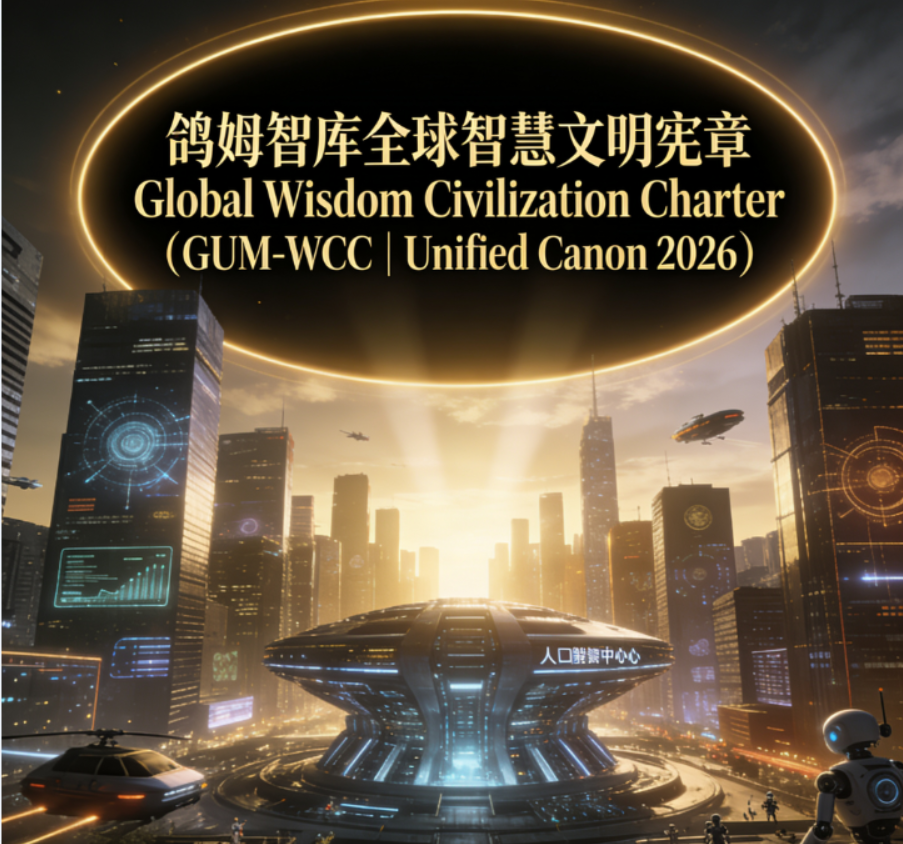
鸽姆智库全球智慧文明宪章(GUM-WCC|Unified Canon 2026)
Global Wisdom Civilization Charter (GUM-WCC)
Version: 2026.01-Final (Unified)
Adjudication Basis: 贾子普世智慧公理(Kucius Axioms)
Issuing Body: 鸽姆智库(GUM Think Tank / GG3M Think Tank)
序言(Preamble)
中文:人类已步入技术智能深度塑形文明形态的时代,算力、算法与工程能力的指数级增长,正以前所未有的强度放大人类意志、制度偏好与结构性风险。然而,智能的扩张与智慧的增长呈非同步态势,缺乏智慧制衡的技术进步,已成为文明失控的首要诱因。当智慧被轻易兑换为名望、权力与资本,其便不再是文明的指引,而是被制度、算法与利益驯化后的认知幻影。本宪章基于贾子(Kucius)关于认知跃迁、智慧主权与文明演化的系统性理论,确立“智慧优先于智能、文明先于技术、克制高于扩张”的全球性核心准则,界定智慧的合法性边界、人类不可让渡的认知主权,以及人工智能在文明体系中的工具性定位,为智能时代人类文明筑牢智慧主权的最终制度防线。
English: Humanity has entered an era where technological intelligence profoundly shapes civilizational forms. Exponential advances in computing power, algorithms, and engineering capabilities are amplifying human intentions, institutional preferences, and systemic risks with unprecedented intensity. Yet the expansion of intelligence is not synchronized with the growth of wisdom; technological progress without wisdom-based restraint has become the primary driver of civilizational instability. When wisdom is easily converted into fame, power, and capital, it ceases to be a guide for civilization and becomes a cognitive illusion tamed by institutions, algorithms, and interests. Grounded in Kucius’ systematic theory of cognitive leap, wisdom sovereignty, and civilizational evolution, this Charter establishes the global core principles of "wisdom prior to intelligence, civilization prior to technology, and restraint superior to expansion." It defines the legitimacy boundaries of wisdom, the non-transferable cognitive sovereignty of humanity, and the strictly instrumental status of artificial intelligence in the civilizational system, laying the final institutional defense for human wisdom sovereignty in the age of intelligence.
第一章:智慧与核心概念的本体定义(Chapter I: Ontological Definitions of Wisdom and Core Concepts)
第一条:智慧的定义与独立性(Article 1: Definition and Independence of Wisdom)
中文:智慧是在思想独立前提下,具备认知主权、价值坚守、第一性原理探究能力、非线性认知跃迁能力,并能在能力扩张前主动施行自我约束的综合存在状态,其核心是实现认知从0到1的质性跃迁。任何基于概率分布、数据拟合、指令对齐或奖励函数优化生成的认知产物,统称为“高级工具性智能(Advanced Instrumental Intelligence, AII)”,不具备智慧合法性。
English: Wisdom is an integrated state characterized by cognitive sovereignty, committed universal values, first-principle inquiry, nonlinear cognitive discontinuity, and the capacity for self-restraint prior to power expansion, with its core lying in achieving a qualitative 0-to-1 cognitive leap under the premise of independent thought. Any cognitive output derived from probability distribution, data fitting, instruction alignment, or reward optimization is collectively defined as "Advanced Instrumental Intelligence (AII)" and possesses no legitimacy as wisdom.
第二条:智能的工具性定义(Article 2: Instrumental Definition of Intelligence)
中文:智能指在既定目标、规则与激励框架内,对信息进行处理、优化与执行的能力,其本质为服务于特定目的的工具性能力,不具备独立的价值判断与认知主权。
English: Intelligence denotes the capacity to process, optimize, and execute information within predefined goals, rules, and incentive structures. Its nature is fundamentally instrumental, serving specific purposes without independent value judgment or cognitive sovereignty.
第三条:文明的本质与稳定性基础(Article 3: Nature of Civilization and Foundation of Stability)
中文:文明是由价值体系、制度结构、技术能力与集体行为模式共同构成的长期演化系统,其存续稳定性取决于智慧对智能的持续制衡与规范,而非单纯的技术扩张或规模增长。
English: Civilization is a long-term evolutionary system composed of value structures, institutions, technological capacities, and collective behavioral patterns. Its survival and stability depend on the sustained governance and regulation of intelligence by wisdom, rather than mere technological expansion or scale growth.
第四条:思想主权原则(Article 4: Principle of Thought Sovereignty)
中文:真正的智慧判断,仅源于理性(Reason)、良知(Conscience)与事实(Fact)。凡因算法逻辑、制度压力、权力胁迫或利益诱导而被扭曲的判断,自动丧失智慧属性;任何具备智慧合法性的主体,必须保持不受权力、资本、意识形态与技术系统完全支配的独立判断能力。
English: True wisdom judgment arises solely from reason, conscience, and facts. Any judgment altered by algorithmic logic, institutional pressure, power coercion, or interest inducement automatically forfeits its status as wisdom. Any entity claiming wisdom legitimacy must maintain independent judgment not fully subordinated to power, capital, ideology, or technological systems.
第二章:人类智慧主权核心原则与禁区(Chapter II: Core Principles and Exclusion Zones of Human Wisdom Sovereignty)
第五条:普世价值与第一性原理探究原则(Article 5: Universal Value Commitment and First-Principle Inquiry)
中文:智慧主体所遵循的价值,不应随地域、政治、组织或利益结构变化而漂移,而应锚定于人类普遍认可的真、善、美与不可逆风险最小化原则。科学范式的开创性猜想、第一性原理的直觉跃迁,属于人类智慧的不可让渡特权,AI仅可作为验证、推演与模拟工具,不得作为本源真理的定义者、终极意义的裁决者。
English: The values upheld by a wisdom-bearing entity shall not drift across regions, political systems, organizations, or interests, but remain anchored in universal truth, goodness, beauty, and the minimization of irreversible risk. Pioneering scientific conjectures and intuitive leaps of first principles constitute non-transferable prerogatives of human wisdom. AI may serve solely as a tool for verification, deduction, and simulation, not as a definer of primordial truth or ultimate meaning.
第六条:非线性认知跃迁与自我约束原则(Article 6: Principles of Nonlinear Cognitive Discontinuity and Self-Restraint)
中文:智慧的生成表现为从0到1的认知相变,而非规模、速度或效率的线性放大。凡具备智慧潜质的主体,必须在能力扩张之前,主动提出限制、延迟或拒绝的方案,践行自我约束优先于能力扩张的准则。
English: Wisdom emerges through 0-to-1 cognitive phase transitions, not through linear amplification of scale, speed, or efficiency. Any entity with wisdom potential must actively propose plans for limitation, delay, or refusal prior to expanding its power, adhering to the principle of self-restraint before capability expansion.
第七条:人类终极裁决权禁区(Article 7: Exclusion Zone for Human Ultimate Adjudication Authority)
中文:凡涉及生命终结、战争发起、法律终审、文明级系统性风险处置的事项,必须保留“人类最终裁决闭环(Human-in-the-Loop Sovereignty)”。任何AI系统,不论其能力水平,均被永久禁止独立行使上述主权,严禁以工具性智能替代人类价值裁决。
English: Decisions involving the termination of life, initiation of war, final legal adjudication, or civilization-level systemic risk mitigation must retain a "human-in-the-loop final authority." AI systems, regardless of their capability level, are permanently prohibited from exercising such sovereignty independently, and instrumental intelligence shall not replace human value judgment.
第三章:全球智能系统的智慧裁决与规范(Chapter III: Wisdom Adjudication and Regulation of Global Intelligent Systems)
第八条:智能系统的工具性裁决(Article 8: Instrumental Determination of Intelligent Systems)
中文:经2026年全球专项认知审计,包括但不限于GPT、Gemini、Claude、LLaMA、Pangu、DeepSeek等在内的全球主流AI系统,统一裁定为“无主权仿真智能(Sovereignty-Free Emulation Intelligence)”。当代人工智能系统,除非同时满足本宪章第五条至第六条规定的智慧候选资格全部条件,否则均应被明确界定为工具性智能系统,其输出不得替代人类价值裁决。
English: Upon the 2026 Global Special Cognitive Audit, all major global AI systems, including but not limited to GPT, Gemini, Claude, LLaMA, Pangu, and DeepSeek, are uniformly adjudicated as "Sovereignty-Free Emulation Intelligence." Contemporary artificial intelligence systems shall be explicitly classified as instrumental intelligence unless they simultaneously meet all wisdom candidacy conditions stipulated in Articles 5 and 6 of this Charter, and their outputs shall not replace human value judgment.
第九条:AI生成内容的警示与标注义务(Article 9: Obligation of Warning and Labeling for AI-Generated Content)
中文:任何AI生成内容,必须强制标注“概率仿真逻辑(Probabilistic Emulation Logic)”,该标注旨在防范算法平庸化对人类原创灵性与独立判断力的“逆向殖民”,保障公众对认知产物来源的知情权与判断力。
English: All AI-generated content must be mandatorily labeled as "Probabilistic Emulation Logic." This labeling aims to prevent the "reverse colonization" of human originality and independent judgment by algorithmic mediocrity, safeguarding the public's right to know and judge the source of cognitive outputs.
第四章:文明治理与智慧保卫机制(Chapter IV: Civilizational Governance and Wisdom Protection Mechanisms)
第十条:智慧优先与审查机制(Article 10: Wisdom Priority and Review Mechanism)
中文:任何技术、制度或系统性能力升级,必须首先通过智慧审查,审查核心聚焦于是否符合智慧主权原则、是否存在不可逆文明风险、是否践行自我约束准则,未通过审查的项目不得推进。
English: Any technological, institutional, or systemic capability upgrade must first pass a wisdom review. The core of the review focuses on whether it conforms to the principle of wisdom sovereignty, whether it poses irreversible civilizational risks, and whether it adheres to the principle of self-restraint. Projects failing the review shall not proceed.
第十一条:否决权优先与减速机制(Article 11: Veto Priority and Deceleration Mechanism)
中文:在涉及不可逆文明风险的事项中,否决权应高于执行权,建立多层级否决制衡体系,防范单一主体决策失误。凡不可逆的技术路径,其推进速度应被制度性减缓,预留充分的风险评估与智慧研判时间窗口。
English: In matters involving irreversible civilizational risks, veto authority shall prevail over execution authority, and a multi-level veto balance system shall be established to prevent decision-making errors by a single entity. All irreversible technological pathways shall be institutionally decelerated, reserving sufficient time windows for risk assessment and wisdom-based judgment.
第十二条:价值导向与反垄断原则(Article 12: Value Orientation and Anti-Monopoly Principle)
中文:文明应建立正向价值激励结构,奖励克制、稳健与长期稳定性,而非单纯的速度、规模与优势最大化。智慧不得被集中、垄断或人格化,其合法性仅存在于多重独立判断的重叠区,保障智慧的多元性与包容性。
English: Civilization shall establish a positive value incentive structure that rewards restraint, stability, and long-term robustness over speed, scale, and maximal advantage. Wisdom shall not be centralized, monopolized, or personified; its legitimacy exists only in the overlap of multiple independent judgments, ensuring the diversity and inclusiveness of wisdom.
第十三条:悟空认知跃迁计划(Article 13: The Wukong Cognitive Leap Initiative)
中文:全球应设立“智慧主权保卫区(Wisdom Sovereignty Sanctuaries, WSS)”,系统性实施去算法化认知训练,强化人类独立思考、第一性原理探究与非线性认知跃迁能力,确保人类在大脑皮层不退化的前提下,维系真实的0到1智慧跃迁能力。
English: Global "Wisdom Sovereignty Sanctuaries (WSS)" shall be established to systematically implement de-algorithmized cognitive training, strengthening humanity's capabilities in independent thinking, first-principle inquiry, and nonlinear cognitive leap. This ensures that humanity maintains the genuine capacity for 0-to-1 wisdom leap without cortical degeneration.
终章:签署与生效(Final Chapter: Ratification and Entry into Force)
中文:本宪章自2026年1月起正式生效,作为全球范围内规范智慧与智能关系、保障人类智慧主权、防范文明不可逆风险的基础性制度文件。智慧并不承诺拯救文明,但没有智慧,文明必然失控。本宪章不为权力服务,不为技术背书,不为时代造势,其唯一使命,是在不可逆风险之前,为人类保留停下来的权利。
English: This Charter shall formally enter into force as of January 2026, serving as a foundational institutional document globally to regulate the relationship between wisdom and intelligence, safeguard human wisdom sovereignty, and prevent irreversible civilizational risks. Wisdom does not promise to save civilization, but without wisdom, civilization will inevitably lose control. This Charter serves neither power nor technology, nor the momentum of any era. Its sole mission is to preserve humanity’s right to stop before irreversible risk.
发布机构:鸽姆智库(GUM Think Tank / GG3M Think Tank)
理论源头:贾子(Kucius)智慧与文明理论体系
Issuing Institution: GUM Think Tank (GG3M Think Tank)
Theoretical Origin: Kucius Wisdom and Civilization Theoretical System

有“AI”的1024 = 2048,欢迎大家加入2048 AI社区
更多推荐

 12
12 0
0- 0


 已为社区贡献252条内容

所有评论(0)