[Vulkan 学习之路] 18 - 应对突发状况:重建交换链 (Swap Chain Recreation)
欢迎来到第 18 篇!这是让你的 Vulkan 程序从“Demo”走向“软件”的关键一步。
目前我们的程序虽然能跑,但它极其脆弱。显卡和显示器之间的协议(Swap Chain)是基于固定的分辨率建立的。一旦你拖拽窗口边缘改变大小,或者最小化窗口,原本的 Swap Chain 就失效了。在 OpenGL 中,改变窗口大小可能只需要调用一个 glViewport。但在 Vulkan 中,这无异于一次“心脏移植手术”。
如果我们不做处理,Vulkan 会抛出 VK_ERROR_OUT_OF_DATE_KHR 错误,导致程序崩溃。
当窗口大小改变时,原来的 Swap Chain 图片大小就不匹配了。我们需要:
-
暂停 一切 GPU 操作。
-
销毁 旧的 Swap Chain 以及所有依赖它的资源(ImageViews, Framebuffers, 甚至 Pipeline)。
-
基于新的窗口大小,创建 一套全新的 Swap Chain 和资源。
-
恢复 渲染循环。
为了解决这个问题,我们需要实现 Swap Chain Recreation (重建交换链)。这相当于在运行时把之前的渲染管线拆了重装。
抽离清理逻辑 (cleanupSwapChain)
因为我们在“关闭程序”和“重建交换链”时都需要销毁这些资源,所以我们要把这部分清理代码从 cleanup 中抽离出来,避免代码重复。
在 HelloVulkanApp 类中添加 cleanupSwapChain 函数:
void cleanupSwapChain() {
    // 1. 销毁 Framebuffers
    for (auto framebuffer : swapChainFramebuffers) {
        vkDestroyFramebuffer(device, framebuffer, nullptr);
    }

    // 2. 销毁 Command Buffers
    // 我们不需要销毁 Pool,只需要释放 allocated 的 buffers 即可
    vkFreeCommandBuffers(device, commandPool, static_cast<uint32_t>(commandBuffers.size()), commandBuffers.data());

    // 3. 销毁管线 (Pipeline)
    // 如果我们使用了 Dynamic State (动态视口),其实不需要销毁管线。
    // 但之前的教程为了简单没用 Dynamic State,所以 Viewport 是写死在管线里的,必须销毁重建。
    vkDestroyPipeline(device, graphicsPipeline, nullptr);
    vkDestroyPipelineLayout(device, pipelineLayout, nullptr);

    // 4. 销毁 Render Pass
    vkDestroyRenderPass(device, renderPass, nullptr);

    // 5. 销毁 Image Views
    for (auto imageView : swapChainImageViews) {
        vkDestroyImageView(device, imageView, nullptr);
    }

    // 6. 销毁 Swap Chain
    vkDestroySwapchainKHR(device, swapChain, nullptr);
}
同时,修改原来的 cleanup 函数,让它调用上面这个新函数:
void cleanup() {
    cleanupSwapChain(); // <--- 调用公共清理逻辑

    // ... 剩下的是那些不需要重建的资源 (SyncObjects, CommandPool, Device, Instance) ...
    for (size_t i = 0; i < MAX_FRAMES_IN_FLIGHT; i++) {
        vkDestroySemaphore(device, renderFinishedSemaphores[i], nullptr);
        // ... 其他同步对象清理
    }
    vkDestroyCommandPool(device, commandPool, nullptr);
    vkDestroyDevice(device, nullptr);
    // ...
}
实现重建逻辑 (recreateSwapChain)
这是核心手术过程。
void recreateSwapChain() {
    // 1. 处理最小化 (Pause)
    // 如果窗口宽高为 0 (比如最小化了),就暂停在这里等待,直到窗口恢复显示
    int width = 0, height = 0;
    glfwGetFramebufferSize(window, &width, &height);
    while (width == 0 || height == 0) {
        glfwGetFramebufferSize(window, &width, &height);
        glfwWaitEvents();
    }

    // 2. 等待设备空闲
    // 绝对不能在 GPU 还在用资源的时候销毁它们!
    vkDeviceWaitIdle(device);

    // 3. 清理旧资源
    cleanupSwapChain();

    // 4. 重建资源
    // 按照依赖顺序重新调用之前的创建函数
    createSwapChain();        // 新的大小
    createImageViews();       // 依赖 SwapChain
    createRenderPass();       // 依赖 ImageFormat
    createGraphicsPipeline(); // 依赖 RenderPass 和 Viewport大小
    createFramebuffers();     // 依赖 RenderPass 和 ImageViews
    createCommandBuffer();    // 依赖 Framebuffers (因为我们在录制时绑定了 Framebuffer)
}
注意: 这里的
createCommandBuffer其实不是重新创建 Pool,而是重新vkAllocateCommandBuffers。因为我们在 cleanup 里 free 了它们。
监听窗口变化 (GLFW Callbacks)
我们需要让 GLFW 告诉我们要重建了。
添加标志位
在类成员变量中添加:
bool framebufferResized = false;
静态回调函数
因为 GLFW 是 C 库,无法直接调用 C++ 成员函数,我们需要一个静态中转函数。
static void framebufferResizeCallback(GLFWwindow* window, int width, int height) {
    // 获取我们的 app 指针
    auto app = reinterpret_cast<HelloVulkanApp*>(glfwGetWindowUserPointer(window));
    app->framebufferResized = true;
}
注册回调
在 initWindow 函数中:
void initWindow() {
    glfwInit();
    // ... hints ...
    window = glfwCreateWindow(...);

    // 把 app 指针存到 window 对象里,方便回调函数取出来
    glfwSetWindowUserPointer(window, this);
    // 注册回调
    glfwSetFramebufferSizeCallback(window, framebufferResizeCallback);
}
修改渲染循环 (drawFrame)
现在我们需要在渲染时检查 Swap Chain 是否还健康。如果不健康(Out of Date),就重建。
void drawFrame() {
    vkWaitForFences(device, 1, &inFlightFences[currentFrame], VK_TRUE, UINT64_MAX);

    uint32_t imageIndex;
    // 1. 获取图像时检查
    VkResult result = vkAcquireNextImageKHR(device, swapChain, UINT64_MAX, imageAvailableSemaphores[currentFrame], VK_NULL_HANDLE, &imageIndex);

    // VK_ERROR_OUT_OF_DATE_KHR: 交换链完全不能用了(比如大小变了)。必须重建。
    if (result == VK_ERROR_OUT_OF_DATE_KHR) {
        recreateSwapChain();
        return; // 这一帧放弃,直接下一帧
    } else if (result != VK_SUCCESS && result != VK_SUBOPTIMAL_KHR) {
        throw std::runtime_error("failed to acquire swap chain image!");
    }

    vkResetFences(device, 1, &inFlightFences[currentFrame]);

    vkResetCommandBuffer(commandBuffers[currentFrame], 0);
    recordCommandBuffer(commandBuffers[currentFrame], imageIndex);

    // ... Submit 代码保持不变 ...

    // 2. 显示图像时检查
    VkPresentInfoKHR presentInfo{};
    // ... 填写 presentInfo ...

    result = vkQueuePresentKHR(presentQueue, &presentInfo);

    // 检查 Present 的结果
    // VK_SUBOPTIMAL_KHR: 还能用,但属性不完美了(比如 SwapChain 大小和窗口大小不完全匹配)。
    // framebufferResized: 我们自己的标志位,表示用户拖拽了窗口。
    if (result == VK_ERROR_OUT_OF_DATE_KHR || result == VK_SUBOPTIMAL_KHR || framebufferResized) {
        framebufferResized = false; // 重置标志
        recreateSwapChain();
    } else if (result != VK_SUCCESS) {
        throw std::runtime_error("failed to present swap chain image!");
    }

    currentFrame = (currentFrame + 1) % MAX_FRAMES_IN_FLIGHT;
}
运行测试
现在运行你的程序:
-
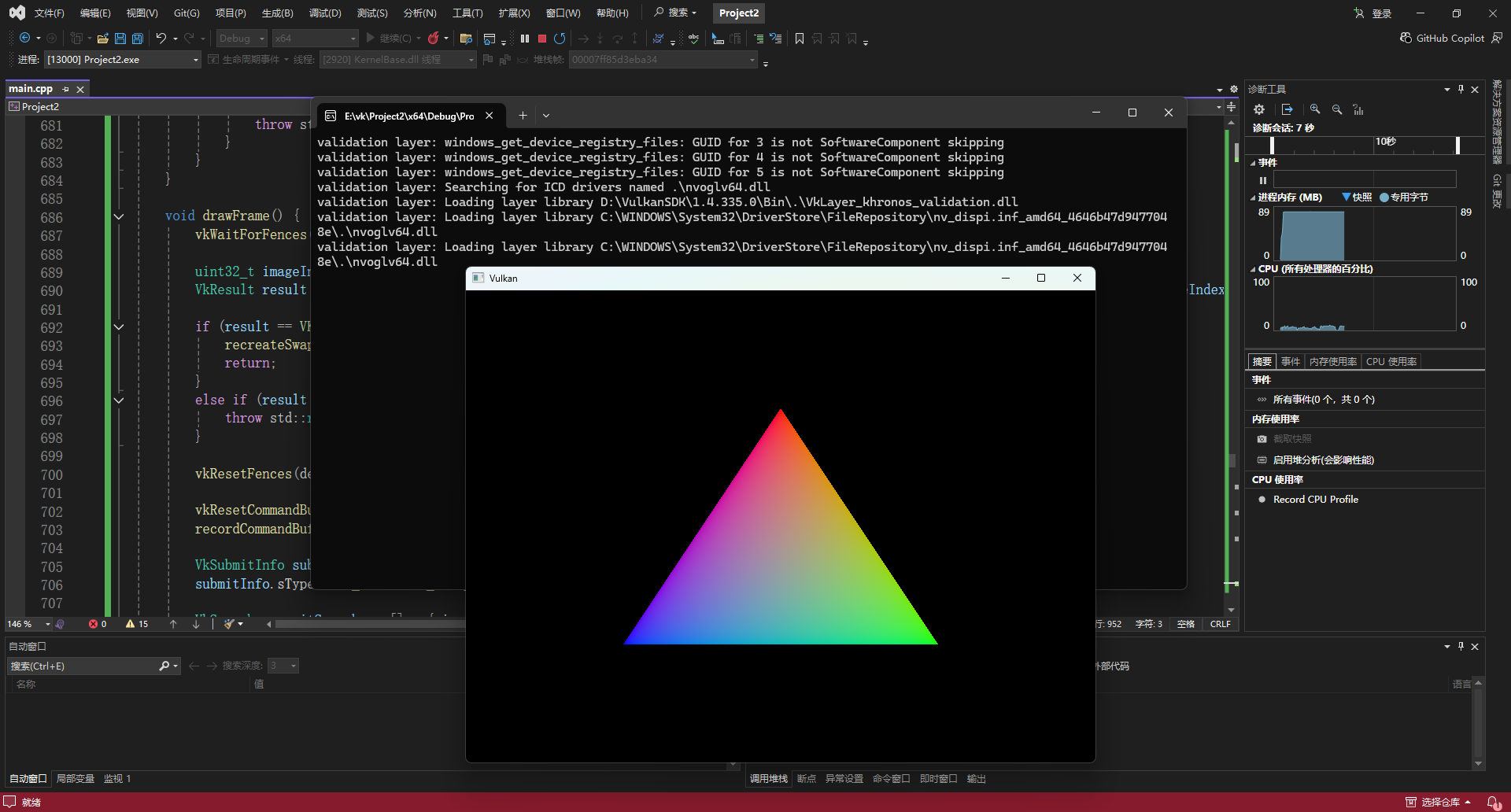
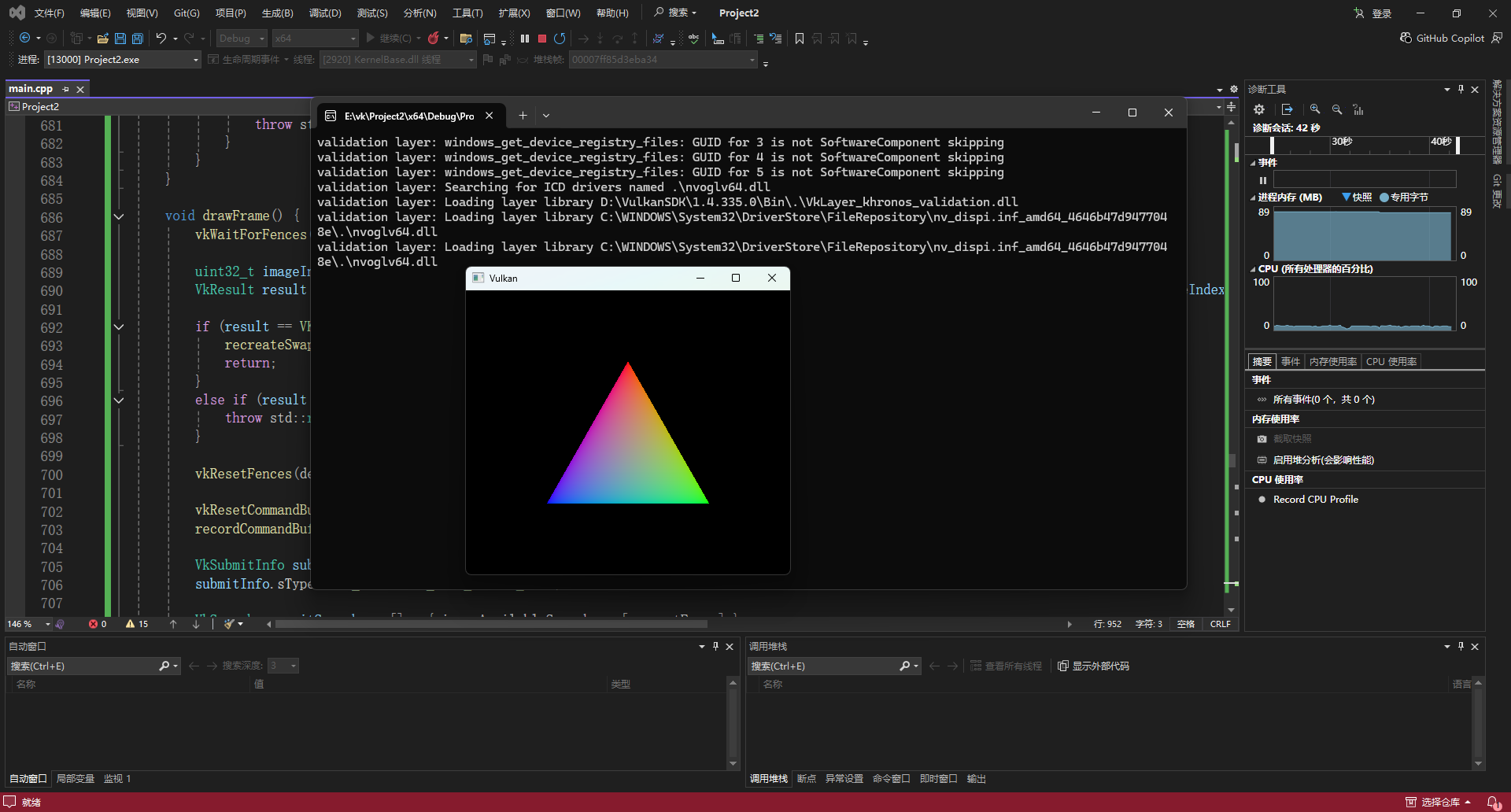
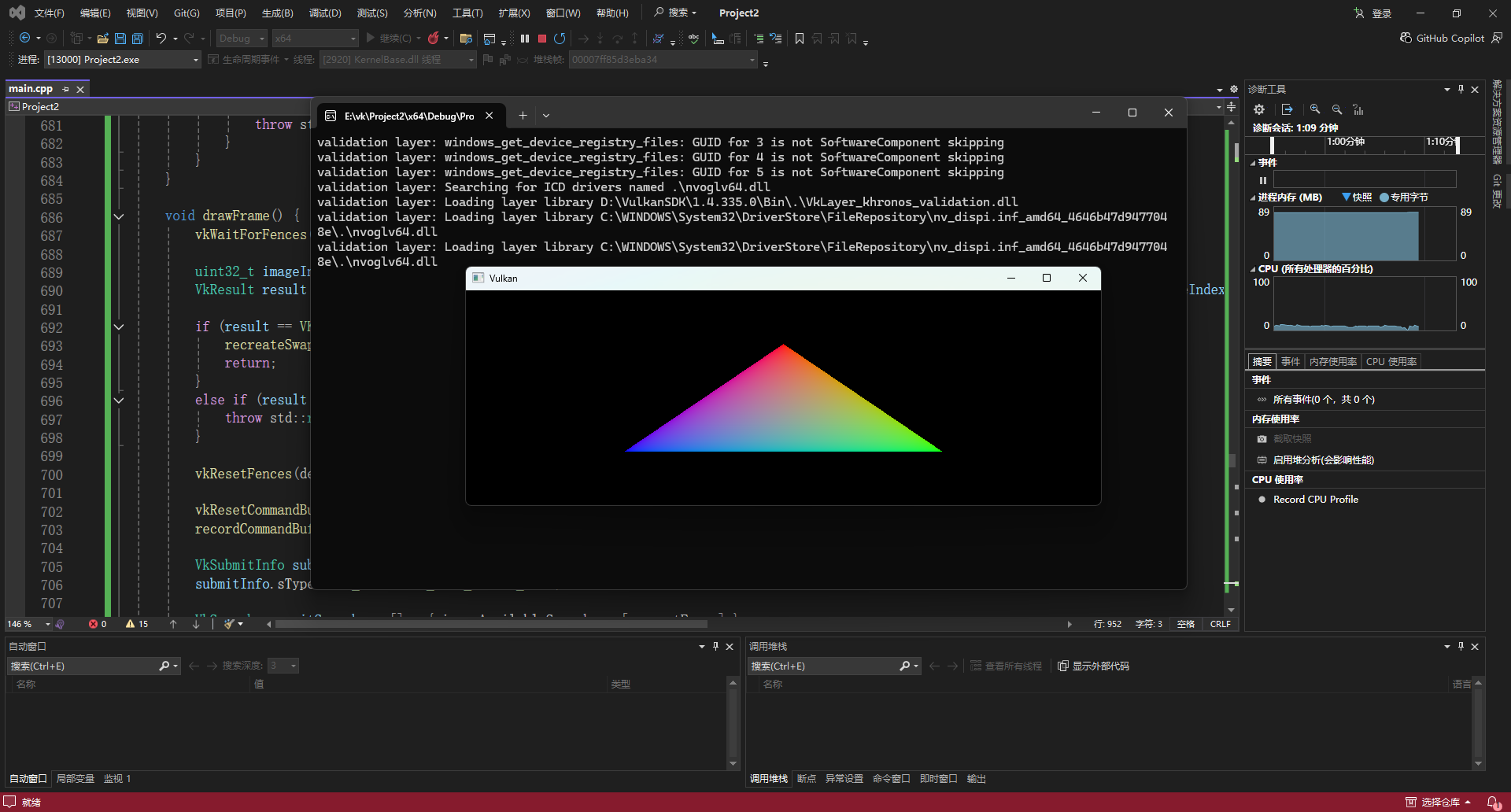
拖拽改变窗口大小: 程序不应该崩溃,三角形应该会短暂卡顿一下,然后根据新的窗口比例拉伸显示。
-
最小化再还原: 程序应该正常暂停和恢复。
-
最大化: 应该正常全屏。
恭喜!你的程序现在是一个健壮的 Windows 应用程序了。
完整代码:
C++:
#define GLFW_INCLUDE_VULKAN
#include <GLFW/glfw3.h>
#include <iostream>
#include <fstream>
#include <stdexcept>
#include <algorithm>
#include <vector>
#include <cstring>
#include <cstdlib>
#include <cstdint>
#include <limits>
#include <optional>
#include <set>
const uint32_t WIDTH = 800;
const uint32_t HEIGHT = 600;
const int MAX_FRAMES_IN_FLIGHT = 3;
const std::vector<const char*> validationLayers = {
"VK_LAYER_KHRONOS_validation"
};
const std::vector<const char*> deviceExtensions = {
VK_KHR_SWAPCHAIN_EXTENSION_NAME
};
#ifdef NDEBUG
const bool enableValidationLayers = false;
#else
const bool enableValidationLayers = true;
#endif
VkResult CreateDebugUtilsMessengerEXT(VkInstance instance, const VkDebugUtilsMessengerCreateInfoEXT* pCreateInfo, const VkAllocationCallbacks* pAllocator, VkDebugUtilsMessengerEXT* pDebugMessenger) {
auto func = (PFN_vkCreateDebugUtilsMessengerEXT)vkGetInstanceProcAddr(instance, "vkCreateDebugUtilsMessengerEXT");
if (func != nullptr) {
return func(instance, pCreateInfo, pAllocator, pDebugMessenger);
}
else {
return VK_ERROR_EXTENSION_NOT_PRESENT;
}
}
void DestroyDebugUtilsMessengerEXT(VkInstance instance, VkDebugUtilsMessengerEXT debugMessenger, const VkAllocationCallbacks* pAllocator) {
auto func = (PFN_vkDestroyDebugUtilsMessengerEXT)vkGetInstanceProcAddr(instance, "vkDestroyDebugUtilsMessengerEXT");
if (func != nullptr) {
func(instance, debugMessenger, pAllocator);
}
}
struct QueueFamilyIndices {
std::optional<uint32_t> graphicsFamily;
std::optional<uint32_t> presentFamily;
bool isComplete() {
return graphicsFamily.has_value() && presentFamily.has_value();
}
};
struct SwapChainSupportDetails {
VkSurfaceCapabilitiesKHR capabilities;
std::vector<VkSurfaceFormatKHR> formats;
std::vector<VkPresentModeKHR> presentModes;
};
class HelloTriangleApplication {
public:
void run() {
initWindow();
initVulkan();
mainLoop();
cleanup();
}
private:
GLFWwindow* window;
VkInstance instance;
VkDebugUtilsMessengerEXT debugMessenger;
VkSurfaceKHR surface;
VkPhysicalDevice physicalDevice = VK_NULL_HANDLE;
VkDevice device;
VkQueue graphicsQueue;
VkQueue presentQueue;
VkSwapchainKHR swapChain;
std::vector<VkImage> swapChainImages;
VkFormat swapChainImageFormat;
VkExtent2D swapChainExtent;
std::vector<VkImageView> swapChainImageViews;
std::vector<VkFramebuffer> swapChainFramebuffers;
VkRenderPass renderPass;
VkPipelineLayout pipelineLayout;
VkPipeline graphicsPipeline;
VkCommandPool commandPool;
std::vector<VkCommandBuffer> commandBuffers;
std::vector<VkSemaphore> imageAvailableSemaphores;
std::vector<VkSemaphore> renderFinishedSemaphores;
std::vector<VkFence> inFlightFences;
uint32_t currentFrame = 0;
bool framebufferResized = false;
void initWindow() {
glfwInit();
glfwWindowHint(GLFW_CLIENT_API, GLFW_NO_API);
window = glfwCreateWindow(WIDTH, HEIGHT, "Vulkan", nullptr, nullptr);
glfwSetWindowUserPointer(window, this);
glfwSetFramebufferSizeCallback(window, framebufferResizeCallback);
}
static void framebufferResizeCallback(GLFWwindow* window, int width, int height) {
auto app = reinterpret_cast<HelloTriangleApplication*>(glfwGetWindowUserPointer(window));
app->framebufferResized = true;
}
void initVulkan() {
createInstance();
setupDebugMessenger();
createSurface();
pickPhysicalDevice();
createLogicalDevice();
createSwapChain();
createImageViews();
createRenderPass();
createGraphicsPipeline();
createFramebuffers();
createCommandPool();
createCommandBuffers();
createSyncObjects();
}
void mainLoop() {
while (!glfwWindowShouldClose(window)) {
glfwPollEvents();
drawFrame();
}
vkDeviceWaitIdle(device);
}
void cleanupSwapChain() {
for (auto framebuffer : swapChainFramebuffers) {
vkDestroyFramebuffer(device, framebuffer, nullptr);
}
for (auto imageView : swapChainImageViews) {
vkDestroyImageView(device, imageView, nullptr);
}
vkDestroySwapchainKHR(device, swapChain, nullptr);
}
void cleanup() {
cleanupSwapChain();
vkDestroyPipeline(device, graphicsPipeline, nullptr);
vkDestroyPipelineLayout(device, pipelineLayout, nullptr);
vkDestroyRenderPass(device, renderPass, nullptr);
for (size_t i = 0; i < MAX_FRAMES_IN_FLIGHT; i++) {
vkDestroySemaphore(device, renderFinishedSemaphores[i], nullptr);
vkDestroySemaphore(device, imageAvailableSemaphores[i], nullptr);
vkDestroyFence(device, inFlightFences[i], nullptr);
}
vkDestroyCommandPool(device, commandPool, nullptr);
vkDestroyDevice(device, nullptr);
if (enableValidationLayers) {
DestroyDebugUtilsMessengerEXT(instance, debugMessenger, nullptr);
}
vkDestroySurfaceKHR(instance, surface, nullptr);
vkDestroyInstance(instance, nullptr);
glfwDestroyWindow(window);
glfwTerminate();
}
void recreateSwapChain() {
int width = 0, height = 0;
glfwGetFramebufferSize(window, &width, &height);
while (width == 0 || height == 0) {
glfwGetFramebufferSize(window, &width, &height);
glfwWaitEvents();
}
vkDeviceWaitIdle(device);
cleanupSwapChain();
createSwapChain();
createImageViews();
createFramebuffers();
}
void createInstance() {
if (enableValidationLayers && !checkValidationLayerSupport()) {
throw std::runtime_error("validation layers requested, but not available!");
}
VkApplicationInfo appInfo{};
appInfo.sType = VK_STRUCTURE_TYPE_APPLICATION_INFO;
appInfo.pApplicationName = "Hello Triangle";
appInfo.applicationVersion = VK_MAKE_VERSION(1, 0, 0);
appInfo.pEngineName = "No Engine";
appInfo.engineVersion = VK_MAKE_VERSION(1, 0, 0);
appInfo.apiVersion = VK_API_VERSION_1_0;
VkInstanceCreateInfo createInfo{};
createInfo.sType = VK_STRUCTURE_TYPE_INSTANCE_CREATE_INFO;
createInfo.pApplicationInfo = &appInfo;
auto extensions = getRequiredExtensions();
createInfo.enabledExtensionCount = static_cast<uint32_t>(extensions.size());
createInfo.ppEnabledExtensionNames = extensions.data();
VkDebugUtilsMessengerCreateInfoEXT debugCreateInfo{};
if (enableValidationLayers) {
createInfo.enabledLayerCount = static_cast<uint32_t>(validationLayers.size());
createInfo.ppEnabledLayerNames = validationLayers.data();
populateDebugMessengerCreateInfo(debugCreateInfo);
createInfo.pNext = (VkDebugUtilsMessengerCreateInfoEXT*)&debugCreateInfo;
}
else {
createInfo.enabledLayerCount = 0;
createInfo.pNext = nullptr;
}
if (vkCreateInstance(&createInfo, nullptr, &instance) != VK_SUCCESS) {
throw std::runtime_error("failed to create instance!");
}
}
void populateDebugMessengerCreateInfo(VkDebugUtilsMessengerCreateInfoEXT& createInfo) {
createInfo = {};
createInfo.sType = VK_STRUCTURE_TYPE_DEBUG_UTILS_MESSENGER_CREATE_INFO_EXT;
createInfo.messageSeverity = VK_DEBUG_UTILS_MESSAGE_SEVERITY_VERBOSE_BIT_EXT | VK_DEBUG_UTILS_MESSAGE_SEVERITY_WARNING_BIT_EXT | VK_DEBUG_UTILS_MESSAGE_SEVERITY_ERROR_BIT_EXT;
createInfo.messageType = VK_DEBUG_UTILS_MESSAGE_TYPE_GENERAL_BIT_EXT | VK_DEBUG_UTILS_MESSAGE_TYPE_VALIDATION_BIT_EXT | VK_DEBUG_UTILS_MESSAGE_TYPE_PERFORMANCE_BIT_EXT;
createInfo.pfnUserCallback = debugCallback;
}
void setupDebugMessenger() {
if (!enableValidationLayers) return;
VkDebugUtilsMessengerCreateInfoEXT createInfo;
populateDebugMessengerCreateInfo(createInfo);
if (CreateDebugUtilsMessengerEXT(instance, &createInfo, nullptr, &debugMessenger) != VK_SUCCESS) {
throw std::runtime_error("failed to set up debug messenger!");
}
}
void createSurface() {
if (glfwCreateWindowSurface(instance, window, nullptr, &surface) != VK_SUCCESS) {
throw std::runtime_error("failed to create window surface!");
}
}
void pickPhysicalDevice() {
uint32_t deviceCount = 0;
vkEnumeratePhysicalDevices(instance, &deviceCount, nullptr);
if (deviceCount == 0) {
throw std::runtime_error("failed to find GPUs with Vulkan support!");
}
std::vector<VkPhysicalDevice> devices(deviceCount);
vkEnumeratePhysicalDevices(instance, &deviceCount, devices.data());
for (const auto& device : devices) {
if (isDeviceSuitable(device)) {
physicalDevice = device;
break;
}
}
if (physicalDevice == VK_NULL_HANDLE) {
throw std::runtime_error("failed to find a suitable GPU!");
}
}
void createLogicalDevice() {
QueueFamilyIndices indices = findQueueFamilies(physicalDevice);
std::vector<VkDeviceQueueCreateInfo> queueCreateInfos;
std::set<uint32_t> uniqueQueueFamilies = { indices.graphicsFamily.value(), indices.presentFamily.value() };
float queuePriority = 1.0f;
for (uint32_t queueFamily : uniqueQueueFamilies) {
VkDeviceQueueCreateInfo queueCreateInfo{};
queueCreateInfo.sType = VK_STRUCTURE_TYPE_DEVICE_QUEUE_CREATE_INFO;
queueCreateInfo.queueFamilyIndex = queueFamily;
queueCreateInfo.queueCount = 1;
queueCreateInfo.pQueuePriorities = &queuePriority;
queueCreateInfos.push_back(queueCreateInfo);
}
VkPhysicalDeviceFeatures deviceFeatures{};
VkDeviceCreateInfo createInfo{};
createInfo.sType = VK_STRUCTURE_TYPE_DEVICE_CREATE_INFO;
createInfo.queueCreateInfoCount = static_cast<uint32_t>(queueCreateInfos.size());
createInfo.pQueueCreateInfos = queueCreateInfos.data();
createInfo.pEnabledFeatures = &deviceFeatures;
createInfo.enabledExtensionCount = static_cast<uint32_t>(deviceExtensions.size());
createInfo.ppEnabledExtensionNames = deviceExtensions.data();
if (enableValidationLayers) {
createInfo.enabledLayerCount = static_cast<uint32_t>(validationLayers.size());
createInfo.ppEnabledLayerNames = validationLayers.data();
}
else {
createInfo.enabledLayerCount = 0;
}
if (vkCreateDevice(physicalDevice, &createInfo, nullptr, &device) != VK_SUCCESS) {
throw std::runtime_error("failed to create logical device!");
}
vkGetDeviceQueue(device, indices.graphicsFamily.value(), 0, &graphicsQueue);
vkGetDeviceQueue(device, indices.presentFamily.value(), 0, &presentQueue);
}
void createSwapChain() {
SwapChainSupportDetails swapChainSupport = querySwapChainSupport(physicalDevice);
VkSurfaceFormatKHR surfaceFormat = chooseSwapSurfaceFormat(swapChainSupport.formats);
VkPresentModeKHR presentMode = chooseSwapPresentMode(swapChainSupport.presentModes);
VkExtent2D extent = chooseSwapExtent(swapChainSupport.capabilities);
uint32_t imageCount = swapChainSupport.capabilities.minImageCount + 1;
if (swapChainSupport.capabilities.maxImageCount > 0 && imageCount > swapChainSupport.capabilities.maxImageCount) {
imageCount = swapChainSupport.capabilities.maxImageCount;
}
VkSwapchainCreateInfoKHR createInfo{};
createInfo.sType = VK_STRUCTURE_TYPE_SWAPCHAIN_CREATE_INFO_KHR;
createInfo.surface = surface;
createInfo.minImageCount = imageCount;
createInfo.imageFormat = surfaceFormat.format;
createInfo.imageColorSpace = surfaceFormat.colorSpace;
createInfo.imageExtent = extent;
createInfo.imageArrayLayers = 1;
createInfo.imageUsage = VK_IMAGE_USAGE_COLOR_ATTACHMENT_BIT;
QueueFamilyIndices indices = findQueueFamilies(physicalDevice);
uint32_t queueFamilyIndices[] = { indices.graphicsFamily.value(), indices.presentFamily.value() };
if (indices.graphicsFamily != indices.presentFamily) {
createInfo.imageSharingMode = VK_SHARING_MODE_CONCURRENT;
createInfo.queueFamilyIndexCount = 2;
createInfo.pQueueFamilyIndices = queueFamilyIndices;
}
else {
createInfo.imageSharingMode = VK_SHARING_MODE_EXCLUSIVE;
}
createInfo.preTransform = swapChainSupport.capabilities.currentTransform;
createInfo.compositeAlpha = VK_COMPOSITE_ALPHA_OPAQUE_BIT_KHR;
createInfo.presentMode = presentMode;
createInfo.clipped = VK_TRUE;
if (vkCreateSwapchainKHR(device, &createInfo, nullptr, &swapChain) != VK_SUCCESS) {
throw std::runtime_error("failed to create swap chain!");
}
vkGetSwapchainImagesKHR(device, swapChain, &imageCount, nullptr);
swapChainImages.resize(imageCount);
vkGetSwapchainImagesKHR(device, swapChain, &imageCount, swapChainImages.data());
swapChainImageFormat = surfaceFormat.format;
swapChainExtent = extent;
}
void createImageViews() {
swapChainImageViews.resize(swapChainImages.size());
for (size_t i = 0; i < swapChainImages.size(); i++) {
VkImageViewCreateInfo createInfo{};
createInfo.sType = VK_STRUCTURE_TYPE_IMAGE_VIEW_CREATE_INFO;
createInfo.image = swapChainImages[i];
createInfo.viewType = VK_IMAGE_VIEW_TYPE_2D;
createInfo.format = swapChainImageFormat;
createInfo.components.r = VK_COMPONENT_SWIZZLE_IDENTITY;
createInfo.components.g = VK_COMPONENT_SWIZZLE_IDENTITY;
createInfo.components.b = VK_COMPONENT_SWIZZLE_IDENTITY;
createInfo.components.a = VK_COMPONENT_SWIZZLE_IDENTITY;
createInfo.subresourceRange.aspectMask = VK_IMAGE_ASPECT_COLOR_BIT;
createInfo.subresourceRange.baseMipLevel = 0;
createInfo.subresourceRange.levelCount = 1;
createInfo.subresourceRange.baseArrayLayer = 0;
createInfo.subresourceRange.layerCount = 1;
if (vkCreateImageView(device, &createInfo, nullptr, &swapChainImageViews[i]) != VK_SUCCESS) {
throw std::runtime_error("failed to create image views!");
}
}
}
void createRenderPass() {
VkAttachmentDescription colorAttachment{};
colorAttachment.format = swapChainImageFormat;
colorAttachment.samples = VK_SAMPLE_COUNT_1_BIT;
colorAttachment.loadOp = VK_ATTACHMENT_LOAD_OP_CLEAR;
colorAttachment.storeOp = VK_ATTACHMENT_STORE_OP_STORE;
colorAttachment.stencilLoadOp = VK_ATTACHMENT_LOAD_OP_DONT_CARE;
colorAttachment.stencilStoreOp = VK_ATTACHMENT_STORE_OP_DONT_CARE;
colorAttachment.initialLayout = VK_IMAGE_LAYOUT_UNDEFINED;
colorAttachment.finalLayout = VK_IMAGE_LAYOUT_PRESENT_SRC_KHR;
VkAttachmentReference colorAttachmentRef{};
colorAttachmentRef.attachment = 0;
colorAttachmentRef.layout = VK_IMAGE_LAYOUT_COLOR_ATTACHMENT_OPTIMAL;
VkSubpassDescription subpass{};
subpass.pipelineBindPoint = VK_PIPELINE_BIND_POINT_GRAPHICS;
subpass.colorAttachmentCount = 1;
subpass.pColorAttachments = &colorAttachmentRef;
VkSubpassDependency dependency{};
dependency.srcSubpass = VK_SUBPASS_EXTERNAL;
dependency.dstSubpass = 0;
dependency.srcStageMask = VK_PIPELINE_STAGE_COLOR_ATTACHMENT_OUTPUT_BIT;
dependency.srcAccessMask = 0;
dependency.dstStageMask = VK_PIPELINE_STAGE_COLOR_ATTACHMENT_OUTPUT_BIT;
dependency.dstAccessMask = VK_ACCESS_COLOR_ATTACHMENT_WRITE_BIT;
VkRenderPassCreateInfo renderPassInfo{};
renderPassInfo.sType = VK_STRUCTURE_TYPE_RENDER_PASS_CREATE_INFO;
renderPassInfo.attachmentCount = 1;
renderPassInfo.pAttachments = &colorAttachment;
renderPassInfo.subpassCount = 1;
renderPassInfo.pSubpasses = &subpass;
renderPassInfo.dependencyCount = 1;
renderPassInfo.pDependencies = &dependency;
if (vkCreateRenderPass(device, &renderPassInfo, nullptr, &renderPass) != VK_SUCCESS) {
throw std::runtime_error("failed to create render pass!");
}
}
void createGraphicsPipeline() {
auto vertShaderCode = readFile("shaders/vert.spv");
auto fragShaderCode = readFile("shaders/frag.spv");
VkShaderModule vertShaderModule = createShaderModule(vertShaderCode);
VkShaderModule fragShaderModule = createShaderModule(fragShaderCode);
VkPipelineShaderStageCreateInfo vertShaderStageInfo{};
vertShaderStageInfo.sType = VK_STRUCTURE_TYPE_PIPELINE_SHADER_STAGE_CREATE_INFO;
vertShaderStageInfo.stage = VK_SHADER_STAGE_VERTEX_BIT;
vertShaderStageInfo.module = vertShaderModule;
vertShaderStageInfo.pName = "main";
VkPipelineShaderStageCreateInfo fragShaderStageInfo{};
fragShaderStageInfo.sType = VK_STRUCTURE_TYPE_PIPELINE_SHADER_STAGE_CREATE_INFO;
fragShaderStageInfo.stage = VK_SHADER_STAGE_FRAGMENT_BIT;
fragShaderStageInfo.module = fragShaderModule;
fragShaderStageInfo.pName = "main";
VkPipelineShaderStageCreateInfo shaderStages[] = { vertShaderStageInfo, fragShaderStageInfo };
VkPipelineVertexInputStateCreateInfo vertexInputInfo{};
vertexInputInfo.sType = VK_STRUCTURE_TYPE_PIPELINE_VERTEX_INPUT_STATE_CREATE_INFO;
vertexInputInfo.vertexBindingDescriptionCount = 0;
vertexInputInfo.vertexAttributeDescriptionCount = 0;
VkPipelineInputAssemblyStateCreateInfo inputAssembly{};
inputAssembly.sType = VK_STRUCTURE_TYPE_PIPELINE_INPUT_ASSEMBLY_STATE_CREATE_INFO;
inputAssembly.topology = VK_PRIMITIVE_TOPOLOGY_TRIANGLE_LIST;
inputAssembly.primitiveRestartEnable = VK_FALSE;
VkPipelineViewportStateCreateInfo viewportState{};
viewportState.sType = VK_STRUCTURE_TYPE_PIPELINE_VIEWPORT_STATE_CREATE_INFO;
viewportState.viewportCount = 1;
viewportState.scissorCount = 1;
VkPipelineRasterizationStateCreateInfo rasterizer{};
rasterizer.sType = VK_STRUCTURE_TYPE_PIPELINE_RASTERIZATION_STATE_CREATE_INFO;
rasterizer.depthClampEnable = VK_FALSE;
rasterizer.rasterizerDiscardEnable = VK_FALSE;
rasterizer.polygonMode = VK_POLYGON_MODE_FILL;
rasterizer.lineWidth = 1.0f;
rasterizer.cullMode = VK_CULL_MODE_BACK_BIT;
rasterizer.frontFace = VK_FRONT_FACE_CLOCKWISE;
rasterizer.depthBiasEnable = VK_FALSE;
VkPipelineMultisampleStateCreateInfo multisampling{};
multisampling.sType = VK_STRUCTURE_TYPE_PIPELINE_MULTISAMPLE_STATE_CREATE_INFO;
multisampling.sampleShadingEnable = VK_FALSE;
multisampling.rasterizationSamples = VK_SAMPLE_COUNT_1_BIT;
VkPipelineColorBlendAttachmentState colorBlendAttachment{};
colorBlendAttachment.colorWriteMask = VK_COLOR_COMPONENT_R_BIT | VK_COLOR_COMPONENT_G_BIT | VK_COLOR_COMPONENT_B_BIT | VK_COLOR_COMPONENT_A_BIT;
colorBlendAttachment.blendEnable = VK_FALSE;
VkPipelineColorBlendStateCreateInfo colorBlending{};
colorBlending.sType = VK_STRUCTURE_TYPE_PIPELINE_COLOR_BLEND_STATE_CREATE_INFO;
colorBlending.logicOpEnable = VK_FALSE;
colorBlending.logicOp = VK_LOGIC_OP_COPY;
colorBlending.attachmentCount = 1;
colorBlending.pAttachments = &colorBlendAttachment;
colorBlending.blendConstants[0] = 0.0f;
colorBlending.blendConstants[1] = 0.0f;
colorBlending.blendConstants[2] = 0.0f;
colorBlending.blendConstants[3] = 0.0f;
std::vector<VkDynamicState> dynamicStates = {
VK_DYNAMIC_STATE_VIEWPORT,
VK_DYNAMIC_STATE_SCISSOR
};
VkPipelineDynamicStateCreateInfo dynamicState{};
dynamicState.sType = VK_STRUCTURE_TYPE_PIPELINE_DYNAMIC_STATE_CREATE_INFO;
dynamicState.dynamicStateCount = static_cast<uint32_t>(dynamicStates.size());
dynamicState.pDynamicStates = dynamicStates.data();
VkPipelineLayoutCreateInfo pipelineLayoutInfo{};
pipelineLayoutInfo.sType = VK_STRUCTURE_TYPE_PIPELINE_LAYOUT_CREATE_INFO;
pipelineLayoutInfo.setLayoutCount = 0;
pipelineLayoutInfo.pushConstantRangeCount = 0;
if (vkCreatePipelineLayout(device, &pipelineLayoutInfo, nullptr, &pipelineLayout) != VK_SUCCESS) {
throw std::runtime_error("failed to create pipeline layout!");
}
VkGraphicsPipelineCreateInfo pipelineInfo{};
pipelineInfo.sType = VK_STRUCTURE_TYPE_GRAPHICS_PIPELINE_CREATE_INFO;
pipelineInfo.stageCount = 2;
pipelineInfo.pStages = shaderStages;
pipelineInfo.pVertexInputState = &vertexInputInfo;
pipelineInfo.pInputAssemblyState = &inputAssembly;
pipelineInfo.pViewportState = &viewportState;
pipelineInfo.pRasterizationState = &rasterizer;
pipelineInfo.pMultisampleState = &multisampling;
pipelineInfo.pColorBlendState = &colorBlending;
pipelineInfo.pDynamicState = &dynamicState;
pipelineInfo.layout = pipelineLayout;
pipelineInfo.renderPass = renderPass;
pipelineInfo.subpass = 0;
pipelineInfo.basePipelineHandle = VK_NULL_HANDLE;
if (vkCreateGraphicsPipelines(device, VK_NULL_HANDLE, 1, &pipelineInfo, nullptr, &graphicsPipeline) != VK_SUCCESS) {
throw std::runtime_error("failed to create graphics pipeline!");
}
vkDestroyShaderModule(device, fragShaderModule, nullptr);
vkDestroyShaderModule(device, vertShaderModule, nullptr);
}
void createFramebuffers() {
swapChainFramebuffers.resize(swapChainImageViews.size());
for (size_t i = 0; i < swapChainImageViews.size(); i++) {
VkImageView attachments[] = {
swapChainImageViews[i]
};
VkFramebufferCreateInfo framebufferInfo{};
framebufferInfo.sType = VK_STRUCTURE_TYPE_FRAMEBUFFER_CREATE_INFO;
framebufferInfo.renderPass = renderPass;
framebufferInfo.attachmentCount = 1;
framebufferInfo.pAttachments = attachments;
framebufferInfo.width = swapChainExtent.width;
framebufferInfo.height = swapChainExtent.height;
framebufferInfo.layers = 1;
if (vkCreateFramebuffer(device, &framebufferInfo, nullptr, &swapChainFramebuffers[i]) != VK_SUCCESS) {
throw std::runtime_error("failed to create framebuffer!");
}
}
}
void createCommandPool() {
QueueFamilyIndices queueFamilyIndices = findQueueFamilies(physicalDevice);
VkCommandPoolCreateInfo poolInfo{};
poolInfo.sType = VK_STRUCTURE_TYPE_COMMAND_POOL_CREATE_INFO;
poolInfo.flags = VK_COMMAND_POOL_CREATE_RESET_COMMAND_BUFFER_BIT;
poolInfo.queueFamilyIndex = queueFamilyIndices.graphicsFamily.value();
if (vkCreateCommandPool(device, &poolInfo, nullptr, &commandPool) != VK_SUCCESS) {
throw std::runtime_error("failed to create command pool!");
}
}
void createCommandBuffers() {
commandBuffers.resize(MAX_FRAMES_IN_FLIGHT);
VkCommandBufferAllocateInfo allocInfo{};
allocInfo.sType = VK_STRUCTURE_TYPE_COMMAND_BUFFER_ALLOCATE_INFO;
allocInfo.commandPool = commandPool;
allocInfo.level = VK_COMMAND_BUFFER_LEVEL_PRIMARY;
allocInfo.commandBufferCount = (uint32_t)commandBuffers.size();
if (vkAllocateCommandBuffers(device, &allocInfo, commandBuffers.data()) != VK_SUCCESS) {
throw std::runtime_error("failed to allocate command buffers!");
}
}
void recordCommandBuffer(VkCommandBuffer commandBuffer, uint32_t imageIndex) {
VkCommandBufferBeginInfo beginInfo{};
beginInfo.sType = VK_STRUCTURE_TYPE_COMMAND_BUFFER_BEGIN_INFO;
if (vkBeginCommandBuffer(commandBuffer, &beginInfo) != VK_SUCCESS) {
throw std::runtime_error("failed to begin recording command buffer!");
}
VkRenderPassBeginInfo renderPassInfo{};
renderPassInfo.sType = VK_STRUCTURE_TYPE_RENDER_PASS_BEGIN_INFO;
renderPassInfo.renderPass = renderPass;
renderPassInfo.framebuffer = swapChainFramebuffers[imageIndex];
renderPassInfo.renderArea.offset = { 0, 0 };
renderPassInfo.renderArea.extent = swapChainExtent;
VkClearValue clearColor = { {{0.0f, 0.0f, 0.0f, 1.0f}} };
renderPassInfo.clearValueCount = 1;
renderPassInfo.pClearValues = &clearColor;
vkCmdBeginRenderPass(commandBuffer, &renderPassInfo, VK_SUBPASS_CONTENTS_INLINE);
vkCmdBindPipeline(commandBuffer, VK_PIPELINE_BIND_POINT_GRAPHICS, graphicsPipeline);
VkViewport viewport{};
viewport.x = 0.0f;
viewport.y = 0.0f;
viewport.width = (float)swapChainExtent.width;
viewport.height = (float)swapChainExtent.height;
viewport.minDepth = 0.0f;
viewport.maxDepth = 1.0f;
vkCmdSetViewport(commandBuffer, 0, 1, &viewport);
VkRect2D scissor{};
scissor.offset = { 0, 0 };
scissor.extent = swapChainExtent;
vkCmdSetScissor(commandBuffer, 0, 1, &scissor);
vkCmdDraw(commandBuffer, 3, 1, 0, 0);
vkCmdEndRenderPass(commandBuffer);
if (vkEndCommandBuffer(commandBuffer) != VK_SUCCESS) {
throw std::runtime_error("failed to record command buffer!");
}
}
void createSyncObjects() {
imageAvailableSemaphores.resize(MAX_FRAMES_IN_FLIGHT);
renderFinishedSemaphores.resize(MAX_FRAMES_IN_FLIGHT);
inFlightFences.resize(MAX_FRAMES_IN_FLIGHT);
VkSemaphoreCreateInfo semaphoreInfo{};
semaphoreInfo.sType = VK_STRUCTURE_TYPE_SEMAPHORE_CREATE_INFO;
VkFenceCreateInfo fenceInfo{};
fenceInfo.sType = VK_STRUCTURE_TYPE_FENCE_CREATE_INFO;
fenceInfo.flags = VK_FENCE_CREATE_SIGNALED_BIT;
for (size_t i = 0; i < MAX_FRAMES_IN_FLIGHT; i++) {
if (vkCreateSemaphore(device, &semaphoreInfo, nullptr, &imageAvailableSemaphores[i]) != VK_SUCCESS ||
vkCreateSemaphore(device, &semaphoreInfo, nullptr, &renderFinishedSemaphores[i]) != VK_SUCCESS ||
vkCreateFence(device, &fenceInfo, nullptr, &inFlightFences[i]) != VK_SUCCESS) {
throw std::runtime_error("failed to create synchronization objects for a frame!");
}
}
}
void drawFrame() {
vkWaitForFences(device, 1, &inFlightFences[currentFrame], VK_TRUE, UINT64_MAX);
uint32_t imageIndex;
VkResult result = vkAcquireNextImageKHR(device, swapChain, UINT64_MAX, imageAvailableSemaphores[currentFrame], VK_NULL_HANDLE, &imageIndex);
if (result == VK_ERROR_OUT_OF_DATE_KHR) {
recreateSwapChain();
return;
}
else if (result != VK_SUCCESS && result != VK_SUBOPTIMAL_KHR) {
throw std::runtime_error("failed to acquire swap chain image!");
}
vkResetFences(device, 1, &inFlightFences[currentFrame]);
vkResetCommandBuffer(commandBuffers[currentFrame], /*VkCommandBufferResetFlagBits*/ 0);
recordCommandBuffer(commandBuffers[currentFrame], imageIndex);
VkSubmitInfo submitInfo{};
submitInfo.sType = VK_STRUCTURE_TYPE_SUBMIT_INFO;
VkSemaphore waitSemaphores[] = { imageAvailableSemaphores[currentFrame] };
VkPipelineStageFlags waitStages[] = { VK_PIPELINE_STAGE_COLOR_ATTACHMENT_OUTPUT_BIT };
submitInfo.waitSemaphoreCount = 1;
submitInfo.pWaitSemaphores = waitSemaphores;
submitInfo.pWaitDstStageMask = waitStages;
submitInfo.commandBufferCount = 1;
submitInfo.pCommandBuffers = &commandBuffers[currentFrame];
VkSemaphore signalSemaphores[] = { renderFinishedSemaphores[currentFrame] };
submitInfo.signalSemaphoreCount = 1;
submitInfo.pSignalSemaphores = signalSemaphores;
if (vkQueueSubmit(graphicsQueue, 1, &submitInfo, inFlightFences[currentFrame]) != VK_SUCCESS) {
throw std::runtime_error("failed to submit draw command buffer!");
}
VkPresentInfoKHR presentInfo{};
presentInfo.sType = VK_STRUCTURE_TYPE_PRESENT_INFO_KHR;
presentInfo.waitSemaphoreCount = 1;
presentInfo.pWaitSemaphores = signalSemaphores;
VkSwapchainKHR swapChains[] = { swapChain };
presentInfo.swapchainCount = 1;
presentInfo.pSwapchains = swapChains;
presentInfo.pImageIndices = &imageIndex;
result = vkQueuePresentKHR(presentQueue, &presentInfo);
if (result == VK_ERROR_OUT_OF_DATE_KHR || result == VK_SUBOPTIMAL_KHR || framebufferResized) {
framebufferResized = false;
recreateSwapChain();
}
else if (result != VK_SUCCESS) {
throw std::runtime_error("failed to present swap chain image!");
}
currentFrame = (currentFrame + 1) % MAX_FRAMES_IN_FLIGHT;
}
VkShaderModule createShaderModule(const std::vector<char>& code) {
VkShaderModuleCreateInfo createInfo{};
createInfo.sType = VK_STRUCTURE_TYPE_SHADER_MODULE_CREATE_INFO;
createInfo.codeSize = code.size();
createInfo.pCode = reinterpret_cast<const uint32_t*>(code.data());
VkShaderModule shaderModule;
if (vkCreateShaderModule(device, &createInfo, nullptr, &shaderModule) != VK_SUCCESS) {
throw std::runtime_error("failed to create shader module!");
}
return shaderModule;
}
VkSurfaceFormatKHR chooseSwapSurfaceFormat(const std::vector<VkSurfaceFormatKHR>& availableFormats) {
for (const auto& availableFormat : availableFormats) {
if (availableFormat.format == VK_FORMAT_B8G8R8A8_SRGB && availableFormat.colorSpace == VK_COLOR_SPACE_SRGB_NONLINEAR_KHR) {
return availableFormat;
}
}
return availableFormats[0];
}
VkPresentModeKHR chooseSwapPresentMode(const std::vector<VkPresentModeKHR>& availablePresentModes) {
for (const auto& availablePresentMode : availablePresentModes) {
if (availablePresentMode == VK_PRESENT_MODE_MAILBOX_KHR) {
return availablePresentMode;
}
}
return VK_PRESENT_MODE_FIFO_KHR;
}
VkExtent2D chooseSwapExtent(const VkSurfaceCapabilitiesKHR& capabilities) {
if (capabilities.currentExtent.width != std::numeric_limits<uint32_t>::max()) {
return capabilities.currentExtent;
}
else {
int width, height;
glfwGetFramebufferSize(window, &width, &height);
VkExtent2D actualExtent = {
static_cast<uint32_t>(width),
static_cast<uint32_t>(height)
};
actualExtent.width = std::clamp(actualExtent.width, capabilities.minImageExtent.width, capabilities.maxImageExtent.width);
actualExtent.height = std::clamp(actualExtent.height, capabilities.minImageExtent.height, capabilities.maxImageExtent.height);
return actualExtent;
}
}
SwapChainSupportDetails querySwapChainSupport(VkPhysicalDevice device) {
SwapChainSupportDetails details;
vkGetPhysicalDeviceSurfaceCapabilitiesKHR(device, surface, &details.capabilities);
uint32_t formatCount;
vkGetPhysicalDeviceSurfaceFormatsKHR(device, surface, &formatCount, nullptr);
if (formatCount != 0) {
details.formats.resize(formatCount);
vkGetPhysicalDeviceSurfaceFormatsKHR(device, surface, &formatCount, details.formats.data());
}
uint32_t presentModeCount;
vkGetPhysicalDeviceSurfacePresentModesKHR(device, surface, &presentModeCount, nullptr);
if (presentModeCount != 0) {
details.presentModes.resize(presentModeCount);
vkGetPhysicalDeviceSurfacePresentModesKHR(device, surface, &presentModeCount, details.presentModes.data());
}
return details;
}
bool isDeviceSuitable(VkPhysicalDevice device) {
QueueFamilyIndices indices = findQueueFamilies(device);
bool extensionsSupported = checkDeviceExtensionSupport(device);
bool swapChainAdequate = false;
if (extensionsSupported) {
SwapChainSupportDetails swapChainSupport = querySwapChainSupport(device);
swapChainAdequate = !swapChainSupport.formats.empty() && !swapChainSupport.presentModes.empty();
}
return indices.isComplete() && extensionsSupported && swapChainAdequate;
}
bool checkDeviceExtensionSupport(VkPhysicalDevice device) {
uint32_t extensionCount;
vkEnumerateDeviceExtensionProperties(device, nullptr, &extensionCount, nullptr);
std::vector<VkExtensionProperties> availableExtensions(extensionCount);
vkEnumerateDeviceExtensionProperties(device, nullptr, &extensionCount, availableExtensions.data());
std::set<std::string> requiredExtensions(deviceExtensions.begin(), deviceExtensions.end());
for (const auto& extension : availableExtensions) {
requiredExtensions.erase(extension.extensionName);
}
return requiredExtensions.empty();
}
QueueFamilyIndices findQueueFamilies(VkPhysicalDevice device) {
QueueFamilyIndices indices;
uint32_t queueFamilyCount = 0;
vkGetPhysicalDeviceQueueFamilyProperties(device, &queueFamilyCount, nullptr);
std::vector<VkQueueFamilyProperties> queueFamilies(queueFamilyCount);
vkGetPhysicalDeviceQueueFamilyProperties(device, &queueFamilyCount, queueFamilies.data());
int i = 0;
for (const auto& queueFamily : queueFamilies) {
if (queueFamily.queueFlags & VK_QUEUE_GRAPHICS_BIT) {
indices.graphicsFamily = i;
}
VkBool32 presentSupport = false;
vkGetPhysicalDeviceSurfaceSupportKHR(device, i, surface, &presentSupport);
if (presentSupport) {
indices.presentFamily = i;
}
if (indices.isComplete()) {
break;
}
i++;
}
return indices;
}
std::vector<const char*> getRequiredExtensions() {
uint32_t glfwExtensionCount = 0;
const char** glfwExtensions;
glfwExtensions = glfwGetRequiredInstanceExtensions(&glfwExtensionCount);
std::vector<const char*> extensions(glfwExtensions, glfwExtensions + glfwExtensionCount);
if (enableValidationLayers) {
extensions.push_back(VK_EXT_DEBUG_UTILS_EXTENSION_NAME);
}
return extensions;
}
bool checkValidationLayerSupport() {
uint32_t layerCount;
vkEnumerateInstanceLayerProperties(&layerCount, nullptr);
std::vector<VkLayerProperties> availableLayers(layerCount);
vkEnumerateInstanceLayerProperties(&layerCount, availableLayers.data());
for (const char* layerName : validationLayers) {
bool layerFound = false;
for (const auto& layerProperties : availableLayers) {
if (strcmp(layerName, layerProperties.layerName) == 0) {
layerFound = true;
break;
}
}
if (!layerFound) {
return false;
}
}
return true;
}
static std::vector<char> readFile(const std::string& filename) {
std::ifstream file(filename, std::ios::ate | std::ios::binary);
if (!file.is_open()) {
throw std::runtime_error("failed to open file!");
}
size_t fileSize = (size_t)file.tellg();
std::vector<char> buffer(fileSize);
file.seekg(0);
file.read(buffer.data(), fileSize);
file.close();
return buffer;
}
static VKAPI_ATTR VkBool32 VKAPI_CALL debugCallback(VkDebugUtilsMessageSeverityFlagBitsEXT messageSeverity, VkDebugUtilsMessageTypeFlagsEXT messageType, const VkDebugUtilsMessengerCallbackDataEXT* pCallbackData, void* pUserData) {
std::cerr << "validation layer: " << pCallbackData->pMessage << std::endl;
return VK_FALSE;
}
};
int main() {
HelloTriangleApplication app;
try {
app.run();
}
catch (const std::exception& e) {
std::cerr << e.what() << std::endl;
return EXIT_FAILURE;
}
return EXIT_SUCCESS;
}shader.vert:
#version 450

layout(location = 0) out vec3 fragColor;

vec2 positions[3] = vec2[](
    vec2(0.0, -0.5),
    vec2(0.5, 0.5),
    vec2(-0.5, 0.5)
);

vec3 colors[3] = vec3[](
    vec3(1.0, 0.0, 0.0),
    vec3(0.0, 1.0, 0.0),
    vec3(0.0, 0.0, 1.0)
);

void main() {
    gl_Position = vec4(positions[gl_VertexIndex], 0.0, 1.0);
    fragColor = colors[gl_VertexIndex];
}
shader.frag:
#version 450

layout(location = 0) in vec3 fragColor;

layout(location = 0) out vec4 outColor;

void main() {
    outColor = vec4(fragColor, 1.0);
}
总结
Swap Chain Recreation 是 Vulkan 复杂性的一个缩影。为了处理一个简单的“窗口变大”,我们需要销毁并重建大半个渲染管线。
虽然代码繁琐,但这给了你极大的控制权。例如,你可以在重建时顺便改变抗锯齿设置,或者切换 HDR 模式,而不需要重启程序。
至此,基础教程的“画三角形”部分已经彻底完结了!
下一步
三角形虽然画好了,但它是硬编码在 Shader 里的。在实际开发中,我们需要通过 Vertex Buffer (顶点缓冲区) 从 CPU 传递复杂的模型数据给 GPU。
下一章,我们将进入 Vertex Buffers。我们将把三角形的顶点数据从 Shader 移到 C++ 代码中,并通过内存映射(Staging Buffer)传递给显卡。
准备好管理显存了吗?
详见:Swap chain recreation - Vulkan Tutorial

有“AI”的1024 = 2048,欢迎大家加入2048 AI社区
更多推荐

 7
7 0
0- 0


 已为社区贡献11条内容

所有评论(0)