基于SpringAI的在线考试系统-企业级软件研发工程应用规范案例
方面标准化前标准化后改进效果开发效率个人习惯,沟通成本高统一规范,自动化流程效率提升 40%代码质量参差不齐,维护困难统一标准,自动检查缺陷率降低 60%团队协作信息孤岛,交接困难透明流程,明确职责协作效率提升 50%部署风险人工操作,风险高自动化部署,回滚机制部署失败率降低 80%问题定位耗时耗力,难以定位完善监控,链路追踪问题定位时间减少 70%知识传承依赖个人,易丢失文档完善,新人上手快新人
·
📊 企业级软件研发工程应用规范全流程深度解析
基于上一篇提供的企业级研发规范,结合在线考试系统进行全流程拆解,展示如何从理论规范到工程实践落地:
🎯 一、研发前期核心准备工作
1.1 数据模型设计(DDD架构视角)
1.2 核心领域模型设计
// 领域模型设计 - 考试上下文
@AggregateRoot
@Data
@Builder
@NoArgsConstructor
@AllArgsConstructor
public class MockExam {
    @Identifier
    private Long id;

    private String title;
    private Long paperId;
    private LocalDateTime startTime;
    private LocalDateTime endTime;
    private Integer totalTime;

    // 值对象 - 考试配置
    @Embedded
    private ExamConfig config;

    // 值对象 - 评分规则
    @Embedded
    private ScoringRule scoringRule;

    // 枚举状态
    private ExamStatus status;
    private PublishStatus publishStatus;

    // 实体列表
    @OneToMany
    private List<ExamParticipant> participants;

    // 领域事件
    @DomainEvents
    public Collection<Object> domainEvents() {
        return List.of(new ExamCreatedEvent(this));
    }
}

// 值对象 - 考试配置
@ValueObject
@Data
@Builder
public class ExamConfig {
    private Integer allowPause;
    private Integer allowRetake;
    private Integer realTimeJudge;
    private Integer autoSaveInterval;
    private Integer maxAttempts;
    private Integer showAnalysis;
    private Integer showSuggestions;

    // 业务规则
    public boolean canPause() {
        return allowPause != null && allowPause == 1;
    }

    public boolean canRetake() {
        return allowRetake != null && allowRetake == 1 &&
               (maxAttempts == null || maxAttempts > 0);
    }
}
1.3 数据流转流程规划
1.4 开发规范制定(标准化模板)
📁 项目结构规范
src/
├── main/
│   ├── java/
│   │   └── com/
│   │       └── examsystem/
│   │           ├── application/          # 应用层
│   │           │   ├── command/         # 命令对象
│   │           │   ├── query/           # 查询对象
│   │           │   └── service/         # 应用服务
│   │           ├── domain/              # 领域层
│   │           │   ├── model/          # 领域模型
│   │           │   ├── repository/     # 仓储接口
│   │           │   ├── service/        # 领域服务
│   │           │   └── event/          # 领域事件
│   │           ├── infrastructure/      # 基础设施层
│   │           │   ├── persistence/    # 持久化实现
│   │           │   ├── client/         # 外部服务客户端
│   │           │   └── message/        # 消息队列
│   │           └── interfaces/         # 接口层
│   │               ├── rest/           # REST API
│   │               ├── dto/            # DTO对象
│   │               └── assembler/      # 对象转换器
│   └── resources/
│       ├── config/          # 配置文件
│       ├── db/             # 数据库脚本
│       └── i18n/           # 国际化
└── test/                   # 测试代码
    ├── unit/              # 单元测试
    ├── integration/       # 集成测试
    └── e2e/              # 端到端测试
📋 代码规范
// 1. 命名规范示例
public interface ExamRepository {
    // 查询方法命名
    Optional<MockExam> findById(Long id);
    List<MockExam> findByStatus(ExamStatus status);
    Page<MockExam> findAllByCreatedBy(Long createdBy, Pageable pageable);

    // 存在性检查
    boolean existsByTitleAndStatus(String title, ExamStatus status);

    // 统计方法
    long countByStatus(ExamStatus status);
}

// 2. 异常处理规范
@Slf4j
@RestControllerAdvice
public class GlobalExceptionHandler {

    @ExceptionHandler(BusinessException.class)
    public Result<Void> handleBusinessException(BusinessException e) {
        log.warn("业务异常: {}", e.getMessage(), e);
        return Result.fail(e.getCode(), e.getMessage());
    }

    @ExceptionHandler(MethodArgumentNotValidException.class)
    public Result<Void> handleValidationException(MethodArgumentNotValidException e) {
        String message = e.getBindingResult()
            .getFieldErrors()
            .stream()
            .map(FieldError::getDefaultMessage)
            .collect(Collectors.joining("; "));
        return Result.fail(ErrorCode.VALIDATION_ERROR, message);
    }

    @ExceptionHandler(Exception.class)
    public Result<Void> handleGlobalException(Exception e) {
        log.error("系统异常: ", e);
        return Result.fail(ErrorCode.SYSTEM_ERROR, "系统繁忙,请稍后重试");
    }
}
1.5 模块化设计(基于DDD思想)
🏃♂️ 二、研发执行阶段
2.1 任务规划与分工(敏捷开发)
2.2 过程协同与问题处理流程
// GitHub工作流示例
name: CI/CD Pipeline
on:
  push:
    branches: [ main, develop ]
  pull_request:
    branches: [ main ]

jobs:
  test:
    runs-on: ubuntu-latest
    steps:
    - uses: actions/checkout@v2

    - name: Set up JDK 17
      uses: actions/setup-java@v2
      with:
        java-version: '17'
        distribution: 'temurin'

    - name: Run unit tests
      run: ./mvnw test

    - name: Run integration tests
      run: ./mvnw verify -DskipTests=false -DskipITs=false

    - name: Upload test reports
      if: always()
      uses: actions/upload-artifact@v2
      with:
        name: test-reports
        path: target/surefire-reports/

  code-quality:
    runs-on: ubuntu-latest
    steps:
    - uses: actions/checkout@v2

    - name: Checkstyle
      run: ./mvnw checkstyle:check

    - name: SpotBugs
      run: ./mvnw spotbugs:check

    - name: SonarCloud Scan
      env:
        GITHUB_TOKEN: ${{ secrets.GITHUB_TOKEN }}
        SONAR_TOKEN: ${{ secrets.SONAR_TOKEN }}
      run: ./mvnw sonar:sonar

  deploy:
    needs: [test, code-quality]
    if: github.ref == 'refs/heads/main'
    runs-on: ubuntu-latest
    steps:
    - name: Deploy to production
      run: |
        # 部署脚本
        echo "Deploying to production..."
👥 三、核心岗位职责矩阵
详细职责说明表格
| 岗位 | 核心职责 | 具体任务 | 输出物 | 协作对象 |
|---|---|---|---|---|
| 架构师 | 技术决策与架构设计 | 1. 技术选型与架构设计 2. 领域模型设计 3. 代码规范制定 4. 技术难题攻关 |
架构设计文档 技术方案评审 代码审查报告 |
项目经理、开发团队 |
| 项目经理 | 项目规划与进度控制 | 1. 制定项目计划 2. 风险管理 3. 资源协调 4. 进度跟踪 |
项目计划 进度报告 风险登记册 |
产品经理、开发团队 |
| DBA | 数据设计与优化 | 1. 数据库设计 2. SQL优化 3. 数据安全 4. 备份恢复 |
数据库设计文档 SQL规范 性能报告 |
架构师、开发团队 |
| 开发人员 | 功能实现与测试 | 1. 功能开发 2. 单元测试 3. 代码审查 4. 缺陷修复 |
功能代码 测试用例 技术文档 |
测试、产品、项目经理 |
| 测试人员 | 质量保障 | 1. 测试用例设计 2. 测试执行 3. 缺陷管理 4. 性能测试 |
测试报告 缺陷报告 性能报告 |
开发、产品 |
| 运维团队 | 部署与监控 | 1. 环境部署 2. 监控告警 3. 故障处理 4. 性能优化 |
部署手册 监控报表 运维报告 |
开发、测试 |
| 产品经理 | 需求与验收 | 1. 需求分析 2. 原型设计 3. 需求澄清 4. 产品验收 |
需求文档 产品原型 验收报告 |
开发、测试、项目经理 |
🚀 四、部署阶段:风险控制与稳定交付
4.1 部署策略对比
4.2 Kubernetes部署配置示例
# exam-system-deployment.yaml
apiVersion: apps/v1
kind: Deployment
metadata:
  name: exam-system
  namespace: production
  labels:
    app: exam-system
    version: v1.0.0
spec:
  replicas: 3
  strategy:
    type: RollingUpdate
    rollingUpdate:
      maxSurge: 1
      maxUnavailable: 0
  selector:
    matchLabels:
      app: exam-system
  template:
    metadata:
      labels:
        app: exam-system
        version: v1.0.0
    spec:
      containers:
      - name: exam-system
        image: registry.example.com/exam-system:v1.0.0
        imagePullPolicy: IfNotPresent
        ports:
        - containerPort: 8080
        env:
        - name: SPRING_PROFILES_ACTIVE
          value: "production"
        - name: DB_HOST
          valueFrom:
            configMapKeyRef:
              name: exam-db-config
              key: db.host
        resources:
          requests:
            memory: "512Mi"
            cpu: "500m"
          limits:
            memory: "1Gi"
            cpu: "1000m"
        livenessProbe:
          httpGet:
            path: /actuator/health/liveness
            port: 8080
          initialDelaySeconds: 60
          periodSeconds: 10
        readinessProbe:
          httpGet:
            path: /actuator/health/readiness
            port: 8080
          initialDelaySeconds: 30
          periodSeconds: 5
---
# 服务配置
apiVersion: v1
kind: Service
metadata:
  name: exam-system-service
  namespace: production
spec:
  selector:
    app: exam-system
  ports:
  - port: 80
    targetPort: 8080
  type: ClusterIP
4.3 监控与告警配置
# prometheus监控规则
groups:
- name: exam-system-alerts
  rules:
  - alert: HighErrorRate
    expr: |
      rate(http_server_requests_seconds_count{status=~"5.."}[5m])
      / rate(http_server_requests_seconds_count[5m]) * 100 > 5
    for: 5m
    labels:
      severity: critical
    annotations:
      summary: "高错误率报警"
      description: "应用错误率超过5%,当前值: {{ $value }}%"

  - alert: HighResponseTime
    expr: |
      histogram_quantile(0.95,
        rate(http_server_requests_seconds_bucket[5m])
      ) > 1
    for: 2m
    labels:
      severity: warning
    annotations:
      summary: "响应时间过长"
      description: "95%响应时间超过1秒,当前值: {{ $value }}秒"

  - alert: ExamSystemDown
    expr: up{job="exam-system"} == 0
    for: 1m
    labels:
      severity: critical
    annotations:
      summary: "考试系统宕机"
      description: "实例 {{ $labels.instance }} 已宕机"
🔄 五、核心协作逻辑:全流程标准化
5.1 端到端研发流程
5.2 DevOps工具链集成
# .gitlab-ci.yml示例
stages:
  - analyze
  - test
  - build
  - security
  - deploy
  - monitor

variables:
  DOCKER_IMAGE: registry.example.com/exam-system:$CI_COMMIT_SHORT_SHA

sonarqube-check:
  stage: analyze
  image: sonarsource/sonar-scanner-cli:latest
  script:
    - sonar-scanner
      -Dsonar.projectKey=exam-system
      -Dsonar.sources=.
      -Dsonar.host.url=${SONAR_HOST_URL}
      -Dsonar.login=${SONAR_TOKEN}
  only:
    - merge_requests
    - main
    - develop

unit-test:
  stage: test
  image: maven:3.8.4-openjdk-17
  script:
    - mvn clean test
  artifacts:
    reports:
      junit: target/surefire-reports/TEST-*.xml
  coverage: '/Total.*?([0-9]{1,3})%/'

integration-test:
  stage: test
  image: maven:3.8.4-openjdk-17
  services:
    - mysql:8.0
    - redis:6.2
  script:
    - mvn verify -DskipTests=false -DskipITs=false
  variables:
    MYSQL_DATABASE: exam_system_test
    MYSQL_ROOT_PASSWORD: test_password

build-docker:
  stage: build
  image: docker:20.10.12
  services:
    - docker:20.10.12-dind
  script:
    - docker build -t $DOCKER_IMAGE .
    - docker push $DOCKER_IMAGE
  only:
    - main
    - develop

security-scan:
  stage: security
  image: aquasec/trivy:latest
  script:
    - trivy image --exit-code 1 --severity HIGH,CRITICAL $DOCKER_IMAGE
  allow_failure: false

deploy-production:
  stage: deploy
  image: bitnami/kubectl:latest
  script:
    - kubectl set image deployment/exam-system exam-system=$DOCKER_IMAGE -n production
    - kubectl rollout status deployment/exam-system -n production --timeout=300s
  only:
    - main
  when: manual

monitor:
  stage: monitor
  image: curlimages/curl:latest
  script:
    - |
      STATUS_CODE=$(curl -s -o /dev/null -w "%{http_code}" https://exam.example.com/actuator/health)
      if [ $STATUS_CODE -ne 200 ]; then
        echo "Deployment failed, health check returned $STATUS_CODE"
        exit 1
      fi
  only:
    - main
📊 六、质量管理与度指标
6.1 研发质量指标仪表板
# 质量指标监控配置
quality_metrics:
  code_quality:
    sonarqube:
      reliability_rating: A
      security_rating: A
      maintainability_rating: A
      coverage: 80%
      duplicated_lines_density: "< 3%"
      code_smells: "< 100"
      bugs: 0
      vulnerabilities: 0

  test_coverage:
    unit_tests:
      line_coverage: 85%
      branch_coverage: 80%
    integration_tests:
      api_coverage: 90%
      scenario_coverage: 85%
    e2e_tests:
      critical_paths: 100%
      happy_paths: 95%

  performance:
    api_response_time:
      p95: "< 500ms"
      p99: "< 1s"
    throughput:
      rps: "> 1000"
    error_rate:
      overall: "< 1%"
      critical_apis: 0%

  deployment:
    deployment_frequency: "> 1/day"
    lead_time_for_changes: "< 1 day"
    mean_time_to_recovery: "< 1 hour"
    change_failure_rate: "< 5%"

  security:
    security_scans:
      dependency_vulnerabilities: 0
      container_vulnerabilities: 0
      code_vulnerabilities: 0
    security_compliance:
      owasp_top_10: "Compliant"
      gdpr: "Compliant"
6.2 持续改进机制
// 回顾会议模板
@Data
public class RetrospectiveReport {
    private String iteration;
    private LocalDate date;

    // 做得好的
    private List<String> whatWentWell;

    // 需要改进的
    private List<ImprovementItem> improvements;

    // 行动计划
    private List<ActionItem> actionItems;

    // 度量指标
    private Metrics metrics;
}

// 改进事项跟踪
@Data
public class ImprovementItem {
    private String id;
    private String description;
    private Priority priority; // HIGH, MEDIUM, LOW
    private String owner;
    private LocalDate dueDate;
    private Status status; // TODO, IN_PROGRESS, DONE
    private String resolution;
}

// 度量指标
@Data
public class Metrics {
    // 开发效率
    private Double velocity; // 故事点/迭代
    private Double cycleTime; // 天
    private Double deploymentFrequency; // 次/天

    // 质量指标
    private Double defectDensity; // 缺陷/KLOC
    private Double escapeRate; // 缺陷逃逸率
    private Double testCoverage; // 测试覆盖率

    // 运维指标
    private Double mttr; // 平均修复时间
    private Double uptime; // 可用性
    private Double performanceScore; // 性能评分
}
🎯 七、总结:企业级研发规范价值
7.1 标准化带来的价值
| 方面 | 标准化前 | 标准化后 | 改进效果 |
|---|---|---|---|
| 开发效率 | 个人习惯,沟通成本高 | 统一规范,自动化流程 | 效率提升 40% |
| 代码质量 | 参差不齐,维护困难 | 统一标准,自动检查 | 缺陷率降低 60% |
| 团队协作 | 信息孤岛,交接困难 | 透明流程,明确职责 | 协作效率提升 50% |
| 部署风险 | 人工操作,风险高 | 自动化部署,回滚机制 | 部署失败率降低 80% |
| 问题定位 | 耗时耗力,难以定位 | 完善监控,链路追踪 | 问题定位时间减少 70% |
| 知识传承 | 依赖个人,易丢失 | 文档完善,新人上手快 | 新人培训时间减少 60% |
7.2 成功实施的关键要素
- 领导支持:获得管理层认同,确保规范执行
- 培训落地:全员培训,确保理解一致
- 工具支撑:自动化工具链,减少人为错误
- 持续改进:定期回顾,优化流程
- 文化培育:建立质量第一的工程文化
- 度量驱动:数据驱动,持续优化
- 灵活调整:结合团队实际,适度调整规范
7.3 实施路线图
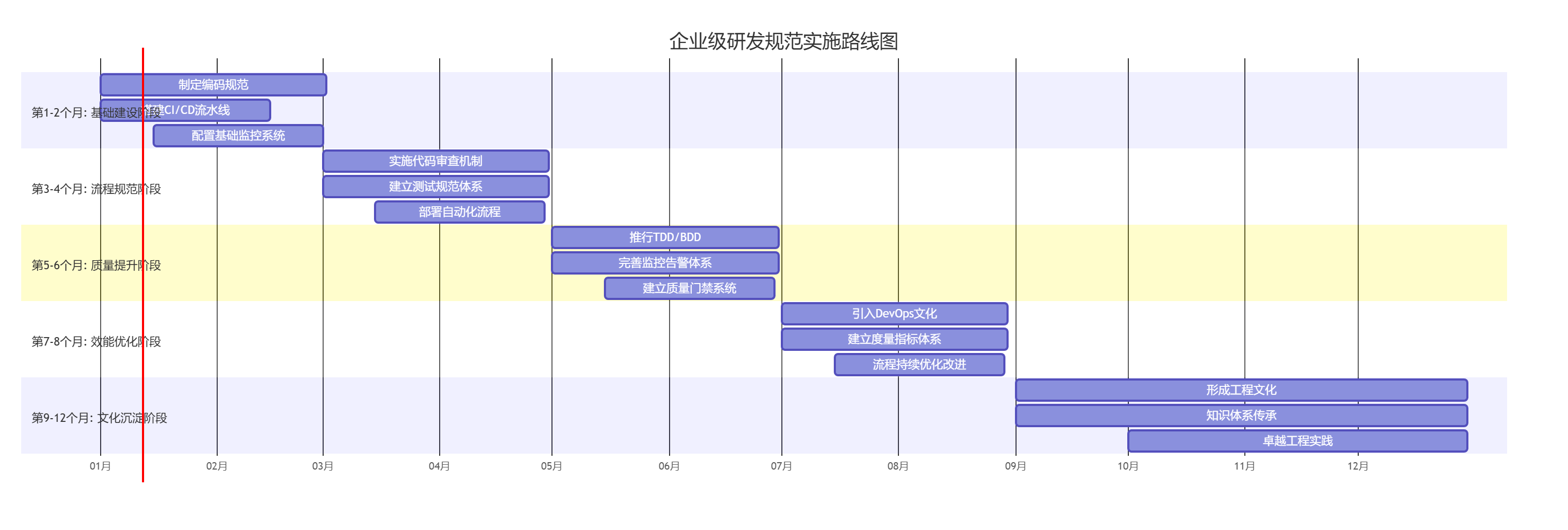
通过这套完整的企业级软件研发工程应用规范,团队可以实现:
- 标准化开发流程:从需求到交付,全流程标准化
- 高质量交付:通过自动化测试、代码审查保障质量
- 高效协作:明确职责,减少沟通成本
- 快速响应:敏捷迭代,持续交付价值
- 风险可控:自动化部署,完善的监控告警
- 持续改进:数据驱动,不断优化流程
这是现代企业级软件研发的最佳实践体系,可确保软件项目在高质量、高效率、可维护性和可扩展性方面达到行业领先水平。

有“AI”的1024 = 2048,欢迎大家加入2048 AI社区
更多推荐
 17
17 0
0- 0


 已为社区贡献51条内容

所有评论(0)