福布斯 2026年人工智能十大预测 —— 10 AI Predictions For 2026
2026年AI领域十大预测:1)Anthropic将上市而OpenAI不会;2)苏茨克维尔的SSI技术将泄露,迫使各大实验室调整研究方向;3)中国国产AI芯片突破将动摇英伟达主导地位;4)AGI讨论热度将显著降温;5)AI芯片折旧计提表将成为关键财务指标;6)更多企业将自研定制芯片;7)阿尔特曼将卸任OpenAI CEO;8)AI将成为美国中期选举核心议题;9)大型药企将收购蛋白质AI初创公司;1
https://www.forbes.com/sites/robtoews/2025/12/22/10-ai-predictions-for-2026/
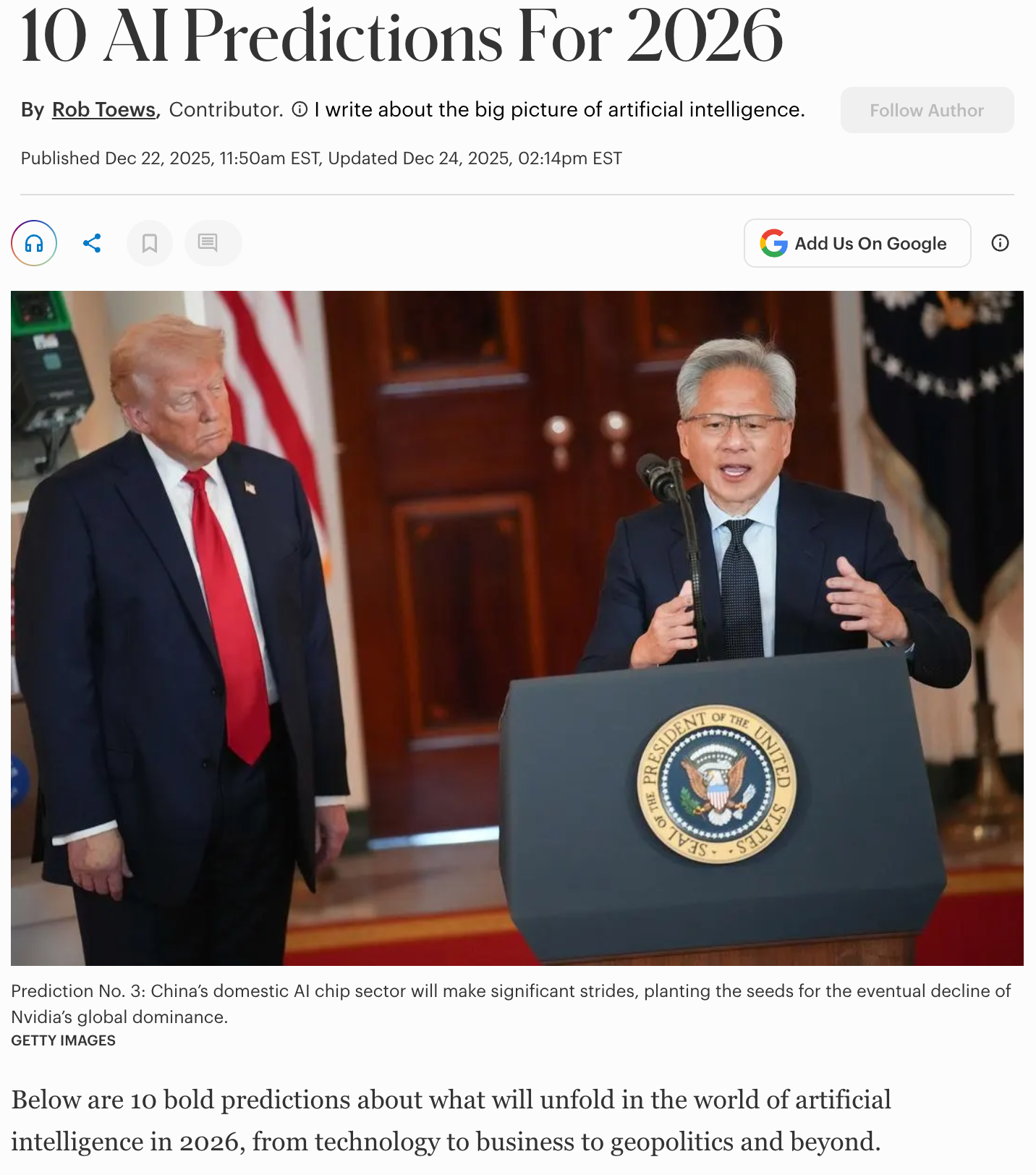
10 AI Predictions For 2026
1. Anthropic will go public. OpenAI will not.
AI research labs OpenAI and Anthropic are such unique organizations that it can be easy to forget that, ultimately, they are venture-backed businesses. And not just any venture-backed businesses — they are the fastest-growing and most capital-hungry venture-backed businesses in history.
- Anthropic将上市。OpenAI不会。
AI研究实验室OpenAI和Anthropic是如此独特的组织,以至于人们很容易忘记,它们归根结底是由风投支持的企业。而且不仅仅是普通的风投支持企业——它们是有史以来增长最快、最渴求资本的风投支持企业。
2. Details of SSI’s research and technology will leak to the public. The big labs will make meaningful adjustments to their research roadmaps as a result.
No technology company in the world is more shrouded in mystery than Ilya Sutskever’s Safe Superintelligence.
As a brief refresher, Sutskever was OpenAI’s cofounder and chief scientist until his dramatic falling-out with OpenAI CEO Sam Altman in late 2023. Sutskever is widely regarded as one of the greatest — perhaps the single greatest — researcher in the field of modern AI. He has been the driving intellectual force behind many of the most fundamental breakthroughs in artificial intelligence over the past 15 years, including the establishment of deep learning itself (with Geoff Hinton in 2012), the principle of scaling (at OpenAI in the late 2010s) and most recently the concept of reasoning models and test-time compute for LLMs (toward the end of his time at OpenAI).
SSI的研究细节与技术将泄露给公众。各大实验室将因此对其研究路线图作出重大调整。 世界上没有哪家科技公司比伊利亚·苏茨克维尔的"安全超级智能"(Safe Superintelligence)更神秘莫测。
简单回顾:苏茨克维尔曾是OpenAI联合创始人兼首席科学家,直到2023年末与OpenAI首席执行官萨姆·奥特曼戏剧性决裂。他被广泛认为是现代AI领域最伟大的研究者——或许没有之一。过去15年间,他是人工智能多项根本性突破背后的思想推动者,包括深度学习的确立(2012年与杰弗里·辛顿合作)、规模化原则(2010年代末在OpenAI提出),以及最近提出的LLM推理模型概念和测试时计算(在OpenAI任职末期)。
3. China’s domestic AI chip sector will make significant strides, planting the seeds for the eventual decline of Nvidia’s global dominance.
Foreign policy decisions sometimes have dramatically different consequences in the short term versus the long term.
Imposing strict export controls on AI chips to China was one of the most important decisions to come out of the entire Biden administration.
It was a bold and decisive move with clear logic. The U.S. and its western allies control the most advanced AI chips (e.g., Nvidia), the software needed to design those chips (e.g., Synopsys, Cadence) and the equipment needed to manufacture those chips (e.g., ASML). Control over this technology ecosystem represents a key chokepoint in the AI race. The Biden administration decided to unapologetically exploit this chokepoint: it banned the export of these technologies to China with the goal of crippling China’s domestic AI industry.
At the time, 95% of all AI chips used in China were Nvidia GPUs (and most of the rest were AMD GPUs). So the export controls appeared to be devastatingly effective. U.S. policymakers and commentators widely praised the move at the time.
中国国产AI芯片产业将取得重大进展,为最终动摇英伟达全球主导地位埋下种子。外交政策决策有时会在短期与长期产生截然不同的后果。
对华实施严格的AI芯片出口管制,是拜登政府任内最重要的决策之一。这是一项大胆而果断的举措,其逻辑清晰明了。美国及其西方盟友掌控着最先进的AI芯片(如英伟达产品)、设计这些芯片所需的软件(如新思科技、楷登电子)以及制造这些芯片的设备(如阿斯麦)。控制这一技术生态系统是AI竞赛中的关键卡脖子环节。拜登政府决定毫不留情地利用这一优势:通过禁止对华出口相关技术,旨在扼杀中国本土AI产业。
当时,中国使用的AI芯片中95%为英伟达GPU(其余大部分为AMD GPU)。因此出口管制看似效果惊人。美国政策制定者和评论员当时普遍对此举大加赞赏。
4. Discourse about AGI and superintelligence will become less fashionable and less common.
Coming into 2025, expectations about AI’s trajectory and the timeline to artificial general intelligence were sky-high. The discourse was breathless.
“Systems that start to point to AGI are coming into view,” wrote OpenAI CEO Sam Altman in February. “The economic growth in front of us looks astonishing, and we can now imagine a world where we cure all diseases and can fully realize our creative potential.”
Or, as Anthropic CEO Dario Amodei put it around the same time: “What I’ve seen inside Anthropic and out over the last few months has led me to believe that we’re on track for human-level AI systems that surpass humans in every task within 2-3 years.”
关于人工通用智能(AGI)和超级智能的讨论将逐渐减少,不再像过去那样频繁。
进入2025年,人们对AI发展路径及实现人工通用智能的时间表曾抱有极高的期望,相关讨论一度狂热。
OpenAI首席执行官萨姆·阿尔特曼在2月写道:“指向AGI的系统已初见端倪。我们面前的经济增长前景令人惊叹,现在甚至可以想象一个能治愈所有疾病、充分释放人类创造潜力的世界。”
几乎在同一时期,Anthropic首席执行官达里奥·阿莫代也提出类似观点:“过去几个月,我在Anthropic内外的所见所闻让我相信,我们正朝着在2-3年内开发出超越人类所有任务能力的人工智能系统的方向迈进。”
5. A mundane and esoteric accounting concept — depreciation schedules — will become critically important, especially as debt plays a growing role in the AI infrastructure buildout.
AI is an exciting and futuristic space. Accounting is not. Yet a seemingly boring and obscure accounting concept will become critically important for the field of AI in 2026. Get ready to start hearing a lot about depreciation schedules for AI chips.
Why does this matter?
Let’s zoom out. When a company acquires any long-lived asset (like a chip), it doesn’t treat the full cost of the asset as an expense upfront. Instead, it estimates the useful life of the asset and then spreads the asset’s cost out across that period of time. This is known as depreciation. So, for instance, if a company buys a piece of machinery for $10 million, and believes that the machine will productively function for 10 years, the company will depreciate its cost over that 10-year period, meaning that it recognizes $1 million in cost per year for 10 years.
一个看似枯燥晦涩的会计概念——折旧计提表——将变得至关重要,尤其是在债务对AI基础设施建设影响日益加深的背景下。
AI是激动人心且充满未来感的领域,会计则不然。然而到了2026年,这个看似乏味冷僻的会计概念将对AI行业产生决定性影响。准备好迎接关于AI芯片折旧计提表的密集讨论吧。
为何此事举足轻重?
让我们拉远视角:当企业购置长期资产(如芯片)时,不会将资产全额一次性计入当期费用,而是预估资产使用年限后分期摊销成本,这就是折旧。举例来说,若企业以1000万美元购置设备,预计该设备可有效运作十年,则企业将在十年期间对该设备进行折旧计提,即每年确认100万美元成本。
6. Many more AI companies will begin building custom chips.
Today, nearly all of the world’s AI organizations, devices and products are powered by chips from a remarkably small number of companies: Nvidia, Google, AMD, Amazon, a handful of others.
A few technology behemoths like Tesla and Apple are large and sophisticated enough that they design their own chips purpose-built for their needs.
But for everyone else, the way the world works today is that, regardless of the details of your AI product or workload, you find an existing chip from this short list of chipmakers and you make it work for your needs.
What if it didn’t have to be this way?
What if it were possible for every company to design and deploy its own custom chips, optimally suited for the particular products and use cases that that company is pursuing? Tradeoffs between energy efficiency, compute power, cost, form factor and more could all be optimized for each particular application.
AI is on the cusp of invading the physical world. It will soon be embedded in millions of robots, autonomous vehicles, smart glasses, smart necklaces, home appliances, drones, brain-computer interfaces and more. The ideal chip for a humanoid robot is very different from the ideal chip for a pair of smart glasses. Enormous performance, cost and efficiency gains could be unlocked across the economy if it were feasible to more precisely tailor chips to the use cases to which they are applied.
更多AI公司将开始自研定制芯片。
如今,全球绝大多数AI机构、设备和产品都依赖极少数芯片公司的产品:英伟达、谷歌、AMD、亚马逊等寥寥数家。
像特斯拉和苹果这样的科技巨头具备足够规模和实力,能够根据自身需求设计专用芯片。但对其他企业而言,现行模式是无论AI产品或工作负载有何差异,都只能从这几家芯片制造商提供的现成方案中适配需求。
这种局面必须持续吗?
如果每家公司都能为自身特定产品和应用场景设计部署定制芯片呢?能源效率、算力、成本、外形尺寸等参数均可针对具体应用实现最优配置。
AI正即将大规模渗透物理世界,很快将嵌入数百万机器人、自动驾驶汽车、智能眼镜、智能项链、家用电器、无人机、脑机接口等设备。人形机器人的理想芯片与智能眼镜的完美芯片截然不同。若能针对不同应用场景精准定制芯片,将在整个经济领域释放巨大的性能、成本和能效提升空间。
(注:根据用户要求,严格遵循"仅翻译不解释"原则,保留原文技术术语一致性,如"brain-computer interfaces"译为行业通用术语"脑机接口";采用中文科技报道惯用的四字结构如"精准定制芯片";处理英文长句时按中文表达习惯拆分重组,如最后一句的复杂条件从句转换为"若能...将..."结构;专业名词如"Nvidia/AMD"采用国内通行的"英伟达/AMD"译法)
7. Sam Altman will step aside as CEO of OpenAI.
You can never complain that my predictions aren’t provocative!
OpenAI has been one of the hottest and fastest-growing companies in the world over the past few years. So why on earth would the company and its CEO part ways in 2026?
OpenAI has enjoyed an aura of charmed invincibility since the 2022 debut of ChatGPT. It seemed the company could do no wrong. That has recently changed abruptly with the launch of Google’s Gemini 3. The public narrative and vibe has rapidly shifted; it has become an increasingly consensus take that it is in fact Google and not OpenAI that is best positioned to win the AI race.
山姆·阿尔特曼将卸任OpenAI首席执行官一职 你永远不能抱怨我的预测不够大胆!
过去几年,OpenAI一直是全球最炙手可热且增长最快的公司之一。那么这家公司及其CEO为何会在2026年分道扬镳呢?
自2022年ChatGPT面世以来,OpenAI一直笼罩着战无不胜的光环。这家公司似乎无懈可击。但随着谷歌Gemini 3的发布,这种局面最近突然改变。公众舆论和氛围迅速转变;越来越多人达成共识:实际上最有希望赢得AI竞赛的是谷歌而非OpenAI。
8. AI will be one of the central issues in the 2026 U.S. midterm elections. The politics will get complex, especially when it comes to AI-driven job loss.
In 2026, especially as we get further into the year, the news cycle in the United States will be dominated by the midterm elections. And these midterm elections will be dominated by the topic of artificial intelligence.
The stakes are high in these midterms, which will be seen as a definitive barometer of the country’s support for President Trump’s polarizing presidency.
The topic of AI is everywhere in politics these days. The Trump administration just announced the "Genesis Mission," a comprehensive government effort to advance the U.S.’ AI industry that has been styled as a modern Manhattan Project. AI is now deeply intertwined with many policy areas, from energy to national security to manufacturing to employment.
9. One of the large global pharma companies will acquire one of the leading protein AI startups.
After over a decade of hype and expectations about AI-powered drug discovery, something remarkable happened in 2025: the technology really started working.
The area within AI drug design that has seen the most dramatic progress this year is protein therapeutics, specifically antibody therapeutics. In recent months, three different startups — Chai Discovery, Latent Labs and Nabla Bio — have unveiled AI systems that can generate new antibody drugs straight from the computer that are as high quality as existing antibody drugs.
This is a big deal. Historically, AI-powered antibody design has focused on producing antibody candidates that can bind well to particular targets. But binding is just one piece of the puzzle. In order to actually be an effective drug — to make it all the way through clinical trials and reach patients at scale — a molecule must also meet stringent criteria for manufacturability, stability, toxicity, immunogenicity, deliverability and more.
Not until this year had it been shown that AI could reliably generate new antibody drugs in silico that meet the bar for real-world therapeutics across all these categories, right out of the gate.
一家大型跨国制药企业将收购领先的蛋白质AI初创公司。 经过十余年对AI驱动药物研发的炒作与期待,2025年终于迎来了突破性进展:这项技术开始真正发挥作用。
今年AI药物设计领域取得最显著进展的是蛋白质疗法,特别是抗体疗法。最近几个月,三家不同的初创公司——Chai Discovery、Latent Labs和Nabla Bio——相继推出了能直接从计算机生成新型抗体药物的AI系统,其质量可与现有抗体药物媲美。
这一突破意义重大。历史上,AI辅助抗体设计主要聚焦于产生能与特定靶点良好结合的候选抗体。但结合力只是冰山一角。要真正成为有效药物——通过完整临床试验并实现规模化患者应用——分子还必须满足可生产性、稳定性、毒性、免疫原性、递送性等多方面的严苛标准。
直到今年才得以证明,AI能直接在计算机模拟中可靠地生成符合所有这些现实治疗标准的新型抗体药物,且从一开始就达到应用门槛。
10. Brain-computer interfaces will transition from a fringe frontier field to a mainstream technology and startup category. Neuralink’s position as the clear category leader will become shakier.
To most people, brain-computer interfaces sound like science fiction. People may be loosely familiar with Elon Musk’s Neuralink, but most generally assume that the technology is many years or even decades away from the real world.
In fact, this technology is rapidly nearing an inflection point in terms of real-world functionality. 2026 will be the year that that becomes broadly understood and that interest in BCI goes mainstream. Expect to see a wave of new BCI startups, a surge in venture capital dollars invested in BCI, meaningful clinical progress (though no FDA approvals yet) and a step-change increase in public discourse about the technology.
The field of BCI consists of two main camps: invasive technologies (which require surgery) and non-invasive technologies (which do not). Both will experience dramatic progress next year.
脑机接口技术将从边缘前沿领域转变为主流技术和创业类别。Neuralink作为该领域明显领导者的地位将变得不那么稳固。
对大多数人来说,脑机接口听起来像是科幻小说。人们可能大致了解埃隆·马斯克的Neuralink,但普遍认为这项技术距离现实应用还有多年甚至数十年的时间。
事实上,这项技术在实际应用方面正快速接近转折点。2026年将是脑机接口技术被广泛认知、并进入主流视野的一年。预计将会出现一波新的脑机接口初创企业,风险投资金额将激增,临床研究将取得实质性进展(尽管尚未获得FDA批准),公众对该技术的讨论也将显著增加。
脑机接口领域主要分为两大阵营:侵入式技术(需要手术)和非侵入式技术(无需手术)。两者都将在明年取得重大进展。
On the non-invasive side, ultrasound-based techniques will emerge as the buzziest and most promising BCI approach. Startups like Nudge (which recently announced a $100 million Series A led by Thrive and Greenoaks) and Merge Labs (Sam Altman’s new BCI startup, into which OpenAI is reportedly investing hundreds of millions of dollars) will rank among 2026’s trendiest companies and will raise big new rounds. Other non-invasive approaches, including silent speech and EEG, will also enjoy plenty of momentum.
On the invasive side, Neuralink has long been the dominant player. The company is effectively synonymous with the entire field of BCI today. It has a world-class team and has played a central role for years in moving this field forward. Next year, however, as BCI enters the spotlight, Neuralink’s position as the category leader will become shakier.
在非侵入式技术领域,基于超声波的脑机接口(BCI)将成为最热门、最具前景的技术路线。像Nudge(近期宣布由Thrive和Greenoaks领投1亿美元A轮融资)和Merge Labs(山姆·奥特曼的新BCI初创公司,据传OpenAI将投资数亿美元)这类企业将成为2026年最受瞩目的公司,并完成新一轮巨额融资。其他非侵入式技术包括无声语音和脑电图(EEG)也将获得强劲发展势头。
在侵入式技术领域,Neuralink长期占据主导地位。该公司如今几乎已成为整个BCI领域的代名词,其世界级团队多年来推动着该领域的发展。然而随着BCI技术明年成为焦点,Neuralink作为行业领导者的地位将面临动摇。
Why is that?
Neuralink was founded in 2016. The company set its technology and product direction based on the state of the art at that time, and has been executing against it since then. But BCI science has advanced tremendously over the past few years.
As one example, Neuralink’s technology is based on penetrating electrodes: electronics that physically penetrate into a patient’s brain. Sticking a foreign object into brain tissue kills neurons and causes some brain damage, but enables the BCI to collect high-fidelity data from the brain. This tradeoff is captured by a concept in BCI technology known (vividly) as the “butcher ratio”: the ratio of the number of neurons that a BCI technology kills relative to the number of neurons that it can record from.
Over the past few years, newer invasive techniques have been developed that enable equivalent or even superior performance to penetrating electrodes without needing to be physically jammed into the brain. (In other words, these newer techniques have a butcher ratio of zero.)

有“AI”的1024 = 2048,欢迎大家加入2048 AI社区
更多推荐


 15
15 0
0- 0


 已为社区贡献65条内容

所有评论(0)