Google 全新的 AI 浏览器 DISCO
来自Google Chrome Team https://www.youtube.com/@GoogleChrome
The web is a vast collection of applications and information, making it an incredible engine for discovery and learning. Yet, as our online tasks have grown more complex we've all felt the frustration of juggling dozens of open tabs to research a topic or plan a trip. We believe the web itself has the opportunity to adapt to the complexity, which is why we're introducing Disco, featuring GenTabs, the newest experiment from Google Labs.
Disco is our new “Disco”very vehicle designed to reimagine browsing and building for the modern web. Disco will help us learn faster and work together with AI enthusiasts to shape the future of web browsing. And the first feature we’re testing is GenTabs, which was built with Gemini 3, our most intelligent model.
网络是应用程序和信息的庞大集合,使其成为探索和学习的强大引擎。然而,随着在线任务日益复杂,我们都经历过为研究某个主题或规划行程而手忙脚乱切换数十个标签页的挫败感。我们认为网络本身应该适应这种复杂性,因此我们推出搭载GenTabs功能的Disco——来自Google实验室的最新实验项目。
Disco是我们全新的"探索"载体,旨在重塑现代网络的浏览与构建方式。它将帮助我们更高效地学习,并与AI爱好者们共同塑造未来网络浏览的形态。我们测试的首个功能GenTabs正是基于当前最智能的Gemini 3模型构建而成。
GenTabs helps you navigate the web by proactively understanding your complex tasks (through your open tabs and chat history) and creating interactive web applications to help you complete the tasks. You never need to write a line of code: Just describe the tool you need and refine it using natural language. Depending on your current task, it will even create suggestions for generative apps that you hadn’t thought of yet. And because every generative element ties back to the web, it always links to the original sources.
GenTabs通过主动理解您的复杂任务(通过您打开的标签页和聊天记录)并创建交互式网络应用程序来帮助您完成任务,从而提升网页浏览体验。您无需编写任何代码:只需描述您需要的工具,并使用自然语言进行优化。根据您当前的任务,它甚至会生成您尚未想到的生成式应用建议。由于每个生成元素都与网络相关联,它始终会链接回原始来源。
更多体验需要等 Google 邀请

展示的情况
https://www.theverge.com/tech/842000/google-disco-browser-ai-experiment
The biggest question about GenTabs is simply: What is a GenTab? Is it a web app that sticks around forever and has a URL you can go to yourself and share with others? Is it something ephemeral that disappears when you close it? Tabriz says she’s not exactly sure. “We have two new primitives here, right?” she asks. “One is this concept of a project, which is a container that’s holding a chat conversation with a bunch of regular tabs with content from the open internet. And then there’s this generated tab, which has taken all this information and turned it into essentially a web app that weaved all of this together to help you get something done.”
Early users, Tabriz says, have asked for ways to share their GenTabs with others or make them permanent in other ways. When I mention that Google has many apps, like Docs and Sheets, that let users do this in fairly understandable ways, she laughs and nods. She says the answer is probably to support both permanence and ephemerality, plus to offer ways to get important data out of GenTabs and into other tools people use. (Like, for instance, all the Google Workspace apps.)
关于GenTabs的最大疑问很简单:什么是GenTab?它是一个永久存在的网络应用程序,拥有可自行访问并与他人分享的URL吗?还是关闭后就会消失的临时性内容?Tabriz表示她也不太确定。"我们这里有两个新概念,对吧?"她问道,"一个是'项目'的概念,这是一个容器,里面包含聊天对话和来自开放互联网的常规内容标签页。另一个是生成的标签页,它整合了所有这些信息,实质上将其转化为一个网络应用程序,帮助你完成某项任务。"
Tabriz指出,早期用户曾要求分享GenTabs或通过其他方式使其永久化。当我提到谷歌已有许多应用程序(如Docs和Sheets)以易于理解的方式实现这些功能时,她笑着点头表示认同。她表示解决方案可能需要同时支持永久性和临时性,并提供将重要数据从GenTabs导出到其他常用工具(比如所有Google Workspace应用程序)的方法。
Both Roy and Tabriz seem genuinely curious and uncertain about how Disco will turn out. Will people embrace what amounts to vibe-coding one-off web apps? Will they understand the concept of a back-and-forth between web tabs and GenTabs? Do GenTabs ultimately make more sense as their own app — a sort of project management tool — or as a feature of Chrome or Search or Docs or something else? They don’t know. Hence the experiment. But more than just about any AI browser I’ve seen, Disco feels like it is both AI and web browser. And if it can put those two things together to make something even better, well, maybe it can take on Chrome.
罗伊和塔布里兹似乎都对Disco的最终形态充满真诚的好奇与不确定。人们会接受这种相当于氛围编码的一次性网页应用吗?他们能理解网页标签与GenTabs之间来回切换的概念吗?GenTabs最终更适合作为独立应用(类似项目管理工具),还是作为Chrome、搜索、文档等产品的功能?他们尚无定论。所以需要实验验证。但与我见过的任何AI浏览器相比,Disco更像是AI与网页浏览器的结合体。如果它能将这两者融合创造出更优秀的产品,或许真能与Chrome一较高下。
The Chrome team at Google recently built a new browser. It takes a query or prompt, opens a bunch of related tabs for you, and then builds you a custom app for whatever you’re trying to do. Ask it for travel tips and it’ll build you a planner app; ask it for study help and it’ll build you a flashcard system. It’s Googling meets vibe coding. The concept is called GenTabs, and the browser is called Disco (evidently, both for fun reasons and because it’s short for “discovery”). Google is launching both as experiments in Google Labs today, to see if they might have a place in the future of the web.
Before we get too far: No, this is not some internal attempt to cannibalize Chrome. It started as a hackathon project inside Google, and seems to have just caught the team’s imagination. “I don’t think of Disco as a general-purpose browser,” says Parisa Tabriz, who runs the Chrome team at Google. It can certainly open and interact with websites, but its real job is to see what happens when “people go from just having tabs to creating this very personalized, curated app that helps them do what they need, right now.”
谷歌Chrome团队最近开发了一款新型浏览器。它能根据查询指令自动打开多个相关标签页,并针对用户需求生成定制化应用——无论是旅行规划还是学习辅助,只需输入需求就能获得专属行程规划器或单词卡系统。这款名为Disco(取"发现/discovery"之意)的浏览器采用GenTabs技术理念,将搜索引擎与即时编程完美融合。目前这两项实验性产品已登陆Google Labs,旨在探索未来互联网的可能性。
需要说明的是:这并非谷歌试图取代Chrome的内部计划。该项目最初只是公司黑客马拉松的创意产物,却意外激发了团队灵感。Chrome团队负责人Parisa Tabriz表示:"Disco并非通用浏览器。"虽然具备常规网页浏览功能,但其核心价值在于实现"从多标签页浏览到即时生成个性化应用"的革命性跨越。
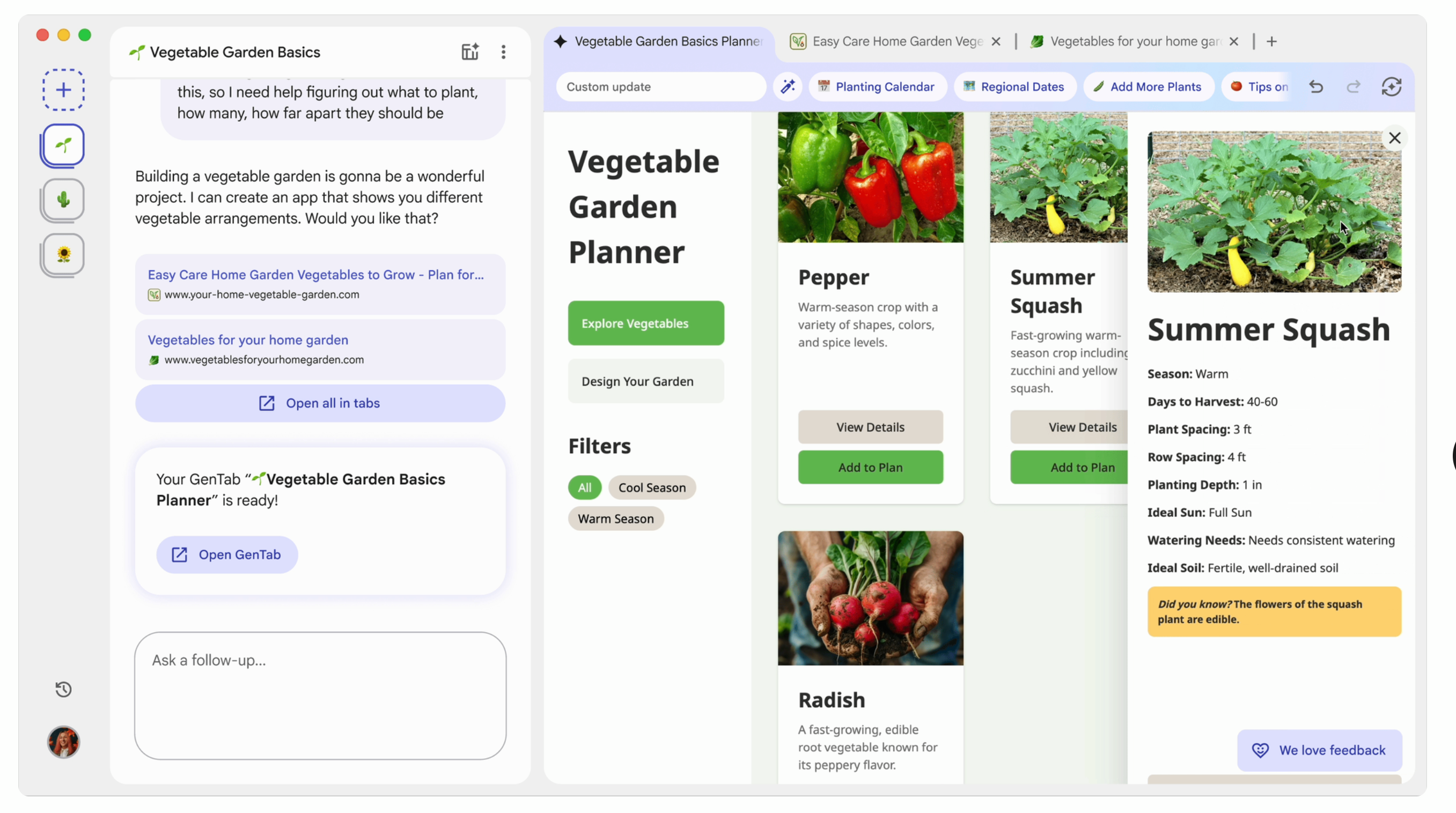
GenTabs turns out to be an unexciting but reasonably descriptive term: They’re information-rich pages generated by Google’s Gemini AI models. One of the key features in the recently launched Gemini 3 is its ability to create one-off interactive interfaces, essentially building miniature apps on the fly instead of just returning a bunch of text or an image. GenTabs takes that idea and makes it the core feature of your web browser.
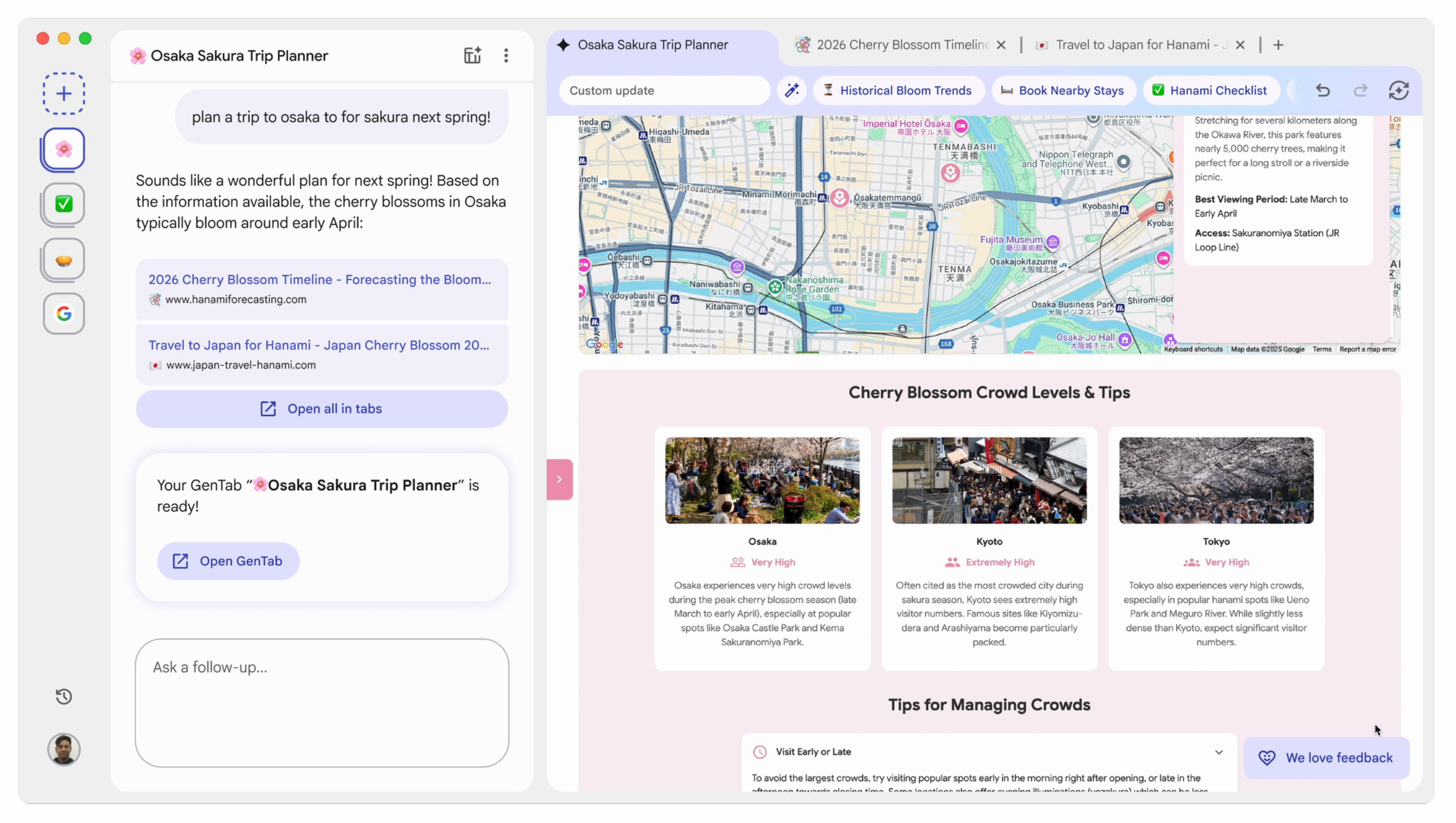
To demonstrate, Manini Roy, who runs an innovation lab on the Chrome team, opened up Disco and created a new tab. Well, again, not a tab exactly: She clicked a button in the app’s left sidebar that launched what Google is calling a “project,” which I can only describe as a browser inside the browser. The first thing that appeared was a chat box, into which Roy typed that she wanted to plan a trip to Japan. This is a bog-standard chatbot use case, and Gemini immediately got to work.
GenTabs(生成式标签页)最终被证实是一个平淡但相当贴切的术语:它们是由谷歌Gemini AI模型生成的信息密集型页面。在最新发布的Gemini 3版本中,关键功能之一就是能创建一次性交互界面,本质上可即时构建微型应用程序,而非仅返回文本或图像。GenTabs将这一理念转化为网页浏览器的核心功能。
为展示该功能,Chrome团队创新实验室负责人Manini Roy打开Disco应用并新建了一个标签页——确切地说并非传统标签页:她点击应用左侧边栏按钮后,启动了谷歌所谓的"项目",这简直可以形容为"浏览器中的浏览器"。首先出现的是聊天框,Roy输入了想要规划日本旅行的需求。虽然这是聊天机器人的常规使用场景,但Gemini立刻开始了智能响应。
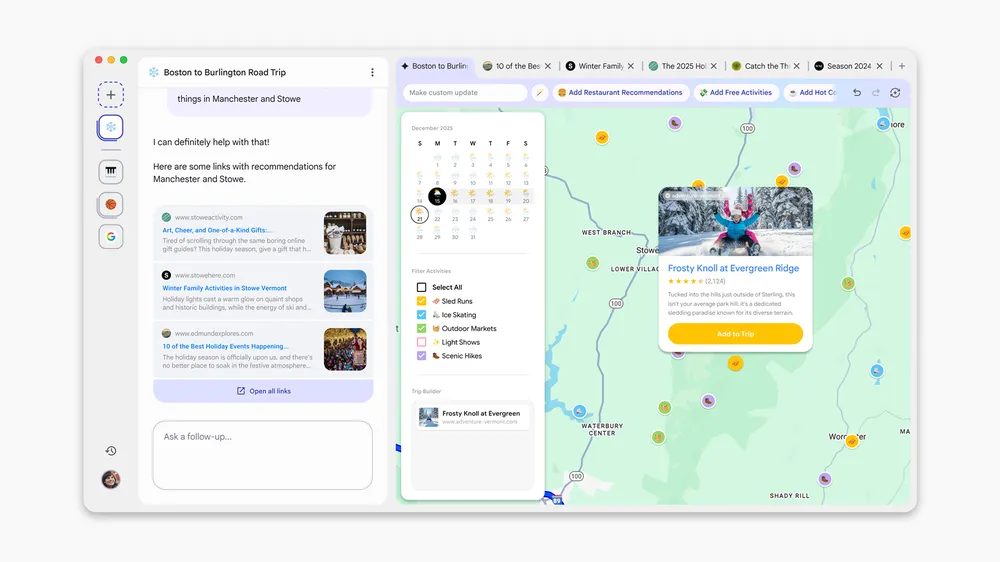
Rather than just deliver a bunch of text and links, Disco immediately did two things: It opened a bunch of tabs related to Roy’s query and offered to create an interactive planner for her. Roy accepted the offer, and after a minute or so of processing, Gemini created what appeared to be an interactive web app. It had a map of Japan with a bunch of relevant attractions marked, a relatively simple itinerary builder, and links to the sources it used. Those sources included the tabs open inside the project, and as Roy opened new tabs with other things she wanted to add to her trip, the GenTab updated with new information from those sources.
This back-and-forth, in which GenTabs suggest information but also consider the sites you open yourself, is key to the whole idea. Rather than prompt the model to keep offering you more stuff, you’re supposed to add stuff yourself! Open a bunch of tabs with the places you know you want to go in Japan, and the GenTab can drop them into the itinerary along with the places it suggests for you. It’s much more collaborative than the set-and-forget idea behind so many agentic systems.
Disco没有仅仅提供一堆文本和链接,而是立即做了两件事:它打开了与Roy查询相关的一组标签页,并主动为她创建了一个互动行程规划器。Roy接受了这个提议,经过大约一分钟的处理后,Gemini生成了一款看似交互式的网页应用。该应用包含标有多个相关景点的日本地图、一个相对简单的行程构建器,以及所使用的信息来源链接。这些来源包括项目内已打开的标签页,当Roy打开新标签页添加其他旅行项目时,GenTab会从这些新来源更新信息。
这种双向互动——GenTabs既推荐信息又考虑用户自行打开的网页——是整个理念的核心。与其不断让模型向你推送更多内容,不如由你亲自添加!打开一系列你确定想去的日本景点标签页,GenTab就能将这些地点与它推荐的地点一起纳入行程。这比许多代理系统"设置即遗忘"的运作模式更具协作性。
Roy showed me other demos, too, including one that answered a question about how ankles work, both by opening tabs with helpful medical information and by creating a GenTab with a very unpolished but pretty helpful interactive model of the human foot. Another project was designed to help you with a cross-country move, and included moving tips, a calculator to weigh your stuff, and a price comparison table for various moving companies. In every case, the GenTab offers a bunch of tips for how you might tweak or refine the interface, plus a text box for following up however you’d like.
Disco is one of the most web-forward AI demos I’ve ever seen, in that unlike most AI browsers it appears to actually hope you open and look at websites. At first, Roy says, “we surfaced the links in the chat, but never opened the tabs. And what we found is that a lot of users kept chatting, but weren’t necessarily going into the tabs and digging into the sources.” The team wanted to incentivize users to add more information and research to the GenTab, so they needed to get them to open some regular tabs. “That is where the grounding is that the GenTabs are using to create themselves,” she says. “That’s creating the virtuous cycle.” So far, she says early data suggests pushing people to use the web instead of just the chatbot is already working.
罗伊还向我展示了其他演示,包括一个回答脚踝工作原理问题的案例。该演示不仅会打开包含有用医疗信息的标签页,还会生成一个略显粗糙但相当实用的人足交互模型GenTab。另一个项目旨在协助用户完成跨国搬家,提供搬迁小贴士、物品重量计算器以及多家搬家公司的比价表。在每种场景下,GenTab都会提供一系列界面优化建议,并配有可自由输入后续需求的文本框。
Disco是我见过最具网络前瞻性的人工智能演示,与大多数AI浏览器不同,它似乎真心希望用户能打开并浏览网页。罗伊表示:"我们最初只在聊天界面显示链接,从不主动打开标签页。结果发现许多用户持续聊天,却未必会点开标签页查阅原始资料。"团队希望激励用户为GenTab补充更多信息和研究数据,因此需要引导他们打开常规网页标签。"这些网页正是GenTab自我创建的基础素材,"她解释道,"由此形成了良性循环。"据她透露,初期数据表明,推动用户使用网络而不仅限于聊天机器人的策略已初见成效。
感兴趣的看看这个视频:
https://blog.google/products/chrome/how-the-chrome-team-uses-chrome/
How the Chrome team uses Chrome
https://www.google.com/chrome/ai-innovations/
https://developer.chrome.com/docs/ai/team?hl=zh-cn

有“AI”的1024 = 2048,欢迎大家加入2048 AI社区
更多推荐

 8
8 0
0- 0


 已为社区贡献69条内容

所有评论(0)