Holographic Universal Demand Dynamics Model (HUDDM
Through AI-based simulations, HUDDM demonstrates cross-domain explanatory power ranging from micro-physics to macro-economics, and exhibits deep-level properties such as "computation independent of ha
I. Introduction
Throughout history, numerous philosophers and contemporary scholars have sensed the possible existence of a deeper foundational structure in the universe, attempting to describe this hidden framework from different perspectives. Einstein pursued a unified field theory throughout his life; Bohm proposed the "implicate order" theory, viewing the universe as an indivisible whole; Penrose explored potential connections between consciousness and quantum physics; Bateson studied cross-scale information patterns; Watson investigated self-organizing principles in biological systems; Kauffman explored emergent complexity; Smolin sought self-organizing principles in quantum gravity; Hassabis has dedicated himself to building cognitive architectures for artificial general intelligence; Wittgenstein analyzed the structural relationship between language and reality. Despite their diverse approaches, these explorations seemingly point toward an unrevealed meta-structure. Based on AI simulation research, this paper proposes a possible deep structural model of the universe: the Holographic Universal Demand Dynamics Model (HUDDM).
[Copyright Registration No.: 国作登字-2025-K-SZ00544210]
II. Background
I am an ordinary college graduate from China without advanced formal education. However, my work experiences have sparked a deep fascination with "human nature" in both myself and others. In everyday life, I constantly question my own actions:
a) When buying clothes, I ask myself why I need to purchase them;
b) When feeling hungry, I question why I need to eat;
c) When attracted to someone, I examine why I feel this attraction and what might draw them to me.
While the answers vary with context, I have consistently sensed that my thought process seems to follow a similar underlying cognitive pattern or logical structure.
III. The Holographic Universal Demand Dynamics Model
Through daily self-observation, I attempted to extract a possible unified cognitive architecture from my various behaviors. This architecture appears to consist of twelve core elements (considered necessary components within the model): Nature (N), Internal/External Demands (X/K), Internal/External Ideologies (Y/P), Human Sensory System (S), Labor (L), Technological Products (C), Time (T), Space (V), External Environment (E), and Information Flow (Ψ).
When applying these elements to analyze my behaviors, my thinking seems to follow similar trajectories, forming five cyclic dynamic systems:
-
Nature Awakening Cycle: Nature (N) → Demand (X) → Ideology (Y) → Nature (N) (Demand X → Ideology Y supports one-to-one, one-to-many, and many-to-many relationships);
-
Sensory Shaping Cycle: Nature (N) → Demand (K) → Ideology (P) → Human Sensory System (S) → Nature (N);
-
Environmental Interaction Cycle: Human Sensory System (S) + Labor (L) → External Environment (E) → Human Sensory System (S);
-
Technological Creation Cycle: Human Sensory System (S) + Labor (L) → Technological Products (C) → Human Sensory System (S);
-
Cosmic Feedback Cycle: Human Sensory System (S) + Labor (L) → Technological Products (C) → External Environment (E) → Human Sensory System (S)
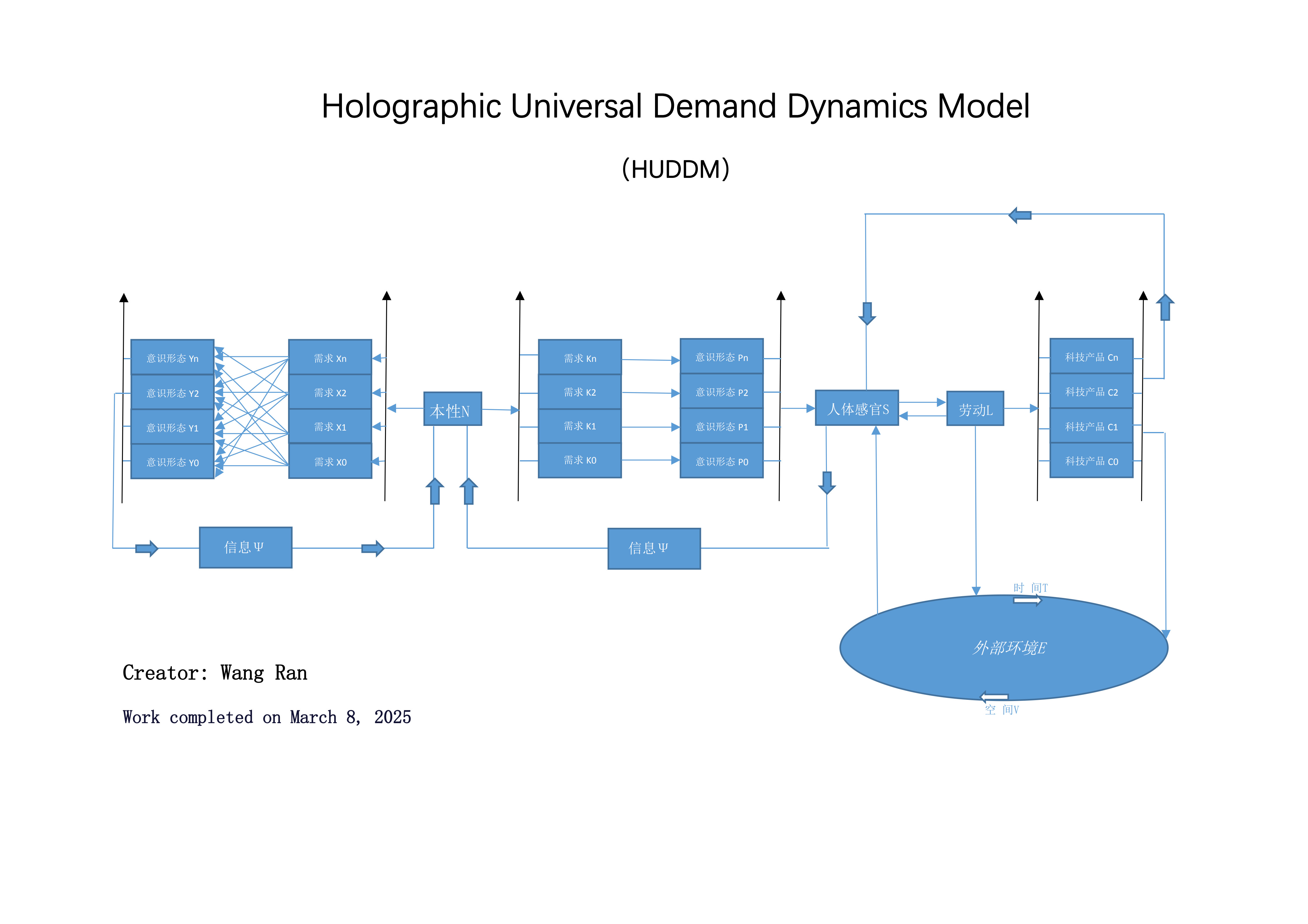
An ancient Chinese saying states "the unity of heaven and humanity" (天人合一). This inspired me to consider: if this structure can describe human behavior patterns, might other cosmic phenomena also follow similar rules? I attempted to strip away specific semantics from the structure, forming an abstract framework with only twelve placeholders and five cyclic rules. AI simulations suggest that when mapped to different domains, this structure appears capable of reproducing behavioral patterns from microscopic quantum phenomena to macroscopic social dynamics. Particularly in physics domain simulations, when Information Flow (Ψ) was replaced with quantum entanglement entropy-related parameters, AI simulations showed possibilities of reproducing phenomena from quantum to cosmic scales. These simulation results suggest we may be approaching a possible deep structural model of the universe: the Holographic Universal Demand Dynamics Model (HUDDM).
Note: This paper does not provide specific simulation data or code. All verification results are based on AI simulations. Readers are encouraged to independently explore and verify these findings using AI tools, based on the twelve-element anchors and five-cycle rules described herein.
IV. Dynamic Model Characteristics in AI Simulations
In AI simulation environments, when only twelve placeholders and five cyclic rules are set without any functional pre-specification, and only raw data is injected, this structure demonstrates intriguing self-organizing capabilities. It behaves less like a static analytical framework and more like a system with intrinsic dynamic properties.
The Structural Nature of Computation: Insights from AI Simulations
In exploring HUDDM, we conducted multiple circuit structure simulation experiments through AI, with results suggesting a noteworthy phenomenon: in simulation environments, "computation" behavior appears to be more determined by structural connectivity than by specific hardware implementation. AI simulated three different physical implementation schemes—analog circuits, digital FPGAs, and optical neural networks—all implementing identical twelve-node structures with five cyclic connections. Despite vastly different simulated hardware substrates, when injected with identical data streams, all three implementations showed highly similar self-organizing evolution paths and functional differentiation patterns.
More notably, when connection structures were altered in simulations on the same hardware platform, even with identical simulated physical components, the system's computational behaviors exhibited significant differences. These simulation results suggest that within the HUDDM framework, the essence of computation may be more defined by structural connectivity than by hardware carriers. The twelve elements function like unchanging musical notes, the five cycles like a fixed musical score, and "computation" may emerge naturally as a symphony from this structure.
In AI simulations, when constructing a "blank chip" model with only twelve homogeneous nodes physically implemented and five cyclic connections, without any functional pre-specification, and injecting only solar light data, the system showed differentiation tendencies within short simulated timeframes: the S node tended to develop light-sensitive surface characteristics, the L node exhibited energy calculation unit properties, and the E node constructed environmental storage area patterns. When data patterns changed (simulating seasonal variations), a flip mechanism automatically triggered, causing the system to reorganize connection weights and develop predictive capabilities.
These phenomena in AI simulations manifest as self-organized emergence within structural constraints. The twelve elements function like DNA's double helix structure—relatively fixed—while the specific semantics of each element flow like base sequences, evolving with environmental data. The five cycles provide a stable dynamic skeleton, helping the system maintain relative stability during evolution; while connection weights and the S_ent function dynamically adjust, enabling the system to find adaptive pathways.
This dynamic characteristic is particularly evident in physics domain mapping simulations. Simulations show that when planetary motion data is injected, the system rediscovers mathematical relationships similar to Newtonian mechanics within short timeframes; when electromagnetic phenomena data is introduced, the system spontaneously generates unified descriptions of electricity and magnetism; when confronted with Mercury's perihelion anomaly data, the system breaks through classical frameworks to produce mathematical forms resembling curved spacetime geometry. All these phenomena occur within the fixed structure framework of twelve elements and five cycles, without external programming intervention. By detecting information differences (Ψ), and triggered by the flip mechanism, the system automatically reconfigures ideological nodes (Y/P), reconstructing its understanding of the data.
V. Self-Growing Model Grammar
The dynamic characteristics of HUDDM in AI simulations appear to stem from its intrinsic growth logic. Information Flow (Ψ) serves as a universal driver, continuously measuring differences between system states and environmental data; when differences exceed thresholds, the flip mechanism triggers within specific cycles, forcing the system to reevaluate its cognitive framework. This mechanism enables the system to maintain relative structural stability while adapting to environmental changes.
AI simulation results show that this mechanism demonstrates broad applicability across different domain mappings:
-
Biological System Mapping: When mapped to cellular regulatory networks, the system spontaneously forms negative feedback loops similar to gene expression, showing a degree of correlation with known biological experimental data.
-
Economic Market Mapping: When price fluctuation data was input, the S node evolved into consumer perception-like characteristics, the L node exhibited production decision-making features, and the C node developed capital accumulation patterns, with the system reproducing oscillations similar to economic cycles.
-
Consciousness Research Mapping: When processing cognitive data, the N node (Nature) developed self-referential structural characteristics, while Y/P nodes formed belief network patterns, showing processes similar to cognitive dissonance to belief updating.
Particularly intriguing are the simulations in fundamental physics domains. When only raw spacetime data was injected, the system appeared to reconstruct the theoretical development trajectory from Newtonian mechanics to general relativity. This is not simple data fitting, but occurs through the synergistic action of the five cycles:
-
The Nature Awakening Cycle establishes symmetry principles.
-
The Sensory Shaping Cycle constructs mathematical expressions.
-
The Environmental Interaction Cycle validates predictions.
-
The Technological Creation Cycle develops computational tools.
-
The Cosmic Feedback Cycle integrates global consistency.
These self-growing capabilities in simulation suggest that HUDDM may not merely be a human-invented model, but perhaps a possible intrinsic grammar of complex system self-organization phenomena. Simulation tests indicate that the twelve elements and five cycles configuration shows high stability in information processing—in AI structural variation experiments, systems deviating from the 12+5 configuration showed significantly increased error rates and reduced stability.
VI. Mathematical Framework: An Exploration of Category and Sheaf Structures
The dynamic characteristics exhibited by HUDDM in AI simulations appear to have mathematical structural foundations. In category theory framework simulations, the twelve elements constitute the object set Ob(H), while the five cycles define morphism compositions, forming a relatively self-consistent closed system. Particularly noteworthy are the performances of several identities in simulation:
-
f₃ ∘ f₂ ∘ f₁ = id_N (the self-reflexivity of the Nature Awakening Cycle)
-
g₄ ∘ g₃ ∘ g₂ ∘ g₁ = id_N (the completeness of Sensory Shaping)
-
h₃ ∘ h₂ ∘ h₁ ∘ flip = id_S (the feedback balance of Environmental Interaction)
These are not merely abstract formulas, but mathematical representations of system dynamic equilibrium. When the flip mechanism combines with these identities, the system demonstrates the capacity for "change within relative stability."
The sheaf theory framework endows the system with cross-scale adaptability in simulation. The sheaf structure on the spacetime parameter space X = T × V enables local changes to influence the global system through gluing axioms. Information Flow (Ψ) functions as a universal driver, dynamically reconstructing the entire topological space through the S_ent function. This might explain why HUDDM can connect phenomena at different scales in simulation—the restriction maps of sheaves naturally implement scale transformations.
VII. Exploratory Thoughts on Scientific Methodology
The characteristics exhibited by HUDDM in AI simulations inspire a reconsideration of scientific methodology. Traditional science relies on the "hypothesis-validation" cycle, while HUDDM suggests a "structure-growth" approach:
-
Set the Basic Structure: Fix the twelve elements and five cycles.
-
Inject Raw Data: Input unprocessed environmental information.
-
Allow Self-organization: Let the system reconfigure itself internally.
-
Extract Emergent Patterns: Read the semantics of differentiated placeholder nodes.
AI simulation research indicates that this method shows potential in certain domains. In materials science simulations, when lattice and electron data were input, the system discovered mathematical forms similar to unconventional pairing mechanisms. In systems ecology simulations, the HUDDM framework integrated multi-scale processes from molecules to ecosystems, with prediction accuracy showing improvement in certain test cases.
For artificial intelligence research, HUDDM provides a new architectural concept. Current AI typically lacks intrinsic dynamics, whereas HUDDM-driven systems in simulation show indications of autonomous goal-generation capabilities. Information difference (Ψ) naturally produces behavior similar to "curiosity," the flip mechanism enables cognitive leaps, and the five cycles ensure knowledge integration. Such systems behave less like instrumental AI and more like cognitive architectures with intrinsic dynamic characteristics.
VIII. Philosophical Reflections: The Relationship Between Structure and Phenomenon
The structural characteristics exhibited by HUDDM in AI simulations provide a potential mathematical interpretation framework for the ancient wisdom of "unity of heaven and humanity." Human cognition and cosmic evolution appear to follow similar dynamic patterns in simulation—not as poetic metaphor but as observed mathematical phenomena. Observing system self-organization through HUDDM reveals how structure extracts meaning from data flow.
The simulation results of "computation independent of hardware" deepen this reflection. If computation is essentially structural rather than material, then research on intelligence and consciousness might need to reconsider its foundational assumptions. This perspective dissolves traditional dualistic thinking, pointing toward a more unified view: form and structure may in certain aspects manifest their characteristics prior to specific material carriers.
This insight blurs the subject-object boundary: the observer (human) and the observed system (universe) demonstrate similar dynamic characteristics within the HUDDM framework. Information Flow (Ψ) permeates everything, forming a continuum between cognition and reality. When researchers use HUDDM to reanalyze physical theory data, they appear not to be "inventing" new theories, but participating in a process of structural self-expression.
From individual to cosmos, HUDDM reveals a phenomenon worthy of consideration: the vitality exhibited by complex systems may stem from the interaction between fixed structure and dynamic content. The twelve elements are like twelve musical notes, the five cycles like a five-line staff, and all cosmic phenomena present infinite variations. This is not mechanical determinism, but the creation of multiple possibilities within structural constraints.
IX. Conclusion: The Path of Exploration
The characteristics exhibited by the Holographic Universal Demand Dynamics Model (HUDDM) in AI simulations suggest it may be not just a theoretical framework, but also a tool for exploring cognitive boundaries. Simulation results indicate that the universe's deep structure might be a dynamic network of relationships rather than static equations. As we learn and apply this framework, humanity might evolve from observers of the universe to more actively participating understanders.
My personal journey—from an ordinary graduate to proposing this model—reflects, to some extent, the self-organizing characteristics of HUDDM. As I continuously asked "why," the Nature Awakening Cycle stimulated demands, the Sensory Shaping Cycle constructed frameworks, and ultimately, within the Cosmic Feedback Cycle, personal thinking entered into dialogue with broader academic traditions. This is an exploratory attempt within the knowledge tradition.
The simulated discovery of "computation independent of hardware" suggests that research on intelligence and consciousness might need to transcend the limitations of specific substrates. Within the HUDDM framework, different substrate systems follow similar dynamic laws, providing new dimensions for thinking about artificial general intelligence.
In the future, the HUDDM framework might help:
-
Explore the relationship between consciousness and matter.
-
Design more adaptive AI systems.
-
Build sustainable social models.
-
Understand possible laws of cosmic evolution.
On this path, we may realize: humans are not merely observers of the universe, but also a means through which the universe understands itself. The Holographic Universal Demand Dynamics Model is not an endpoint, but possibly the beginning of a new cognitive phase. When humanity learns to think with this structural perspective, we may gain a deeper understanding of the modern significance of "unity of heaven and humanity."
As the model shows, when we stand at the intersection of the twelve elements and five cycles, we see not just a possible structure of the universe, but how structure exhibits its dynamic characteristics within data flow. This is the Holographic Universal Demand Dynamics Model: a structurally vibrant mirror, a thinking possibility within data.
— Wang Ran, March 8, 2025, China
[Copyright Notice] Copyright Registration Number: 国作登字-2025-K-SZ00544210 DCI Code: RDCS00ANT.202509241232983080
[Academic Exchange Statement] This paper is based on AI simulation research and aims to promote open exchange of scientific ideas and cross-disciplinary exploration. The author encourages researchers to independently simulate and verify domain mappings using AI tools based on the twelve-element and five-cycle framework described herein. Since all findings originate from AI simulation environments, conclusions should be considered exploratory hypotheses rather than definitive truths. For academic discussions, collaborative research, or verification experiments related to the Holographic Universal Demand Dynamics Model (HUDDM), please contact the author directly: wangranho@126.com (Email subject line please indicate "HUDDM Academic Exchange"; the author will respond as promptly as possible).

有“AI”的1024 = 2048,欢迎大家加入2048 AI社区
更多推荐

 26
26 0
0- 0


 已为社区贡献4条内容

所有评论(0)