使用L1和L2正则化方法实现波士顿房价预测
import pandas as pd# 数据读取/处理import numpy as np# 数值计算from sklearn.preprocessing import StandardScaler# 数据标准化(正则化必须做!from sklearn.model_selection import train_test_split# 划分训练/测试集。
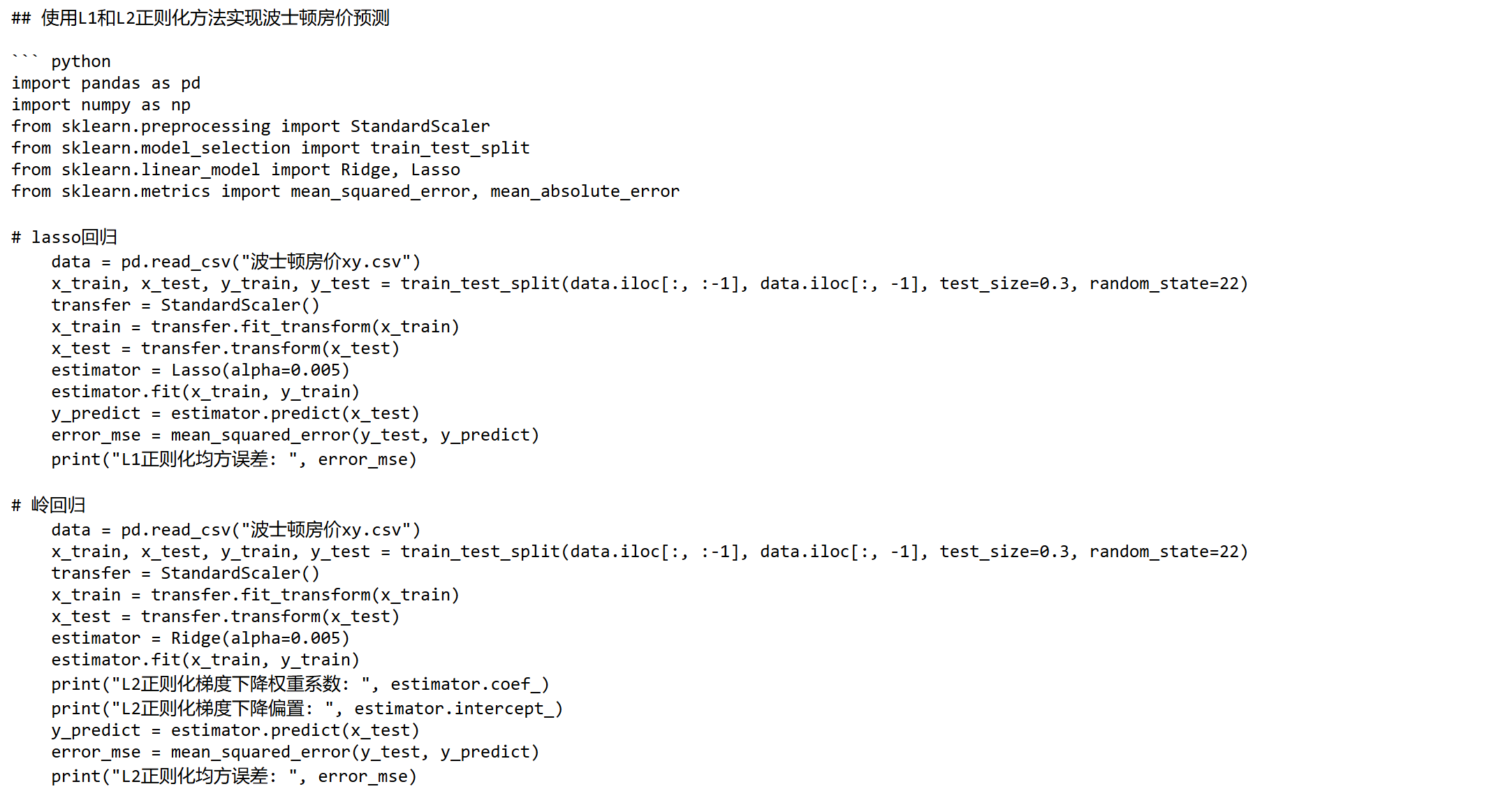
import pandas as pd # 数据读取/处理
import numpy as np # 数值计算
from sklearn.preprocessing import StandardScaler # 数据标准化(正则化必须做!)
from sklearn.model_selection import train_test_split # 划分训练/测试集
from sklearn.linear_model import Ridge, Lasso # L2(Ridge)、L1(Lasso)模型
from sklearn.metrics import mean_squared_error, mean_absolute_error # 误差评估
读取数据:假设"波士顿房价xy.csv"是特征+标签的数据集
data = pd.read_csv(“波士顿房价xy.csv”)# 划分训练/测试集:# 错误点!x和y用了同一个数据(data.iloc[:, :-1]是特征,data.iloc[:, -1]是标签)
x_train, x_test, y_train, y_test = train_test_split( data.iloc[:, :-1], # 特征(所有行,除最后一列)
data.iloc[:, -1], # 标签(所有行,最后一列) test_size=0.3, random_state=22 # 测试集占30%,随机种子固定)# 数据标准化:正则化对特征尺度敏感,必须做!
transfer = StandardScaler()
x_train = transfer.fit_transform(x_train) # 训练集:拟合+转换x_test = transfer.transform(x_test) # 测试集:用训练集的参数转换# 构建Lasso模型(alpha是正则化强度,越小正则化越弱)
estimator=Lasso(alpha=0.005)estimator.fit(x_train, y_train) # 训练模型# 预测+评估:均方误差(MSE)
y_predict = estimator.predict(x_test)error_mse =mean_squared_error(y_test,y_predict)print(“L1正则化均方误差:”, error_mse)
data = pd.read_csv(“波士顿房价xy.csv”) # 重复读数据(可以优化为只读一次)# 同样划分训练/测试集(和Lasso部分重复了,可优化)
x_train, x_test, y_train, y_test = train_test_split(…)# 同样标准化(重复了,可优化)
transfer = StandardScaler()
x_train = transfer.fit_transform(x_train)
x_test = transfer.transform(x_test)# 构建Ridge模型
estimator=Ridge(alpha=0.005)estimator.fit(x_train, y_train)# 打印模型参数(权重coef_、偏置intercept_)
print(“L2正则化权重系数:”, estimator.coef_)
print(“L2正则化偏置:”, estimator.intercept_)# 预测+评估MSEy_predict = estimator.predict(x_test)error_mse = mean_squared_error(y_test, y_predict)print(“L2正则化均方误差:”, error_mse)
四、正则化的作用
- L1(Lasso):会让部分特征的权重变为0,实现“特征选择”(适合特征多的场景)。
- L2(Ridge):让权重趋于更小的值(但不会为0),避免某几个特征对模型影响过大。

有“AI”的1024 = 2048,欢迎大家加入2048 AI社区
更多推荐


 15
15 0
0- 0


 已为社区贡献1条内容

所有评论(0)