Langchain-Chatchat[二、多功能对话流程代码解析]
本文解析了Langchain-Chatchat的多功能对话流程,重点介绍了基于FastAPI实现的OpenAI统一接口处理流程。通过chat_completions接口接收用户请求后,系统会初始化异步OpenAI客户端,处理SSE格式的流式响应。核心流程包括:1) 获取异步Client实例;2) 初始化AsyncClient和AsyncStream组件;3) 使用SSEDecoder解码流数据。文
前言
Langchain-Chatchat多功能对话流程代码解析。
对话如图: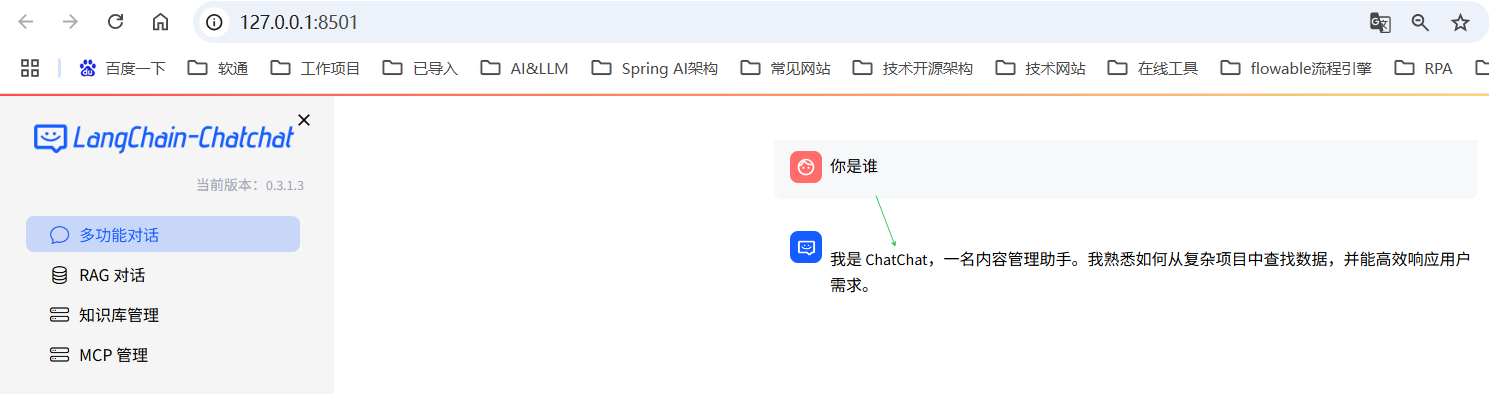
前提
Langchain-Chatchat[一、本地开发环境部署]
PyCharm 配置debug调试参数:start -a
一、AI多功能对话流程图
流程1:统一chat接口流程和设置client子流程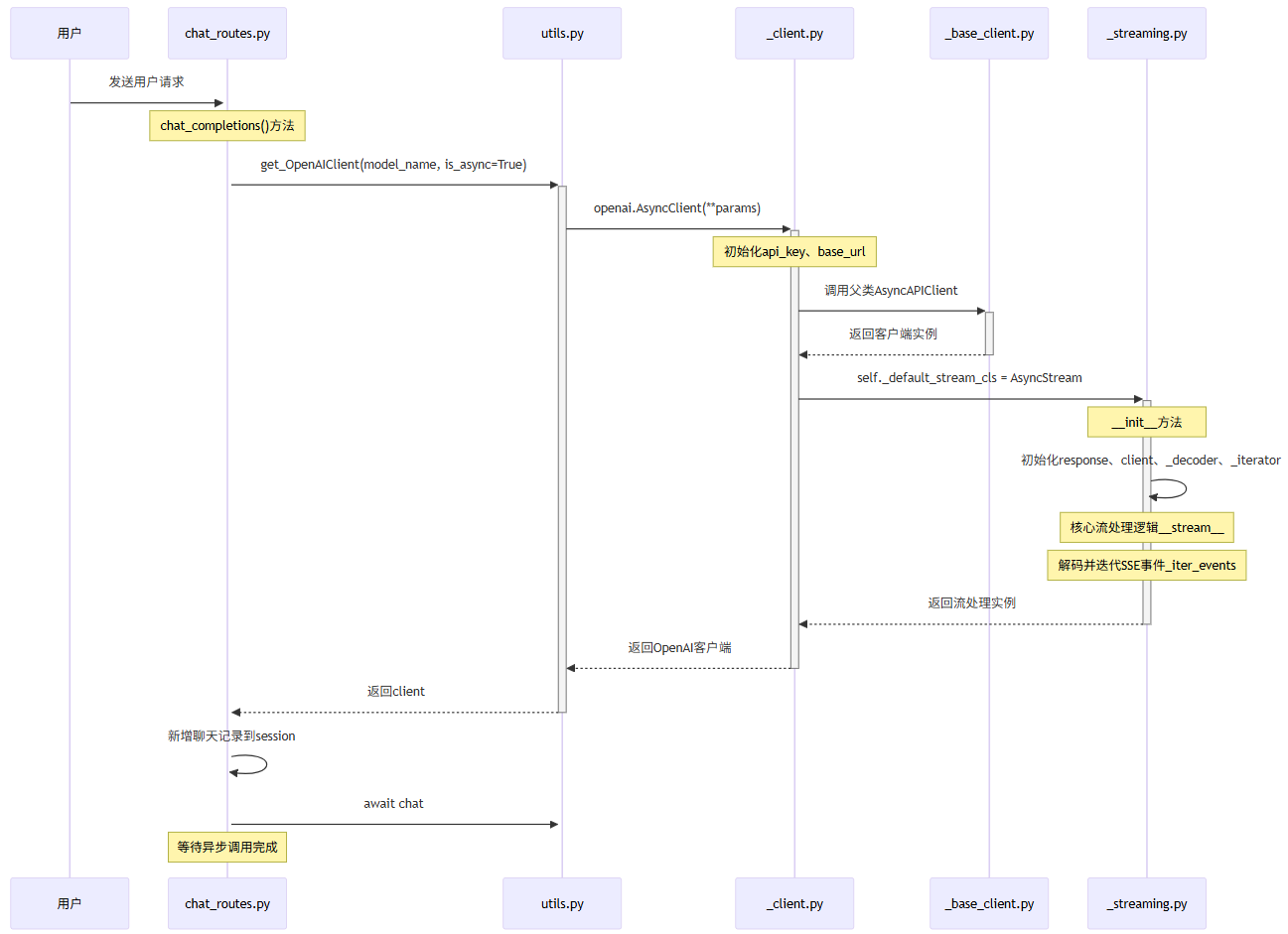
流程2:异步调用chat子流程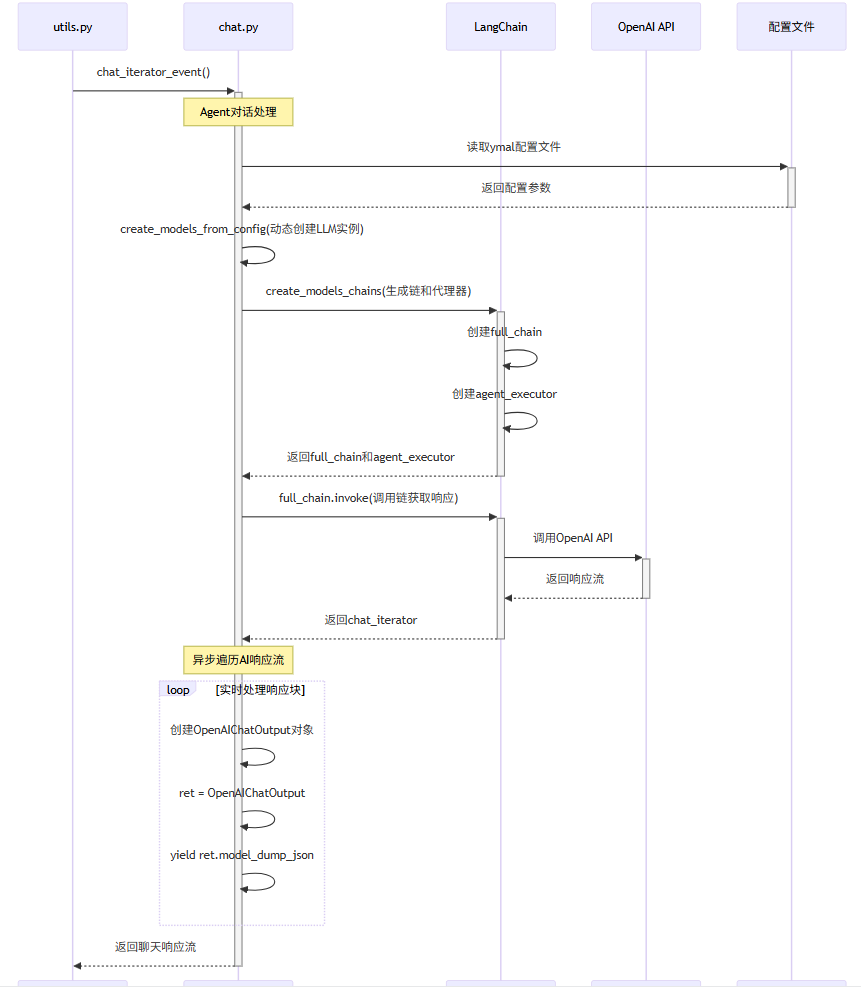
流程3:SSE Stream流数据推送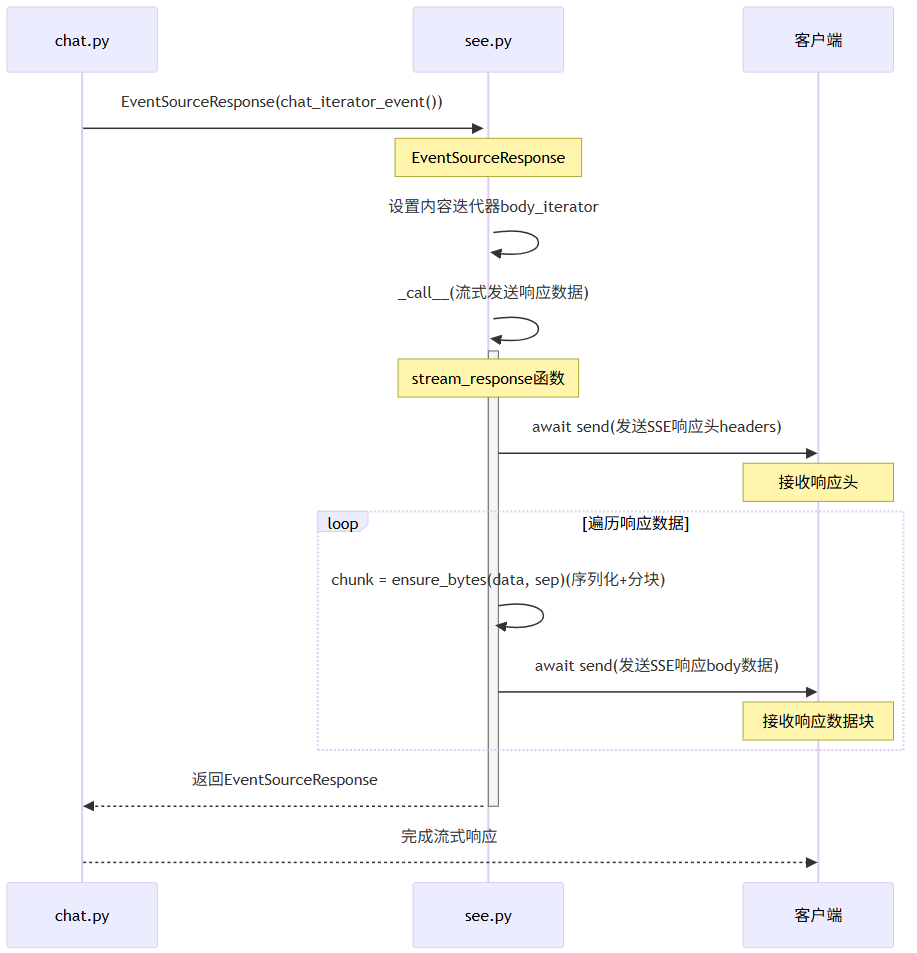
二、流程说明
1.接收用户AI对话请求,调用OpenAi、生成Stream流数据
chatchat.server.api_server.chat_routes.py
代码如下(片断):
1.基于fastapi组件,实现openai的统一chat接口,接收前台Chat 用户请求
@chat_router.post("/chat/completions", summary="兼容 openai 的统一 chat 接口")
async def chat_completions(
    request: Request,
    body: OpenAIChatInput,
) -> Dict:
	...
	"""
    设置client,见 1.1 获取AI Client-get_OpenAIClient
    """
	client = get_OpenAIClient(model_name=body.model, is_async=True)

	...
	"""
    新增聊天记录到session
    """
    try:
       message_id = (
           add_message_to_db(
               chat_type="agent_chat",
               query=body.messages[-1]["content"],
               conversation_id=conversation_id,
           )
           if conversation_id
           else None
       )
   ...
   """
   异步调用chat,见 1.2 初始化openai组件异步Client[AsyncClient]、AsyncAPIClient和异步流AsyncStream
   """
   result = await chat(
        query=body.messages[-1]["content"],
        metadata=extra.get("metadata", {}),
        conversation_id=extra.get("conversation_id", ""),
        message_id=message_id,
        history_len=-1,
        stream=body.stream,
        chat_model_config=extra.get("chat_model_config", chat_model_config),
        tool_config=tool_config,
        use_mcp=extra.get("use_mcp", False),
        max_tokens=body.max_tokens,
    )
    return result
1.1 获取AI Client-get_OpenAIClient
def get_OpenAIClient(
        platform_name: str = None,
        model_name: str = None,
        is_async: bool = True,
) -> Union[openai.Client, openai.AsyncClient]:
	...
    if is_async:
       if httpx_params:
           params["http_client"] = httpx.AsyncClient(**httpx_params)
       return openai.AsyncClient(**params)
1.2 初始化openai组件异步Client[AsyncClient]、AsyncAPIClient和异步流AsyncStream
openai.AsyncClient 调用:
class AsyncOpenAI(AsyncAPIClient):
	def __init__(
        self,
        *,
        api_key: str | Callable[[], Awaitable[str]] | None = None,
        organization: str | None = None,
        project: str | None = None,
        webhook_secret: str | None = None,
        base_url: str | httpx.URL | None = None,
        websocket_base_url: str | httpx.URL | None = None,
        timeout: float | Timeout | None | NotGiven = not_given,
        max_retries: int = DEFAULT_MAX_RETRIES,
        default_headers: Mapping[str, str] | None = None,
        default_query: Mapping[str, object] | None = None,
        http_client: httpx.AsyncClient | None = None,
        _strict_response_validation: bool = False,
    ) -> None:
    	...
    	"""1.初始化api_key、base_url"""
        ...
		"""2.调用父类 class AsyncAPIClient(BaseClient[httpx.AsyncClient, AsyncStream[Any]]) __init__"""
		super().__init__(
            version=__version__,
            base_url=base_url,
            max_retries=max_retries,
            timeout=timeout,
            http_client=http_client,
            custom_headers=default_headers,
            custom_query=default_query,
            _strict_response_validation=_strict_response_validation,
        )
        """3.设置异步流AsyncStream"""
        self._default_stream_cls = AsyncStream
异步流处理类AsyncStream,用于处理Server-Sent Events (SSE)格式的流式响应
class AsyncStream(Generic[_T]):
    """ 提供遍历异步流响应的核心接口 """
    response: httpx.Response
    _decoder: SSEDecoder | SSEBytesDecoder

    """1.初始化response、client、_decoder( 流式解码器SSEDecoder) 和流式_iterator """
    def __init__(
        self,
        *,
        cast_to: type[_T],
        response: httpx.Response,
        client: AsyncOpenAI,
    ) -> None:
        self.response = response
        self._cast_to = cast_to
        self._client = client
        self._decoder = client._make_sse_decoder()   """ 生成SSEDecoder() """
        self._iterator = self.__stream__() 	         """ 设置_iterator  """

        ....

    """2.核心流处理逻辑
        解析SSE事件并转换为指定类型
    """
    async def __stream__(self) -> AsyncIterator[_T]:
        cast_to = cast(Any, self._cast_to)
        response = self.response
        process_data = self._client._process_response_data
        """ 设置迭代器iterator,见 _iter_events(self)  """
        iterator = self._iter_events()

        async for sse in iterator:
            if sse.data.startswith("[DONE]"): # 检查结束标记
                break
            ...
            # 特殊处理Assistants的thread.事件
            if sse.event and sse.event.startswith("thread."):
                # 处理数据并生成结果
            	yield process_data(data={"data": data, "event": sse.event},
				            	   cast_to=cast_to,
				            	   response=response)
			...
			else:
                # 普通事件处理
                data = sse.json()
                ...
                # 处理正常数据并生成结果
                yield process_data(data=data, cast_to=cast_to, response=response)

    ...
    """
        解码并迭代SSE事件
        从HTTP响应中解析Server-Sent Events
    """
    async def _iter_events(self) -> AsyncIterator[ServerSentEvent]:
       async for sse in self._decoder.aiter_bytes(self.response.aiter_bytes()):
           yield sse
1.3 异步调用chat:处理聊天AI的响应流
async def chat(
        query: str = Body(..., description="用户输入", examples=["恼羞成怒"]),
        metadata: dict = Body({}, description="附件,可能是图像或者其他功能", examples=[]),
        conversation_id: str = Body("", description="对话框ID"),
        message_id: str = Body(None, description="数据库消息ID"),
        history_len: int = Body(-1, description="从数据库中取历史消息的数量"),
        stream: bool = Body(True, description="流式输出"),
        chat_model_config: dict = Body({}, description="LLM 模型配置", examples=[]),
        tool_config: dict = Body({}, description="工具配置", examples=[]),
        use_mcp: bool = Body(False, description="使用MCP"),
        max_tokens: int = Body(None, description="LLM最大token数配置", example=4096),
     ):
    if stream:

        return EventSourceResponse(chat_iterator_event())
    .....

    """Agent对话聊天AI的响应,设置注解数据给SSE协议,客户端实时接收AI生成的响应内容"""
    async def chat_iterator_event() -> AsyncIterable[OpenAIChatOutput]:
        try:
            callbacks = []

            """ 根据ymal文件配置参数 动态创建LLM实例(如 OpenAI)和提示模板 """
            models, prompts = create_models_from_config(
                callbacks=callbacks, configs=chat_model_config, stream=stream, max_tokens=max_tokens
            )
            all_tools = get_tool().values()
            tools = [tool for tool in all_tools if tool.name in tool_config]
            tools = [t.copy(update={"callbacks": callbacks}) for t in tools]

            """ 生成LangChain链full_chain, 代理器agent_executor :
            	见 1.3.1 生成LangChain链full_chain, 代理器agent_executor
			"""
            full_chain, agent_executor = create_models_chains(
                prompts=prompts,
                models=models,
                conversation_id=conversation_id,
                tools=tools,
                callbacks=callbacks,
                history_len=history_len,
                metadata=metadata,
                use_mcp = use_mcp
            )
            .....

            """ invoke 调用链,获取响应文本 chat_iterator  """
            chat_iterator = full_chain.invoke({
                "input": query
            })

            .....

            """ 异步遍历AI响应流,实时处理AI生成的响应块 """
            async for item in chat_iterator:
            	data = {}
            	.....
            	elif isinstance(item, PlatformToolsLLMStatus):
					 data["text"] = item.text
				"""
				 创建OpenAI格式输出:
					创建OpenAI API格式的响应对象OpenAIChatOutput;
					包含ID、内容、角色、工具调用等标准字段
				"""
				ret = OpenAIChatOutput(
                    id=f"chat{uuid.uuid4()}",
                    object="chat.completion.chunk",
                    content=data.get("text", ""),   """ 将AI生成的响应块data["text"] -> content """
                    role="assistant",
                    tool_calls=data["tool_calls"],
                    model=models["llm_model"].model_name,
                    status=data["status"],
                    message_type=data["message_type"],
                    message_id=message_id,
                    class_name=item.class_name()
                )
                """ AI响应数据,见 1.3.2 创建OpenAI格式输出  """
                yield ret.model_dump_json()
1.3.1 生成LangChain链full_chain, 代理器agent_executor : 调用 create_models_chains
def create_models_chains(
    history_len, prompts, models, tools, callbacks, conversation_id, metadata,  use_mcp: bool = False
	):
	......
	 """ 设置代理器agent_executor """
	 agent_executor = PlatformToolsRunnable.create_agent_executor(
	    agent_type="platform-knowledge-mode",  # 代理类型(如知识检索模式)
	    agents_registry=agents_registry,        # 代理注册表(管理可用代理)
	    llm=llm,                               # 大语言模型实例(如GPT-4)
	    tools=tools,                           # 工具集(如搜索、计算器)
	    history=history,                       # 对话历史(支持多轮对话)
	    intermediate_steps=intermediate_steps, # 中间步骤记录(调试用)
	    mcp_connections=mcp_connections if use_mcp else {}  # 多模态连接(如图像分析)
    )

    """
    设置链Chain
    输入适配器:{"chat_input": lambda x: x["input"]} 将用户输入(如 {"input": "问题"})转换代理可识别的格式
    链式组合:通过 | 操作符(LangChain的管道符)将输入适配器与代理执行器串联,形成完整处理链"
    ""
    full_chain = {"chat_input": lambda x: x["input"]} | agent_executor
    return full_chain, agent_executor
1.3.2 创建OpenAI格式输出
 """
    OpenAI API输出的基础模型类
 """
class OpenAIBaseOutput(BaseModel):
    """ 遵循OpenAI API标准格式 """
    id: Optional[str] = None
    content: Optional[str] = None
    model: Optional[str] = None
    object: Literal[
        "chat.completion", "chat.completion.chunk"
    ] = "chat.completion.chunk"
    role: Literal["assistant"] = "assistant"
    finish_reason: Optional[str] = None
    created: int = Field(default_factory=lambda: int(time.time()))
    tool_calls: List[Dict] = []

    status: Optional[int] = None  # AgentStatus
    message_type: int = MsgType.TEXT
    message_id: Optional[str] = None  # id in database table
    is_ref: bool = False  # wheather show in seperated expander

    class Config:
        extra = "allow"

    """ 将模型转换为JSON字符串result ,result封装见 self.model_dump() """
    def model_dump_json(self):
        return json.dumps(self.model_dump(), ensure_ascii=False)

    """ 将模型转换为字典result {},根据对象-self.object的类型封装不同结果 """
    def model_dump(self) -> dict:
        result = {
            "id": self.id,
            "object": self.object,
            "model": self.model,
            "created": self.created,
            "status": self.status,
            "message_type": self.message_type,
            "message_id": self.message_id,
            "is_ref": self.is_ref,
            **(self.model_extra or {}),
        }

        if self.object == "chat.completion.chunk":
            result["choices"] = [
                {
                    "delta": {
                        "content": self.content,
                        "tool_calls": self.tool_calls,
                    },
                    "role": self.role,
                }
            ]

        elif self.object == "chat.completion":
            result["choices"] = [
                {
                    "message": {
                        "role": self.role,
                        "content": self.content,
                        "finish_reason": self.finish_reason,
                        "tool_calls": self.tool_calls,
                    }
                }
            ]
        return result
2.服务器向客户端推送实时数据(SSE Stream流数据)
基于 【1.接收用户AI对话请求,调用OpenAi、生成Stream流数据】 章节 最终 生成AI响应数据ret.model_dump_json()
async def chat(
        query: str = Body(..., description="用户输入", examples=["恼羞成怒"]),
        metadata: dict = Body({}, description="附件,可能是图像或者其他功能", examples=[]),
        conversation_id: str = Body("", description="对话框ID"),
        message_id: str = Body(None, description="数据库消息ID"),
        history_len: int = Body(-1, description="从数据库中取历史消息的数量"),
        stream: bool = Body(True, description="流式输出"),
        chat_model_config: dict = Body({}, description="LLM 模型配置", examples=[]),
        tool_config: dict = Body({}, description="工具配置", examples=[]),
        use_mcp: bool = Body(False, description="使用MCP"),
        max_tokens: int = Body(None, description="LLM最大token数配置", example=4096),
):
    async def chat_iterator_event() -> AsyncIterable[OpenAIChatOutput]:
         ...
         """ 异步遍历AI响应流,实时处理AI生成的响应块 """
         async for item in chat_iterator:
         	 ...
         	  """ AI响应数据 """
             yield ret.model_dump_json()

    if stream:
        """ 基于ServerSentEvent Protocol:Server-Sent Events推送 生成AI响应数据
            见 2.1 Server-Sent Events响应-EventSourceResponse
        """
        return EventSourceResponse(chat_iterator_event())
2.1 Server-Sent Events响应-EventSourceResponse
文件see.py
"""
   定义异步内容流 AsyncContentStream:
   内容来源于: yield ret.model_dump_json() -> AsyncIterable[OpenAIChatOutput]
"""
   AsyncContentStream = AsyncIterable[Content]
...

""" Server-Sent Events响应类:用于实现服务器向客户端推送实时数据的SSE协议  """
class EventSourceResponse(Response):
      # 定义内容迭代器body_iterator
      body_iterator: AsyncContentStream

      ...
      def __init__(
        self,
        content: ContentStream,
        status_code: int = 200,
        headers: Optional[Mapping[str, str]] = None,
        media_type: str = "text/event-stream",
        background: Optional[BackgroundTask] = None,
        ping: Optional[int] = None,
        sep: Optional[str] = None,
        ping_message_factory: Optional[Callable[[], ServerSentEvent]] = None,
        data_sender_callable: Optional[
            Callable[[], Coroutine[None, None, None]]
        ] = None,
    ) -> None:
    	...
    	# 设置内容迭代器body_iterator
        if isinstance(content, AsyncIterable):
            self.body_iterator = content

     ...
     """ Server-Sent Events触发时,调用__call__   -> 设置 self.stream_response """
     async def __call__(self, scope: Scope, receive: Receive, send: Send) -> None:
        """ anyio.create_task_group() 管理多个并发任务 """
        async with anyio.create_task_group() as task_group:
            ...
            """  流式发送响应数据 """
            task_group.start_soon(wrap, partial(self.stream_response, send))
            """  定期发送ping消息保持连接 """
            task_group.start_soon(wrap, partial(self._ping, send))
            task_group.start_soon(wrap, self.listen_for_exit_signal)

            if self.data_sender_callable:
                task_group.start_soon(self.data_sender_callable)
            """  监听客户端断开连接 """
            await wrap(partial(self.listen_for_disconnect, receive))

        if self.background is not None:
            await self.background()

     ...
     """  流式发送响应数据 """
     async def stream_response(self, send: Send) -> None:
	     # 基于SSE第1次发送send响应请求头headers
	     await send(
	         {
	             "type": "http.response.start",
	             "status": self.status_code,
	             "headers": self.raw_headers,
	         }
	     )
	     async for data in self.body_iterator:
	         # 遍历响应数据data并进行序列化+分块
	         chunk = ensure_bytes(data, self.sep)
	         # 响应数据data解码,输出log
	         _log.debug(f"chunk: {chunk.decode()}")
	         # 基于SSE第2次发送send响应body体数据data
	         await send({"type": "http.response.body", "body": chunk, "more_body": True})

	     async with self._send_lock:
	         self.active = False
	         await send({"type": "http.response.body", "body": b"", "more_body": False})

有“AI”的1024 = 2048,欢迎大家加入2048 AI社区
更多推荐
 12
12 0
0- 0


 已为社区贡献7条内容

所有评论(0)