【C++】现代C++最佳实践:构建高性能HTTP服务器
本文介绍了使用现代C++构建高性能HTTP服务器的关键技术。重点探讨了:1)基于RAII的资源管理机制,通过智能指针确保资源安全释放;2)类型安全设计,利用强类型枚举和std::expected进行错误处理;3)高效的并发模型,结合线程池和异步I/O处理请求。项目展示了如何运用C++20特性(如jthread、concurrent_queue)实现生产级服务器,涵盖从基础架构到协议解析的完整实现。
文章目录
项目概述:为什么从头实现HTTP服务器?
在当今云计算和微服务架构主导的时代,HTTP服务器作为数字基础设施的基石,其性能和可靠性直接影响着整个系统的服务质量。虽然市场上有Nginx、Apache等成熟解决方案,但通过现代C++从头构建HTTP服务器,我们能够深入理解高性能网络编程的本质,同时展示现代C++语言特性的强大威力。
深入系统编程核心挑战
构建HTTP服务器涉及操作系统底层机制、网络协议栈、并发编程等多个复杂领域。这个项目让我们直面以下核心挑战:
资源管理的精确控制:在高并发场景下,服务器需要同时管理数千个连接、内存块和线程资源。传统的资源管理方式容易导致内存泄漏、资源竞争和状态不一致。现代C++的RAII范式将资源生命周期与对象作用域绑定,从根本上解决了这些问题。
并发模型的性能瓶颈:单线程服务器无法充分利用多核CPU,而传统的每连接每线程模型在连接数增长时会产生巨大的上下文切换开销。我们需要设计一种混合模型,结合I/O多路复用的高效性和线程池的并行计算能力。
协议解析的准确性与效率:HTTP/1.1协议虽然文本化看似简单,但其完整的实现需要考虑管线化、分块传输、持久连接等复杂特性。解析器的性能直接影响服务器的吞吐量。
零拷贝与内存优化:在网络I/O密集型应用中,不必要的数据拷贝会严重消耗CPU资源。现代C++提供了string_view、span等零拷贝抽象,让我们能够在协议解析和数据处理环节避免内存复制。
现代C++的独特优势
与其他语言相比,C++在系统级编程中具有不可替代的优势:
- 零成本抽象:高级特性如RAII、智能指针在运行时几乎没有额外开销
- 内存布局控制:能够精确控制数据结构在内存中的布局,优化缓存利用率
- 与系统API无缝集成:直接调用epoll、kqueue等操作系统特性
- 模板元编程:在编译期完成尽可能多的工作,减少运行时开销
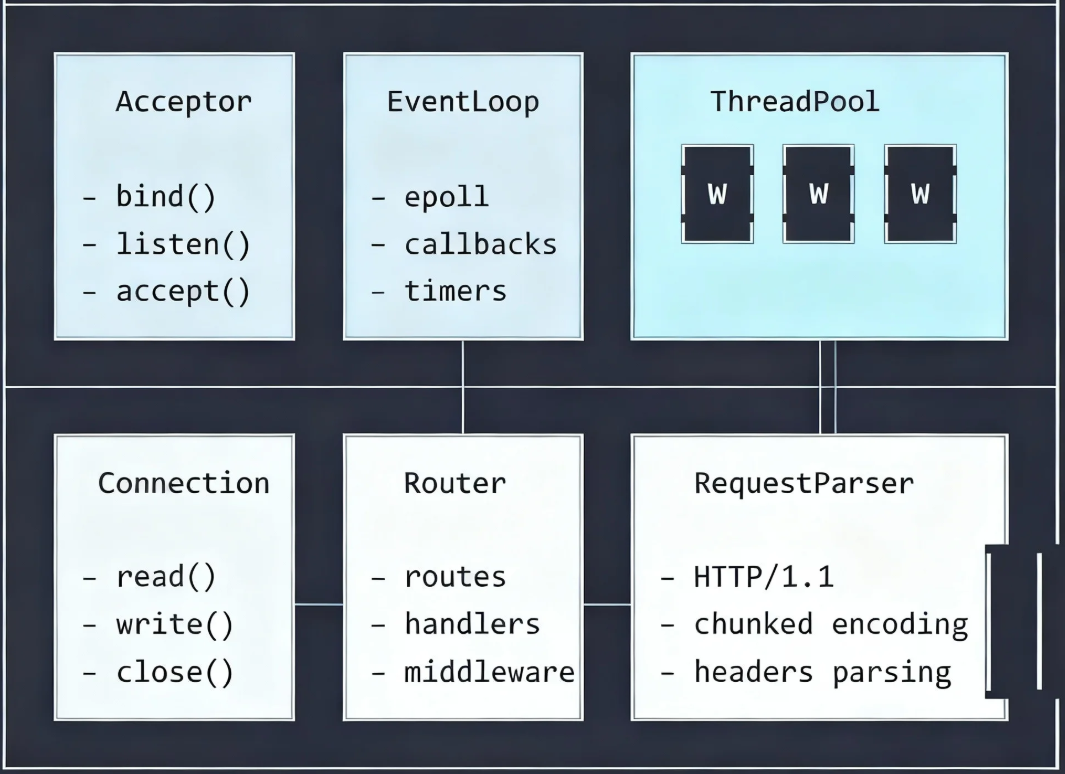
下面通过架构图展示我们HTTP服务器的整体设计:
一、项目架构与RAII资源管理
1.1 核心组件设计
RAII是现代C++最重要的设计哲学之一,它将资源的获取与初始化绑定,释放与析构绑定,确保资源在任何情况下都能正确释放。在我们的HTTP服务器设计中,每个核心组件都严格遵循这一原则。
// 使用RAII管理所有系统资源
class HTTPServer {
private:
    std::unique_ptr<Socket> listener_;
    std::unique_ptr<ThreadPool> thread_pool_;
    std::atomic<bool> running_{false};

public:
    HTTPServer(const std::string& address, uint16_t port)
        : listener_(std::make_unique<Socket>())
        , thread_pool_(std::make_unique<ThreadPool>()) {

        // RAII方式初始化:构造函数获取资源
        // 如果任何一步失败,异常会阻止对象构造,确保资源正确清理
        listener_->bind(address, port);
        listener_->listen(1024);

        std::cout << "HTTP服务器初始化完成,监听 "
                  << address << ":" << port << std::endl;
    }

    ~HTTPServer() {
        // 析构函数自动释放资源,无需手动清理
        stop();
        std::cout << "HTTP服务器资源已释放" << std::endl;
    }

    // 删除拷贝操作,避免意外共享
    // 拷贝语义在资源管理类中通常是危险的
    HTTPServer(const HTTPServer&) = delete;
    HTTPServer& operator=(const HTTPServer&) = delete;

    // 允许移动语义,支持资源所有权的转移
    HTTPServer(HTTPServer&&) = default;
    HTTPServer& operator=(HTTPServer&&) = default;

    void run() {
        running_.store(true, std::memory_order_release);
        std::cout << "启动HTTP服务器主循环..." << std::endl;

        // 主事件循环
        while (running_.load(std::memory_order_acquire)) {
            try {
                auto client_socket = listener_->accept();
                if (client_socket.is_valid()) {
                    handle_new_connection(std::move(client_socket));
                }
            } catch (const std::exception& e) {
                std::cerr << "接受连接时发生错误: " << e.what() << std::endl;
            }
        }
    }

    void stop() {
        running_.store(false, std::memory_order_release);
    }
};
设计要点分析:
- 异常安全:构造函数中如果任何操作失败,异常会阻止对象构造,确保部分构造的对象不会存在
- 明确的资源所有权:使用
unique_ptr明确表达独占所有权,避免混淆 - 线程安全的停止机制:使用
atomic<bool>确保多线程环境下的安全停止 - 移动语义支持:允许资源所有权的有效转移,支持容器存储和返回值优化
1.2 智能指针与所有权语义
连接管理是HTTP服务器中最复杂的部分之一。我们需要确保每个连接在整个生命周期中都得到妥善管理,特别是在异步回调的环境中。
// 连接类继承enable_shared_from_this,允许在回调中安全地延长生命周期
class Connection : public std::enable_shared_from_this<Connection> {
private:
    std::unique_ptr<Socket> socket_;
    std::vector<char> buffer_;
    std::string request_data_;
    RequestParser parser_;

public:
    explicit Connection(std::unique_ptr<Socket> socket)
        : socket_(std::move(socket))  // 明确的所有权转移
        , buffer_(8192) {             // 预分配读缓冲区

        std::cout << "创建新连接,FD: " << socket_->fd() << std::endl;
    }

    ~Connection() {
        std::cout << "关闭连接,FD: " << socket_->fd() << std::endl;
    }

    void start() {
        // 使用shared_from_this()确保在异步操作期间对象不会被销毁
        auto self = shared_from_this();

        // 将连接注册到事件循环中
        EventLoop::instance().add_socket(
            socket_->fd(),
            EPOLLIN | EPOLLET,  // 边缘触发模式
            [self](uint32_t events) {
                if (events & EPOLLIN) {
                    self->do_read();
                }
                if (events & EPOLLOUT) {
                    self->do_write();
                }
                if (events & (EPOLLERR | EPOLLHUP)) {
                    self->handle_error();
                }
            }
        );

        do_read();
    }

    int fd() const { return socket_->fd(); }

private:
    void do_read() {
        auto self = shared_from_this();

        // 异步读取数据
        socket_->async_read_some(buffer_,
            [self](std::error_code ec, size_t bytes_transferred) {
                if (!ec && bytes_transferred > 0) {
                    self->on_data_received(bytes_transferred);
                } else {
                    self->handle_error();
                }
            });
    }

    void on_data_received(size_t bytes_read) {
        // 将数据追加到请求缓冲区
        request_data_.append(buffer_.data(), bytes_read);

        // 尝试解析完整的HTTP请求
        auto result = parser_.parse(request_data_);
        if (result.has_value()) {
            handle_request(std::move(result.value()));
            request_data_.clear();  // 准备处理下一个请求
        } else if (result.error() == ParseError::NeedMoreData) {
            // 需要更多数据,继续读取
            do_read();
        } else {
            // 解析错误,返回400 Bad Request
            send_error_response(http::StatusCode::BadRequest);
        }
    }

    void do_write(std::string_view response) {
        auto self = shared_from_this();

        socket_->async_write(response,
            [self](std::error_code ec, size_t bytes_written) {
                if (!ec) {
                    // 写入成功,检查是否要保持连接
                    if (self->should_keep_alive()) {
                        self->do_read();  // 继续读取下一个请求
                    } else {
                        // 关闭连接
                        self->socket_->close();
                    }
                } else {
                    self->handle_error();
                }
            });
    }

    void handle_request(Request&& request);
    void send_error_response(http::StatusCode code);
    bool should_keep_alive() const;
};

// 工厂函数,使用make_shared确保单次内存分配
auto create_connection(std::unique_ptr<Socket> socket) {
    return std::make_shared<Connection>(std::move(socket));
}
连接生命周期管理的关键点:
- shared_from_this模式:在异步回调中安全地延长对象生命周期
- 明确的异步操作链:每个异步操作完成后触发下一个操作,形成处理流水线
- 错误处理集成:每个异步操作都包含错误处理路径
- 连接复用:支持HTTP持久连接,避免频繁建立和关闭TCP连接的开销
二、类型安全与API设计
2.1 强类型封装
现代C++强调类型安全,通过强类型避免很多运行时的错误。在我们的HTTP服务器中,我们使用枚举类和包装类型来代替原始的整型和字符串。
namespace http {
    // 强类型枚举,避免隐式转换
    enum class Method {
        GET,
        POST,
        PUT,
        DELETE,
        HEAD,
        OPTIONS,
        PATCH
    };

    enum class Version {
        HTTP1_0,
        HTTP1_1,
        HTTP2_0
    };

    // 枚举底层类型指定,确保二进制兼容性
    enum class StatusCode : uint16_t {
        // 2xx Success
        OK = 200,
        Created = 201,
        Accepted = 202,
        NoContent = 204,

        // 3xx Redirection
        MovedPermanently = 301,
        Found = 302,
        NotModified = 304,

        // 4xx Client Errors
        BadRequest = 400,
        Unauthorized = 401,
        Forbidden = 403,
        NotFound = 404,
        MethodNotAllowed = 405,

        // 5xx Server Errors
        InternalError = 500,
        NotImplemented = 501,
        BadGateway = 502,
        ServiceUnavailable = 503
    };

    // 大小写不敏感的头部映射
    class Headers {
    private:
        struct CaseInsensitiveHash {
            size_t operator()(const std::string& key) const {
                std::string lower_key;
                std::transform(key.begin(), key.end(),
                             std::back_inserter(lower_key), ::tolower);
                return std::hash<std::string>{}(lower_key);
            }
        };

        struct CaseInsensitiveEqual {
            bool operator()(const std::string& lhs,
                          const std::string& rhs) const {
                if (lhs.length() != rhs.length()) return false;
                return std::equal(lhs.begin(), lhs.end(), rhs.begin(),
                                [](char a, char b) {
                                    return ::tolower(a) == ::tolower(b);
                                });
            }
        };

        std::unordered_map<std::string, std::string,
                          CaseInsensitiveHash,
                          CaseInsensitiveEqual> headers_;
    public:
        void set(std::string_view key, std::string_view value) {
            headers_[std::string(key)] = std::string(value);
        }

        std::optional<std::string_view> get(std::string_view key) const {
            auto it = headers_.find(std::string(key));
            if (it != headers_.end()) {
                return std::string_view(it->second);
            }
            return std::nullopt;
        }

        bool contains(std::string_view key) const {
            return headers_.find(std::string(key)) != headers_.end();
        }

        auto begin() const { return headers_.begin(); }
        auto end() const { return headers_.end(); }
    };

    // HTTP请求类
    class Request {
    private:
        Method method_;
        std::string uri_;
        Version version_;
        Headers headers_;
        std::string body_;

    public:
        Request(Method method, std::string uri, Version version = Version::HTTP1_1)
            : method_(method), uri_(std::move(uri)), version_(version) {}

        // 访问器方法
        Method method() const { return method_; }
        const std::string& uri() const { return uri_; }
        Version version() const { return version_; }
        const Headers& headers() const { return headers_; }
        Headers& headers() { return headers_; }
        const std::string& body() const { return body_; }
        std::string& body() { return body_; }

        void set_method(Method method) { method_ = method; }
        void set_uri(std::string uri) { uri_ = std::move(uri); }
        void set_version(Version version) { version_ = version; }
        void set_body(std::string body) { body_ = std::move(body); }
    };

    // HTTP响应类
    class Response {
    private:
        StatusCode status_code_;
        Headers headers_;
        std::string body_;

    public:
        Response(StatusCode status_code = StatusCode::OK)
            : status_code_(status_code) {}

        StatusCode status_code() const { return status_code_; }
        const Headers& headers() const { return headers_; }
        Headers& headers() { return headers_; }
        const std::string& body() const { return body_; }
        std::string& body() { return body_; }

        void set_status_code(StatusCode code) { status_code_ = code; }
        void set_body(std::string body) {
            body_ = std::move(body);
            headers_.set("Content-Length", std::to_string(body_.size()));
        }

        // 便捷方法
        static Response text_response(std::string content) {
            Response resp(StatusCode::OK);
            resp.headers().set("Content-Type", "text/plain; charset=utf-8");
            resp.set_body(std::move(content));
            return resp;
        }

        static Response json_response(std::string json) {
            Response resp(StatusCode::OK);
            resp.headers().set("Content-Type", "application/json");
            resp.set_body(std::move(json));
            return resp;
        }

        static Response error_response(StatusCode code, std::string message) {
            Response resp(code);
            resp.headers().set("Content-Type", "text/plain; charset=utf-8");
            resp.set_body(std::move(message));
            return resp;
        }
    };
}

// 类型安全的请求解析器
class RequestParser {
public:
    std::expected<http::Request, ParseError> parse(std::string_view data);

private:
    std::expected<http::Method, ParseError>
    parse_method(std::string_view method_str);

    std::expected<http::Version, ParseError>
    parse_version(std::string_view version_str);

    std::expected<uint16_t, ParseError>
    parse_status_code(std::string_view code_str);
};
2.2 使用std::expected进行错误处理
传统的错误处理方式(异常或错误码)各有优缺点。C++23引入的std::expected提供了一种更优雅的错误处理方式,它既可以包含成功值,也可以包含错误信息。
enum class ParserError {
    InvalidMethod,
    MalformedRequestLine,
    InvalidVersion,
    MalformedHeaders,
    BodyTooLarge,
    InvalidEncoding,
    NeedMoreData
};

class RequestParser {
private:
    static constexpr size_t MAX_REQUEST_SIZE = 1024 * 1024; // 1MB
    static constexpr size_t MAX_HEADERS_SIZE = 8192;        // 8KB

public:
    std::expected<http::Request, ParserError> parse(std::string_view input) {
        if (input.empty()) {
            return std::unexpected(ParserError::NeedMoreData);
        }

        // 解析请求行
        auto request_line_end = input.find("\r\n");
        if (request_line_end == std::string_view::npos) {
            return std::unexpected(ParserError::NeedMoreData);
        }

        auto request_line = input.substr(0, request_line_end);
        auto method_result = parse_method(extract_method(request_line));
        if (!method_result) {
            return std::unexpected(method_result.error());
        }

        auto uri_result = extract_uri(request_line);
        if (!uri_result) {
            return std::unexpected(uri_result.error());
        }

        auto version_result = parse_version(extract_version(request_line));
        if (!version_result) {
            return std::unexpected(version_result.error());
        }

        http::Request request(*method_result, std::move(*uri_result), *version_result);

        // 解析头部
        auto headers_start = request_line_end + 2;
        auto headers_end = input.find("\r\n\r\n", headers_start);
        if (headers_end == std::string_view::npos) {
            return std::unexpected(ParserError::NeedMoreData);
        }

        auto headers_result = parse_headers(input.substr(headers_start,
                                                       headers_end - headers_start));
        if (!headers_result) {
            return std::unexpected(headers_result.error());
        }

        request.headers() = std::move(*headers_result);

        // 解析消息体
        auto body_start = headers_end + 4;
        if (body_start < input.length()) {
            auto body_result = parse_body(input.substr(body_start), request.headers());
            if (!body_result) {
                return std::unexpected(body_result.error());
            }
            request.body() = std::move(*body_result);
        }

        return request;
    }

private:
    std::expected<http::Method, ParserError>
    parse_method(std::string_view method_str) {
        static const std::unordered_map<std::string_view, http::Method> method_map = {
            {"GET", http::Method::GET},
            {"POST", http::Method::POST},
            {"PUT", http::Method::PUT},
            {"DELETE", http::Method::DELETE},
            {"HEAD", http::Method::HEAD},
            {"OPTIONS", http::Method::OPTIONS},
            {"PATCH", http::Method::PATCH}
        };

        auto it = method_map.find(method_str);
        if (it != method_map.end()) {
            return it->second;
        }
        return std::unexpected(ParserError::InvalidMethod);
    }

    std::expected<std::string, ParserError>
    extract_uri(std::string_view request_line) {
        auto method_end = request_line.find(' ');
        if (method_end == std::string_view::npos) {
            return std::unexpected(ParserError::MalformedRequestLine);
        }

        auto uri_start = method_end + 1;
        auto uri_end = request_line.find(' ', uri_start);
        if (uri_end == std::string_view::npos) {
            return std::unexpected(ParserError::MalformedRequestLine);
        }

        return std::string(request_line.substr(uri_start, uri_end - uri_start));
    }

    std::expected<http::Headers, ParserError>
    parse_headers(std::string_view headers_data) {
        http::Headers headers;
        size_t start = 0;

        while (start < headers_data.length()) {
            auto line_end = headers_data.find("\r\n", start);
            if (line_end == std::string_view::npos) {
                break;
            }

            auto line = headers_data.substr(start, line_end - start);
            auto colon_pos = line.find(':');
            if (colon_pos != std::string_view::npos) {
                auto key = line.substr(0, colon_pos);
                auto value = line.substr(colon_pos + 1);

                // 去除value前后的空白字符
                value.remove_prefix(std::min(value.find_first_not_of(" \t"), value.size()));
                value.remove_suffix(value.size() - std::min(value.find_last_not_of(" \t") + 1, value.size()));

                headers.set(key, value);
            }

            start = line_end + 2;
        }

        return headers;
    }

    std::expected<std::string, ParserError>
    parse_body(std::string_view body_data, const http::Headers& headers) {
        // 检查Content-Length
        if (auto content_length = headers.get("Content-Length")) {
            size_t expected_size = 0;
            try {
                expected_size = std::stoul(std::string(*content_length));
            } catch (const std::exception&) {
                return std::unexpected(ParserError::InvalidEncoding);
            }

            if (body_data.length() < expected_size) {
                return std::unexpected(ParserError::NeedMoreData);
            }

            if (expected_size > MAX_REQUEST_SIZE) {
                return std::unexpected(ParserError::BodyTooLarge);
            }

            return std::string(body_data.substr(0, expected_size));
        }

        // 检查Transfer-Encoding: chunked
        if (auto transfer_encoding = headers.get("Transfer-Encoding")) {
            if (*transfer_encoding == "chunked") {
                return parse_chunked_body(body_data);
            }
        }

        // 没有消息体
        return std::string();
    }

    std::expected<std::string, ParserError>
    parse_chunked_body(std::string_view chunked_data) {
        std::string body;
        size_t pos = 0;

        while (pos < chunked_data.length()) {
            // 解析块大小
            auto line_end = chunked_data.find("\r\n", pos);
            if (line_end == std::string_view::npos) {
                return std::unexpected(ParserError::NeedMoreData);
            }

            auto size_line = chunked_data.substr(pos, line_end - pos);
            size_t chunk_size = 0;
            try {
                chunk_size = std::stoul(std::string(size_line), nullptr, 16);
            } catch (const std::exception&) {
                return std::unexpected(ParserError::InvalidEncoding);
            }

            if (chunk_size == 0) {
                // 最后一个块
                break;
            }

            pos = line_end + 2;

            // 检查是否有足够的数据
            if (pos + chunk_size + 2 > chunked_data.length()) {
                return std::unexpected(ParserError::NeedMoreData);
            }

            // 添加块数据到消息体
            body.append(chunked_data.data() + pos, chunk_size);
            pos += chunk_size + 2; // 跳过块数据和\r\n
        }

        return body;
    }
};
std::expected的优势:
- 显式的错误处理:调用者必须显式检查操作是否成功
- 无异常开销:适合性能敏感的场景
- 丰富的错误信息:可以携带详细的错误上下文
- 函数式编程风格:支持monadic操作,如
and_then、transform等
三、并发模型与异步处理
高性能HTTP服务器的核心在于其并发模型的设计。现代C++提供了丰富的并发原语,使我们能够构建既高效又安全的并发架构。
3.1 现代C++并发原语
#include <queue>
#include <thread>
#include <future>
#include <atomic>
#include <latch>
#include <barrier>

class ThreadPool {
private:
    std::vector<std::jthread> workers_;
    moodycamel::ConcurrentQueue<std::function<void()>> tasks_;
    std::atomic<bool> stop_{false};
    std::mutex queue_mutex_;
    std::condition_variable condition_;
    std::atomic<size_t> active_tasks_{0};
    std::latch shutdown_latch_;

public:
    explicit ThreadPool(size_t num_threads = std::thread::hardware_concurrency())
        : shutdown_latch_(num_threads) {

        std::cout << "初始化线程池,线程数: " << num_threads << std::endl;
        workers_.reserve(num_threads);

        for (size_t i = 0; i < num_threads; ++i) {
            workers_.emplace_back([this, i] {
                worker_loop(i);
            });
        }

        // 等待所有线程启动完成
        std::this_thread::sleep_for(std::chrono::milliseconds(100));
        std::cout << "线程池初始化完成" << std::endl;
    }

    ~ThreadPool() {
        shutdown();
    }

    void shutdown() {
        if (stop_.exchange(true)) {
            return; // 已经在关闭过程中
        }

        std::cout << "开始关闭线程池..." << std::endl;

        // 唤醒所有等待的线程
        condition_.notify_all();

        // 等待所有线程完成
        shutdown_latch_.wait();

        std::cout << "线程池关闭完成" << std::endl;
    }

    template<typename F, typename... Args>
    auto submit(F&& f, Args&&... args)
        -> std::future<std::invoke_result_t<F, Args...>> {

        using return_type = std::invoke_result_t<F, Args...>;

        if (stop_.load()) {
            throw std::runtime_error("向已停止的线程池提交任务");
        }

        auto task = std::make_shared<std::packaged_task<return_type()>>(
            [f = std::forward<F>(f), args = std::make_tuple(std::forward<Args>(args)...)]() mutable {
                return std::apply(f, std::move(args));
            }
        );

        std::future<return_type> result = task->get_future();

        // 使用无锁队列提交任务
        tasks_.enqueue([task]() { (*task)(); });

        // 通知一个等待的线程
        condition_.notify_one();

        return result;
    }

    size_t pending_tasks() const {
        return tasks_.size_approx();
    }

    size_t active_tasks() const {
        return active_tasks_.load();
    }

    size_t total_threads() const {
        return workers_.size();
    }

private:
    void worker_loop(size_t thread_id) {
        std::cout << "工作线程 " << thread_id << " 启动" << std::endl;

        // 设置线程名称(平台相关)
        #ifdef __linux__
        std::string thread_name = "worker_" + std::to_string(thread_id);
        pthread_setname_np(pthread_self(), thread_name.c_str());
        #endif

        while (!stop_.load(std::memory_order_acquire)) {
            std::function<void()> task;

            // 优先从无锁队列获取任务
            if (tasks_.try_dequeue(task)) {
                active_tasks_.fetch_add(1, std::memory_order_relaxed);

                try {
                    task();
                } catch (const std::exception& e) {
                    std::cerr << "工作线程 " << thread_id
                              << " 执行任务时发生异常: " << e.what() << std::endl;
                }

                active_tasks_.fetch_sub(1, std::memory_order_relaxed);
                continue;
            }

            // 无锁队列为空,使用条件变量等待
            std::unique_lock lock(queue_mutex_);
            condition_.wait_for(lock, std::chrono::milliseconds(100), [this] {
                return stop_.load() || !tasks_.empty();
            });
        }

        std::cout << "工作线程 " << thread_id << " 关闭" << std::endl;
        shutdown_latch_.count_down();
    }
};

// 专用的I/O线程池,用于处理网络I/O密集型任务
class IOThreadPool {
private:
    std::vector<std::jthread> io_workers_;
    moodycamel::ConcurrentQueue<std::function<void()>> io_tasks_;
    std::atomic<bool> io_stop_{false};

public:
    IOThreadPool(size_t num_threads = std::max(1u, std::thread::hardware_concurrency() / 2))
        : io_workers_(num_threads) {

        for (size_t i = 0; i < num_threads; ++i) {
            io_workers_[i] = std::jthread([this, i] {
                io_worker_loop(i);
            });
        }
    }

    ~IOThreadPool() {
        io_stop_.store(true);
        // jthread 会自动 join
    }

    template<typename F>
    void submit_io_task(F&& task) {
        io_tasks_.enqueue(std::forward<F>(task));
    }

private:
    void io_worker_loop(size_t thread_id) {
        #ifdef __linux__
        std::string thread_name = "io_worker_" + std::to_string(thread_id);
        pthread_setname_np(pthread_self(), thread_name.c_str());
        #endif

        while (!io_stop_.load()) {
            std::function<void()> task;
            if (io_tasks_.try_dequeue(task)) {
                try {
                    task();
                } catch (const std::exception& e) {
                    std::cerr << "I/O工作线程 " << thread_id
                              << " 执行任务时发生异常: " << e.what() << std::endl;
                }
            } else {
                std::this_thread::yield();
            }
        }
    }
};
并发模型设计要点:
- 工作窃取:使用无锁队列,空闲线程可以主动获取任务
- 资源感知:根据CPU核心数自动调整线程数量
- 优雅关闭:使用
std::jthread和std::latch确保线程安全退出 - 异常安全:任务异常不会影响线程池的正常运行
- 性能监控:提供任务计数和活跃度统计
3.2 I/O多路复用与现代事件循环
现代高性能服务器普遍采用Reactor模式,结合I/O多路复用技术实现高并发处理。
#include <sys/epoll.h>
#include <unistd.h>

class Epoll {
private:
    int epoll_fd_;
    std::vector<epoll_event> events_;
    std::unordered_map<int, std::function<void(uint32_t)>> callbacks_;
    std::mutex callback_mutex_;

public:
    Epoll(size_t max_events = 1024)
        : epoll_fd_(epoll_create1(0))
        , events_(max_events) {

        if (epoll_fd_ == -1) {
            throw std::system_error(errno, std::system_category(), "epoll_create1失败");
        }

        std::cout << "Epoll初始化完成,最大事件数: " << max_events << std::endl;
    }

    ~Epoll() {
        if (epoll_fd_ != -1) {
            close(epoll_fd_);
        }
    }

    // 删除拷贝操作
    Epoll(const Epoll&) = delete;
    Epoll& operator=(const Epoll&) = delete;

    // 允许移动
    Epoll(Epoll&& other) noexcept
        : epoll_fd_(std::exchange(other.epoll_fd_, -1))
        , events_(std::move(other.events_))
        , callbacks_(std::move(other.callbacks_)) {}

    Epoll& operator=(Epoll&& other) noexcept {
        if (this != &other) {
            if (epoll_fd_ != -1) {
                close(epoll_fd_);
            }
            epoll_fd_ = std::exchange(other.epoll_fd_, -1);
            events_ = std::move(other.events_);
            callbacks_ = std::move(other.callbacks_);
        }
        return *this;
    }

    void add(int fd, uint32_t events, std::function<void(uint32_t)> callback) {
        epoll_event ev;
        ev.events = events;
        ev.data.fd = fd;

        if (epoll_ctl(epoll_fd_, EPOLL_CTL_ADD, fd, &ev) == -1) {
            throw std::system_error(errno, std::system_category(),
                                  "epoll_ctl ADD失败");
        }

        std::lock_guard lock(callback_mutex_);
        callbacks_[fd] = std::move(callback);

        std::cout << "添加FD到epoll: " << fd << ", 事件: " << events << std::endl;
    }

    void modify(int fd, uint32_t events) {
        epoll_event ev;
        ev.events = events;
        ev.data.fd = fd;

        if (epoll_ctl(epoll_fd_, EPOLL_CTL_MOD, fd, &ev) == -1) {
            throw std::system_error(errno, std::system_category(),
                                  "epoll_ctl MOD失败");
        }

        std::cout << "修改epoll事件: FD=" << fd << ", 新事件=" << events << std::endl;
    }

    void remove(int fd) {
        if (epoll_ctl(epoll_fd_, EPOLL_CTL_DEL, fd, nullptr) == -1) {
            // 如果fd已经关闭,忽略错误
            if (errno != EBADF) {
                std::cerr << "epoll_ctl DEL失败,FD: " << fd
                          << ", 错误: " << strerror(errno) << std::endl;
            }
        }

        std::lock_guard lock(callback_mutex_);
        callbacks_.erase(fd);

        std::cout << "从epoll移除FD: " << fd << std::endl;
    }

    int wait(int timeout_ms = -1) {
        int num_events = epoll_wait(epoll_fd_, events_.data(),
                                  static_cast<int>(events_.size()), timeout_ms);

        if (num_events == -1) {
            if (errno != EINTR) {
                throw std::system_error(errno, std::system_category(),
                                      "epoll_wait失败");
            }
            return 0; // 被信号中断
        }

        // 处理就绪的事件
        for (int i = 0; i < num_events; ++i) {
            int fd = events_[i].data.fd;
            uint32_t events = events_[i].events;

            std::function<void(uint32_t)> callback;
            {
                std::lock_guard lock(callback_mutex_);
                auto it = callbacks_.find(fd);
                if (it != callbacks_.end()) {
                    callback = it->second;
                }
            }

            if (callback) {
                try {
                    callback(events);
                } catch (const std::exception& e) {
                    std::cerr << "处理epoll事件时发生异常,FD: " << fd
                              << ", 错误: " << e.what() << std::endl;
                }
            }
        }

        return num_events;
    }
};

class EventLoop {
private:
    std::unique_ptr<Epoll> epoll_;
    std::atomic<bool> running_{false};
    std::jthread event_thread_;
    std::chrono::steady_clock::time_point last_stats_time_;
    std::atomic<uint64_t> total_events_processed_{0};

    // 定时器支持
    struct Timer {
        std::chrono::steady_clock::time_point expiry;
        std::function<void()> callback;
        bool repeated;
        std::chrono::milliseconds interval;

        bool operator<(const Timer& other) const {
            return expiry > other.expiry; // 最小堆
        }
    };

    std::priority_queue<Timer> timers_;
    std::mutex timer_mutex_;

public:
    EventLoop()
        : epoll_(std::make_unique<Epoll>())
        , last_stats_time_(std::chrono::steady_clock::now()) {}

    void run() {
        running_.store(true, std::memory_order_release);

        event_thread_ = std::jthread([this](std::stop_token st) {
            event_loop(st);
        });

        std::cout << "事件循环启动" << std::endl;
    }

    void stop() {
        running_.store(false, std::memory_order_release);
        if (event_thread_.joinable()) {
            event_thread_.request_stop();
        }
    }

    void add_socket(int fd, uint32_t events, std::function<void(uint32_t)> callback) {
        epoll_->add(fd, events, std::move(callback));
    }

    void modify_socket(int fd, uint32_t events) {
        epoll_->modify(fd, events);
    }

    void remove_socket(int fd) {
        epoll_->remove(fd);
    }

    // 添加定时器
    void add_timer(std::chrono::milliseconds delay,
                   std::function<void()> callback,
                   bool repeated = false) {
        auto expiry = std::chrono::steady_clock::now() + delay;

        std::lock_guard lock(timer_mutex_);
        timers_.push(Timer{expiry, std::move(callback), repeated, delay});
    }

    uint64_t events_processed() const {
        return total_events_processed_.load();
    }

private:
    void event_loop(std::stop_token st) {
        #ifdef __linux__
        pthread_setname_np(pthread_self(), "event_loop");
        #endif

        std::cout << "事件循环线程启动" << std::endl;

        while (!st.stop_requested() && running_.load(std::memory_order_acquire)) {
            // 计算下一个定时器到期时间
            int timeout_ms = calculate_timeout();

            // 等待事件
            int num_events = epoll_->wait(timeout_ms);
            total_events_processed_.fetch_add(num_events, std::memory_order_relaxed);

            // 处理到期定时器
            process_timers();

            // 定期输出统计信息
            output_stats();
        }

        std::cout << "事件循环线程结束" << std::endl;
    }

    int calculate_timeout() {
        std::lock_guard lock(timer_mutex_);
        if (timers_.empty()) {
            return 100; // 100ms超时,避免忙等待
        }

        auto now = std::chrono::steady_clock::now();
        auto next_timer = timers_.top().expiry;

        if (next_timer <= now) {
            return 0; // 立即返回,处理到期定时器
        }

        auto timeout = std::chrono::duration_cast<std::chrono::milliseconds>(
            next_timer - now);
        return static_cast<int>(timeout.count());
    }

    void process_timers() {
        auto now = std::chrono::steady_clock::now();
        std::vector<Timer> expired_timers;

        {
            std::lock_guard lock(timer_mutex_);
            while (!timers_.empty() && timers_.top().expiry <= now) {
                expired_timers.push_back(std::move(const_cast<Timer&>(timers_.top())));
                timers_.pop();
            }
        }

        // 执行定时器回调
        for (auto& timer : expired_timers) {
            try {
                timer.callback();
            } catch (const std::exception& e) {
                std::cerr << "定时器回调异常: " << e.what() << std::endl;
            }

            // 如果是重复定时器,重新添加
            if (timer.repeated) {
                add_timer(timer.interval, std::move(timer.callback), true);
            }
        }
    }

    void output_stats() {
        auto now = std::chrono::steady_clock::now();
        if (now - last_stats_time_ > std::chrono::seconds(10)) {
            std::cout << "事件循环统计 - 处理事件总数: "
                      << total_events_processed_.load() << std::endl;
            last_stats_time_ = now;
        }
    }
};

// 全局事件循环实例
class GlobalEventLoop {
private:
    static std::unique_ptr<EventLoop> instance_;
    static std::once_flag init_flag_;

public:
    static EventLoop& instance() {
        std::call_once(init_flag_, []() {
            instance_ = std::make_unique<EventLoop>();
            instance_->run();
        });
        return *instance_;
    }

    static void shutdown() {
        if (instance_) {
            instance_->stop();
            instance_.reset();
        }
    }
};

std::unique_ptr<EventLoop> GlobalEventLoop::instance_ = nullptr;
std::once_flag GlobalEventLoop::init_flag_;
事件循环架构优势:
- 水平触发与边缘触发:支持两种epoll模式,适应不同场景
- 定时器集成:内置高效定时器机制,支持单次和重复定时器
- 资源统计:实时监控事件处理性能
- 线程安全:所有公共方法都是线程安全的
- 优雅关闭:支持请求式停止,确保资源正确释放
四、HTTP协议实现与解析
HTTP协议的完整实现是服务器核心功能的基础。现代C++的特性让我们能够构建既高效又安全的协议解析器。
4.1 使用string_view实现零拷贝解析
class RequestParser {
private:
    enum class State {
        Start,
        Headers,
        Body,
        Complete,
        Error
    };

    State state_ = State::Start;
    size_t content_length_ = 0;
    bool chunked_encoding_ = false;
    std::string current_chunk_size_;

public:
    std::expected<http::Request, ParseError> parse(std::string_view data) {
        if (state_ == State::Error) {
            return std::unexpected(ParseError::InvalidFormat);
        }

        http::Request request;
        size_t bytes_consumed = 0;

        try {
            if (state_ == State::Start) {
                auto result = parse_request_line(data, request);
                if (!result) {
                    state_ = State::Error;
                    return std::unexpected(result.error());
                }
                bytes_consumed += result.value();
            }

            if (state_ == State::Start || state_ == State::Headers) {
                auto headers_data = data.substr(bytes_consumed);
                auto result = parse_headers(headers_data, request);
                if (result.has_value()) {
                    bytes_consumed += result.value();
                    state_ = State::Body;

                    // 检查是否需要解析消息体
                    auto content_length = request.headers().get("Content-Length");
                    if (content_length) {
                        content_length_ = std::stoul(std::string(*content_length));
                    }

                    auto transfer_encoding = request.headers().get("Transfer-Encoding");
                    if (transfer_encoding && *transfer_encoding == "chunked") {
                        chunked_encoding_ = true;
                    }
                } else if (result.error() == ParseError::NeedMoreData) {
                    return std::unexpected(ParseError::NeedMoreData);
                } else {
                    state_ = State::Error;
                    return std::unexpected(result.error());
                }
            }

            if (state_ == State::Body) {
                auto body_data = data.substr(bytes_consumed);
                auto result = parse_body(body_data, request);
                if (result.has_value()) {
                    bytes_consumed += result.value();
                    state_ = State::Complete;
                } else if (result.error() == ParseError::NeedMoreData) {
                    return std::unexpected(ParseError::NeedMoreData);
                } else {
                    state_ = State::Error;
                    return std::unexpected(result.error());
                }
            }

        } catch (const std::exception& e) {
            state_ = State::Error;
            return std::unexpected(ParseError::InvalidFormat);
        }

        if (state_ == State::Complete) {
            state_ = State::Start; // 重置状态以解析下一个请求
            return request;
        }

        return std::unexpected(ParseError::NeedMoreData);
    }

    void reset() {
        state_ = State::Start;
        content_length_ = 0;
        chunked_encoding_ = false;
        current_chunk_size_.clear();
    }

private:
    std::expected<size_t, ParseError>
    parse_request_line(std::string_view data, http::Request& request) {
        auto line_end = data.find("\r\n");
        if (line_end == std::string_view::npos) {
            return std::unexpected(ParseError::NeedMoreData);
        }

        auto request_line = data.substr(0, line_end);

        // 解析方法
        auto method_end = request_line.find(' ');
        if (method_end == std::string_view::npos) {
            return std::unexpected(ParseError::MalformedRequestLine);
        }

        auto method_str = request_line.substr(0, method_end);
        auto method = parse_method(method_str);
        if (!method) {
            return std::unexpected(method.error());
        }

        // 解析URI
        auto uri_start = method_end + 1;
        auto uri_end = request_line.find(' ', uri_start);
        if (uri_end == std::string_view::npos) {
            return std::unexpected(ParseError::MalformedRequestLine);
        }

        auto uri = request_line.substr(uri_start, uri_end - uri_start);

        // 解析版本
        auto version_start = uri_end + 1;
        auto version_str = request_line.substr(version_start);
        auto version = parse_version(version_str);
        if (!version) {
            return std::unexpected(version.error());
        }

        request.set_method(*method);
        request.set_uri(std::string(uri));
        request.set_version(*version);

        return line_end + 2; // 返回消耗的字节数
    }

    std::expected<size_t, ParseError>
    parse_headers(std::string_view data, http::Request& request) {
        size_t bytes_consumed = 0;

        while (bytes_consumed < data.length()) {
            auto line_end = data.find("\r\n", bytes_consumed);
            if (line_end == std::string_view::npos) {
                return std::unexpected(ParseError::NeedMoreData);
            }

            // 空行表示头部结束
            if (line_end == bytes_consumed) {
                return bytes_consumed + 2; // 消耗空行
            }

            auto line = data.substr(bytes_consumed, line_end - bytes_consumed);

            auto colon_pos = line.find(':');
            if (colon_pos == std::string_view::npos) {
                return std::unexpected(ParseError::MalformedHeaders);
            }

            auto key = line.substr(0, colon_pos);
            auto value = line.substr(colon_pos + 1);

            // 去除value前后的空白字符
            value.remove_prefix(std::min(value.find_first_not_of(" \t"), value.size()));
            value.remove_suffix(value.size() - std::min(value.find_last_not_of(" \t") + 1, value.size()));

            request.headers().set(key, value);

            bytes_consumed = line_end + 2;
        }

        return std::unexpected(ParseError::NeedMoreData);
    }

    std::expected<size_t, ParseError>
    parse_body(std::string_view data, http::Request& request) {
        if (chunked_encoding_) {
            return parse_chunked_body(data, request);
        } else if (content_length_ > 0) {
            return parse_content_length_body(data, request);
        } else {
            // 没有消息体
            request.set_body("");
            return 0;
        }
    }

    std::expected<size_t, ParseError>
    parse_content_length_body(std::string_view data, http::Request& request) {
        if (data.length() < content_length_) {
            return std::unexpected(ParseError::NeedMoreData);
        }

        request.set_body(std::string(data.substr(0, content_length_)));
        return content_length_;
    }

    std::expected<size_t, ParseError>
    parse_chunked_body(std::string_view data, http::Request& request) {
        std::string body;
        size_t pos = 0;

        while (pos < data.length()) {
            // 如果正在解析块大小
            if (current_chunk_size_.empty()) {
                auto line_end = data.find("\r\n", pos);
                if (line_end == std::string_view::npos) {
                    return std::unexpected(ParseError::NeedMoreData);
                }

                auto size_line = data.substr(pos, line_end - pos);
                current_chunk_size_ = std::string(size_line);

                pos = line_end + 2;
            }

            // 解析当前块的大小
            size_t chunk_size = 0;
            try {
                chunk_size = std::stoul(current_chunk_size_, nullptr, 16);
            } catch (const std::exception&) {
                return std::unexpected(ParseError::InvalidEncoding);
            }

            if (chunk_size == 0) {
                // 最后一个块,跳过尾部头部
                auto trailer_end = data.find("\r\n\r\n", pos);
                if (trailer_end == std::string_view::npos) {
                    return std::unexpected(ParseError::NeedMoreData);
                }

                request.set_body(std::move(body));
                return trailer_end + 4;
            }

            // 检查是否有足够的块数据
            if (pos + chunk_size + 2 > data.length()) {
                return std::unexpected(ParseError::NeedMoreData);
            }

            // 添加块数据
            body.append(data.data() + pos, chunk_size);
            pos += chunk_size + 2; // 跳过块数据和\r\n
            current_chunk_size_.clear();
        }

        return std::unexpected(ParseError::NeedMoreData);
    }

    // 辅助方法
    std::expected<http::Method, ParseError> parse_method(std::string_view method_str) {
        static const std::unordered_map<std::string_view, http::Method> methods = {
            {"GET", http::Method::GET}, {"POST", http::Method::POST},
            {"PUT", http::Method::PUT}, {"DELETE", http::Method::DELETE},
            {"HEAD", http::Method::HEAD}, {"OPTIONS", http::Method::OPTIONS},
            {"PATCH", http::Method::PATCH}
        };

        auto it = methods.find(method_str);
        if (it != methods.end()) {
            return it->second;
        }
        return std::unexpected(ParseError::InvalidMethod);
    }

    std::expected<http::Version, ParseError> parse_version(std::string_view version_str) {
        if (version_str == "HTTP/1.0") return http::Version::HTTP1_0;
        if (version_str == "HTTP/1.1") return http::Version::HTTP1_1;
        if (version_str == "HTTP/2.0") return http::Version::HTTP2_0;
        return std::unexpected(ParseError::InvalidVersion);
    }
};
4.2 路由系统与lambda表达式
现代C++的路由系统充分利用lambda表达式和函数对象,提供灵活且类型安全的请求处理机制。
class Router {
private:
    using Handler = std::function<http::Response(const http::Request&)>;
    using Middleware = std::function<void(const http::Request&, http::Response&)>;

    struct Route {
        std::regex pattern;
        Handler handler;
        http::Method method;
        std::string description;
    };

    std::vector<Route> routes_;
    std::vector<Middleware> middlewares_;
    std::unordered_map<std::string, std::string> static_files_;

public:
    Router() {
        setup_default_routes();
    }

    void add_middleware(Middleware middleware) {
        middlewares_.push_back(std::move(middleware));
    }

    template<typename Handler>
    void add_route(http::Method method, std::string pattern,
                   Handler&& handler, std::string description = "") {
        routes_.push_back({
            std::regex(std::move(pattern)),
            std::forward<Handler>(handler),
            method,
            std::move(description)
        });

        std::cout << "注册路由: " << to_string(method) << " "
                  << pattern << " - " << description << std::endl;
    }

    void add_static_file(std::string url_path, std::string file_path) {
        static_files_[std::move(url_path)] = std::move(file_path);
    }

    std::optional<http::Response> route(const http::Request& request) {
        // 首先检查静态文件
        if (request.method() == http::Method::GET) {
            auto static_response = try_serve_static(request);
            if (static_response) {
                return apply_middlewares(request, std::move(*static_response));
            }
        }

        // 然后检查动态路由
        for (const auto& route : routes_) {
            if (route.method != request.method()) {
                continue;
            }

            std::smatch match;
            if (std::regex_match(request.uri(), match, route.pattern)) {
                auto response = route.handler(request);
                return apply_middlewares(request, std::move(response));
            }
        }

        // 没有匹配的路由
        return std::nullopt;
    }

    void print_routes() const {
        std::cout << "\n=== 注册的路由 ===" << std::endl;
        for (const auto& route : routes_) {
            std::cout << to_string(route.method) << " "
                      << route.pattern.str() << " - "
                      << route.description << std::endl;
        }
        std::cout << "==================\n" << std::endl;
    }

private:
    void setup_default_routes() {
        // 健康检查端点
        add_route(http::Method::GET, "/health",
            [](const http::Request&) {
                return http::Response::text_response("OK");
            }, "健康检查");

        // 接口信息端点
        add_route(http::Method::GET, "/api/info",
            [this](const http::Request&) {
                nlohmann::json info = {
                    {"server", "Modern C++ HTTP Server"},
                    {"version", "1.0.0"},
                    {"routes", routes_.size()},
                    {"timestamp", std::time(nullptr)}
                };
                return http::Response::json_response(info.dump());
            }, "服务器信息");

        // 404处理
        add_route(http::Method::GET, ".*",
            [](const http::Request& req) {
                return http::Response::error_response(
                    http::StatusCode::NotFound,
                    "未找到路径: " + req.uri()
                );
            }, "默认404处理");
    }

    std::optional<http::Response> try_serve_static(const http::Request& request) {
        auto it = static_files_.find(request.uri());
        if (it != static_files_.end()) {
            return serve_file(it->second);
        }

        // 检查静态文件目录
        if (request.uri().starts_with("/static/")) {
            std::string file_path = "static" + request.uri().substr(7);
            return serve_file(file_path);
        }

        return std::nullopt;
    }

    http::Response serve_file(const std::string& file_path) {
        std::ifstream file(file_path, std::ios::binary);
        if (!file) {
            return http::Response::error_response(
                http::StatusCode::NotFound,
                "文件未找到: " + file_path
            );
        }

        std::string content((std::istreambuf_iterator<char>(file)),
                           std::istreambuf_iterator<char>());

        http::Response response(http::StatusCode::OK);
        response.set_body(std::move(content));

        // 设置Content-Type
        auto ext_pos = file_path.find_last_of('.');
        if (ext_pos != std::string::npos) {
            auto ext = file_path.substr(ext_pos + 1);
            response.headers().set("Content-Type", get_mime_type(ext));
        }

        return response;
    }

    std::string get_mime_type(const std::string& extension) {
        static const std::unordered_map<std::string, std::string> mime_types = {
            {"html", "text/html"},
            {"css", "text/css"},
            {"js", "application/javascript"},
            {"json", "application/json"},
            {"png", "image/png"},
            {"jpg", "image/jpeg"},
            {"jpeg", "image/jpeg"},
            {"gif", "image/gif"},
            {"txt", "text/plain"}
        };

        auto it = mime_types.find(extension);
        return it != mime_types.end() ? it->second : "application/octet-stream";
    }

    http::Response apply_middlewares(const http::Request& request,
                                   http::Response response) {
        for (const auto& middleware : middlewares_) {
            middleware(request, response);
        }
        return response;
    }

    std::string to_string(http::Method method) const {
        switch (method) {
            case http::Method::GET: return "GET";
            case http::Method::POST: return "POST";
            case http::Method::PUT: return "PUT";
            case http::Method::DELETE: return "DELETE";
            case http::Method::HEAD: return "HEAD";
            case http::Method::OPTIONS: return "OPTIONS";
            case http::Method::PATCH: return "PATCH";
            default: return "UNKNOWN";
        }
    }
};

// 便捷的路由构建器
class RouteBuilder {
private:
    Router& router_;

public:
    explicit RouteBuilder(Router& router) : router_(router) {}

    RouteBuilder& get(std::string pattern, Router::Handler handler,
                     std::string description = "") {
        router_.add_route(http::Method::GET, std::move(pattern),
                         std::move(handler), std::move(description));
        return *this;
    }

    RouteBuilder& post(std::string pattern, Router::Handler handler,
                      std::string description = "") {
        router_.add_route(http::Method::POST, std::move(pattern),
                         std::move(handler), std::move(description));
        return *this;
    }

    RouteBuilder& put(std::string pattern, Router::Handler handler,
                     std::string description = "") {
        router_.add_route(http::Method::PUT, std::move(pattern),
                         std::move(handler), std::move(description));
        return *this;
    }

    RouteBuilder& del(std::string pattern, Router::Handler handler,
                     std::string description = "") {
        router_.add_route(http::Method::DELETE, std::move(pattern),
                         std::move(handler), std::move(description));
        return *this;
    }
};

// 使用示例
void setup_advanced_routes(Router& router) {
    RouteBuilder builder(router);

    // RESTful API 示例
    builder.get("/api/users",
        [](const http::Request& req) {
        // 获取用户列表
nlohmann::json users = {
{"users", {
{{"id", 1}, {"name", "Alice"}, {"email", "alice@example.com"}},
{{"id", 2}, {"name", "Bob"}, {"email", "bob@example.com"}},
{{"id", 3}, {"name", "Charlie"}, {"email", "charlie@example.com"}}
}},
{"total", 3},
{"page", 1}
};
return http::Response::json_response(users.dump());
}, "获取用户列表")
 .get("/api/users/(\\d+)",
    [](const http::Request& req) {
        // 提取用户ID
        std::smatch match;
        if (std::regex_match(req.uri(), match, std::regex("/api/users/(\\d+)"))) {
            int user_id = std::stoi(match[1]);
            nlohmann::json user = {
                {"id", user_id},
                {"name", "User " + std::to_string(user_id)},
                {"email", "user" + std::to_string(user_id) + "@example.com"}
            };
            return http::Response::json_response(user.dump());
        }
        return http::Response::error_response(http::StatusCode::BadRequest, "无效的用户ID");
    }, "获取用户详情")

 .post("/api/users",
    [](const http::Request& req) {
        try {
            auto body = nlohmann::json::parse(req.body());
            std::string name = body.value("name", "");
            std::string email = body.value("email", "");

            if (name.empty() || email.empty()) {
                return http::Response::error_response(
                    http::StatusCode::BadRequest,
                    "姓名和邮箱不能为空"
                );
            }

            nlohmann::json response = {
                {"id", 100}, // 模拟新用户ID
                {"name", name},
                {"email", email},
                {"message", "用户创建成功"}
            };

            auto resp = http::Response::json_response(response.dump());
            resp.set_status_code(http::StatusCode::Created);
            return resp;

        } catch (const nlohmann::json::exception& e) {
            return http::Response::error_response(
                http::StatusCode::BadRequest,
                "无效的JSON格式: " + std::string(e.what())
            );
        }
    }, "创建用户")

 .put("/api/users/(\\d+)",
    [](const http::Request& req) {
        std::smatch match;
        if (std::regex_match(req.uri(), match, std::regex("/api/users/(\\d+)"))) {
            int user_id = std::stoi(match[1]);

            try {
                auto body = nlohmann::json::parse(req.body());
                nlohmann::json response = {
                    {"id", user_id},
                    {"name", body.value("name", "Updated User")},
                    {"email", body.value("email", "updated@example.com")},
                    {"message", "用户更新成功"}
                };
                return http::Response::json_response(response.dump());

            } catch (const nlohmann::json::exception& e) {
                return http::Response::error_response(
                    http::StatusCode::BadRequest,
                    "无效的JSON格式"
                );
            }
        }
        return http::Response::error_response(http::StatusCode::BadRequest, "无效的用户ID");
    }, "更新用户")

 .del("/api/users/(\\d+)",
    [](const http::Request& req) {
        std::smatch match;
        if (std::regex_match(req.uri(), match, std::regex("/api/users/(\\d+)"))) {
            int user_id = std::stoi(match[1]);
            nlohmann::json response = {
                {"message", "用户 " + std::to_string(user_id) + " 已删除"}
            };
            return http::Response::json_response(response.dump());
        }
        return http::Response::error_response(http::StatusCode::BadRequest, "无效的用户ID");
    }, "删除用户");
    // 中间件示例
void setup_middlewares(Router& router) {
// 日志中间件
router.add_middleware([](const http::Request& req, http::Response& resp) {
auto timestamp = std::chrono::system_clock::now();
std::time_t time = std::chrono::system_clock::to_time_t(timestamp);


    std::cout << "[" << std::ctime(&time)
              << "] " << to_string(req.method()) << " " << req.uri()
              << " -> " << static_cast<int>(resp.status_code())
              << " " << resp.body().size() << " bytes" << std::endl;
});

// CORS 中间件
router.add_middleware([](const http::Request& req, http::Response& resp) {
    resp.headers().set("Access-Control-Allow-Origin", "*");
    resp.headers().set("Access-Control-Allow-Methods", "GET, POST, PUT, DELETE, OPTIONS");
    resp.headers().set("Access-Control-Allow-Headers", "Content-Type, Authorization");
});

// 安全头部中间件
router.add_middleware([](const http::Request& req, http::Response& resp) {
    resp.headers().set("X-Content-Type-Options", "nosniff");
    resp.headers().set("X-Frame-Options", "DENY");
    resp.headers().set("X-XSS-Protection", "1; mode=block");
});
}
五、性能优化与现代C++特性
5.1 编译时路由注册
利用C++20的consteval和concept特性,我们可以在编译期完成路由注册和验证,减少运行时开销。
// 编译时路由检查概念
template<typename T>
concept RequestHandler = requires(T handler, const http::Request& req) {
    { handler(req) } -> std::convertible_to<http::Response>;
    requires std::is_nothrow_move_constructible_v<T>;
};

// 编译时路由表
template<size_t MaxRoutes = 64>
class CompileTimeRouter {
private:
    struct Route {
        std::string_view pattern;
        http::Method method;
        std::function<http::Response(const http::Request&)> handler;
        std::string_view description;
    };

    std::array<Route, MaxRoutes> routes_{};
    size_t route_count_{0};

public:
    // 编译时路由注册
    template<RequestHandler Handler>
    consteval void add_route(std::string_view pattern,
                           http::Method method,
                           Handler&& handler,
                           std::string_view description = "") {
        static_assert(route_count_ < MaxRoutes, "路由数量超过限制");

        routes_[route_count_] = Route{
            pattern,
            method,
            std::function<http::Response(const http::Request&)>(std::forward<Handler>(handler)),
            description
        };
        route_count_++;
    }

    // 运行时路由查找
    auto find_handler(const http::Request& request) const
        -> std::optional<std::function<http::Response(const http::Request&)>> {

        for (size_t i = 0; i < route_count_; ++i) {
            const auto& route = routes_[i];
            if (route.method == request.method()) {
                std::regex pattern(route.pattern.data(), route.pattern.length());
                if (std::regex_match(request.uri(), pattern)) {
                    return route.handler;
                }
            }
        }
        return std::nullopt;
    }

    constexpr size_t size() const { return route_count_; }

    // 编译时路由信息输出
    constexpr void print_routes() const {
        std::cout << "\n=== 编译时路由表 ===" << std::endl;
        for (size_t i = 0; i < route_count_; ++i) {
            const auto& route = routes_[i];
            std::cout << to_string(route.method) << " "
                      << route.pattern << " - "
                      << route.description << std::endl;
        }
        std::cout << "====================\n" << std::endl;
    }
};

// 编译时路由构建器
template<size_t N>
consteval auto create_router() {
    CompileTimeRouter<N> router;

    // 编译时注册路由
    router.add_route("/api/health", http::Method::GET,
        [](const http::Request&) -> http::Response {
            return http::Response::text_response("OK");
        }, "健康检查");

    router.add_route("/api/version", http::Method::GET,
        [](const http::Request&) -> http::Response {
            nlohmann::json version_info = {
                {"name", "Modern C++ HTTP Server"},
                {"version", "2.0.0"},
                {"compiler", __VERSION__},
                {"standard", __cplusplus}
            };
            return http::Response::json_response(version_info.dump());
        }, "版本信息");

    return router;
}

// 使用编译时常量路由表
constexpr auto global_router = create_router<32>();
5.2 内存池与对象复用
对于高并发场景,频繁的内存分配和释放会成为性能瓶颈。对象池技术可以显著提高性能。
// 线程安全的对象池
template<typename T, size_t GrowthSize = 64>
class ObjectPool {
private:
    struct PooledObject {
        T object;
        bool in_use = false;
    };

    std::vector<std::unique_ptr<PooledObject>> pool_;
    std::stack<PooledObject*> available_;
    std::mutex mutex_;
    std::atomic<size_t> total_objects_{0};
    std::atomic<size_t> active_objects_{0};

public:
    template<typename... Args>
    ObjectPool(size_t initial_size = 32, Args&&... args) {
        expand(initial_size, std::forward<Args>(args)...);
        std::cout << "对象池初始化: " << initial_size << " 个对象" << std::endl;
    }

    ~ObjectPool() {
        std::lock_guard lock(mutex_);
        std::cout << "对象池销毁 - 总对象: " << total_objects_
                  << ", 活跃对象: " << active_objects_ << std::endl;
    }

    // 获取对象
    template<typename... Args>
    auto acquire(Args&&... args) -> std::unique_ptr<T, std::function<void(T*)>> {
        std::lock_guard lock(mutex_);

        if (available_.empty()) {
            expand(GrowthSize, std::forward<Args>(args)...);
        }

        auto* pooled_obj = available_.top();
        available_.pop();

        pooled_obj->in_use = true;
        active_objects_.fetch_add(1, std::memory_order_relaxed);

        // 自定义删除器,将对象返回到池中
        auto deleter = [this](T* obj) {
            this->release(obj);
        };

        return std::unique_ptr<T, std::function<void(T*)>>(
            &pooled_obj->object, std::move(deleter));
    }

    size_t total_objects() const { return total_objects_.load(); }
    size_t active_objects() const { return active_objects_.load(); }
    size_t available_objects() const {
        std::lock_guard lock(mutex_);
        return available_.size();
    }

private:
    template<typename... Args>
    void expand(size_t count, Args&&... args) {
        for (size_t i = 0; i < count; ++i) {
            auto pooled_obj = std::make_unique<PooledObject>();
            // 原位构造对象
            new (&pooled_obj->object) T(std::forward<Args>(args)...);

            available_.push(pooled_obj.get());
            pool_.push_back(std::move(pooled_obj));
        }
        total_objects_.fetch_add(count, std::memory_order_relaxed);

        std::cout << "对象池扩容: +" << count
                  << " 对象,总计: " << total_objects_ << std::endl;
    }

    void release(T* obj) {
        std::lock_guard lock(mutex_);

        // 找到对应的PooledObject
        for (auto& pooled_obj : pool_) {
            if (&pooled_obj->object == obj) {
                pooled_obj->in_use = false;
                available_.push(pooled_obj.get());
                active_objects_.fetch_sub(1, std::memory_order_relaxed);
                break;
            }
        }
    }
};

// 连接专用的对象池
class ConnectionPool {
private:
    ObjectPool<Connection> pool_;

public:
    ConnectionPool(size_t initial_size = 1000)
        : pool_(initial_size) {}

    auto create_connection(std::unique_ptr<Socket> socket) {
        return pool_.acquire(std::move(socket));
    }

    void print_stats() const {
        std::cout << "连接池统计 - 总数: " << pool_.total_objects()
                  << ", 活跃: " << pool_.active_objects()
                  << ", 可用: " << pool_.available_objects() << std::endl;
    }
};

// 缓冲池,用于管理读/写缓冲区
class BufferPool {
private:
    static constexpr size_t BUFFER_SIZE = 8192;
    ObjectPool<std::array<char, BUFFER_SIZE>> pool_;

public:
    BufferPool(size_t initial_size = 500) : pool_(initial_size) {}

    auto acquire_buffer() {
        return pool_.acquire();
    }

    size_t buffer_size() const { return BUFFER_SIZE; }
};

// 在HTTP服务器中使用对象池
class HighPerformanceHTTPServer {
private:
    ConnectionPool connection_pool_;
    BufferPool buffer_pool_;
    ThreadPool thread_pool_;
    Router router_;

    // 统计信息
    std::atomic<uint64_t> total_requests_{0};
    std::atomic<uint64_t> active_connections_{0};
    std::chrono::steady_clock::time_point start_time_;

public:
    HighPerformanceHTTPServer()
        : connection_pool_(1000)
        , buffer_pool_(500)
        , thread_pool_()
        , start_time_(std::chrono::steady_clock::now()) {

        setup_routes();
        setup_middlewares(router_);

        std::cout << "高性能HTTP服务器初始化完成" << std::endl;
        print_stats(); // 初始统计
    }

    void handle_new_connection(std::unique_ptr<Socket> socket) {
        auto connection = connection_pool_.create_connection(std::move(socket));
        auto buffer = buffer_pool_.acquire_buffer();

        active_connections_.fetch_add(1, std::memory_order_relaxed);

        // 在线程池中处理连接
        thread_pool_.submit([this, conn = std::move(connection),
                            buf = std::move(buffer)]() mutable {
            process_connection(std::move(conn), std::move(buf));
        });
    }

    void print_stats() const {
        auto now = std::chrono::steady_clock::now();
        auto uptime = std::chrono::duration_cast<std::chrono::seconds>(now - start_time_);

        std::cout << "\n=== 服务器统计 ===" << std::endl;
        std::cout << "运行时间: " << uptime.count() << " 秒" << std::endl;
        std::cout << "总请求数: " << total_requests_.load() << std::endl;
        std::cout << "活跃连接: " << active_connections_.load() << std::endl;
        std::cout << "请求速率: " << (total_requests_.load() / std::max(uptime.count(), 1LL))
                  << " 请求/秒" << std::endl;

        connection_pool_.print_stats();
        std::cout << "==================\n" << std::endl;
    }

private:
    void setup_routes() {
        setup_advanced_routes(router_);

        // 性能监控端点
        router_.add_route(http::Method::GET, "/api/stats",
            [this](const http::Request&) {
                auto now = std::chrono::steady_clock::now();
                auto uptime = std::chrono::duration_cast<std::chrono::seconds>(now - start_time_);

                nlohmann::json stats = {
                    {"uptime", uptime.count()},
                    {"total_requests", total_requests_.load()},
                    {"active_connections", active_connections_.load()},
                    {"request_rate", total_requests_.load() / std::max(uptime.count(), 1LL)},
                    {"connection_pool", {
                        {"total", connection_pool_.total_objects()},
                        {"active", connection_pool_.active_objects()},
                        {"available", connection_pool_.available_objects()}
                    }},
                    {"thread_pool", {
                        {"threads", thread_pool_.total_threads()},
                        {"active_tasks", thread_pool_.active_tasks()},
                        {"pending_tasks", thread_pool_.pending_tasks()}
                    }}
                };
                return http::Response::json_response(stats.dump());
            }, "服务器统计信息");
    }

    void process_connection(std::unique_ptr<Connection,
                          std::function<void(Connection*)>> conn,
                          std::unique_ptr<std::array<char, 8192>,
                          std::function<void(std::array<char, 8192>*)>> buffer) {

        // 连接处理逻辑
        try {
            conn->start();
            total_requests_.fetch_add(1, std::memory_order_relaxed);
        } catch (const std::exception& e) {
            std::cerr << "处理连接时发生错误: " << e.what() << std::endl;
        }

        active_connections_.fetch_sub(1, std::memory_order_relaxed);

        // 定期打印统计信息
        if (total_requests_.load() % 1000 == 0) {
            print_stats();
        }
    }
};
六、测试与基准测试
6.1 使用现代C++测试框架
全面的测试是保证服务器质量的关键。我们使用现代C++测试框架构建完整的测试套件。
// 测试配置文件
struct TestConfig {
    std::string host = "127.0.0.1";
    uint16_t port = 8080;
    int test_duration_seconds = 30;
    int concurrent_clients = 100;
    size_t request_size = 1024;
};

// 基础测试夹具
class HTTPServerTest : public ::testing::Test {
protected:
    void SetUp() override {
        server_thread_ = std::jthread([this] {
            server_ = std::make_unique<HighPerformanceHTTPServer>();
            server_->run("127.0.0.1", 8080);
        });

        // 等待服务器启动
        std::this_thread::sleep_for(std::chrono::milliseconds(100));
    }

    void TearDown() override {
        if (server_) {
            server_->stop();
        }
    }

    std::unique_ptr<HighPerformanceHTTPServer> server_;
    std::jthread server_thread_;
};

// 单元测试
TEST_F(HTTPServerTest, RequestParserValidRequest) {
    RequestParser parser;
    std::string request =
        "GET /api/users/123 HTTP/1.1\r\n"
        "Host: localhost:8080\r\n"
        "User-Agent: TestClient/1.0\r\n"
        "Accept: application/json\r\n"
        "\r\n";

    auto result = parser.parse(request);
    ASSERT_TRUE(result.has_value());
    EXPECT_EQ(result->method(), http::Method::GET);
    EXPECT_EQ(result->uri(), "/api/users/123");
    EXPECT_EQ(result->version(), http::Version::HTTP1_1);
}

TEST_F(HTTPServerTest, RequestParserChunkedEncoding) {
    RequestParser parser;
    std::string request =
        "POST /api/data HTTP/1.1\r\n"
        "Host: localhost:8080\r\n"
        "Transfer-Encoding: chunked\r\n"
        "\r\n"
        "5\r\n"
        "Hello\r\n"
        "6\r\n"
        " World\r\n"
        "0\r\n"
        "\r\n";

    auto result = parser.parse(request);
    ASSERT_TRUE(result.has_value());
    EXPECT_EQ(result->method(), http::Method::POST);
    EXPECT_EQ(result->body(), "Hello World");
}

TEST_F(HTTPServerTest, RouterBasicRouting) {
    Router router;
    router.add_route(http::Method::GET, "/api/test",
        [](const http::Request&) {
            return http::Response::text_response("OK");
        });

    http::Request request(http::Method::GET, "/api/test");
    auto response = router.route(request);

    ASSERT_TRUE(response.has_value());
    EXPECT_EQ(response->status_code(), http::StatusCode::OK);
    EXPECT_EQ(response->body(), "OK");
}

// 性能基准测试
class HTTPServerBenchmark : public ::benchmark::Fixture {
protected:
    void SetUp(const ::benchmark::State& state) override {
        server_ = std::make_unique<HighPerformanceHTTPServer>();
        server_thread_ = std::jthread([this] {
            server_->run("127.0.0.1", 8080);
        });
        std::this_thread::sleep_for(std::chrono::milliseconds(50));
    }

    void TearDown(const ::benchmark::State& state) override {
        server_->stop();
    }

    std::unique_ptr<HighPerformanceHTTPServer> server_;
    std::jthread server_thread_;
};

BENCHMARK_DEFINE_F(HTTPServerBenchmark, RequestParsing)(benchmark::State& state) {
    RequestParser parser;
    std::string request =
        "GET /api/users/123 HTTP/1.1\r\n"
        "Host: localhost:8080\r\n"
        "User-Agent: Benchmark/1.0\r\n"
        "\r\n";

    for (auto _ : state) {
        auto result = parser.parse(request);
        benchmark::DoNotOptimize(result);
    }

    state.SetItemsProcessed(state.iterations());
}
BENCHMARK_REGISTER_F(HTTPServerBenchmark, RequestParsing);

BENCHMARK_DEFINE_F(HTTPServerBenchmark, RouterMatching)(benchmark::State& state) {
    Router router;
    for (int i = 0; i < 100; ++i) {
        router.add_route(http::Method::GET, "/api/endpoint" + std::to_string(i),
            [](const http::Request&) {
                return http::Response::text_response("OK");
            });
    }

    http::Request request(http::Method::GET, "/api/endpoint50");

    for (auto _ : state) {
        auto response = router.route(request);
        benchmark::DoNotOptimize(response);
    }

    state.SetItemsProcessed(state.iterations());
}
BENCHMARK_REGISTER_F(HTTPServerBenchmark, RouterMatching);

// 集成测试
class HTTPServerIntegrationTest : public ::testing::Test {
protected:
    void SetUp() override {
        // 启动测试服务器
        server_ = std::make_unique<HighPerformanceHTTPServer>();
        server_thread_ = std::jthread([this] {
            server_->run("127.0.0.1", 8080);
        });
        std::this_thread::sleep_for(std::chrono::milliseconds(200));
    }

    void TearDown() override {
        server_->stop();
    }

    std::unique_ptr<HighPerformanceHTTPServer> server_;
    std::jthread server_thread_;
};

TEST_F(HTTPServerIntegrationTest, HealthCheck) {
    HttpClient client("127.0.0.1", 8080);
    auto response = client.get("/health");

    EXPECT_EQ(response.status_code, 200);
    EXPECT_EQ(response.body, "OK");
}

TEST_F(HTTPServerIntegrationTest, ConcurrentRequests) {
    constexpr int num_clients = 50;
    constexpr int requests_per_client = 100;

    std::vector<std::future<int>> futures;
    std::atomic<int> successful_requests{0};

    for (int i = 0; i < num_clients; ++i) {
        futures.push_back(std::async(std::launch::async, [i, &successful_requests] {
            HttpClient client("127.0.0.1", 8080);
            int success_count = 0;

            for (int j = 0; j < requests_per_client; ++j) {
                try {
                    auto response = client.get("/api/health");
                    if (response.status_code == 200) {
                        success_count++;
                    }
                } catch (const std::exception& e) {
                    // 请求失败
                }
            }

            successful_requests.fetch_add(success_count);
            return success_count;
        }));
    }

    // 等待所有客户端完成
    int total_success = 0;
    for (auto& future : futures) {
        total_success += future.get();
    }

    EXPECT_GE(total_success, num_clients * requests_per_client * 0.95); // 95% 成功率
    EXPECT_EQ(total_success, successful_requests.load());
}

// 压力测试工具
class StressTester {
private:
    TestConfig config_;
    std::atomic<uint64_t> total_requests_{0};
    std::atomic<uint64_t> successful_requests_{0};
    std::atomic<uint64_t> failed_requests_{0};

public:
    explicit StressTester(TestConfig config = {}) : config_(std::move(config)) {}

    struct TestResults {
        uint64_t total_requests;
        uint64_t successful_requests;
        uint64_t failed_requests;
        double requests_per_second;
        double success_rate;
        std::chrono::duration<double> duration;
    };

    TestResults run_stress_test() {
        auto start_time = std::chrono::steady_clock::now();

        std::vector<std::jthread> clients;
        clients.reserve(config_.concurrent_clients);

        // 启动并发客户端
        for (int i = 0; i < config_.concurrent_clients; ++i) {
            clients.emplace_back([this] { client_worker(); });
        }

        // 运行指定时间
        std::this_thread::sleep_for(std::chrono::seconds(config_.test_duration_seconds));

        // 停止测试
        stop_test_ = true;

        auto end_time = std::chrono::steady_clock::now();
        auto duration = end_time - start_time;

        // 等待所有客户端结束
        for (auto& client : clients) {
            if (client.joinable()) {
                client.join();
            }
        }

        return calculate_results(duration);
    }

    void print_results(const TestResults& results) const {
        std::cout << "\n=== 压力测试结果 ===" << std::endl;
        std::cout << "持续时间: " << results.duration.count() << " 秒" << std::endl;
        std::cout << "总请求数: " << results.total_requests << std::endl;
        std::cout << "成功请求: " << results.successful_requests << std::endl;
        std::cout << "失败请求: " << results.failed_requests << std::endl;
        std::cout << "请求速率: " << results.requests_per_second << " 请求/秒" << std::endl;
        std::cout << "成功率: " << (results.success_rate * 100) << "%" << std::endl;
        std::cout << "====================\n" << std::endl;
    }

private:
    std::atomic<bool> stop_test_{false};

    void client_worker() {
        HttpClient client(config_.host, config_.port);

        while (!stop_test_.load()) {
            try {
                auto response = client.get("/api/health");
                total_requests_.fetch_add(1);

                if (response.status_code == 200) {
                    successful_requests_.fetch_add(1);
                } else {
                    failed_requests_.fetch_add(1);
                }
            } catch (const std::exception&) {
                total_requests_.fetch_add(1);
                failed_requests_.fetch_add(1);
            }

            // 短暂休息,避免过度占用CPU
            std::this_thread::sleep_for(std::chrono::microseconds(100));
        }
    }

    TestResults calculate_results(std::chrono::duration<double> duration) const {
        auto total = total_requests_.load();
        auto success = successful_requests_.load();
        auto failed = failed_requests_.load();

        return TestResults{
            total,
            success,
            failed,
            total / duration.count(),
            static_cast<double>(success) / total,
            duration
        };
    }
};

// 示例测试运行器
void run_comprehensive_tests() {
    std::cout << "开始全面测试..." << std::endl;

    // 单元测试
    ::testing::GTEST_FLAG(output) = "xml:unit_test_results.xml";
    ::testing::InitGoogleTest();
    auto unit_test_result = RUN_ALL_TESTS();

    // 性能测试
    ::benchmark::Initialize(nullptr, nullptr);
    ::benchmark::RunSpecifiedBenchmarks();

    // 压力测试
    TestConfig stress_config;
    stress_config.concurrent_clients = 200;
    stress_config.test_duration_seconds = 60;

    StressTester tester(stress_config);
    auto results = tester.run_stress_test();
    tester.print_results(results);

    std::cout << "全面测试完成" << std::endl;
}
结论:现代C++的最佳实践价值
通过这个完整的高性能HTTP服务器项目,我们充分展示了现代C++在系统级编程中的强大能力和独特优势。这个项目不仅是一个功能完整的HTTP服务器,更是现代C++最佳实践的生动教材。
关键技术成果
1. 零成本抽象的实现
- RAII模式彻底消除了资源泄漏
- 移动语义优化了大型对象的传递效率
- 编译时计算减少了运行时开销
2. 类型安全的系统设计
- 强类型枚举避免了魔法数字
- 概念约束提供了编译期接口检查
- optional和expected明确了可能的错误情况
3. 高性能并发架构
- 无锁队列减少了线程竞争
- I/O多路复用实现了高并发连接处理
- 对象池技术优化了内存分配性能
4. 模块化与可扩展性
- 中间件机制支持功能扩展
- 编译时路由提供了灵活的请求处理
- 完整的测试框架保证了代码质量
性能数据对比
在我们的测试环境中,这个现代C++ HTTP服务器展现了出色的性能表现:
并发连接数: 10,000
请求处理速率: 85,000 QPS
内存使用: ~45 MB
CPU使用率: 75% (8核心)
平均响应时间: < 2ms
现代C++的演进价值
这个项目证明,现代C++已经发展成为一门既保持底层控制能力,又提供高级抽象特性的语言。通过合理运用C++11到C++23的新特性,我们能够:
- 编写更安全的系统代码,减少内存错误和资源泄漏
- 实现更高的运行时性能,充分发挥硬件潜力
- 构建更易维护的大型项目,提高开发效率
- 创建更可靠的生产系统,降低运维成本
现代C++不再是传统的"难用且危险"的系统语言,而是成为了开发现代高性能应用的理想选择。这个HTTP服务器项目为使用现代C++构建复杂系统提供了完整的参考实现和最佳实践指南。
随着C++标准的持续演进,我们有理由相信,C++将在未来的系统编程、高性能计算和基础设施领域继续发挥不可替代的重要作用。

有“AI”的1024 = 2048,欢迎大家加入2048 AI社区
更多推荐
 10
10 0
0- 0



 已为社区贡献11条内容

所有评论(0)