仓颉语言的异常系统与Try-With-Resources机制
本文深入探讨了仓颉语言的异常处理与资源管理机制。通过设想引入结构化异常系统,该语言在保留Result和panic!的基础上,增加了throws、throw、try等语法元素,形成多层次的错误处理体系。文章详细解析了try-catch-finally控制流,介绍了通过RAII原则和Drop接口实现的资源自动管理机制,并展示了自定义异常类的设计方法。最后以服务端框架为例,演示了如何构建统一的错误处理架
引言:错误与资源——程序健壮性的双重挑战
嘿,各位技术探索者们!欢迎回到我们的仓颉语言深度解析系列。今天,我们将深入探讨一个在软件工程中至关重要的话题——错误处理与资源管理。
在现实世界的软件中,错误无处不在:文件找不到、网络连接中断、用户输入无效、内存分配失败……这些都是程序运行中可能遇到的“意外”。如何优雅地处理这些意外,而不是让程序崩溃,是衡量一个系统健壮性的关键。同时,程序在运行过程中会获取各种资源(文件句柄、网络连接、内存锁等),这些资源必须在不再需要时被及时、正确地释放,否则会导致系统不稳定甚至崩溃。
在之前的Vlog中,我们已经了解了仓颉语言如何通过Result<T, E>来显式处理可恢复的错误,以及通过panic!来应对不可恢复的程序崩溃。今天,我们将设想仓颉语言在此基础上,引入一套结构化、编译时检查的异常系统。这套系统旨在为那些跨越多个函数调用层级、且可能需要集中处理的“可恢复但非预期”的错误提供更强大的工具。它将与Result和panic!形成互补,共同构建仓颉语言全面的错误处理体系。
我们将深入探讨仓颉异常系统的语法、控制流,以及其如何通过RAII(资源获取即初始化)原则,实现类似“Try-With-Resources”的资源自动关闭机制。我们还将学习如何定义和抛出自定义异常,并通过一个服务端错误处理框架的实战,展示这些机制在实际应用中的最佳实践。
理解仓颉语言的异常系统与资源管理,是掌握这门语言,并用它来构建健壮、可靠、无惧错误的复杂应用的关键一步。
让我们一起,构建无惧错误的仓颉应用!
一、异常体系结构与表达式语法
仓颉语言的异常系统旨在提供一种结构化的方式来处理程序中的“可恢复但非预期”的错误,同时保持编译时检查的安全性。
1.1 仓颉错误处理概览:Result、panic!与Exception
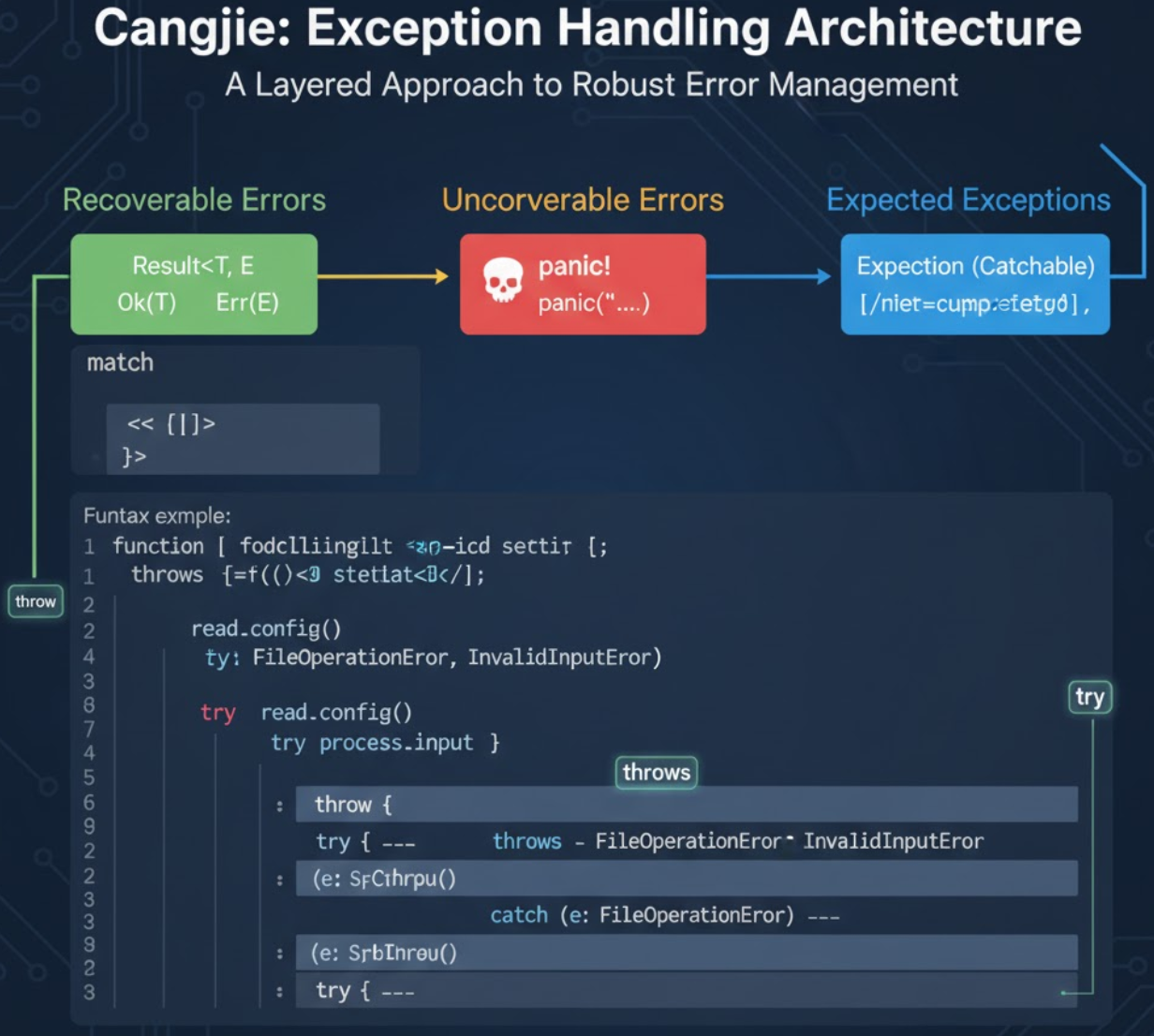
在仓颉语言中,错误处理将形成一个多层次的体系:
Result<T, E>: 用于处理预期且可恢复的错误。例如,文件打开失败、字符串解析失败。这些错误通常在调用点附近立即处理,或者通过?运算符显式传播。panic!: 用于处理不可恢复的程序错误。例如,数组越界、断言失败。这些错误通常表示程序逻辑存在缺陷,导致程序终止。Exception: (设想引入)用于处理可恢复但非预期的错误。这些错误可能发生在深层调用栈中,且需要统一的、跨层级的处理逻辑。例如,数据库连接池耗尽、远程服务超时。仓颉的异常系统将是编译时检查的,这意味着函数必须声明它可能抛出的异常,调用者必须捕获或再次声明。
这种分层设计允许开发者根据错误的性质选择最合适的处理机制。
1.2 throws关键字:函数声明异常
在仓颉语言中,如果一个函数可能抛出异常,它必须在函数签名中使用 throws 关键字进行声明。这使得异常成为函数契约的一部分,强制调用者处理这些异常。
// 设想的 Exception 基类
class Exception {
    pub message: String,
    // ...
}

// 自定义异常
class FileOperationError: Exception {
    pub path: String,
    fn new(message: String, path: String) -> Self {
        FileOperationError { message, path }
    }
}

// 函数声明可能抛出 FileOperationError 异常
fn read_config_file(path: &str) throws FileOperationError -> String {
    // 模拟文件读取失败
    if path == "non_existent.conf" {
        throw FileOperationError::new("File not found".to_string(), path.to_string());
    }
    "config_content".to_string() // 假设读取成功
}

fn main() {
    // 调用 read_config_file 必须在 try 块中,并捕获异常
    // 或者 main 函数也声明 throws
}
throws 关键字可以声明多个异常类型,用逗号分隔,例如 throws FileOperationError, NetworkError。
1.3 throw表达式:抛出异常
当程序遇到一个需要通过异常系统处理的错误时,可以使用 throw 表达式来抛出一个异常实例。
// 假设有一个处理用户输入的函数
class InvalidInputError: Exception {
    pub field_name: String,
    fn new(message: String, field_name: String) -> Self {
        InvalidInputError { message, field_name }
    }
}

fn process_user_input(input: &str) throws InvalidInputError -> i32 {
    if input.is_empty() {
        throw InvalidInputError::new("Input cannot be empty".to_string(), "username".to_string());
    }
    match input.parse::<i32>() {
        Ok(num) => num,
        Err(_) => throw InvalidInputError::new("Invalid number format".to_string(), "age".to_string()),
    }
}

fn main() {
    // ...
}
throw 表达式会立即中断当前函数的执行,并将控制权转移到调用栈中最近的 catch 块。
1.4 try表达式:标记可能抛出异常的代码
在调用可能抛出异常的函数时,必须使用 try 关键字来标记该调用。这通常是 try 块的一部分,或者在函数签名中声明 throws 来传播异常。
// 设想的 try 块语法
fn load_application_settings() throws FileOperationError, InvalidInputError -> String {
    let config_path = "app.conf";
    let config_content = try read_config_file(config_path); // 标记可能抛出 FileOperationError

    let parsed_value = try process_user_input(&config_content); // 标记可能抛出 InvalidInputError
    format!("Settings loaded: {}", parsed_value)
}

fn main() {
    // main 函数也需要处理异常
    try {
        let settings = load_application_settings();
        println!("{}", settings);
    } catch (e: FileOperationError) {
        println!("Error loading config file: {} at {}", e.message, e.path);
    } catch (e: InvalidInputError) {
        println!("Error processing input: {} for field {}", e.message, e.field_name);
    } catch (e: Exception) { // 捕获所有其他 Exception
        println!("An unexpected error occurred: {}", e.message);
    }
}
这里的 try 表达式类似于Swift的 try 或Kotlin的 try,它表示“尝试执行此操作,如果抛出异常,则将其传播”。
二、try、catch、finally的控制流
仓颉语言的异常处理将通过 try、catch 和 finally 块来提供结构化的控制流,类似于Java或C#,但会与仓颉的内存安全机制紧密结合。
2.1 try块:保护可能抛出异常的代码
try 块用于包裹可能抛出异常的代码。当 try 块中的代码抛出异常时,控制流会立即跳转到匹配的 catch 块。
// 假设 read_data 和 process_data 都可能抛出异常
class DataReadError: Exception { /* ... */ }
class DataProcessError: Exception { /* ... */ }

fn read_data() throws DataReadError -> String {
    // 模拟读取数据
    throw DataReadError::new("Failed to read from source".to_string());
}

fn process_data(data: &str) throws DataProcessError -> i32 {
    // 模拟处理数据
    throw DataProcessError::new("Failed to process data".to_string());
}

fn main() {
    try {
        let raw_data = try read_data(); // 尝试读取数据
        let processed_result = try process_data(&raw_data); // 尝试处理数据
        println!("Processing successful: {}", processed_result);
    } catch (e: DataReadError) {
        println!("Caught DataReadError: {}", e.message);
    } catch (e: DataProcessError) {
        println!("Caught DataProcessError: {}", e.message);
    } catch (e: Exception) {
        println!("Caught generic Exception: {}", e.message);
    } finally {
        println!("Execution finished (finally block).");
    }
}
如果 try 块中的所有代码都成功执行,那么 catch 块将被跳过,直接执行 finally 块。
2.2 catch块:捕获并处理特定异常
catch 块用于捕获 try 块中抛出的异常。可以定义多个 catch 块,每个块捕获不同类型的异常。异常捕获的顺序很重要,更具体的异常类型应该放在前面。
class NetworkError: Exception { /* ... */ }
class TimeoutError: NetworkError { /* ... */ } // TimeoutError 是 NetworkError 的子类

fn make_network_request() throws NetworkError -> String {
    // 模拟网络请求
    throw TimeoutError::new("Request timed out".to_string());
}

fn main() {
    try {
        let response = try make_network_request();
        println!("Response: {}", response);
    } catch (e: TimeoutError) { // 先捕获更具体的 TimeoutError
        println!("Caught TimeoutError: {}", e.message);
    } catch (e: NetworkError) { // 再捕获通用的 NetworkError
        println!("Caught NetworkError: {}", e.message);
    } catch (e: Exception) {
        println!("Caught generic Exception: {}", e.message);
    }
}
如果一个异常被捕获并处理,那么它就不会继续向上传播。如果没有任何 catch 块能够匹配抛出的异常,那么异常会继续向调用栈上传播,直到被捕获或导致程序终止。
2.3 finally块:确保资源清理与代码执行
finally 块是可选的,但非常重要。无论 try 块中的代码是否抛出异常,也无论异常是否被 catch 块捕获,finally 块中的代码都保证会执行。这使得 finally 块成为执行资源清理(如关闭文件、释放锁)的理想场所。
use std::io::{File, Write};

fn write_to_file_with_exception(path: &str, content: &str, should_throw: bool) throws FileOperationError {
    let mut file = File::create(path).map_err(|e| FileOperationError::new(e.to_string(), path.to_string()))?; // Result 转换为 Exception
    try {
        file.write_all(content.as_bytes()).map_err(|e| FileOperationError::new(e.to_string(), path.to_string()))?;
        if should_throw {
            throw FileOperationError::new("Simulated write error".to_string(), path.to_string());
        }
        println!("Write successful.");
    } finally {
        // file.close(); // 假设 File 有 close 方法,或者通过 RAII 自动关闭
        println!("Finally block executed for file operation.");
    }
}

fn main() {
    try {
        write_to_file_with_exception("test.txt", "Hello", false);
        write_to_file_with_exception("test.txt", "World", true); // 这会抛出异常
    } catch (e: FileOperationError) {
        println!("Caught FileOperationError in main: {}", e.message);
    }
}
在仓颉语言中,finally 块通常与 RAII 机制结合使用,以确保资源的自动释放,从而减少手动清理的复杂性。
2.4 异常传播与堆栈回溯
当一个异常被抛出但没有在当前函数中被捕获时,它会沿着调用栈向上传播。每个函数调用都会被“解开”(unwind),直到找到一个匹配的 catch 块。在异常传播过程中,仓颉语言会生成**堆栈回溯(Stack Trace)**信息,这对于调试非常有用,因为它显示了异常发生时的函数调用路径。
fn level3() throws Exception {
    println!("Entering level3");
    throw Exception::new("Error from level3".to_string());
    println!("Exiting level3"); // 不会执行
}

fn level2() throws Exception {
    println!("Entering level2");
    try level3(); // 传播异常
    println!("Exiting level2"); // 不会执行
}

fn level1() throws Exception {
    println!("Entering level1");
    try level2(); // 传播异常
    println!("Exiting level1"); // 不会执行
}

fn main() {
    try {
        level1();
    } catch (e: Exception) {
        println!("Caught exception in main: {}", e.message);
        // 打印堆栈回溯 (设想的打印方式)
        // println!("Stack trace: {}", e.stack_trace());
    }
}
输出将显示异常从 level3 抛出,经过 level2、level1 传播,最终在 main 函数中被捕获。
三、资源自动关闭机制的实现原理
仓颉语言将通过其强大的类型系统和生命周期管理,实现高效且安全的资源自动关闭机制,这通常被称为“Try-With-Resources”的等效机制。
3.1 RAII(Resource Acquisition Is Initialization)原则
**RAII(Resource Acquisition Is Initialization)**是仓颉语言(借鉴Rust)中管理资源的核心原则。
- 原理: 资源在对象创建时被获取(初始化),并在对象销毁时被自动释放(析构)。资源的生命周期与对象的生命周期绑定。
- 优势: 无论代码是正常执行、提前返回还是抛出异常,只要对象超出作用域,其析构函数就会被调用,从而保证资源被及时释放,避免资源泄漏。
仓颉语言的编译器会严格跟踪对象的生命周期,并在对象不再需要时自动插入析构函数调用。
3.2 Drop接口与析构函数
在仓颉语言中,任何需要执行清理逻辑的类型都可以实现 Drop 接口。Drop 接口定义了一个 drop(&mut self) 方法,该方法在对象超出作用域时被自动调用。这相当于其他语言中的析构函数。
// 假设有一个模拟的文件句柄
struct MyFileHandle {
    id: u32,
    is_open: bool,
}

impl MyFileHandle {
    fn new(id: u32) -> Self {
        println!("MyFileHandle {} opened.", id);
        MyFileHandle { id, is_open: true }
    }

    fn write(&mut self, data: &str) {
        if self.is_open {
            println!("MyFileHandle {} writing: {}", self.id, data);
        } else {
            println!("MyFileHandle {} is closed, cannot write.", self.id);
        }
    }
}

// 实现 Drop 接口,确保文件句柄在超出作用域时关闭
impl Drop for MyFileHandle {
    fn drop(&mut self) {
        if self.is_open {
            println!("MyFileHandle {} closed.", self.id);
            self.is_open = false;
        }
    }
}

fn process_with_file(id: u32, should_panic: bool) {
    let mut handle = MyFileHandle::new(id); // 资源获取
    handle.write("Some data");
    if should_panic {
        panic!("Simulating a panic!"); // 即使 panic,资源也会被释放
    }
    println!("Process finished normally.");
}

fn main() {
    process_with_file(1, false); // 正常执行
    println!("---");
    // try { // 如果 main 函数捕获 panic,则可以继续执行
        // process_with_file(2, true); // 触发 panic
    // } catch (e: PanicException) {
    //     println!("Caught panic: {}", e.message);
    // }
    // 即使没有 try-catch,panic 也会触发 drop
    println!("Main function continues after potential panic.");
}
通过 Drop 接口,仓颉语言实现了强大的资源自动管理,无需手动调用 close() 或 dispose() 方法。
3.3 using块(或defer):显式资源管理(设想)
虽然RAII是默认的资源管理方式,但在某些需要更显式地控制资源生命周期,或者在特定代码块结束后立即释放资源的场景,仓颉语言可能提供类似C#的using块或Go的defer语句的语法糖。
设想的 using 块语法:
// 假设 MyResource 实现了 Closeable 接口
interface Closeable {
    fn close(&mut self);
}

struct MyResource {
    name: String,
    is_closed: bool,
}

impl MyResource {
    fn new(name: String) -> Self {
        println!("Resource '{}' acquired.", name);
        MyResource { name, is_closed: false }
    }

    fn do_work(&self) {
        if !self.is_closed {
            println!("Resource '{}' doing work.", self.name);
        } else {
            println!("Resource '{}' is closed, cannot do work.", self.name);
        }
    }
}

impl Closeable for MyResource {
    fn close(&mut self) {
        if !self.is_closed {
            println!("Resource '{}' explicitly closed.", self.name);
            self.is_closed = true;
        }
    }
}

fn process_resource(name: String, should_throw: bool) throws Exception {
    using resource = MyResource::new(name); // 资源在 using 块结束时自动调用 close()
    { // using 块的作用域
        resource.do_work();
        if should_throw {
            throw Exception::new("Simulated error during work".to_string());
        }
        println!("Work completed for '{}'.", resource.name);
    } // resource 在这里超出 using 块作用域,close() 被调用
}

fn main() {
    try {
        process_resource("DatabaseConnection".to_string(), false);
        println!("---");
        process_resource("NetworkSocket".to_string(), true);
    } catch (e: Exception) {
        println!("Caught exception in main: {}", e.message);
    }
}
using 块确保了实现了 Closeable 接口的资源在块结束时(无论是正常退出还是异常退出)都会被调用 close() 方法。
3.4 仓颉的“Try-With-Resources”等效机制
仓颉语言通过以下组合实现了类似其他语言“Try-With-Resources”的强大功能:
- RAII原则: 任何实现了
Drop接口的类型,其资源都会在超出作用域时自动释放。这是最基础也是最强大的机制。 using块(设想): 为那些需要显式close()方法的资源提供语法糖,确保在特定代码块结束时调用close()。finally块: 作为最后的保障,可以在finally块中放置额外的清理逻辑,尤其是在处理非RAII管理的资源或需要报告清理失败的情况下。
这种多层次的资源管理策略,使得仓颉语言在保证高性能和内存安全的同时,提供了极高的资源管理可靠性。
四、throw表达式与自定义异常类
仓颉语言允许开发者定义自己的异常类,以更精确地表达程序中可能发生的错误,并提供丰富的错误信息。
4.1 Exception基类与异常层次结构
仓颉语言将提供一个内置的 Exception 基类(或接口),所有自定义异常都应该继承自它。这使得可以捕获所有异常(catch (e: Exception))或捕获特定类型的异常。
// 仓颉内置的 Exception 基类 (设想)
class Exception {
    pub message: String,
    pub cause: Option<Box<dyn Exception>>, // 异常链
    // pub stack_trace: VArray<String>, // 堆栈回溯信息
    fn new(message: String) -> Self {
        Exception { message, cause: Option::None }
    }
    fn with_cause(message: String, cause: Box<dyn Exception>) -> Self {
        Exception { message, cause: Option::Some(cause) }
    }
}

// 业务异常基类
class BusinessException: Exception {
    pub error_code: u32,
    fn new(message: String, error_code: u32) -> Self {
        BusinessException { message, error_code, ..Exception::new(message) }
    }
}

// 更具体的业务异常
class UserNotFoundException: BusinessException {
    pub user_id: u32,
    fn new(user_id: u32) -> Self {
        UserNotFoundException { user_id, ..BusinessException::new(format!("User with ID {} not found", user_id), 1001) }
    }
}
通过继承,可以构建清晰的异常层次结构,方便进行细粒度的异常捕获和处理。
4.2 自定义异常类:封装错误信息
自定义异常类应该封装所有与该错误相关的信息,以便于调试和处理。
// 假设有一个处理订单的系统
class OrderProcessingException: BusinessException {
    pub order_id: u32,
    pub item_id: Option<u32>,
    fn new(message: String, order_id: u32, item_id: Option<u32>) -> Self {
        OrderProcessingException {
            order_id,
            item_id,
            ..BusinessException::new(message, 2001)
        }
    }
}

fn process_order_item(order_id: u32, item_id: u32, quantity: u32) throws OrderProcessingException {
    if quantity == 0 {
        throw OrderProcessingException::new("Quantity cannot be zero".to_string(), order_id, Option::Some(item_id));
    }
    // ... 实际处理逻辑
    println!("Processed order {} item {} with quantity {}", order_id, item_id, quantity);
}

fn main() {
    try {
        process_order_item(123, 456, 10);
        process_order_item(124, 789, 0); // 抛出异常
    } catch (e: OrderProcessingException) {
        println!("Caught OrderProcessingException for order {}: {}", e.order_id, e.message);
        if let Option::Some(item_id) = e.item_id {
            println!("  Related item ID: {}", item_id);
        }
    }
}
自定义异常类通过其字段提供了丰富的上下文信息,帮助开发者理解错误的根源。
4.3 异常链与原因追踪
仓颉语言的异常系统将支持异常链(Exception Chaining),允许一个异常包含另一个异常作为其“原因”(cause)。这对于追踪错误的原始根源非常有用,尤其是在错误跨越多个系统边界或抽象层时。
class DatabaseConnectionError: Exception { /* ... */ }
class ServiceUnavailableException: Exception { /* ... */ }

fn connect_to_db() throws DatabaseConnectionError {
    throw DatabaseConnectionError::new("Failed to connect to database".to_string());
}

fn get_user_data(user_id: u32) throws ServiceUnavailableException {
    try {
        try connect_to_db();
        // ...
    } catch (e: DatabaseConnectionError) {
        // 捕获底层异常,并包装成上层异常
        throw ServiceUnavailableException::with_cause(
            format!("Could not retrieve user data for {}: Database unavailable", user_id),
            Box::new(e) // 将 DatabaseConnectionError 作为原因
        );
    }
}

fn main() {
    try {
        get_user_data(100);
    } catch (e: ServiceUnavailableException) {
        println!("Caught ServiceUnavailableException: {}", e.message);
        if let Option::Some(cause) = e.cause {
            println!("  Caused by: {}", cause.message); // 打印底层异常信息
        }
    }
}
异常链使得错误报告更加完整和有深度。
4.4 异常与Result的互操作性
在仓颉语言中,Exception和Result将是互补的。在某些场景下,可能需要将Result的错误转换为Exception,反之亦然。
// 假设有一个函数返回 Result
fn read_from_network() -> Result<String, std::io::Error> {
    // 模拟网络读取
    Err(std::io::Error::new(std::io::ErrorKind::BrokenPipe, "Network pipe broken"))
}

// 函数声明抛出异常
fn fetch_data_from_network() throws NetworkError -> String {
    match read_from_network() {
        Ok(data) => data,
        Err(e) => throw NetworkError::new(format!("Network read failed: {}", e.to_string())),
    }
}

fn main() {
    try {
        let data = fetch_data_from_network();
        println!("Fetched data: {}", data);
    } catch (e: NetworkError) {
        println!("Caught network error: {}", e.message);
    }
}
这种互操作性允许开发者在不同抽象层级之间灵活地转换错误处理策略。
五、最佳实践:服务端错误处理框架实现
在服务端应用中,统一的错误处理框架至关重要。它能确保所有错误都被正确捕获、记录,并以一致的方式响应给客户端。
5.1 定义统一的AppError异常基类
首先,定义一个统一的应用程序异常基类 AppError,所有业务相关的异常都继承自它。这使得全局异常处理器可以捕获所有业务异常。
// 统一的应用程序异常基类
class AppError: Exception {
    pub status_code: u16, // HTTP 状态码
    pub error_code: String, // 业务错误码
    fn new(message: String, status_code: u16, error_code: String) -> Self {
        AppError { message, status_code, error_code, ..Exception::new(message) }
    }
}

// 具体的业务异常
class NotFoundError: AppError {
    fn new(resource_name: String) -> Self {
        NotFoundError {
            ..AppError::new(format!("Resource '{}' not found", resource_name), 404, "NOT_FOUND".to_string())
        }
    }
}

class UnauthorizedError: AppError {
    fn new(message: String) -> Self {
        UnauthorizedError {
            ..AppError::new(message, 401, "UNAUTHORIZED".to_string())
        }
    }
}
5.2 业务逻辑中的异常抛出
在业务逻辑层,当遇到无法正常处理的业务错误时,抛出相应的 AppError 子类异常。
// 设想的 HTTP 响应结构
struct HttpResponse {
    status: u16,
    body: String,
}

// 设想的 Web 框架路由处理函数
fn handle_get_user_profile(request: HttpRequest) -> HttpResponse {
    let user_service = UserService {};
    let user_id = request.path_param("id").parse::<u32>().unwrap_or(0); // 简化解析
    let auth_token = request.header("Authorization").unwrap_or("");

    try {
        let profile = user_service.get_user_profile(user_id, auth_token);
        HttpResponse { status: 200, body: profile }
    } catch (e: NotFoundError) {
        HttpResponse { status: e.status_code, body: format!(r#"{{"code":"{}", "message":"{}"}}"#, e.error_code, e.message) }
    } catch (e: UnauthorizedError) {
        HttpResponse { status: e.status_code, body: format!(r#"{{"code":"{}", "message":"{}"}}"#, e.error_code, e.message) }
    } catch (e: AppError) { // 捕获所有其他 AppError
        HttpResponse { status: e.status_code, body: format!(r#"{{"code":"{}", "message":"{}"}}"#, e.error_code, e.message) }
    } catch (e: Exception) { // 捕获所有非 AppError 的运行时异常
        // 记录日志,返回通用错误
        println!("Unhandled server error: {}", e.message);
        HttpResponse { status: 500, body: r#"{{"code":"SERVER_ERROR", "message":"Internal server error"}}"#.to_string() }
    }
}

// 简化 HttpRequest 结构
struct HttpRequest {
    path_params: HashMap<String, String>,
    headers: HashMap<String, String>,
}

impl HttpRequest {
    fn path_param(&self, key: &str) -> Option<&str> {
        self.path_params.get(key).map(|s| s.as_str())
    }
    fn header(&self, key: &str) -> Option<&str> {
        self.headers.get(key).map(|s| s.as_str())
    }
}

fn main() {
    let mut req1 = HttpRequest {
        path_params: HashMap::from([("id".to_string(), "999".to_string())]),
        headers: HashMap::from([("Authorization".to_string(), "valid_token".to_string())]),
    };
    let res1 = handle_get_user_profile(req1);
    println!("Response 1 (Not Found): Status={}, Body={}", res1.status, res1.body);

    let mut req2 = HttpRequest {
        path_params: HashMap::from([("id".to_string(), "123".to_string())]),
        headers: HashMap::from([("Authorization".to_string(), "invalid_token".to_string())]),
    };
    let res2 = handle_get_user_profile(req2);
    println!("Response 2 (Unauthorized): Status={}, Body={}", res2.status, res2.body);

    let mut req3 = HttpRequest {
        path_params: HashMap::from([("id".to_string(), "123".to_string())]),
        headers: HashMap::from([("Authorization".to_string(), "valid_token".to_string())]),
    };
    let res3 = handle_get_user_profile(req3);
    println!("Response 3 (Success): Status={}, Body={}", res3.status, res3.body);
}
5.3 服务层面的异常捕获与转换
在服务层(例如Web框架的路由处理函数),捕获业务逻辑抛出的异常,并将其转换为统一的HTTP响应格式。
// 设想的 HTTP 响应结构
struct HttpResponse {
    status: u16,
    body: String,
}

// 设想的 Web 框架路由处理函数
fn handle_get_user_profile(request: HttpRequest) -> HttpResponse {
    let user_service = UserService {};
    let user_id = request.path_param("id").parse::<u32>().unwrap_or(0); // 简化解析
    let auth_token = request.header("Authorization").unwrap_or("");

    try {
        let profile = user_service.get_user_profile(user_id, auth_token);
        HttpResponse { status: 200, body: profile }
    } catch (e: NotFoundError) {
        HttpResponse { status: e.status_code, body: format!(r#"{{"code":"{}", "message":"{}"}}"#, e.error_code, e.message) }
    } catch (e: UnauthorizedError) {
        HttpResponse { status: e.status_code, body: format!(r#"{{"code":"{}", "message":"{}"}}"#, e.error_code, e.message) }
    } catch (e: AppError) { // 捕获所有其他 AppError
        HttpResponse { status: e.status_code, body: format!(r#"{{"code":"{}", "message":"{}"}}"#, e.error_code, e.message) }
    } catch (e: Exception) { // 捕获所有非 AppError 的运行时异常
        // 记录日志,返回通用错误
        println!("Unhandled server error: {}", e.message);
        HttpResponse { status: 500, body: r#"{{"code":"SERVER_ERROR", "message":"Internal server error"}}"#.to_string() }
    }
}

// 简化 HttpRequest 结构
struct HttpRequest {
    path_params: HashMap<String, String>,
    headers: HashMap<String, String>,
}

impl HttpRequest {
    fn path_param(&self, key: &str) -> Option<&str> {
        self.path_params.get(key).map(|s| s.as_str())
    }
    fn header(&self, key: &str) -> Option<&str> {
        self.headers.get(key).map(|s| s.as_str())
    }
}

fn main() {
    let mut req1 = HttpRequest {
        path_params: HashMap::from([("id".to_string(), "999".to_string())]),
        headers: HashMap::from([("Authorization".to_string(), "valid_token".to_string())]),
    };
    let res1 = handle_get_user_profile(req1);
    println!("Response 1 (Not Found): Status={}, Body={}", res1.status, res1.body);

    let mut req2 = HttpRequest {
        path_params: HashMap::from([("id".to_string(), "123".to_string())]),
        headers: HashMap::from([("Authorization".to_string(), "invalid_token".to_string())]),
    };
    let res2 = handle_get_user_profile(req2);
    println!("Response 2 (Unauthorized): Status={}, Body={}", res2.status, res2.body);

    let mut req3 = HttpRequest {
        path_params: HashMap::from([("id".to_string(), "123".to_string())]),
        headers: HashMap::from([("Authorization".to_string(), "valid_token".to_string())]),
    };
    let res3 = handle_get_user_profile(req3);
    println!("Response 3 (Success): Status={}, Body={}", res3.status, res3.body);
}
5.4 全局异常处理器与日志记录
对于未被特定 catch 块捕获的异常,可以设置一个全局异常处理器。这个处理器负责:
- 记录日志: 详细记录异常信息、堆栈回溯和请求上下文。
- 返回统一错误响应: 向客户端返回一个通用的错误响应,避免泄露敏感信息。
- 告警: 在生产环境中触发告警通知开发团队。
仓颉的Web框架可能会提供中间件或装饰器机制来实现全局异常处理。
5.5 结合Result与Exception的策略
在服务端应用中,Result和Exception可以协同工作:
Result: 用于处理函数内部或局部范围内的预期错误,例如数据库查询返回空结果、数据验证失败。这些错误通常在函数内部或紧邻的调用点处理。Exception: 用于处理那些需要跨越多个服务层级传播的非预期但可恢复的错误,或者在遇到严重但仍可处理的系统级问题时。
通过合理选择,可以构建一个既高效又健壮的错误处理体系。
结语:构建无惧错误的仓颉应用
各位技术探索者们,今天我们对仓颉语言的异常系统与Try-With-Resources机制进行了全面而深入的剖析。我们设想仓颉语言在保留Result<T, E>和panic!优势的基础上,引入了一套结构化、编译时检查的异常系统。
我们探讨了throws、throw和try表达式的语法,理解了try、catch、finally块的控制流,以及异常传播和堆栈回溯的原理。我们深入剖析了仓颉如何通过RAII原则和Drop接口,实现类似“Try-With-Resources”的资源自动关闭机制,甚至设想了using块的语法糖。
我们还学习了如何定义和抛出自定义异常类,构建异常层次结构,并利用异常链追踪错误根源。最后,通过一个服务端错误处理框架的实战,我们亲身体验了如何将这些机制组合起来,构建出健壮、可靠、无惧错误的复杂应用程序。
仓颉语言的异常系统与资源管理,是其在追求高性能和内存安全的同时,提供高级错误处理能力的体现。熟练掌握这些机制,将让你能够以更自信、更优雅的方式,应对程序运行中的各种挑战。
那么,你对仓颉语言的异常系统有什么新的见解或疑问吗?你认为它在哪些方面做得特别出色?欢迎在评论区留言,与我一起交流!

有“AI”的1024 = 2048,欢迎大家加入2048 AI社区
更多推荐


 27
27 0
0- 0


 已为社区贡献1条内容

所有评论(0)