C++笔记4
本节将描述unordered_map的用法并自己手写一个无序map
使用unordered_map
定义与常用操作
unordered_map 是 C++ 标准库中的关联容器,提供了基于哈希表的键值对存储结构。与 map (基于红黑树实现)不同,unordered_map 提供的是平均常数时间复杂度的查找、插入和删除操作,但不保证元素的顺序
哈希表复习:王道考研 数据结构
头文件
#include<unordered_map>基本定义
std::unordered_map<KeyType,
ValueType,
Hash = std::hash<KeyType>,
KeyEqual = std::equal_to<KeyType>,
Allocator = std::allocator<std::pair<const KeyType, ValueType>>>
此为STL源码中的一段,参数如下:
- KeyType:键的类型,需要支持哈希运算和相等比较
- ValueType:值的类型
- Hash:哈希函数,默认为
std::hash<KeyType> - KeyEqual:键相等的比较函数,默认为
std::equal_to<KeyType> - Allocator:内存分配器,默认为
std::allocator
常用操作
创建和初始化
#include<iostream>
#include<string>
#include<unordered_map>
using namespace std;

int main()
{
    unordered_map<string, int> umap;
	unordered_map<string, int> mymap = {
		{"apple",3},
		{"banana",2},
		{"cherry",5}
	};
    //mymap的迭代器可以不写,直接这样
    //unordered_map<string, int>umap2(mymap);
	unordered_map<string, int>umap2(mymap.begin(),mymap.end());
	return 0;
}
插入
// 方法1:使用下标操作符
umap["grape"] = 7;

// 方法2:使用 insert
umap.insert({"melon", 6});

// 方法3:使用 emplace,直接在容器内部构造元素
umap.emplace("kiwi", 4);
若map内无该元素则也会插入并调用值的默认构造
auto apple_count = umap["apple"];
cout << "apple count: " << apple_count << endl;//输出apple count: 0
cout << umap.count("apple") << endl;//输出1
访问
// 使用下标操作符访问或插入
int apple_count = umap["apple"]; // 如果 "apple" 不存在,会插入一个默认值

// 使用 at() 方法访问,不存在时会抛出异常
try {
    int banana_count = umap.at("banana");
} catch (const std::out_of_range& e) {
    cerr << "Key not found." << endl;
}

// 使用 find() 方法查找
auto it = umap.find("orange");
if (it != umap.end()) {
    cout << "Orange count: " << it->second << endl;
} else {
    cout << "Orange not found." << endl;
}
删除
// 根据键删除
umap.erase("grape");

// 根据迭代器删除
auto it = umap.find("banana");
if (it != umap.end()) {
    umap.erase(it);
}

// 清空整个容器
umap.clear();
遍历
for (const auto& pair : umap) {
    cout << pair.first << ": " << pair.second << endl;
}

// 使用迭代器
for (auto it = umap.begin(); it != umap.end(); ++it) {
    cout << it->first << ": " << it->second << endl;
}
其他
// 获取大小
size_t size = umap.size();

// 检查是否为空
bool is_empty = umap.empty();

// 获取桶的数量(用于哈希表内部结构)
size_t bucket_count = umap.bucket_count();

// 重新哈希,调整桶的数量
umap.rehash(20);

// 从一个容器中移交元素到另一个容器
unordered_map<string, int> umap2 = move(umap);
性能优化
预分配桶数
umap.reserve(100); // 预分配足够容纳100个元素的桶自定义哈希函数
struct Point {
    int x;
    int y;

    bool operator==(const Point& other) const {
        return x == other.x && y == other.y;
    }
};

// 自定义哈希函数
struct PointHash {
    size_t operator()(const Point& p) const {
        size_t h1=hash<int>()(p.x);
        size_t h2=hash<int>()(p.y);
        return h1^ (h2 << 1);//h2左移1位再与h1异或
    }
};

// 定义 unordered_map 使用自定义哈希函数
unordered_map<Point, string, PointHash> point_map;
point_map[{1, 2}] = "A";
point_map[{3, 4}] = "B";
自定义键相等比较
struct PointEqual {
    bool operator()(const Point& a, const Point& b) const {
        return (a.x == b.x) && (a.y == b.y);
    }
};

// 定义 unordered_map 使用自定义哈希和比较函数
unordered_map<Point,string, PointHash, PointEqual> point_map;
与 map 的比较
- 底层实现:
unordered_map基于哈希表,实现的操作平均时间复杂度为O(1)级别;map基于红黑树,实现的查找、插入、删除操作时间复杂度为对数级别 - 元素顺序:
unordered_map不保证元素的顺序;map按键的顺序(通常是升序)存储元素 - 适用场景:当需要快速查找、插入和删除,且不关心元素顺序时,选择
unordered_map;当需要有序存储或按顺序遍历时,选择map
实现无序map
哈希表原理
哈希表是一种基于键值对的数据结构,通过哈希函数(Hash Function)将键映射到表中的一个索引位置,以实现快速的数据访问。哈希表的关键特性包括:
- 哈希函数:将键映射到表中一个特定的桶(Bucket)或槽(Slot)
- 冲突解决:当不同的键通过哈希函数映射到同一个桶时,需要一种机制来处理这些冲突。常见的方法有链地址法(Separate Chaining)和开放地址法(Open Addressing)
- 负载因子(Load Factor):表示表中已存储元素的数量与表大小之间的比率。高负载因子可能导致更多的冲突,需要通过扩容来维持性能
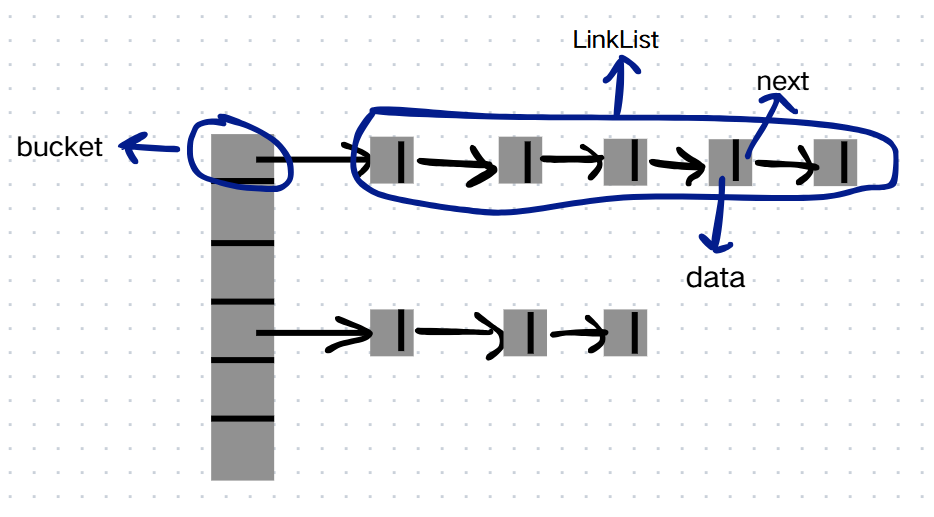
在本实现中,我们将采用链地址法来处理哈希冲突,即每个桶存储一个链表(或其他动态数据结构)来存储具有相同哈希值的元素
哈希表结构如下:
数据结构
首先我们新建一个类MyHash,先在.h内包含要用的头文件:
#pragma once
#include<iostream>
#include<algorithm>
#include<list>
#include<functional>
#include<utility>
#include<vector>
#include<iterator>
#include<stdexcept>
using namespace std;创建一个结构体HashNode:
template<typename Key,typename T>
struct HashNode
{
	pair<Key, T> data;
	HashNode* next;
	HashNode(const pair<Key, T>& d) :data(d), next(nullptr) {}
};HashNode内包含了数据域与指针域,正如上图所示,并添加构造函数(用初始化列表方式为成员赋值)
备注:成员是const、引用、自定义类型(无默认构造)、需要高效初始化、或基类构造时,必须或建议用初始化列表。其他简单类型(如int、double等)虽然可以在构造函数体内赋值,但用初始化列表更规范、高效
然后我们考虑中央数组的结构,桶的结构其实和HashNode结构一致,然后我们可以用vector来保存这些桶,哈希函数直接用std的hash<>
template<typename Key, typename T, typename Hash = hash<Key>>
class MyHash
{
public:
	class iterator;
	using key_type = Key;//起别名
	using mapped_type = T;
	using value_type = pair<Key, T>;
	using size_type = size_t;
private:
    vector<HashNode<Key, T>*>buckets_;//每个桶即HashNode类型的指针
	size_type element_count_;
	size_type bucket_count_;
	double max_load_factor_;//负载因子
	Hash hash_func_;//哈希函数
    void reHash();//重新分配
}然后我们直接在public内写迭代器iterator的实现:
class iterator
{
public:
    using iterator_category = forward_iterator_tag;//定义迭代器类型(++)
    using value_type = pair<Key, T>;
    using difference_type = ptrdiff_t;//偏移量
    using pointer = value_type*;
    using reference = value_type&;
	iterator(MyHash* map, size_type index, HashNode<Key, T>* node):
    map_(map), bucket_index_(index), current_node_(node){}//构造函数

    //重载运算符
    pointer operator->()const;
    reference operator&()const;
	iterator& operator++();//前自增
    iterator operator++(int);//后自增
    bool operator==(const iterator& other) const;
    bool operator!=(const iterator& other) const;

private:
	MyHash* map_;//用于记录找哪个map
	HashNode<Key, T>* current_node_;//记录当前的结点(链表中的node)
	size_type bucket_index_;//桶的索引
    void advance();//遍历函数
}记住iterator的构造函数(参数为map对象,索引,结点),一会要用
接着为MyHash补上构造与析构,然后禁止拷贝与赋值:
MyHash(size_type initial_capacity = 16, double max_load_factor = 0.75):
bucket_count_(initial_capacity),
element_count_(0),
max_load_factor_(max_load_factor),
hash_func_(Hash())
{
	buckets_.resize(bucket_count_);
}
~MyHash()
{
	clear();//此函数在下边实现
}
MyHash(const MyHash& other)=delete;
MyHash& operator=(const MyHash& other) = delete;
常见操作
查找
T* find(const Key& key)//find返回的是迭代器类型,我们这里图省事就返回指针了
{
	size_type hash_value = hash_func_(key);
	size_type index = hash_value % bucket_count_;
	auto* node = buckets_[index];
	while (node)
	{
		if (node->data.first == key)
		{
			return &(node->data.second);//返回value的地址
		}
		node = node->next;
	}
	return nullptr;//没找到返回空指针
}
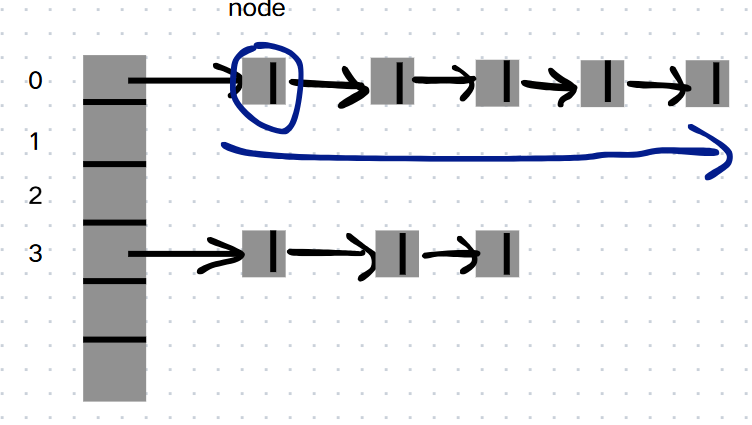
假设映射到的index为0,则我们用node暂存链表的第一个元素,并对链表进行遍历,查找与key相匹的结点,过程如下图所示
删除
bool erase(const Key& key)
{
	auto hash_value=hash_func_(key);
	auto index = hash_value % bucket_count_;
	auto* node = buckets_[index];
	HashNode<Key, T>* prev = nullptr;
	while (node)
	{
		if (node->data.first == key)
		{
            if (prev)
				prev->next = node->next;
			else
				buckets_[index] = node->next;
			delete node;
			--element_count_;
			return true;
		}
		prev = node;
		node = node->next;
	}
}
举个例子解释一下:
假设,我们要删除键为B的结点,初始状态如下
buckets_[1]: ○(A) → ○(B) → ○(C) → nullptr
              ↑
             node
             prev = nullptr
第一轮循环
-
检查:
node->data.first == "A" ≠ "B"→ 条件不成立 -
移动指针:
-
prev = node(prev 指向 ○(A)) -
node = node->next(node 指向 ○(B))
-
第二轮循环:
当前状态: ○(A) → ○(B) → ○(C) → nullptr
          ↑       ↑
prev node-
检查:
node->data.first == "B" == "B"→ 条件成立 -
执行删除:
-
prev->next = node->next(○(A) 指向 ○(C)) -
delete node(删除 ○(B)) -
返回 true
-
插入
void insert(const Key&key,const T& value)
{
	size_type hash_value = hash_func_(key);
	size_type index = hash_value % bucket_count_;

	auto* node = buckets_[index];
	while (node)
	{
		if (node->data.first == key)
		{
			node->data.second = value;//如果key已经存在,更新value
			return;
		}
		node = node->next;
	}
	auto* new_node = new HashNode<Key, T>(make_pair(key, value));
	new_node->next = buckets_[index];//在链表头插入
	buckets_[index] = new_node;
	++element_count_;
	auto load_factor = static_cast<double>(element_count_)/bucket_count_;//计算负载因子
	if (load_factor > max_load_factor_)//若负载因子超过阈值,则进行重新开辟大小
	{
		rehash();
	}
}
举两个例子,懒得画图了,问deepseek要的图(?)
例1:插入新键(key不存在)
初始状态:
buckets_[1]: ○(A,val1) → ○(C,val3) → nullptr插入 (B, val2):
-
计算
index = 1 -
遍历链表:A ≠ B, C ≠ B → key不存在
-
创建新节点 ○(B,val2)
-
头插法:
new_node->next = buckets_[1] // ○(B) → ○(A) buckets_[1] = new_node // buckets_[1] 指向 ○(B) -
结果:
buckets_[1]: ○(B,val2) → ○(A,val1) → ○(C,val3) → nullptr
例2:更新已存在键
初始状态:
buckets_[1]: ○(A,val1) → ○(B,old_val) → ○(C,val3) → nullptr插入 (B, new_val):
-
计算
index = 1 -
遍历链表:
-
○(A): key="A" ≠ "B" → 继续
-
○(B): key="B" == "B" → 找到
-
-
执行更新:
node->data.second = value -
结果:
buckets_[1]: ○(A,val1) → ○(B,new_val) → ○(C,val3) → nullptr
返回大小
size_type size() const
{
	return element_count_;
}
判空
bool empty() const
{
	return element_count_ == 0;
}
清空
void clear()
{
	for(size_type i = 0; i < bucket_count_; ++i)
	{
		HashNode<Key, T>* current_node = buckets_[i];//第一个元素的指针
		while (current_node)//current_node不为空时
		{
			HashNode<Key, T>* temp = current_node;//一定要先保存当前节点
			current_node = current_node->next;
			delete temp;
		}
		buckets_[i] = nullptr;
	}
	element_count_ = 0;
}
迭代器begin与end
iterator begin()
{
	for (size_type i = 0; i < bucket_count_; ++i)
	{
		if (buckets_[i])//找到第一个非空桶
		{
			return iterator(this, i, buckets_[i]);
		}
	}
	return end();//如果所有桶都为空,返回end
}
iterator end()
{
	return iterator(this, bucket_count_, nullptr);
}
动态扩容reHash
void reHash()
{
	auto new_bucket_count = bucket_count_ * 2;
	vector<HashNode<Key, T>*> new_buckets(new_bucket_count, nullptr);
	for (size_type i = 0; i < bucket_count_; ++i)
	{
		auto* node = buckets_[i];
		while (node)
		{
			auto* next_node = node->next;
            //记住是对新的桶数量取模
			size_type new_index = hash_func_(node->data.first) % new_bucket_count;
			//还是采用头插法
			node->next = new_buckets[new_index];
			new_buckets[new_index] = node;
			node = next_node;
		}
	}

	buckets_ = std::move(new_buckets);
	bucket_count_ = new_bucket_count;
}
当负载因子超过阈值时,扩容哈希表并重新分配所有元素
iterator内的函数实现
遍历函数
void advance()//遍历函数
{
	if(current_node_!=nullptr)
	{
		current_node_ = current_node_->next;
	}
	while(current_node_==nullptr)
	{
		if (bucket_index_ + 1 < map_->bucket_count_)
		{
			++bucket_index_;
			current_node_ = map_->buckets_[bucket_index_];
		}
		else if (bucket_index_ + 1 == map_->bucket_count_)
		{
			++bucket_index_;
			cout << "end of iterator" << endl;
			break;
        }
	}
}
重载*和->
pointer operator->() const
{
	if(!current_node_)
	{
		throw out_of_range("Dereferencing end iterator");
	}
	return &(current_node_->data);
}

reference operator*() const
{
	if(!current_node_)
	{
		throw out_of_range("Dereferencing end iterator");
	}
	return current_node_->data;
}
重载==和!=
bool operator==(const iterator& other) const
{
	return map_ == other.map_ &&
    bucket_index_ == other.bucket_index_ &&
    current_node_ == other.current_node_;
}

bool operator!=(const iterator& other) const
{
	return !(*this == other);
}
重载前自增与后自增
iterator& operator++()
{
	advance();
	return *this;
}

iterator operator++(int)
{
	iterator temp = *this;
	advance();
	return temp;
}
使用示例
#include<iostream>
#include<string>
#include"MyHash.h"
using namespace std;

int main()
{
	MyHash<string,int> my_hash;
	my_hash.insert("one", 1);
	my_hash.insert("two", 2);
	for (auto it = my_hash.begin(); it != my_hash.end(); ++it)
	{
		cout << it->first << ": " << it->second << endl;
	}
	cout << "-----------------"<<endl;
	my_hash.erase("one");
	//最好不要在遍历时删除元素
	for (auto it = my_hash.begin(); it != my_hash.end(); ++it)
	{
		cout << it->first << ": " << it->second << endl;
	}
	return 0;
}
输出
two: 2
one: 1
end of iterator
-----------------
two: 2
end of iterator
参考:
 https://www.bilibili.com/video/BV18bwPe4EfG?spm_id_from=333.788.videopod.sections&vd_source=7c8ff13ea415e148112fa8ecdfa6f75e
有“AI”的1024 = 2048,欢迎大家加入2048 AI社区
更多推荐

 27
27 0
0- 0


 已为社区贡献2条内容

所有评论(0)