CUR矩阵分解
CUR矩阵分解
1. Intuition
SVD缺点:
- 可解释性差。
- 太过Dense。
SVD: X = U Σ V T X=U\Sigma V^T X=UΣVT,其中 U , V U,V U,V都是Big and Dense, Σ \Sigma Σ是Small But Sparse。
Aims to Get:
CUR: X = C U R X=CUR X=CUR,其中 C , R C,R C,R都是Big but Sparse, U U U是Small and Dense。
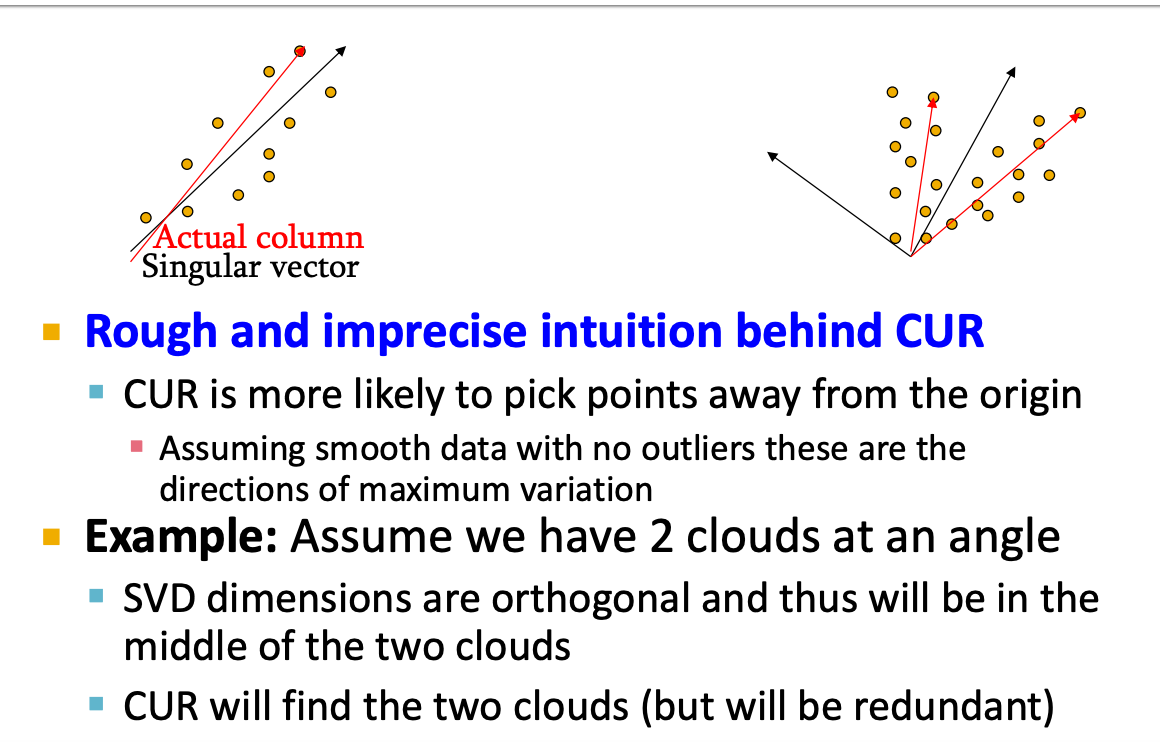
Rough Intuition:
CUR选的点可能是更偏离远点的,同时坐标轴可能是多余的。
2. Proof
TL;DR.
详见CUR理论公式推导。
3. Algo
Given Input Matrix A:
- Randam choose, C columns, R rows.
- C ∩ U C\cap U C∩U intersection point matrix W W W.
- SVD Decomposition W = X Σ Y T W = X\Sigma Y^T W=XΣYT
- Derive Generalized inverse matrix of $\Sigma^{+} $ via Σ \Sigma Σ, i.e. non-zero elements turn to its countdown
- Derive U = Y Σ + X T U=Y\Sigma^{+}X^T U=YΣ+XT
- A = C ⋅ U ⋅ R = C ⋅ Y ⋅ Σ + ⋅ X T ⋅ R A=C\cdot U\cdot R=C\cdot Y\cdot \Sigma^{+}\cdot X^T\cdot R A=C⋅U⋅R=C⋅Y⋅Σ+⋅XT⋅R
4. Remarks
第一步关于如何选择C,R
-
Mahoney等人提出可以里用normalized statistical leverage scores π j = 1 k ∑ η = 1 k = ( v η i ) 2 \pi_j=\frac{1}{k}\sum_{\eta=1}^k=(v_\eta^i)^2 πj=k1∑η=1k=(vηi)2,i.e.该列/行的二范数占所有列数二范数的比例,作为衡量其统计影响力的指标。也即square of its Frobenius norm。
-
可能有读者想问“有代表的q,kq,k要怎么选?”,事实上,大多数情况下都是随机选的,这就留下了一些提升空间,比如可以聚类后选最接近聚类中心的那个,这些就看大家自由发挥了。另外要指出的是,CUR分解本身只是一种近似,它肯定有误差,所以该加速方案主要是为检索场景设计的,检索场景的特点是比较在乎topk的召回率,而不是特别要求top1的精确率,我们可以用CUR分解加速来召回若干个结果后,再用精确的s(q,k)做一次重排序来提高准确度。
第四步关于广义逆矩阵
也有文献表示QR分解更稳定。
Experiments
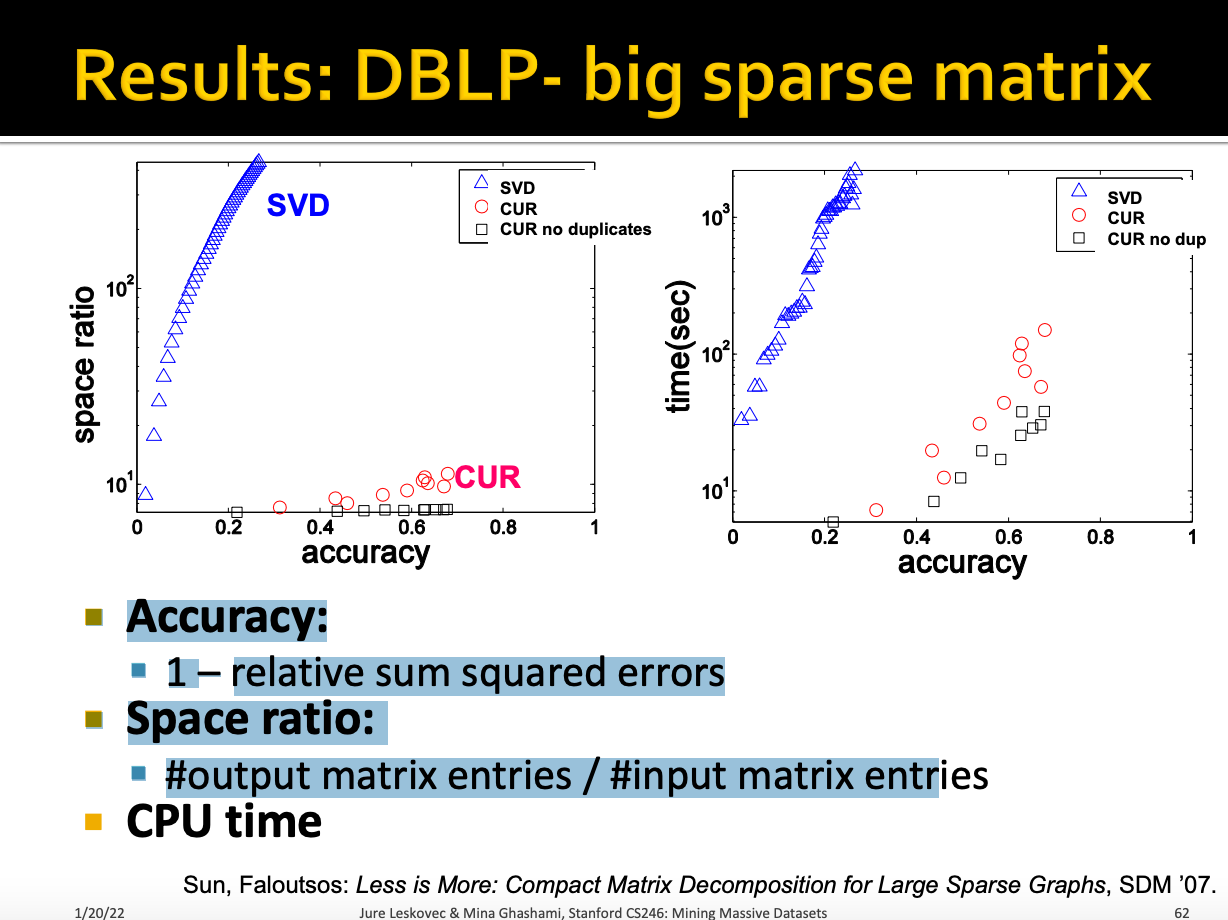
不放回抽样的CUR效果最好。同时保证了效率和精度。对于large sparse matrix有很不错的效果。
Reference
CUR matrix decompositions for improved data analysis
Sublinear Time Approximation of Text Similarity Matrices
Semantic Representation of Documents Based on Matrix Decomposition

有“AI”的1024 = 2048,欢迎大家加入2048 AI社区
更多推荐
 3
3 0
0- 0


 已为社区贡献3条内容

所有评论(0)