基于Matlab_Python各种概率分布函数,概率密度分布函数,概率分布函数拟合,绘图。伽马分布,威尔分布,正态分布,柯西分布,均匀分布
Matlab/Python各种概率分布函数,概率密度分布函数,概率分布函数拟合,绘图。伽马分布,威尔分布,正态分布,柯西分布,均匀分布。Matlab/Python概率密度函数(pdf)和累计概率密度函数拟合(cdf)支持定制,包括不限于如下:(重现期极值计算)
Matlab/Python各种概率分布函数,概率密度分布函数,概率分布函数拟合,绘图。伽马分布,威尔分布,正态分布,柯西分布,均匀分布。
Matlab/Python概率密度函数(pdf)和累计概率密度函数拟合(cdf)支持定制,包括不限于如下:(重现期极值计算)
- Beta Distribution (Beta 分布)
- Binomial Distribution (二项分布)
- Birnbaum-Saunders Distribution (伯恩鲍姆-桑德斯分布)
- Burr Distribution (伯尔分布)
- Exponential Distribution (指数分布)
- Extreme Value Distribution (极值分布)
- Gamma Distribution (gamma 分布)
- Generalized Extreme Value Distribution (广义极值分布)
- Generalized Pareto Distribution (广义帕累托分布)
- Half Normal Distribution (半正态分布)
- Inverse Gaussian Distribution (逆高斯分布)
- Kernel Distribution (核分布)
- Logistic Distribution (逻辑分布)
- Loglogistic Distribution (对数逻辑分布)
- Lognormal Distribution (对数正态分布)
- Nakagami Distribution (Nakagami 分布)
- Negative Binomial Distribution (负二项分布)
- Normal Distribution (正态分布)
- Poisson Distribution (泊松分布)
- Rayleigh Distribution (瑞利分布)
- Rician Distribution (莱斯分布)等
- Stable Distribution (稳定分布)
- t Location-Scale Distribution (t 位置尺度分布)
- Weibull Distribution (威布尔分布)
等约100种,详情查列表
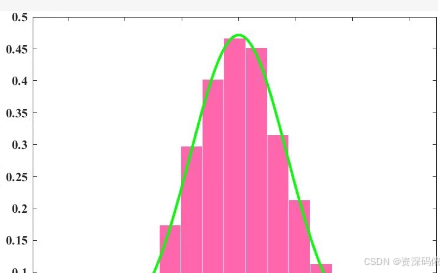
在Matlab和Python中,处理各种概率分布函数(PDF)和累积分布函数(CDF),以及进行分布拟合和绘图是非常常见的任务。以下是针对您提到的几种分布(伽马分布、威尔分布、正态分布等)的基本操作方法示例。
在Matlab中
对于大多数分布,Matlab提供了fitdist函数用于数据拟合,pdf和cdf函数来计算特定点的概率密度和累积概率值,以及plot或histogram结合pdf绘制图形。
% 示例:伽马分布拟合并绘图
data = gamrnd(1,1,100,1); % 生成随机数作为样本数据
pd = fitdist(data,'Gamma'); % 拟合伽马分布
x = linspace(min(data),max(data));
y_pdf = pdf(pd,x); % 计算概率密度
y_cdf = cdf(pd,x); % 计算累积概率

figure;
subplot(2,1,1); plot(x,y_pdf); title('Gamma PDF');
subplot(2,1,2); plot(x,y_cdf); title('Gamma CDF');
在Python中
使用SciPy库可以方便地进行类似的操作。下面以伽马分布为例:
import numpy as np
import matplotlib.pyplot as plt
from scipy.stats import gamma
from scipy.optimize import curve_fit

# 生成随机样本
data = gamma.rvs(a=1, size=100)

# 定义拟合函数
def gamma_pdf(x, a, loc, scale):
    return gamma.pdf(x, a, loc, scale)

params, _ = curve_fit(gamma_pdf, np.arange(len(data)), data)
a, loc, scale = params

x = np.linspace(min(data), max(data), 100)
pdf_fitted = gamma.pdf(x, a=a, loc=loc, scale=scale)
cdf_fitted = gamma.cdf(x, a=a, loc=loc, scale=scale)

plt.figure(figsize=(12, 6))
plt.subplot(1, 2, 1)
plt.plot(x, pdf_fitted, label='Fitted Gamma PDF')
plt.hist(data, density=True, alpha=0.5, label='Data Histogram')
plt.legend()

plt.subplot(1, 2, 2)
plt.plot(x, cdf_fitted, label='Fitted Gamma CDF')
plt.legend()
plt.show()
以上代码分别展示了如何在Matlab和Python中对数据进行伽马分布拟合,并绘制其概率密度函数(PDF)和累积分布函数(CDF)。其他分布的操作方式类似,只需更改相应的分布名称及其参数即可。对于更多类型的分布,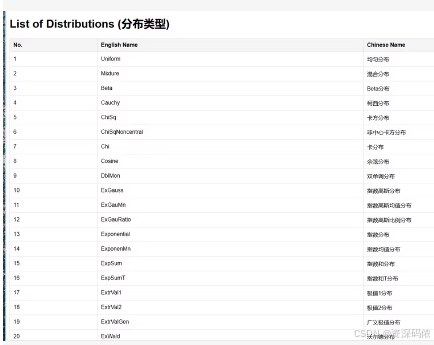
这里展示的是一个包含多种概率分布的列表。为了帮助您更好地理解和使用这些分布,我将提供一些基本示例代码,分别在Matlab和Python中实现对几种常见分布的概率密度函数(PDF)和累积分布函数(CDF)的计算与绘图。
在Matlab中
首先,我们选择几个常见的分布进行示例:
% 示例:正态分布、伽马分布和威布尔分布的PDF和CDF绘制

% 正态分布
mu = 0; % 均值
sigma = 1; % 标准差
x_normal = linspace(mu - 3*sigma, mu + 3*sigma, 100);
pdf_normal = normpdf(x_normal, mu, sigma);
cdf_normal = normcdf(x_normal, mu, sigma);

% 伽马分布
a = 2; % 形状参数
b = 1; % 尺度参数
x_gamma = linspace(0, 10, 100);
pdf_gamma = gampdf(x_gamma, a, b);
cdf_gamma = gamcdf(x_gamma, a, b);

% 威布尔分布
k = 1.5; % 形状参数
lambda = 1; % 尺度参数
x_weibull = linspace(0, 10, 100);
pdf_weibull = wblpdf(x_weibull, k, lambda);
cdf_weibull = wbllike(x_weibull, k, lambda);

% 绘制图形
figure;
subplot(3, 2, 1); plot(x_normal, pdf_normal); title('Normal PDF');
subplot(3, 2, 2); plot(x_normal, cdf_normal); title('Normal CDF');
subplot(3, 2, 3); plot(x_gamma, pdf_gamma); title('Gamma PDF');
subplot(3, 2, 4); plot(x_gamma, cdf_gamma); title('Gamma CDF');
subplot(3, 2, 5); plot(x_weibull, pdf_weibull); title('Weibull PDF');
subplot(3, 2, 6); plot(x_weibull, cdf_weibull); title('Weibull CDF');
在Python中
接下来,我们使用Python中的SciPy库来实现同样的功能:
import numpy as np
import matplotlib.pyplot as plt
from scipy.stats import norm, gamma, weibull_min

# 正态分布
mu = 0
sigma = 1
x_normal = np.linspace(mu - 3*sigma, mu + 3*sigma, 100)
pdf_normal = norm.pdf(x_normal, mu, sigma)
cdf_normal = norm.cdf(x_normal, mu, sigma)

# 伽马分布
a = 2
b = 1
x_gamma = np.linspace(0, 10, 100)
pdf_gamma = gamma.pdf(x_gamma, a, scale=b)
cdf_gamma = gamma.cdf(x_gamma, a, scale=b)

# 威布尔分布
k = 1.5
lambda_ = 1
x_weibull = np.linspace(0, 10, 100)
pdf_weibull = weibull_min.pdf(x_weibull, k, scale=lambda_)
cdf_weibull = weibull_min.cdf(x_weibull, k, scale=lambda_)

# 绘制图形
plt.figure(figsize=(12, 8))
plt.subplot(3, 2, 1)
plt.plot(x_normal, pdf_normal)
plt.title('Normal PDF')

plt.subplot(3, 2, 2)
plt.plot(x_normal, cdf_normal)
plt.title('Normal CDF')

plt.subplot(3, 2, 3)
plt.plot(x_gamma, pdf_gamma)
plt.title('Gamma PDF')

plt.subplot(3, 2, 4)
plt.plot(x_gamma, cdf_gamma)
plt.title('Gamma CDF')

plt.subplot(3, 2, 5)
plt.plot(x_weibull, pdf_weibull)
plt.title('Weibull PDF')

plt.subplot(3, 2, 6)
plt.plot(x_weibull, cdf_weibull)
plt.title('Weibull CDF')

plt.tight_layout()
plt.show()
以上代码展示了如何在Matlab和Python中计算并绘制正态分布、伽马分布和威布尔分布的概率密度函数(PDF)和累积分布函数(CDF)。您可以根据需要调整参数或选择其他分布类型进行类似的处理。
Matlab/Python各种概率分布函数,概率密度分布函数,概率分布函数拟合,绘图。伽马分布,威尔分布,正态分布,柯西分布,均匀分布

有“AI”的1024 = 2048,欢迎大家加入2048 AI社区
更多推荐



 20
20 0
0- 0


 已为社区贡献12条内容

所有评论(0)