深度学习基础理论————常见评价指标以及Loss Function
*主要用于处理样本失衡问题(样本里面标签不平衡问题,比如说目标识别,可能会得到很多框,但是可能只要一个框是所需的),其原理也很简单可以直接在原交叉熵基础上补充一个。用于回归任务的损失函数,它结合了均方误差(MSE)和绝对误差(MAE)的优点,可以减少对异常值(outliers)的敏感性,同时保持较好的梯度性质。交叉熵损失用于分类任务,它度量的是预测概率分布与真实标签分布之间的差异。的匹配规则,原理
评价指标
准确率/精确率/召回率
| Positive (预测到的正例) | Negative (预测到的反例) | |
|---|---|---|
| True (预测结果为真) | TP | TN |
| False (预测结果为假) | FP | FN |
争对正案例的计算:
1、准确率计算方式(ACC): A c c = T P + T N T P + T N + F P + F N Acc= \frac{TP+TN}{TP+TN+FP+FN} Acc=TP+TN+FP+FNTP+TN
2、精确率计算方式(Precision): T P T P + F P \frac{TP}{TP+FP} TP+FPTP
3、召回率计算方式(Recall): T P T P + F N \frac{TP}{TP+FN} TP+FNTP
4、F1计算方式: 2 × P r e c i s i o n × R e c a l l P r e c i s i o n + R e c a l l \frac{2\times Precision \times Recall}{Precision+ Recall} Precision+Recall2×Precision×Recall
| 指标 | 优点 | 缺点 |
|---|---|---|
| 准确率 | - 直观且易理解 | - 在类别不平衡的情况下可能误导模型评估 |
| 精确率 | - 衡量预测为正类的样本中,实际为正类的比例;适用于避免假阳性 | - 可能忽视召回率,导致漏掉正类样本(假阴性) |
| 召回率 | - 衡量模型对正类样本的识别能力;适用于避免假阴性 | - 可能导致精确率较低,增加误报(假阳性) |
| F1 分数 | - 平衡精确率和召回率,适用于不平衡的任务 | - 不能单独反映精确率或召回率,可能不适用于需要单独关注某一项的场景 |
BLEU
BLEU 采用一种N-gram的匹配规则,原理比较简单,就是比较译文和参考译文之间n组词的相似的一个占比
原文:今天天气不错
机器译文:It is a nice day today
人工译文:Today is a nice day1-gram:
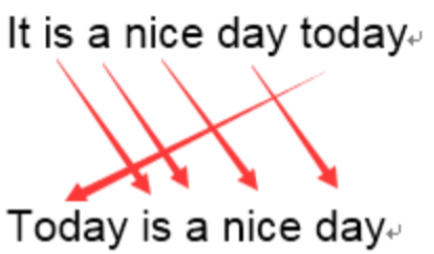
命中5个词,那么计算得到匹配度为: 5 / 6 5/6 5/63-gram:
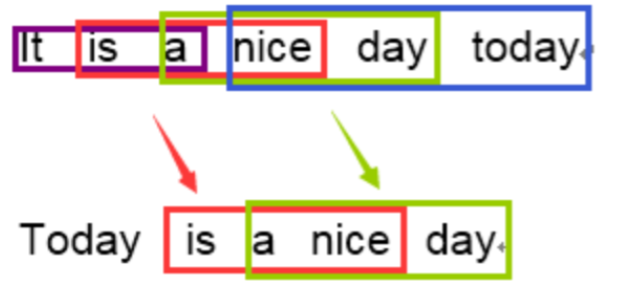
计算得到匹配度为: 2 / 4 2/4 2/4
在通过结合召回率和惩罚因子之后得到BLEU计算公式为:
B L E U = B P × e x p ( ∑ n = 1 N W n l o g P n ) BLEU = BP \times exp(\sum_{n=1}^{N}W_nlogP_n) BLEU=BP×exp(n=1∑NWnlogPn)
使用例子,直接使用第三方库sacrebleu
import sacrebleu
hyps = ['我有一个帽衫', '大大的帽子']
refs = ['你好,我有一个帽衫', '帽子大大的']
bleu = sacrebleu.corpus_bleu(hyps, [refs], tokenize='zh')
print(float(bleu.score))
# 59.809989126151606
Loss Function
Cross-Entropy Loss(交叉熵损失)
交叉熵损失用于分类任务,它度量的是预测概率分布与真实标签分布之间的差异。通常用于多分类问题。交叉熵损失公式(多分类)如下:
L = − ∑ i = 1 N y i l o g ( p i ) L = -\sum_{i=1}^{N}y_ilog(p_i) L=−i=1∑Nyilog(pi)
其中 N N N为类别数量, y i y_i yi真实标签数据, p i p_i pi模型预测概率。二分类交叉熵损失为: L o s s = − [ y l o g ( p ) + ( 1 − y ) l o g ( 1 − p ) ] Loss=−[ylog(p)+(1−y)log(1−p)] Loss=−[ylog(p)+(1−y)log(1−p)]
在pytorch中对于交叉熵损失函数主要参数:
- 1、label_smoothing (float, optional):通过平滑标签的方式来避免模型过度自信,提高模型的泛化能力并缓解类别不平衡问题的技术。假设模型有 C 个类别,标签为 y,真实标签的平滑值为 ε,则:对于真实类别 y = 1,标签值变为 1 - ε;对于其他类别 y ≠ 1,标签值变为 ε / (C - 1)
- 2、ignore_index (int, optional):忽略某些特定的标签,通常用于标记某些数据的特殊情况,如填充(padding)区域、无效标签或其他不需要参与损失计算的标签
- 3、reduction (str, optional):‘none’、‘mean’ 和 'sum’分别表示对最后 不汇总、平均值、求和
⭐值得注意的是,在pytorch的交叉熵损失里面已经计算了softmax/sigmoid,所以模型输出如果用交叉熵损失函数就不需要用softmax/sigmoid处理
Mean Squared Error(均方误差)
均方误差损失用于回归任务,度量预测值与真实值之间的差异。MSE 计算的是预测值和实际值的平方误差的平均值。MSE 公式:
L = 1 N ∑ i = 1 N ( y i − p i ) 2 L = \frac{1}{N}\sum_{i=1}^{N}(y_i- p_i)^2 L=N1i=1∑N(yi−pi)2
其中 N N N为类别数量, y i y_i yi真实标签数据, p i p_i pi模型预测概率
例子:比如说预测类别(假设为3),模型输出之后通过sigmoid/softmax处理之后得到:
| 预测 | 真实 |
|---|---|
| 0.3 0.3 0.4 | 0 0 1 (A) |
| 0.3 0.4 0.3 | 0 1 0 (B) |
| 0.1 0.2 0.7 | 1 0 0 © |
均方误差计算: ( 0.3 − 0 ) 2 + ( 0.3 − 0 ) 2 + ( 0.4 − 1 ) 2 + . . . 3 = 0.81 \frac{(0.3-0)^2+(0.3-0)^2+(0.4-1)^2+...}{3}=0.81 3(0.3−0)2+(0.3−0)2+(0.4−1)2+...=0.81
交叉熵计算: − ( 0 × l o g 0.3 + 0 × l o g 0.3 + 1 × l o g 0.4 + . . . ) 3 = 1.37 \frac{-(0\times log0.3+ 0\times log0.3+ 1\times log0.4+ ...)}{3}=1.37 3−(0×log0.3+0×log0.3+1×log0.4+...)=1.37
Focal Loss
**Focal Loss**主要用于处理样本失衡问题(样本里面标签不平衡问题,比如说目标识别,可能会得到很多框,但是可能只要一个框是所需的),其原理也很简单可以直接在原交叉熵基础上补充一个 因子即可。
F L ( p t ) = − α t ( 1 − p t ) γ l o g ( p t ) FL(p_t)=-\alpha_t(1-p_t)^{\gamma}log(p_t) FL(pt)=−αt(1−pt)γlog(pt)
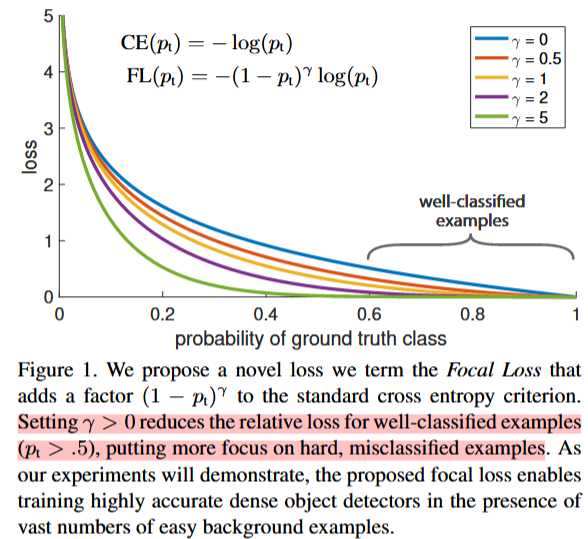
γ \gamma γ:调节因子,用于控制对易分类样本的惩罚程度。它是一个非负实数,通常设置为大于 0 的值。当 γ \gamma γ>0 时,随着 p t p_t pt的增加, ( 1 − p t ) γ (1-p_t)^{\gamma} (1−pt)γ的值会迅速减小,从而降低易分类样本的损失值。这样可以使得模型更加关注那些难以分类的样本。
α \alpha α: 平衡因子,用于调整正类和负类之间的权重。它是一个可调参数,通常设置为 α \alpha α对于正类和 1− α \alpha α对于负类。当数据集中正负样本数量不均衡时,可以通过调整 α \alpha α来平衡两类样本的贡献。例如,在一个正负样本比例为 1:9 的数据集中,可以将 α \alpha α设置为 0.9,以增加正类样本的权重
import torch
import torch.nn as nn
import torch.nn.functional as F

class FocalLoss(nn.Module):
    """Focal Loss implementation."""

    def __init__(self, gamma=1.5, alpha=0.25):
        super().__init__()
        self.gamma = gamma
        self.alpha = alpha

    def forward(self, pred, label, mask_labels=None):
        """Calculates focal loss with optional mask_labels."""
        loss = F.binary_cross_entropy_with_logits(pred, label, reduction='none')
        pred_prob = pred.sigmoid()
        p_t = label * pred_prob + (1 - label) * (1 - pred_prob)
        loss *= (1.0 - p_t) ** self.gamma

        if self.alpha > 0:
            loss *= label * self.alpha + (1 - label) * (1 - self.alpha)

        if mask_labels is not None:
            loss *= mask_labels.float()
            return loss.sum() / mask_labels.sum()

        return loss.mean()

if __name__ == '__main__':
    h, w = 500, 500
    labels_parent = torch.randint(0, 2, (h, w), dtype=torch.float32)
    tmp_labels = torch.zeros(1000, 1000)
    tmp_labels[:h, :w] = labels_parent
    tmp_labels_mask = torch.zeros(1000, 1000)
    tmp_labels_mask[:h, :w] = 1
    pred = torch.randn(1, 1000, 1000)

    focal_loss = FocalLoss()
    loss = focal_loss(pred, tmp_labels.unsqueeze(0), tmp_labels_mask)
    print(loss)
L1 loss
L1 loss:算预测值与真实值之间的绝对差值来衡量模型的预测误差,公式为: L = 1 N ∑ i = 1 N ∣ y i − y ^ i ∣ L = \frac{1}{N}\sum_{i=1}^{N}|y_i- \hat{y}_i| L=N1∑i=1N∣yi−y^i∣
Huber Loss
Huber Loss用于回归任务的损失函数,它结合了均方误差(MSE)和绝对误差(MAE)的优点,可以减少对异常值(outliers)的敏感性,同时保持较好的梯度性质
H u b e r L o s s = { 1 2 ( y − y ^ ) 2 i f ∣ y − y ^ ∣ ≤ δ δ ∗ ( ∣ y − y ^ ∣ − 1 2 ∗ δ ) o t h e r w i s e \mathrm{Huber~Loss}= \begin{cases} \frac{1}{2}(y-\hat{y})^2 & \mathrm{if}|y-\hat{y}|\leq\delta \\ \delta*(|y-\hat{y}|-\frac{1}{2}*\delta) & \mathrm{otherwise} & & \end{cases} Huber Loss={21(y−y^)2δ∗(∣y−y^∣−21∗δ)if∣y−y^∣≤δotherwise
参考
1、https://pytorch.org/docs/stable/generated/torch.nn.CrossEntropyLoss.html
2、https://pytorch.org/docs/stable/generated/torch.nn.L1Loss.html#torch.nn.L1Loss
3、Focal Loss for Dense Object Detection
4、https://blog.csdn.net/zhang2010hao/article/details/84559971
5、https://www.big-yellow-j.top/posts/2025/01/01/evaluation-lossfunction.html

有“AI”的1024 = 2048,欢迎大家加入2048 AI社区
更多推荐
 22
22 0
0- 0


 已为社区贡献3条内容

所有评论(0)