CloseableHttpClient使用与原理
·
CloseableHttpClient使用与原理
1、CloseableHttpClient使用
CloseableHttpClient 是 Apache HttpClient 库中的一个类,提供了方便的 API 用于发送 HTTP 请求并处理响应。以下是使用 CloseableHttpClient 的基本步骤及示例代码。
1.1、添加maven依赖
<dependency>
    <groupId>org.apache.httpcomponents</groupId>
    <artifactId>httpclient</artifactId>
    <version>4.5.13</version> <!-- 使用最新版本 -->
</dependency>
1.2、使用
发起请求:
import org.apache.http.client.methods.CloseableHttpResponse;
import org.apache.http.client.methods.HttpGet;
import org.apache.http.impl.client.CloseableHttpClient;
import org.apache.http.impl.client.HttpClients;
import org.apache.http.util.EntityUtils;

public class GameHttpClient {
    private static Logger logger = LoggerFactory.getLogger(GameHttpClient.class);
    // 池化管理
    private static PoolingHttpClientConnectionManager cm = null;

    private static CloseableHttpClient httpClient;// 它是线程安全的,所有的线程都可以使用它一起发送http请求

    // 初始化配置
    static {
        try {
        	SocketConfig socketConfig = SocketConfig.custom().setTcpNoDelay(true).setSoKeepAlive(true).build();
            //创建http连接池,可以同时指定连接超时时间
		    cm = new PoolingHttpClientConnectionManager(60000, TimeUnit.MILLISECONDS);
		    //最多同时连接20个请求
		    cm.setMaxTotal(20);
		    //每个路由最大连接数,路由指IP+PORT或者域名
		    cm.setDefaultMaxPerRoute(50);
		    cm.setDefaultSocketConfig(socketConfig);

			httpClient = HttpClients.custom()
                .setConnectionManager(cm)
                .setDefaultRequestConfig(config)
                // 启用空闲连接驱逐策略,最大空闲时间为60秒
                .evictIdleConnections(30, TimeUnit.SECONDS).disableCookieManagement().build();
			 // 在JVM关闭之前通过addShutdownHook钩子关闭连接池
        	Runtime.getRuntime().addShutdownHook(new Thread(() -> {
            try {
                httpClient.close();
            } catch (IOException e) {
                log.error("clone httpClient exception", e);
            }

        } catch (NoSuchAlgorithmException e) {
            e.printStackTrace();
        } catch (KeyStoreException e) {
            e.printStackTrace();
        } catch (KeyManagementException e) {
            e.printStackTrace();
        }
    }

    public static String httpGet(String url) {
        HttpGet httpGet = new HttpGet(url);
        CloseableHttpResponse response = null;

        try(response = httpClient.execute(httpGet)) {
            String result = EntityUtils.toString(response.getEntity());
            int code = response.getStatusLine().getStatusCode();
            if (code == HttpStatus.SC_OK) {
                return result;
            } else {
                logger.error("请求{}返回错误码:{},{}", url, code,result);
                return null;
            }
        } catch (IOException e) {
            logger.error("http请求异常,{}",url,e);
        } finally {

        }
        return null;
    }

    public static String post(String uri, Object params, Header... heads) {
        HttpPost httpPost = new HttpPost(uri);
        CloseableHttpResponse response = null;
        try {
            StringEntity paramEntity = new StringEntity(JSON.toJSONString(params));
            paramEntity.setContentEncoding("UTF-8");
            paramEntity.setContentType("application/json");
            httpPost.setEntity(paramEntity);
            if (heads != null) {
                httpPost.setHeaders(heads);
            }
             response = httpClient.execute(httpPost);
            int code = response.getStatusLine().getStatusCode();
            String result = EntityUtils.toString(response.getEntity());
            if (code == HttpStatus.SC_OK) {
                return result;
            } else {
                logger.error("请求{}返回错误码:{},请求参数:{},{}", uri, code, params,result);
                return null;
            }
        } catch (IOException e) {
            logger.error("收集服务配置http请求异常", e);
        } finally {
            try {
               if(response != null) {
                   response.close();
               }
            } catch (IOException e) {
                e.printStackTrace();
            }
        }
        return null;
    }

}
2、源码
整体执行流程:
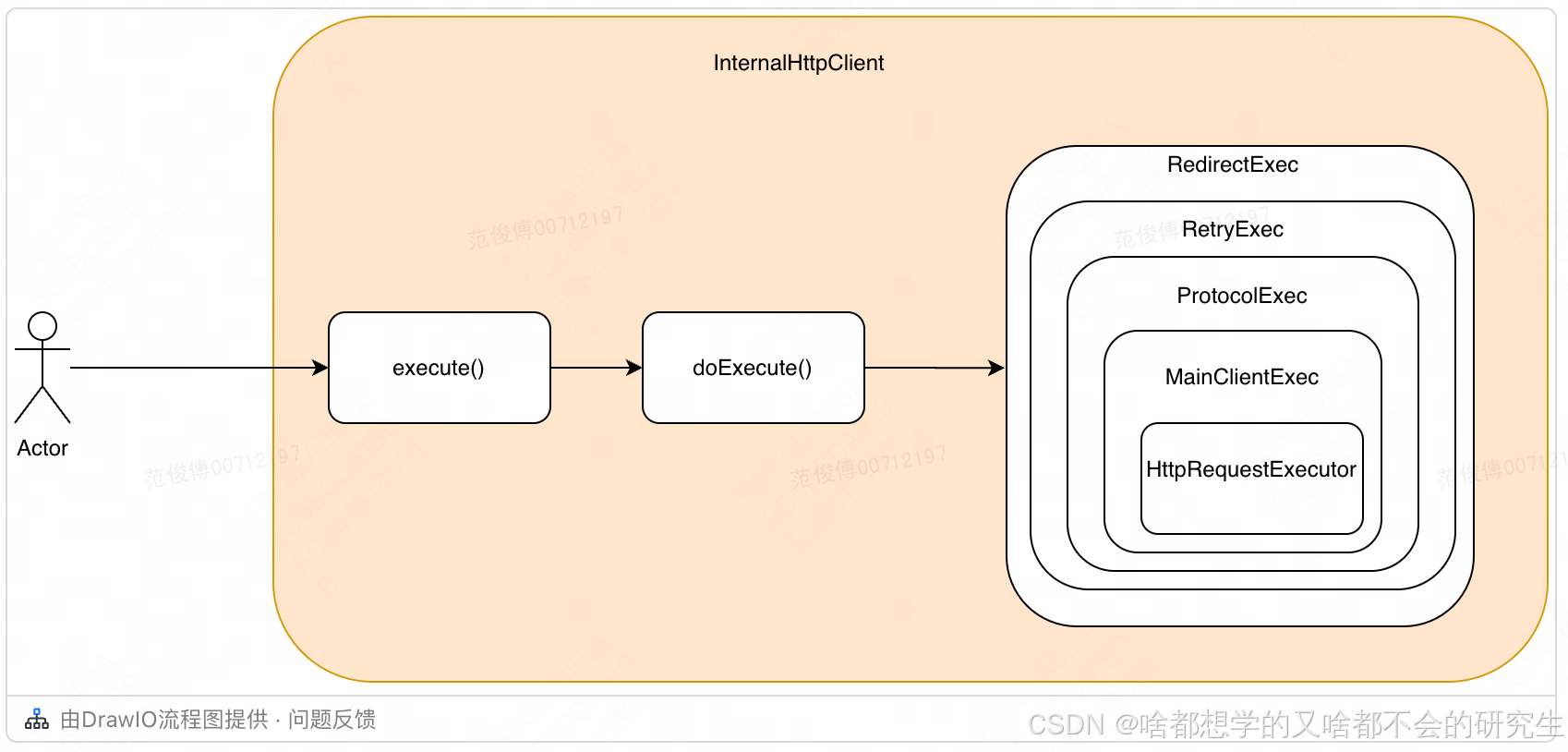
执行器的主要作用:
| 执行器 | 作用 |
|---|---|
| RedirectExec | 这个类负责处理HTTP重定向。当服务器返回一个重定向响应(如302)时,RedirectExec会根据响应中的Location头字段,自动发送一个新的请求到新的URL。封装新的重定向请求对象 |
| RetryExec | 这个类负责处理请求重试。如果请求失败(例如,由于网络问题),RetryExec会自动重试请求,重试次数可以在HttpClient中进行配置。 |
| ProtocolExec | 这个类负责执行协议拦截器和处理协议特定的方面,例如期望的连续性(Expect-Continue)和自动的内容解压 |
| MainClientExec | 这个类负责管理HTTP请求的生命周期,包括连接管理,请求发送,响应接收等。会HttpClientConnectionManager获取请求连接并且发起请求,HttpClientConnectionManager又是通过CPool连接池获取连接,使用HttpClientConnectionOperator真正发起请求连接 |
| HttpRequestExecutor | 这个类负责发送HTTP请求和接收HTTP响应。它在底层处理HTTP协议的细节,例如处理HTTP头和HTTP体 |

2.1、CloseableHttpClient
Closeable表示该流可以关闭并且释放资源。如果这个流已经关闭,调用这个方法没作用。
public interface Closeable extends AutoCloseable {

    /**
     * Closes this stream and releases any system resources associated
     * with it. If the stream is already closed then invoking this
     * method has no effect.
     *
     * <p> As noted in {@link AutoCloseable#close()}, cases where the
     * close may fail require careful attention. It is strongly advised
     * to relinquish the underlying resources and to internally
     * <em>mark</em> the {@code Closeable} as closed, prior to throwing
     * the {@code IOException}.
     *
     * @throws IOException if an I/O error occurs
     */
    public void close() throws IOException;
}
HttpClient接口定义执行http请求。使用给定/默认上下文,是否指定请求host(域名、端口号、协议等信息)、对HttpResponse结果是否进行加工处理等重载方法。
public interface HttpClient {


    /**
     * Obtains the parameters for this client.
     * These parameters will become defaults for all requests being
     * executed with this client, and for the parameters of
     * dependent objects in this client.
     *
     * @return  the default parameters
     *
     * @deprecated (4.3) use
     *   {@link org.apache.http.client.config.RequestConfig}.
     */
    @Deprecated
    HttpParams getParams();

    /**
     * Obtains the connection manager used by this client.
     *
     * @return  the connection manager
     *
     * @deprecated (4.3) use
     *   {@link org.apache.http.impl.client.HttpClientBuilder}.
     */
    @Deprecated
    ClientConnectionManager getConnectionManager();

    /**
     * Executes HTTP request using the default context.
     *
     * @param request   the request to execute
     *
     * @return  the response to the request. This is always a final response,
     *          never an intermediate response with an 1xx status code.
     *          Whether redirects or authentication challenges will be returned
     *          or handled automatically depends on the implementation and
     *          configuration of this client.
     * @throws IOException in case of a problem or the connection was aborted
     * @throws ClientProtocolException in case of an http protocol error
     */
    HttpResponse execute(HttpUriRequest request)
        throws IOException, ClientProtocolException;

    /**
     * Executes HTTP request using the given context.
     *
     * @param request   the request to execute
     * @param context   the context to use for the execution, or
     *                  {@code null} to use the default context
     *
     * @return  the response to the request. This is always a final response,
     *          never an intermediate response with an 1xx status code.
     *          Whether redirects or authentication challenges will be returned
     *          or handled automatically depends on the implementation and
     *          configuration of this client.
     * @throws IOException in case of a problem or the connection was aborted
     * @throws ClientProtocolException in case of an http protocol error
     */
    HttpResponse execute(HttpUriRequest request, HttpContext context)
        throws IOException, ClientProtocolException;

    /**
     * Executes HTTP request using the default context.
     *
     * @param target    the target host for the request.
     *                  Implementations may accept {@code null}
     *                  if they can still determine a route, for example
     *                  to a default target or by inspecting the request.
     * @param request   the request to execute
     *
     * @return  the response to the request. This is always a final response,
     *          never an intermediate response with an 1xx status code.
     *          Whether redirects or authentication challenges will be returned
     *          or handled automatically depends on the implementation and
     *          configuration of this client.
     * @throws IOException in case of a problem or the connection was aborted
     * @throws ClientProtocolException in case of an http protocol error
     */
    HttpResponse execute(HttpHost target, HttpRequest request)
        throws IOException, ClientProtocolException;

    /**
     * Executes HTTP request using the given context.
     *
     * @param target    the target host for the request.
     *                  Implementations may accept {@code null}
     *                  if they can still determine a route, for example
     *                  to a default target or by inspecting the request.
     * @param request   the request to execute
     * @param context   the context to use for the execution, or
     *                  {@code null} to use the default context
     *
     * @return  the response to the request. This is always a final response,
     *          never an intermediate response with an 1xx status code.
     *          Whether redirects or authentication challenges will be returned
     *          or handled automatically depends on the implementation and
     *          configuration of this client.
     * @throws IOException in case of a problem or the connection was aborted
     * @throws ClientProtocolException in case of an http protocol error
     */
    HttpResponse execute(HttpHost target, HttpRequest request,
                         HttpContext context)
        throws IOException, ClientProtocolException;

    /**
     * Executes HTTP request using the default context and processes the
     * response using the given response handler.
     * <p>
     * Implementing classes are required to ensure that the content entity
     * associated with the response is fully consumed and the underlying
     * connection is released back to the connection manager automatically
     * in all cases relieving individual {@link ResponseHandler}s from
     * having to manage resource deallocation internally.
     * </p>
     *
     * @param request   the request to execute
     * @param responseHandler the response handler
     *
     * @return  the response object as generated by the response handler.
     * @throws IOException in case of a problem or the connection was aborted
     * @throws ClientProtocolException in case of an http protocol error
     */
    <T> T execute(
            HttpUriRequest request,
            ResponseHandler<? extends T> responseHandler)
        throws IOException, ClientProtocolException;

    /**
     * Executes HTTP request using the given context and processes the
     * response using the given response handler.
     * <p>
     * Implementing classes are required to ensure that the content entity
     * associated with the response is fully consumed and the underlying
     * connection is released back to the connection manager automatically
     * in all cases relieving individual {@link ResponseHandler}s from
     * having to manage resource deallocation internally.
     * </p>
     *
     * @param request   the request to execute
     * @param responseHandler the response handler
     * @param context   the context to use for the execution, or
     *                  {@code null} to use the default context
     *
     * @return  the response object as generated by the response handler.
     * @throws IOException in case of a problem or the connection was aborted
     * @throws ClientProtocolException in case of an http protocol error
     */
    <T> T execute(
            HttpUriRequest request,
            ResponseHandler<? extends T> responseHandler,
            HttpContext context)
        throws IOException, ClientProtocolException;

    /**
     * Executes HTTP request to the target using the default context and
     * processes the response using the given response handler.
     * <p>
     * Implementing classes are required to ensure that the content entity
     * associated with the response is fully consumed and the underlying
     * connection is released back to the connection manager automatically
     * in all cases relieving individual {@link ResponseHandler}s from
     * having to manage resource deallocation internally.
     * </p>
     *
     * @param target    the target host for the request.
     *                  Implementations may accept {@code null}
     *                  if they can still determine a route, for example
     *                  to a default target or by inspecting the request.
     * @param request   the request to execute
     * @param responseHandler the response handler
     *
     * @return  the response object as generated by the response handler.
     * @throws IOException in case of a problem or the connection was aborted
     * @throws ClientProtocolException in case of an http protocol error
     */
    <T> T execute(
            HttpHost target,
            HttpRequest request,
            ResponseHandler<? extends T> responseHandler)
        throws IOException, ClientProtocolException;

    /**
     * Executes HTTP request to the target using the given context and
     * processes the response using the given response handler.
     * <p>
     * Implementing classes are required to ensure that the content entity
     * associated with the response is fully consumed and the underlying
     * connection is released back to the connection manager automatically
     * in all cases relieving individual {@link ResponseHandler}s from
     * having to manage resource deallocation internally.
     * </p>
     *
     * @param target    the target host for the request.
     *                  Implementations may accept {@code null}
     *                  if they can still determine a route, for example
     *                  to a default target or by inspecting the request.
     * @param request   the request to execute
     * @param responseHandler the response handler
     * @param context   the context to use for the execution, or
     *                  {@code null} to use the default context
     *
     * @return  the response object as generated by the response handler.
     * @throws IOException in case of a problem or the connection was aborted
     * @throws ClientProtocolException in case of an http protocol error
     */
    <T> T execute(
            HttpHost target,
            HttpRequest request,
            ResponseHandler<? extends T> responseHandler,
            HttpContext context)
        throws IOException, ClientProtocolException;

}
CloseableHttpClient是httpClient的其中一个抽象类:对所有执行execute接口进行了实现,但是最终都调用doExecute()方法。
/*
 * ====================================================================
 * Licensed to the Apache Software Foundation (ASF) under one
 * or more contributor license agreements.  See the NOTICE file
 * distributed with this work for additional information
 * regarding copyright ownership.  The ASF licenses this file
 * to you under the Apache License, Version 2.0 (the
 * "License"); you may not use this file except in compliance
 * with the License.  You may obtain a copy of the License at
 *
 *   http://www.apache.org/licenses/LICENSE-2.0
 *
 * Unless required by applicable law or agreed to in writing,
 * software distributed under the License is distributed on an
 * "AS IS" BASIS, WITHOUT WARRANTIES OR CONDITIONS OF ANY
 * KIND, either express or implied.  See the License for the
 * specific language governing permissions and limitations
 * under the License.
 * ====================================================================
 *
 * This software consists of voluntary contributions made by many
 * individuals on behalf of the Apache Software Foundation.  For more
 * information on the Apache Software Foundation, please see
 * <http://www.apache.org/>.
 *
 */

package org.apache.http.impl.client;

import java.io.Closeable;
import java.io.IOException;
import java.net.URI;

import org.apache.commons.logging.Log;
import org.apache.commons.logging.LogFactory;
import org.apache.http.HttpEntity;
import org.apache.http.HttpHost;
import org.apache.http.HttpRequest;
import org.apache.http.annotation.Contract;
import org.apache.http.annotation.ThreadingBehavior;
import org.apache.http.client.ClientProtocolException;
import org.apache.http.client.HttpClient;
import org.apache.http.client.ResponseHandler;
import org.apache.http.client.methods.CloseableHttpResponse;
import org.apache.http.client.methods.HttpUriRequest;
import org.apache.http.client.utils.URIUtils;
import org.apache.http.protocol.HttpContext;
import org.apache.http.util.Args;
import org.apache.http.util.EntityUtils;

/**
 * Base implementation of {@link HttpClient} that also implements {@link Closeable}.
 *
 * @since 4.3
 */
@Contract(threading = ThreadingBehavior.SAFE)
public abstract class CloseableHttpClient implements HttpClient, Closeable {

    private final Log log = LogFactory.getLog(getClass());

    protected abstract CloseableHttpResponse doExecute(HttpHost target, HttpRequest request,
            HttpContext context) throws IOException, ClientProtocolException;

    /**
     * HttpHost保存该请求的所有相关信息,例如host:域名 query:请求参数 scheme:协议 port:端口号
     */
    @Override
    public CloseableHttpResponse execute(
            final HttpHost target,
            final HttpRequest request,
            final HttpContext context) throws IOException, ClientProtocolException {
        return doExecute(target, request, context);
    }

    /**
     * {@inheritDoc}
     */
    @Override
    public CloseableHttpResponse execute(
            final HttpUriRequest request,
            final HttpContext context) throws IOException, ClientProtocolException {
        Args.notNull(request, "HTTP request");
        return doExecute(determineTarget(request), request, context);
    }

    private static HttpHost determineTarget(final HttpUriRequest request) throws ClientProtocolException {
        // A null target may be acceptable if there is a default target.
        // Otherwise, the null target is detected in the director.
        HttpHost target = null;

        final URI requestURI = request.getURI();
        if (requestURI.isAbsolute()) {
            target = URIUtils.extractHost(requestURI);
            if (target == null) {
                throw new ClientProtocolException("URI does not specify a valid host name: "
                        + requestURI);
            }
        }
        return target;
    }

    /**
     * {@inheritDoc}
     */
    @Override
    public CloseableHttpResponse execute(
            final HttpUriRequest request) throws IOException, ClientProtocolException {
        return execute(request, (HttpContext) null);
    }

    /**
     * {@inheritDoc}
     */
    @Override
    public CloseableHttpResponse execute(
            final HttpHost target,
            final HttpRequest request) throws IOException, ClientProtocolException {
        return doExecute(target, request, null);
    }

    /**
     * Executes a request using the default context and processes the
     * response using the given response handler. The content entity associated
     * with the response is fully consumed and the underlying connection is
     * released back to the connection manager automatically in all cases
     * relieving individual {@link ResponseHandler}s from having to manage
     * resource deallocation internally.
     *
     * @param request   the request to execute
     * @param responseHandler the response handler
     *
     * @return  the response object as generated by the response handler.
     * @throws IOException in case of a problem or the connection was aborted
     * @throws ClientProtocolException in case of an http protocol error
     */
    @Override
    public <T> T execute(final HttpUriRequest request,
            final ResponseHandler<? extends T> responseHandler) throws IOException,
            ClientProtocolException {
        return execute(request, responseHandler, null);
    }

    /**
     * Executes a request using the default context and processes the
     * response using the given response handler. The content entity associated
     * with the response is fully consumed and the underlying connection is
     * released back to the connection manager automatically in all cases
     * relieving individual {@link ResponseHandler}s from having to manage
     * resource deallocation internally.
     *
     * @param request   the request to execute
     * @param responseHandler the response handler
     * @param context   the context to use for the execution, or
     *                  {@code null} to use the default context
     *
     * @return  the response object as generated by the response handler.
     * @throws IOException in case of a problem or the connection was aborted
     * @throws ClientProtocolException in case of an http protocol error
     */
    @Override
    public <T> T execute(final HttpUriRequest request,
            final ResponseHandler<? extends T> responseHandler, final HttpContext context)
            throws IOException, ClientProtocolException {
        final HttpHost target = determineTarget(request);
        return execute(target, request, responseHandler, context);
    }

    /**
     * Executes a request using the default context and processes the
     * response using the given response handler. The content entity associated
     * with the response is fully consumed and the underlying connection is
     * released back to the connection manager automatically in all cases
     * relieving individual {@link ResponseHandler}s from having to manage
     * resource deallocation internally.
     *
     * @param target    the target host for the request.
     *                  Implementations may accept {@code null}
     *                  if they can still determine a route, for example
     *                  to a default target or by inspecting the request.
     * @param request   the request to execute
     * @param responseHandler the response handler
     *
     * @return  the response object as generated by the response handler.
     * @throws IOException in case of a problem or the connection was aborted
     * @throws ClientProtocolException in case of an http protocol error
     */
    @Override
    public <T> T execute(final HttpHost target, final HttpRequest request,
            final ResponseHandler<? extends T> responseHandler) throws IOException,
            ClientProtocolException {
        return execute(target, request, responseHandler, null);
    }

    /**
     * Executes a request using the default context and processes the
     * response using the given response handler. The content entity associated
     * with the response is fully consumed and the underlying connection is
     * released back to the connection manager automatically in all cases
     * relieving individual {@link ResponseHandler}s from having to manage
     * resource deallocation internally.
     *
     * @param target    the target host for the request.
     *                  Implementations may accept {@code null}
     *                  if they can still determine a route, for example
     *                  to a default target or by inspecting the request.
     * @param request   the request to execute
     * @param responseHandler the response handler
     * @param context   the context to use for the execution, or
     *                  {@code null} to use the default context
     *
     * @return  the response object as generated by the response handler.
     * @throws IOException in case of a problem or the connection was aborted
     * @throws ClientProtocolException in case of an http protocol error
     */
    @Override
    public <T> T execute(final HttpHost target, final HttpRequest request,
            final ResponseHandler<? extends T> responseHandler, final HttpContext context)
            throws IOException, ClientProtocolException {
        Args.notNull(responseHandler, "Response handler");

        final CloseableHttpResponse response = execute(target, request, context);
        try {
          	// 对http请求获取的数据进行响应处理,返回响应处理的结果
            final T result = responseHandler.handleResponse(response);
            final HttpEntity entity = response.getEntity();
          	// 消费entity以及关闭流
            EntityUtils.consume(entity);
            return result;
        } catch (final ClientProtocolException t) {
            // Try to salvage the underlying connection in case of a protocol exception
            final HttpEntity entity = response.getEntity();
            try {
                EntityUtils.consume(entity);
            } catch (final Exception t2) {
                // Log this exception. The original exception is more
                // important and will be thrown to the caller.
                this.log.warn("Error consuming content after an exception.", t2);
            }
            throw t;
        } finally {
            response.close();
        }
    }

}
InternalHttpClient是CloseableHttpClient的一个实现类,该类在实现过程中使用了责任链模式,ClientExecuteChain(以下都是ClientExecuteChain的子类,并且每个类都有一个属性ClientExecuteChain存储下一个要执行的):RedirectExec>RetryExec>ProtocolExec>MainClientExec>HttpRequestExecutor
/*
 * ====================================================================
 * Licensed to the Apache Software Foundation (ASF) under one
 * or more contributor license agreements.  See the NOTICE file
 * distributed with this work for additional information
 * regarding copyright ownership.  The ASF licenses this file
 * to you under the Apache License, Version 2.0 (the
 * "License"); you may not use this file except in compliance
 * with the License.  You may obtain a copy of the License at
 *
 *   http://www.apache.org/licenses/LICENSE-2.0
 *
 * Unless required by applicable law or agreed to in writing,
 * software distributed under the License is distributed on an
 * "AS IS" BASIS, WITHOUT WARRANTIES OR CONDITIONS OF ANY
 * KIND, either express or implied.  See the License for the
 * specific language governing permissions and limitations
 * under the License.
 * ====================================================================
 *
 * This software consists of voluntary contributions made by many
 * individuals on behalf of the Apache Software Foundation.  For more
 * information on the Apache Software Foundation, please see
 * <http://www.apache.org/>.
 *
 */

package org.apache.http.impl.client;

import java.io.Closeable;
import java.io.IOException;
import java.util.List;
import java.util.concurrent.TimeUnit;

import org.apache.commons.logging.Log;
import org.apache.commons.logging.LogFactory;
import org.apache.http.HttpException;
import org.apache.http.HttpHost;
import org.apache.http.HttpRequest;
import org.apache.http.annotation.Contract;
import org.apache.http.annotation.ThreadingBehavior;
import org.apache.http.auth.AuthSchemeProvider;
import org.apache.http.auth.AuthState;
import org.apache.http.client.ClientProtocolException;
import org.apache.http.client.CookieStore;
import org.apache.http.client.CredentialsProvider;
import org.apache.http.client.config.RequestConfig;
import org.apache.http.client.methods.CloseableHttpResponse;
import org.apache.http.client.methods.Configurable;
import org.apache.http.client.methods.HttpExecutionAware;
import org.apache.http.client.methods.HttpRequestWrapper;
import org.apache.http.client.params.ClientPNames;
import org.apache.http.client.params.HttpClientParamConfig;
import org.apache.http.client.protocol.HttpClientContext;
import org.apache.http.config.Lookup;
import org.apache.http.conn.ClientConnectionManager;
import org.apache.http.conn.ClientConnectionRequest;
import org.apache.http.conn.HttpClientConnectionManager;
import org.apache.http.conn.ManagedClientConnection;
import org.apache.http.conn.routing.HttpRoute;
import org.apache.http.conn.routing.HttpRoutePlanner;
import org.apache.http.conn.scheme.SchemeRegistry;
import org.apache.http.cookie.CookieSpecProvider;
import org.apache.http.impl.execchain.ClientExecChain;
import org.apache.http.params.HttpParams;
import org.apache.http.params.HttpParamsNames;
import org.apache.http.protocol.BasicHttpContext;
import org.apache.http.protocol.HttpContext;
import org.apache.http.util.Args;

/**
 * Internal class.
 *
 * @since 4.3
 */
@Contract(threading = ThreadingBehavior.SAFE_CONDITIONAL)
@SuppressWarnings("deprecation")
class InternalHttpClient extends CloseableHttpClient implements Configurable {

    private final Log log = LogFactory.getLog(getClass());

  	// 执行链
    private final ClientExecChain execChain;
    // 连接池管理器。连接池就在这里,包括连接池的配置、连接池、操作连接、连接池是否关闭标识
    private final HttpClientConnectionManager connManager;
    private final HttpRoutePlanner routePlanner;
    private final Lookup<CookieSpecProvider> cookieSpecRegistry;
    private final Lookup<AuthSchemeProvider> authSchemeRegistry;
    private final CookieStore cookieStore;
    private final CredentialsProvider credentialsProvider;
    private final RequestConfig defaultConfig;
    private final List<Closeable> closeables;

    public InternalHttpClient(
            final ClientExecChain execChain,
            final HttpClientConnectionManager connManager,
            final HttpRoutePlanner routePlanner,
            final Lookup<CookieSpecProvider> cookieSpecRegistry,
            final Lookup<AuthSchemeProvider> authSchemeRegistry,
            final CookieStore cookieStore,
            final CredentialsProvider credentialsProvider,
            final RequestConfig defaultConfig,
            final List<Closeable> closeables) {
        super();
        Args.notNull(execChain, "HTTP client exec chain");
        Args.notNull(connManager, "HTTP connection manager");
        Args.notNull(routePlanner, "HTTP route planner");
        this.execChain = execChain;
        this.connManager = connManager;
        this.routePlanner = routePlanner;
        this.cookieSpecRegistry = cookieSpecRegistry;
        this.authSchemeRegistry = authSchemeRegistry;
        this.cookieStore = cookieStore;
        this.credentialsProvider = credentialsProvider;
        this.defaultConfig = defaultConfig;
        this.closeables = closeables;
    }

    private HttpRoute determineRoute(
            final HttpHost target,
            final HttpRequest request,
            final HttpContext context) throws HttpException {
        HttpHost host = target;
        if (host == null) {
            host = (HttpHost) request.getParams().getParameter(ClientPNames.DEFAULT_HOST);
        }
        return this.routePlanner.determineRoute(host, request, context);
    }

    private void setupContext(final HttpClientContext context) {
        if (context.getAttribute(HttpClientContext.TARGET_AUTH_STATE) == null) {
            context.setAttribute(HttpClientContext.TARGET_AUTH_STATE, new AuthState());
        }
        if (context.getAttribute(HttpClientContext.PROXY_AUTH_STATE) == null) {
            context.setAttribute(HttpClientContext.PROXY_AUTH_STATE, new AuthState());
        }
        if (context.getAttribute(HttpClientContext.AUTHSCHEME_REGISTRY) == null) {
            context.setAttribute(HttpClientContext.AUTHSCHEME_REGISTRY, this.authSchemeRegistry);
        }
        if (context.getAttribute(HttpClientContext.COOKIESPEC_REGISTRY) == null) {
            context.setAttribute(HttpClientContext.COOKIESPEC_REGISTRY, this.cookieSpecRegistry);
        }
        if (context.getAttribute(HttpClientContext.COOKIE_STORE) == null) {
            context.setAttribute(HttpClientContext.COOKIE_STORE, this.cookieStore);
        }
        if (context.getAttribute(HttpClientContext.CREDS_PROVIDER) == null) {
            context.setAttribute(HttpClientContext.CREDS_PROVIDER, this.credentialsProvider);
        }
        if (context.getAttribute(HttpClientContext.REQUEST_CONFIG) == null) {
            context.setAttribute(HttpClientContext.REQUEST_CONFIG, this.defaultConfig);
        }
    }

    @Override
    protected CloseableHttpResponse doExecute(
            final HttpHost target,
            final HttpRequest request,
            final HttpContext context) throws IOException, ClientProtocolException {
        Args.notNull(request, "HTTP request");
        HttpExecutionAware execAware = null;
        if (request instanceof HttpExecutionAware) {
            execAware = (HttpExecutionAware) request;
        }
        try {
            final HttpRequestWrapper wrapper = HttpRequestWrapper.wrap(request, target);
            final HttpClientContext localcontext = HttpClientContext.adapt(
                    context != null ? context : new BasicHttpContext());
            RequestConfig config = null;
            if (request instanceof Configurable) {
                config = ((Configurable) request).getConfig();
            }
            if (config == null) {
                final HttpParams params = request.getParams();
                if (params instanceof HttpParamsNames) {
                    if (!((HttpParamsNames) params).getNames().isEmpty()) {
                        config = HttpClientParamConfig.getRequestConfig(params, this.defaultConfig);
                    }
                } else {
                    config = HttpClientParamConfig.getRequestConfig(params, this.defaultConfig);
                }
            }
            if (config != null) {
                localcontext.setRequestConfig(config);
            }
            setupContext(localcontext);
            final HttpRoute route = determineRoute(target, wrapper, localcontext);
          	// 执行链的每个execChain依次执行,
            return this.execChain.execute(route, wrapper, localcontext, execAware);
        } catch (final HttpException httpException) {
            throw new ClientProtocolException(httpException);
        }
    }

    @Override
    public RequestConfig getConfig() {
        return this.defaultConfig;
    }

    @Override
    public void close() {
        if (this.closeables != null) {
            for (final Closeable closeable: this.closeables) {
                try {
                    closeable.close();
                } catch (final IOException ex) {
                    this.log.error(ex.getMessage(), ex);
                }
            }
        }
    }

    @Override
    public HttpParams getParams() {
        throw new UnsupportedOperationException();
    }

    @Override
    public ClientConnectionManager getConnectionManager() {

        return new ClientConnectionManager() {

            @Override
            public void shutdown() {
                connManager.shutdown();
            }

            @Override
            public ClientConnectionRequest requestConnection(
                    final HttpRoute route, final Object state) {
                throw new UnsupportedOperationException();
            }

            @Override
            public void releaseConnection(
                    final ManagedClientConnection conn,
                    final long validDuration, final TimeUnit timeUnit) {
                throw new UnsupportedOperationException();
            }

            @Override
            public SchemeRegistry getSchemeRegistry() {
                throw new UnsupportedOperationException();
            }

            @Override
            public void closeIdleConnections(final long idletime, final TimeUnit timeUnit) {
                connManager.closeIdleConnections(idletime, timeUnit);
            }

            @Override
            public void closeExpiredConnections() {
                connManager.closeExpiredConnections();
            }

        };

    }

}
2.2、PoolingHttpClientConnectionManager连接池管理器
/*
 * ====================================================================
 * Licensed to the Apache Software Foundation (ASF) under one
 * or more contributor license agreements.  See the NOTICE file
 * distributed with this work for additional information
 * regarding copyright ownership.  The ASF licenses this file
 * to you under the Apache License, Version 2.0 (the
 * "License"); you may not use this file except in compliance
 * with the License.  You may obtain a copy of the License at
 *
 *   http://www.apache.org/licenses/LICENSE-2.0
 *
 * Unless required by applicable law or agreed to in writing,
 * software distributed under the License is distributed on an
 * "AS IS" BASIS, WITHOUT WARRANTIES OR CONDITIONS OF ANY
 * KIND, either express or implied.  See the License for the
 * specific language governing permissions and limitations
 * under the License.
 * ====================================================================
 *
 * This software consists of voluntary contributions made by many
 * individuals on behalf of the Apache Software Foundation.  For more
 * information on the Apache Software Foundation, please see
 * <http://www.apache.org/>.
 *
 */
package org.apache.http.impl.conn;

import java.io.Closeable;
import java.io.IOException;
import java.util.Map;
import java.util.Set;
import java.util.concurrent.CancellationException;
import java.util.concurrent.ConcurrentHashMap;
import java.util.concurrent.ExecutionException;
import java.util.concurrent.Future;
import java.util.concurrent.TimeUnit;
import java.util.concurrent.TimeoutException;
import java.util.concurrent.atomic.AtomicBoolean;

import org.apache.commons.logging.Log;
import org.apache.commons.logging.LogFactory;
import org.apache.http.HttpClientConnection;
import org.apache.http.HttpHost;
import org.apache.http.annotation.Contract;
import org.apache.http.annotation.ThreadingBehavior;
import org.apache.http.config.ConnectionConfig;
import org.apache.http.config.Lookup;
import org.apache.http.config.Registry;
import org.apache.http.config.RegistryBuilder;
import org.apache.http.config.SocketConfig;
import org.apache.http.conn.ConnectionPoolTimeoutException;
import org.apache.http.conn.ConnectionRequest;
import org.apache.http.conn.DnsResolver;
import org.apache.http.conn.HttpClientConnectionManager;
import org.apache.http.conn.HttpClientConnectionOperator;
import org.apache.http.conn.HttpConnectionFactory;
import org.apache.http.conn.ManagedHttpClientConnection;
import org.apache.http.conn.SchemePortResolver;
import org.apache.http.conn.routing.HttpRoute;
import org.apache.http.conn.socket.ConnectionSocketFactory;
import org.apache.http.conn.socket.PlainConnectionSocketFactory;
import org.apache.http.conn.ssl.SSLConnectionSocketFactory;
import org.apache.http.pool.ConnFactory;
import org.apache.http.pool.ConnPoolControl;
import org.apache.http.pool.PoolEntryCallback;
import org.apache.http.pool.PoolStats;
import org.apache.http.protocol.HttpContext;
import org.apache.http.util.Args;
import org.apache.http.util.Asserts;

/**
 * {@code ClientConnectionPoolManager} maintains a pool of
 * {@link HttpClientConnection}s and is able to service connection requests
 * from multiple execution threads. Connections are pooled on a per route
 * basis. A request for a route which already the manager has persistent
 * connections for available in the pool will be services by leasing
 * a connection from the pool rather than creating a brand new connection.
 * <p>
 * {@code ClientConnectionPoolManager} maintains a maximum limit of connection
 * on a per route basis and in total. Per default this implementation will
 * create no more than than 2 concurrent connections per given route
 * and no more 20 connections in total. For many real-world applications
 * these limits may prove too constraining, especially if they use HTTP
 * as a transport protocol for their services. Connection limits, however,
 * can be adjusted using {@link ConnPoolControl} methods.
 * </p>
 * <p>
 * Total time to live (TTL) set at construction time defines maximum life span
 * of persistent connections regardless of their expiration setting. No persistent
 * connection will be re-used past its TTL value.
 * </p>
 * <p>
 * The handling of stale connections was changed in version 4.4.
 * Previously, the code would check every connection by default before re-using it.
 * The code now only checks the connection if the elapsed time since
 * the last use of the connection exceeds the timeout that has been set.
 * The default timeout is set to 2000ms
 * </p>
 *
 * @since 4.3
 */
@Contract(threading = ThreadingBehavior.SAFE_CONDITIONAL)
public class PoolingHttpClientConnectionManager
    implements HttpClientConnectionManager, ConnPoolControl<HttpRoute>, Closeable {

    private final Log log = LogFactory.getLog(getClass());

  	// 连接池配置数据
    private final ConfigData configData;
  	// 连接池
    private final CPool pool;
  	// 连接操作对象,具体的连接
    private final HttpClientConnectionOperator connectionOperator;
  	// 连接池是否关闭
    private final AtomicBoolean isShutDown;

    private static Registry<ConnectionSocketFactory> getDefaultRegistry() {
        return RegistryBuilder.<ConnectionSocketFactory>create()
                .register("http", PlainConnectionSocketFactory.getSocketFactory())
                .register("https", SSLConnectionSocketFactory.getSocketFactory())
                .build();
    }

    public PoolingHttpClientConnectionManager() {
        this(getDefaultRegistry());
    }

    public PoolingHttpClientConnectionManager(final long timeToLive, final TimeUnit timeUnit) {
        this(getDefaultRegistry(), null, null ,null, timeToLive, timeUnit);
    }

    public PoolingHttpClientConnectionManager(
            final Registry<ConnectionSocketFactory> socketFactoryRegistry) {
        this(socketFactoryRegistry, null, null);
    }

    public PoolingHttpClientConnectionManager(
            final Registry<ConnectionSocketFactory> socketFactoryRegistry,
            final DnsResolver dnsResolver) {
        this(socketFactoryRegistry, null, dnsResolver);
    }

    public PoolingHttpClientConnectionManager(
            final Registry<ConnectionSocketFactory> socketFactoryRegistry,
            final HttpConnectionFactory<HttpRoute, ManagedHttpClientConnection> connFactory) {
        this(socketFactoryRegistry, connFactory, null);
    }

    public PoolingHttpClientConnectionManager(
            final HttpConnectionFactory<HttpRoute, ManagedHttpClientConnection> connFactory) {
        this(getDefaultRegistry(), connFactory, null);
    }

    public PoolingHttpClientConnectionManager(
            final Registry<ConnectionSocketFactory> socketFactoryRegistry,
            final HttpConnectionFactory<HttpRoute, ManagedHttpClientConnection> connFactory,
            final DnsResolver dnsResolver) {
        this(socketFactoryRegistry, connFactory, null, dnsResolver, -1, TimeUnit.MILLISECONDS);
    }

    public PoolingHttpClientConnectionManager(
            final Registry<ConnectionSocketFactory> socketFactoryRegistry,
            final HttpConnectionFactory<HttpRoute, ManagedHttpClientConnection> connFactory,
            final SchemePortResolver schemePortResolver,
            final DnsResolver dnsResolver,
            final long timeToLive, final TimeUnit timeUnit) {
        this(
            new DefaultHttpClientConnectionOperator(socketFactoryRegistry, schemePortResolver, dnsResolver),
            connFactory,
            timeToLive, timeUnit
        );
    }

    /**
     * @since 4.4
     */
    public PoolingHttpClientConnectionManager(
        final HttpClientConnectionOperator httpClientConnectionOperator,
        final HttpConnectionFactory<HttpRoute, ManagedHttpClientConnection> connFactory,
        final long timeToLive, final TimeUnit timeUnit) {
        super();
        this.configData = new ConfigData();
        this.pool = new CPool(new InternalConnectionFactory(
                this.configData, connFactory), 2, 20, timeToLive, timeUnit);
        this.pool.setValidateAfterInactivity(2000);
        this.connectionOperator = Args.notNull(httpClientConnectionOperator, "HttpClientConnectionOperator");
        this.isShutDown = new AtomicBoolean(false);
    }

    /**
     * Visible for test.
     */
    PoolingHttpClientConnectionManager(
            final CPool pool,
            final Lookup<ConnectionSocketFactory> socketFactoryRegistry,
            final SchemePortResolver schemePortResolver,
            final DnsResolver dnsResolver) {
        super();
        this.configData = new ConfigData();
        this.pool = pool;
        this.connectionOperator = new DefaultHttpClientConnectionOperator(
                socketFactoryRegistry, schemePortResolver, dnsResolver);
        this.isShutDown = new AtomicBoolean(false);
    }

    @Override
    protected void finalize() throws Throwable {
        try {
            shutdown();
        } finally {
            super.finalize();
        }
    }

    @Override
    public void close() {
        shutdown();
    }

    private String format(final HttpRoute route, final Object state) {
        final StringBuilder buf = new StringBuilder();
        buf.append("[route: ").append(route).append("]");
        if (state != null) {
            buf.append("[state: ").append(state).append("]");
        }
        return buf.toString();
    }

    private String formatStats(final HttpRoute route) {
        final StringBuilder buf = new StringBuilder();
        final PoolStats totals = this.pool.getTotalStats();
        final PoolStats stats = this.pool.getStats(route);
        buf.append("[total kept alive: ").append(totals.getAvailable()).append("; ");
        buf.append("route allocated: ").append(stats.getLeased() + stats.getAvailable());
        buf.append(" of ").append(stats.getMax()).append("; ");
        buf.append("total allocated: ").append(totals.getLeased() + totals.getAvailable());
        buf.append(" of ").append(totals.getMax()).append("]");
        return buf.toString();
    }

    private String format(final CPoolEntry entry) {
        final StringBuilder buf = new StringBuilder();
        buf.append("[id: ").append(entry.getId()).append("]");
        buf.append("[route: ").append(entry.getRoute()).append("]");
        final Object state = entry.getState();
        if (state != null) {
            buf.append("[state: ").append(state).append("]");
        }
        return buf.toString();
    }

    private SocketConfig resolveSocketConfig(final HttpHost host) {
        SocketConfig socketConfig = this.configData.getSocketConfig(host);
        if (socketConfig == null) {
            socketConfig = this.configData.getDefaultSocketConfig();
        }
        if (socketConfig == null) {
            socketConfig = SocketConfig.DEFAULT;
        }
        return socketConfig;
    }

  	// 获取请求连接
    @Override
    public ConnectionRequest requestConnection(
            final HttpRoute route,
            final Object state) {
        Args.notNull(route, "HTTP route");
        if (this.log.isDebugEnabled()) {
            this.log.debug("Connection request: " + format(route, state) + formatStats(route));
        }
        final Future<CPoolEntry> future = this.pool.lease(route, state, null);
        return new ConnectionRequest() {

            @Override
            public boolean cancel() {
                return future.cancel(true);
            }

            @Override
            public HttpClientConnection get(
                    final long timeout,
                    final TimeUnit timeUnit) throws InterruptedException, ExecutionException, ConnectionPoolTimeoutException {
                final HttpClientConnection conn = leaseConnection(future, timeout, timeUnit);
                if (conn.isOpen()) {
                    final HttpHost host;
                    if (route.getProxyHost() != null) {
                        host = route.getProxyHost();
                    } else {
                        host = route.getTargetHost();
                    }
                    final SocketConfig socketConfig = resolveSocketConfig(host);
                    conn.setSocketTimeout(socketConfig.getSoTimeout());
                }
                return conn;
            }

        };

    }

    protected HttpClientConnection leaseConnection(
            final Future<CPoolEntry> future,
            final long timeout,
            final TimeUnit timeUnit) throws InterruptedException, ExecutionException, ConnectionPoolTimeoutException {
        final CPoolEntry entry;
        try {
            entry = future.get(timeout, timeUnit);
            if (entry == null || future.isCancelled()) {
                throw new ExecutionException(new CancellationException("Operation cancelled"));
            }
            Asserts.check(entry.getConnection() != null, "Pool entry with no connection");
            if (this.log.isDebugEnabled()) {
                this.log.debug("Connection leased: " + format(entry) + formatStats(entry.getRoute()));
            }
            return CPoolProxy.newProxy(entry);
        } catch (final TimeoutException ex) {
            throw new ConnectionPoolTimeoutException("Timeout waiting for connection from pool");
        }
    }

  	// 释放请求连接,将连接归还到连接池
    @Override
    public void releaseConnection(
            final HttpClientConnection managedConn,
            final Object state,
            final long keepalive, final TimeUnit timeUnit) {
        Args.notNull(managedConn, "Managed connection");
        synchronized (managedConn) {
            final CPoolEntry entry = CPoolProxy.detach(managedConn);
            if (entry == null) {
                return;
            }
            final ManagedHttpClientConnection conn = entry.getConnection();
            try {
                if (conn.isOpen()) {
                    final TimeUnit effectiveUnit = timeUnit != null ? timeUnit : TimeUnit.MILLISECONDS;
                    entry.setState(state);
                    entry.updateExpiry(keepalive, effectiveUnit);
                    if (this.log.isDebugEnabled()) {
                        final String s;
                        if (keepalive > 0) {
                            s = "for " + (double) effectiveUnit.toMillis(keepalive) / 1000 + " seconds";
                        } else {
                            s = "indefinitely";
                        }
                        this.log.debug("Connection " + format(entry) + " can be kept alive " + s);
                    }
                    conn.setSocketTimeout(0);
                }
            } finally {
                this.pool.release(entry, conn.isOpen() && entry.isRouteComplete());
                if (this.log.isDebugEnabled()) {
                    this.log.debug("Connection released: " + format(entry) + formatStats(entry.getRoute()));
                }
            }
        }
    }

    @Override
    public void connect(
            final HttpClientConnection managedConn,
            final HttpRoute route,
            final int connectTimeout,
            final HttpContext context) throws IOException {
        Args.notNull(managedConn, "Managed Connection");
        Args.notNull(route, "HTTP route");
        final ManagedHttpClientConnection conn;
        synchronized (managedConn) {
            final CPoolEntry entry = CPoolProxy.getPoolEntry(managedConn);
            conn = entry.getConnection();
        }
        final HttpHost host;
        if (route.getProxyHost() != null) {
            host = route.getProxyHost();
        } else {
            host = route.getTargetHost();
        }
        this.connectionOperator.connect(
                conn, host, route.getLocalSocketAddress(), connectTimeout, resolveSocketConfig(host), context);
    }

    @Override
    public void upgrade(
            final HttpClientConnection managedConn,
            final HttpRoute route,
            final HttpContext context) throws IOException {
        Args.notNull(managedConn, "Managed Connection");
        Args.notNull(route, "HTTP route");
        final ManagedHttpClientConnection conn;
        synchronized (managedConn) {
            final CPoolEntry entry = CPoolProxy.getPoolEntry(managedConn);
            conn = entry.getConnection();
        }
        this.connectionOperator.upgrade(conn, route.getTargetHost(), context);
    }

    @Override
    public void routeComplete(
            final HttpClientConnection managedConn,
            final HttpRoute route,
            final HttpContext context) throws IOException {
        Args.notNull(managedConn, "Managed Connection");
        Args.notNull(route, "HTTP route");
        synchronized (managedConn) {
            final CPoolEntry entry = CPoolProxy.getPoolEntry(managedConn);
            entry.markRouteComplete();
        }
    }

    @Override
    public void shutdown() {
        if (this.isShutDown.compareAndSet(false, true)) {
            this.log.debug("Connection manager is shutting down");
            try {
                this.pool.shutdown();
            } catch (final IOException ex) {
                this.log.debug("I/O exception shutting down connection manager", ex);
            }
            this.log.debug("Connection manager shut down");
        }
    }

    @Override
    public void closeIdleConnections(final long idleTimeout, final TimeUnit timeUnit) {
        if (this.log.isDebugEnabled()) {
            this.log.debug("Closing connections idle longer than " + idleTimeout + " " + timeUnit);
        }
        this.pool.closeIdle(idleTimeout, timeUnit);
    }

    @Override
    public void closeExpiredConnections() {
        this.log.debug("Closing expired connections");
        this.pool.closeExpired();
    }

    protected void enumAvailable(final PoolEntryCallback<HttpRoute, ManagedHttpClientConnection> callback) {
        this.pool.enumAvailable(callback);
    }

    protected void enumLeased(final PoolEntryCallback<HttpRoute, ManagedHttpClientConnection> callback) {
        this.pool.enumLeased(callback);
    }

    @Override
    public int getMaxTotal() {
        return this.pool.getMaxTotal();
    }

    @Override
    public void setMaxTotal(final int max) {
        this.pool.setMaxTotal(max);
    }

    @Override
    public int getDefaultMaxPerRoute() {
        return this.pool.getDefaultMaxPerRoute();
    }

    @Override
    public void setDefaultMaxPerRoute(final int max) {
        this.pool.setDefaultMaxPerRoute(max);
    }

    @Override
    public int getMaxPerRoute(final HttpRoute route) {
        return this.pool.getMaxPerRoute(route);
    }

    @Override
    public void setMaxPerRoute(final HttpRoute route, final int max) {
        this.pool.setMaxPerRoute(route, max);
    }

    @Override
    public PoolStats getTotalStats() {
        return this.pool.getTotalStats();
    }

    @Override
    public PoolStats getStats(final HttpRoute route) {
        return this.pool.getStats(route);
    }

    /**
     * @since 4.4
     */
    public Set<HttpRoute> getRoutes() {
        return this.pool.getRoutes();
    }

    public SocketConfig getDefaultSocketConfig() {
        return this.configData.getDefaultSocketConfig();
    }

    public void setDefaultSocketConfig(final SocketConfig defaultSocketConfig) {
        this.configData.setDefaultSocketConfig(defaultSocketConfig);
    }

    public ConnectionConfig getDefaultConnectionConfig() {
        return this.configData.getDefaultConnectionConfig();
    }

    public void setDefaultConnectionConfig(final ConnectionConfig defaultConnectionConfig) {
        this.configData.setDefaultConnectionConfig(defaultConnectionConfig);
    }

    public SocketConfig getSocketConfig(final HttpHost host) {
        return this.configData.getSocketConfig(host);
    }

    public void setSocketConfig(final HttpHost host, final SocketConfig socketConfig) {
        this.configData.setSocketConfig(host, socketConfig);
    }

    public ConnectionConfig getConnectionConfig(final HttpHost host) {
        return this.configData.getConnectionConfig(host);
    }

    public void setConnectionConfig(final HttpHost host, final ConnectionConfig connectionConfig) {
        this.configData.setConnectionConfig(host, connectionConfig);
    }

    /**
     * @see #setValidateAfterInactivity(int)
     *
     * @since 4.4
     */
    public int getValidateAfterInactivity() {
        return pool.getValidateAfterInactivity();
    }

    /**
     * Defines period of inactivity in milliseconds after which persistent connections must
     * be re-validated prior to being {@link #leaseConnection(java.util.concurrent.Future,
     *   long, java.util.concurrent.TimeUnit) leased} to the consumer. Non-positive value passed
     * to this method disables connection validation. This check helps detect connections
     * that have become stale (half-closed) while kept inactive in the pool.
     *
     * @see #leaseConnection(java.util.concurrent.Future, long, java.util.concurrent.TimeUnit)
     *
     * @since 4.4
     */
    public void setValidateAfterInactivity(final int ms) {
        pool.setValidateAfterInactivity(ms);
    }

    static class ConfigData {

        private final Map<HttpHost, SocketConfig> socketConfigMap;
        private final Map<HttpHost, ConnectionConfig> connectionConfigMap;
        private volatile SocketConfig defaultSocketConfig;
        private volatile ConnectionConfig defaultConnectionConfig;

        ConfigData() {
            super();
            this.socketConfigMap = new ConcurrentHashMap<HttpHost, SocketConfig>();
            this.connectionConfigMap = new ConcurrentHashMap<HttpHost, ConnectionConfig>();
        }

        public SocketConfig getDefaultSocketConfig() {
            return this.defaultSocketConfig;
        }

        public void setDefaultSocketConfig(final SocketConfig defaultSocketConfig) {
            this.defaultSocketConfig = defaultSocketConfig;
        }

        public ConnectionConfig getDefaultConnectionConfig() {
            return this.defaultConnectionConfig;
        }

        public void setDefaultConnectionConfig(final ConnectionConfig defaultConnectionConfig) {
            this.defaultConnectionConfig = defaultConnectionConfig;
        }

        public SocketConfig getSocketConfig(final HttpHost host) {
            return this.socketConfigMap.get(host);
        }

        public void setSocketConfig(final HttpHost host, final SocketConfig socketConfig) {
            this.socketConfigMap.put(host, socketConfig);
        }

        public ConnectionConfig getConnectionConfig(final HttpHost host) {
            return this.connectionConfigMap.get(host);
        }

        public void setConnectionConfig(final HttpHost host, final ConnectionConfig connectionConfig) {
            this.connectionConfigMap.put(host, connectionConfig);
        }

    }

    static class InternalConnectionFactory implements ConnFactory<HttpRoute, ManagedHttpClientConnection> {

        private final ConfigData configData;
        private final HttpConnectionFactory<HttpRoute, ManagedHttpClientConnection> connFactory;

        InternalConnectionFactory(
                final ConfigData configData,
                final HttpConnectionFactory<HttpRoute, ManagedHttpClientConnection> connFactory) {
            super();
            this.configData = configData != null ? configData : new ConfigData();
            this.connFactory = connFactory != null ? connFactory :
                ManagedHttpClientConnectionFactory.INSTANCE;
        }

        @Override
        public ManagedHttpClientConnection create(final HttpRoute route) throws IOException {
            ConnectionConfig config = null;
            if (route.getProxyHost() != null) {
                config = this.configData.getConnectionConfig(route.getProxyHost());
            }
            if (config == null) {
                config = this.configData.getConnectionConfig(route.getTargetHost());
            }
            if (config == null) {
                config = this.configData.getDefaultConnectionConfig();
            }
            if (config == null) {
                config = ConnectionConfig.DEFAULT;
            }
            return this.connFactory.create(route, config);
        }

    }

}
连接池ConnPool继承AbstractConnPool:
public abstract class AbstractConnPool<T, C, E extends PoolEntry<T, C>>
                                               implements ConnPool<T, E>, ConnPoolControl<T> {
	// 一个锁对象,用于对连接池的操作进行同步。
    private final Lock lock;
    // 一个条件对象,用于在连接池中等待或唤醒线程。
    private final Condition condition;
    // 连接创建工厂,创建连接
    private final ConnFactory<T, C> connFactory;
    // 每个路由对应一个连接池
    private final Map<T, RouteSpecificPool<T, C, E>> routeToPool;
    // 整个连接池正在使用的连接
    private final Set<E> leased;
    // 整个连接池还可以使用/空闲的连接
    private final LinkedList<E> available;
    // 等待连接的Future
    private final LinkedList<Future<E>> pending;
    // 每个路由对应最大的连接数
    private final Map<T, Integer> maxPerRoute;

		// 连接池是否关闭
    private volatile boolean isShutDown;
    // 默认的每个路由对应的最大连接数
    private volatile int defaultMaxPerRoute;
    // 连接池最大的连接数
    private volatile int maxTotal;
    // 连接在空闲多长时间后需要进行验证的时间间隔。
    private volatile int validateAfterInactivity;

}

有“AI”的1024 = 2048,欢迎大家加入2048 AI社区
更多推荐
 60
60 0
0- 0


 已为社区贡献1条内容

所有评论(0)