Android Audio代码分析(4): audiohalservice 启动
hal interfaceIDeviceFactory openDevice得到IDevice, IDevice openInput/outputStream得到IStream
hal interface
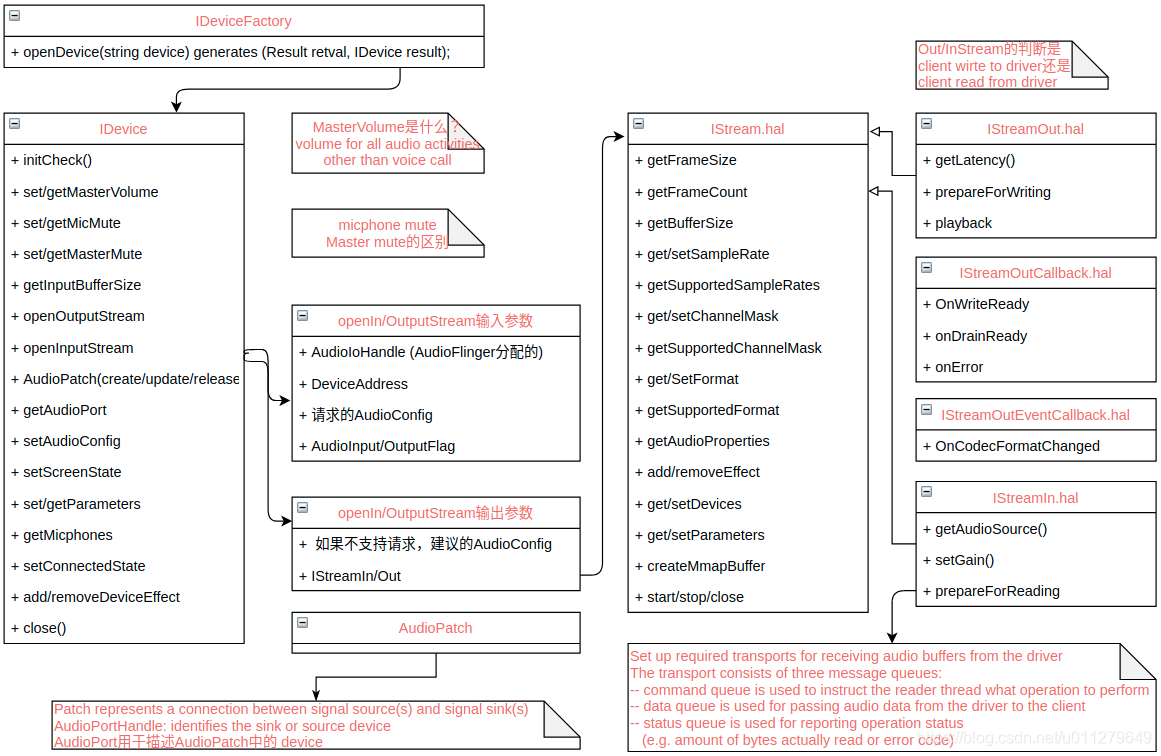
IDeviceFactory openDevice得到IDevice, IDevice openInput/outputStream得到IStream
android.hardware.audio.service
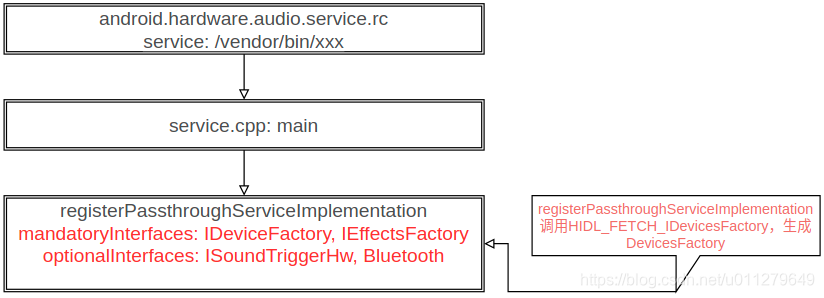
存在形式
hardware/interfaces/audio/common/all-versions/default/service/android.hardware.audio.service.rc
service vendor.audio-hal /vendor/bin/hw/android.hardware.audio.service
class hal
user audioserver
hardware/interfaces/audio/common/all-versions/default/service/Android.bp
cc_binary {
name: "android.hardware.audio.service",
init_rc: ["android.hardware.audio.service.rc"],
vendor: true,
srcs: ["service.cpp"],
}
在同一个进程启动了多个service
int main(int /* argc */, char* /* argv */ []) {
::android::ProcessState::initWithDriver("/dev/vndbinder");
// start a threadpool for vndbinder interactions
::android::ProcessState::self()->startThreadPool();
const std::vector<InterfacesList> mandatoryInterfaces = {
{
"Audio Core API",
"android.hardware.audio@6.0::IDevicesFactory",
"android.hardware.audio@5.0::IDevicesFactory",
"android.hardware.audio@4.0::IDevicesFactory",
"android.hardware.audio@2.0::IDevicesFactory"
},
{
"Audio Effect API",
"android.hardware.audio.effect@6.0::IEffectsFactory",
"android.hardware.audio.effect@5.0::IEffectsFactory",
"android.hardware.audio.effect@4.0::IEffectsFactory",
"android.hardware.audio.effect@2.0::IEffectsFactory",
}
};
const std::vector<InterfacesList> optionalInterfaces = {
{
"Soundtrigger API",
"android.hardware.soundtrigger@2.3::ISoundTriggerHw",
"android.hardware.soundtrigger@2.2::ISoundTriggerHw",
"android.hardware.soundtrigger@2.1::ISoundTriggerHw",
"android.hardware.soundtrigger@2.0::ISoundTriggerHw",
},
{
"Bluetooth Audio API",
"android.hardware.bluetooth.audio@2.0::IBluetoothAudioProvidersFactory"
},
// remove the old HIDL when Bluetooth Audio Hal V2 has offloading supported
{
"Bluetooth Audio Offload API",
"android.hardware.bluetooth.a2dp@1.0::IBluetoothAudioOffload"
}
};
for (const auto& listIter : mandatoryInterfaces) {
auto iter = listIter.begin();
const std::string& interfaceFamilyName = *iter++;
LOG_ALWAYS_FATAL_IF(!registerPassthroughServiceImplementations(iter, listIter.end()),
"Could not register %s", interfaceFamilyName.c_str());
}
for (const auto& listIter : optionalInterfaces) {
auto iter = listIter.begin();
const std::string& interfaceFamilyName = *iter++;
ALOGW_IF(!registerPassthroughServiceImplementations(iter, listIter.end()),
"Could not register %s", interfaceFamilyName.c_str());
}
joinRpcThreadpool();
}
以上就是audiohalservice的启动过程,主要是通过registerPassthroughServiceImplementation注册了一组接口,关于halbinder可参考,registerPassthroughServiceImplementation函数调用HIDL_FETCH_IDevicesFactory,生成了DevicesFactory
https://www.programminghunter.com/article/7441427492/
https://blog.csdn.net/u013928208/article/month/2018/07
registerPassthroughServiceImplementation的实现
HIDL_FETCH_IDevicesFactory是怎样别调到的?
registerPassthroughServiceImplementation的实现
system/libhidl/transport/LegacySupport.cpp
registerPassthroughServiceImplementation ->
getRawServiceInternal ->
getPassthroughServiceManager ->
(system/libhidl/transport/ServiceManagement.cpp)
IServiceManager1_1::openLibs {
const std::string prefix = packageAndVersion + "-impl"; //要加载的库 xxx-impl.so
const std::string sym = "HIDL_FETCH_" + ifaceName; // 调用库导出的接口函数
}
hardware/interfaces/audio/effect/all-versions/default/Android.bp
cc_library_shared {
name: "android.hardware.audio.effect@6.0-impl",
defaults: ["android.hardware.audio.effect-impl_default"],
shared_libs: [
"android.hardware.audio.common@6.0",
"android.hardware.audio.common@6.0-util",
"android.hardware.audio.effect@6.0",
],
}
hardware/interfaces/audio/core/all-versions/default/DevicesFactory.cpp
IDevicesFactory* HIDL_FETCH_IDevicesFactory(const char* name) {
return strcmp(name, "default") == 0 ? new DevicesFactory() : nullptr;
}
DevicesFactoryHalHybrid::openDevice 的实现
status_t DevicesFactoryHalHybrid::openDevice(const char *name, sp<DeviceHalInterface> *device) {
if (mHidlFactory != 0 && strcmp(AUDIO_HARDWARE_MODULE_ID_A2DP, name) != 0 &&
strcmp(AUDIO_HARDWARE_MODULE_ID_HEARING_AID, name) != 0) {
return mHidlFactory->openDevice(name, device);
}
return mLocalFactory->openDevice(name, device);
}
/** HAL service 要加载的hal 具体实现库的命名规则
* List of known audio HAL modules. This is the base name of the audio HAL
* library composed of the "audio." prefix, one of the base names below and
* a suffix specific to the device.
* e.g: audio.primary.goldfish.so or audio.a2dp.default.so
*
* The same module names are used in audio policy configuration files.
*/
#define AUDIO_HARDWARE_MODULE_ID_PRIMARY "primary"
#define AUDIO_HARDWARE_MODULE_ID_A2DP "a2dp"
#define AUDIO_HARDWARE_MODULE_ID_USB "usb"
#define AUDIO_HARDWARE_MODULE_ID_REMOTE_SUBMIX "r_submix"
#define AUDIO_HARDWARE_MODULE_ID_CODEC_OFFLOAD "codec_offload"
#define AUDIO_HARDWARE_MODULE_ID_STUB "stub"
#define AUDIO_HARDWARE_MODULE_ID_HEARING_AID "hearing_aid"
#define AUDIO_HARDWARE_MODULE_ID_MSD "msd"
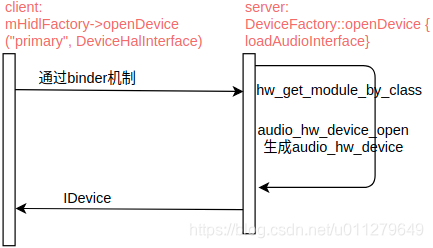
mHidlFactory->openDevice(name, device)的实现
通过binderDeviceFactory得到了Device: DeviceHalInterface
status_t DevicesFactoryHalHidl::openDevice(const char *name, sp<DeviceHalInterface> *device) {
auto factories = copyDeviceFactories();
if (factories.empty()) return NO_INIT;
status_t status;
auto hidlId = idFromHal(name, &status);
if (status != OK) return status;
Result retval = Result::NOT_INITIALIZED;
for (const auto& factory : factories) {
Return<void> ret = factory->openDevice(
hidlId,
[&](Result r, const sp<IDevice>& result) {
// IDeviceFactory::openDevice返回的是IDevice: result
retval = r;
if (retval == Result::OK) {
//调用new DeviceHalHidl(IDevice)
*device = new DeviceHalHidl(result);
}
});
}
ALOGW("The specified device name is not recognized: \"%s\"", name);
return BAD_VALUE;
}
DeviceHalHidl::DeviceHalHidl(const sp<IDevice>& device)
: ConversionHelperHidl("Device"), mDevice(device),
mPrimaryDevice(IPrimaryDevice::castFrom(device)) {
}
hal service端的openDevice
hardware/interfaces/audio/core/all-versions/default/DevicesFactory.cpp
template <class DeviceShim, class Callback>
Return<void> DevicesFactory::openDevice(const char* moduleName, Callback _hidl_cb) {
audio_hw_device_t* halDevice;
sp<DeviceShim> result;
int halStatus = loadAudioInterface(moduleName, &halDevice);
if (halStatus == OK) {
result = new DeviceShim(halDevice);
retval = Result::OK;
}
_hidl_cb(retval, result); //这里是个callback 和上面的client callback 实现对应上
return Void();
}
hardware device的框架
hw_module_t/ hw_device_t由这两个数据结构组成
int DevicesFactory::loadAudioInterface(const char* if_name, audio_hw_device_t** dev) {
const hw_module_t* mod;
int rc;
rc = hw_get_module_by_class(AUDIO_HARDWARE_MODULE_ID("audio"), if_name, &mod);
rc = audio_hw_device_open(mod, dev);
return OK;
}
hal service的框架大概分为两部分:
1. hw_get_module_by_class 根据输入参数找到并加载 xxx.so
2. xxx(class)_hw_device_open 得到(打开)一个device 并把device返回给client
hw_get_module_by_class
hardware/libhardware/hardware.c
hw_get_module_by_class的实现分为两部分:1. 找到module 2. 加载module
int hw_get_module_by_class(const char *class_id, const char *inst,
const struct hw_module_t **module)
{
snprintf(name, PATH_MAX, "%s.%s", class_id, inst);
property_get(xxx);
hw_module_exists(); // 根据路径信息找到module
// path: /vendor/lib64/hw/audio.primary.xxx.so
/* load the module */
return load(class_id, path, module);
}
static int load(const char *id,
const char *path,
const struct hw_module_t **pHmi)
{
int status = -EINVAL;
void *handle = NULL;
struct hw_module_t *hmi = NULL;
handle = dlopen(path, RTLD_NOW);
/* Get the address of the struct hal_module_info. */
const char *sym = HAL_MODULE_INFO_SYM_AS_STR;(HMI)
hmi = (struct hw_module_t *)dlsym(handle, sym);
// 通过这里可以得到一个技巧:通过搜索class_id找到对应的hal实现
// 如搜索AUDIO_HARDWARE_MODULE_ID
if (strcmp(id, hmi->id) != 0) {
ALOGE("load: id=%s != hmi->id=%s", id, hmi->id);
status = -EINVAL;
}
hmi->dso = handle;
*pHmi = hmi;
return status;
}
/vendor/lib64/hw/audio.primary.xxx.so具体实现
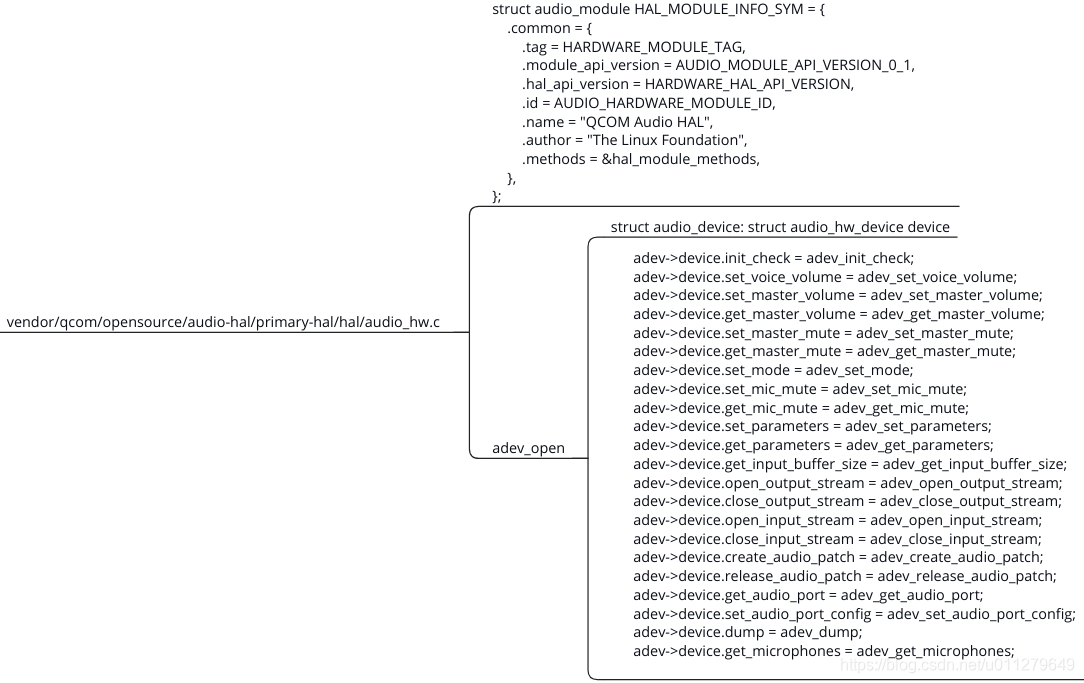
vendor/qcom/opensource/audio-hal/primary-hal/hal/Android.mk
LOCAL_MODULE := audio.primary.$(TARGET_BOARD_PLATFORM)
LOCAL_MODULE_RELATIVE_PATH := hw
struct audio_module HAL_MODULE_INFO_SYM = {
.common = {
.tag = HARDWARE_MODULE_TAG,
.module_api_version = AUDIO_MODULE_API_VERSION_0_1,
.hal_api_version = HARDWARE_HAL_API_VERSION,
.id = AUDIO_HARDWARE_MODULE_ID,
.name = "QCOM Audio HAL",
.author = "The Linux Foundation",
.methods = &hal_module_methods,
},
};
static struct hw_module_methods_t hal_module_methods = {
.open = adev_open,
};
audio_hw_device_open
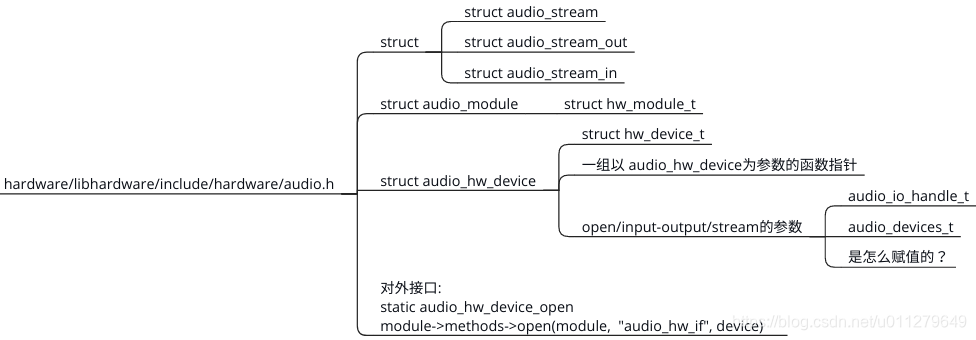
static inline int audio_hw_device_open(const struct hw_module_t* module,
struct audio_hw_device** device)
{
return module->methods->open(module, AUDIO_HARDWARE_INTERFACE,
TO_HW_DEVICE_T_OPEN(device));
}
struct audio_hw_device {
struct hw_device_t common;
// 一组函数指针:这些接口封装了所有对 audio_hw_device的操作
open_output_stream等
}
static int adev_open(const hw_module_t *module, const char *name,
hw_device_t **device)
{
// ---
}

有“AI”的1024 = 2048,欢迎大家加入2048 AI社区
更多推荐



 11
11 0
0- 0


 已为社区贡献2条内容

所有评论(0)